Beauty and The Beast – The Panto

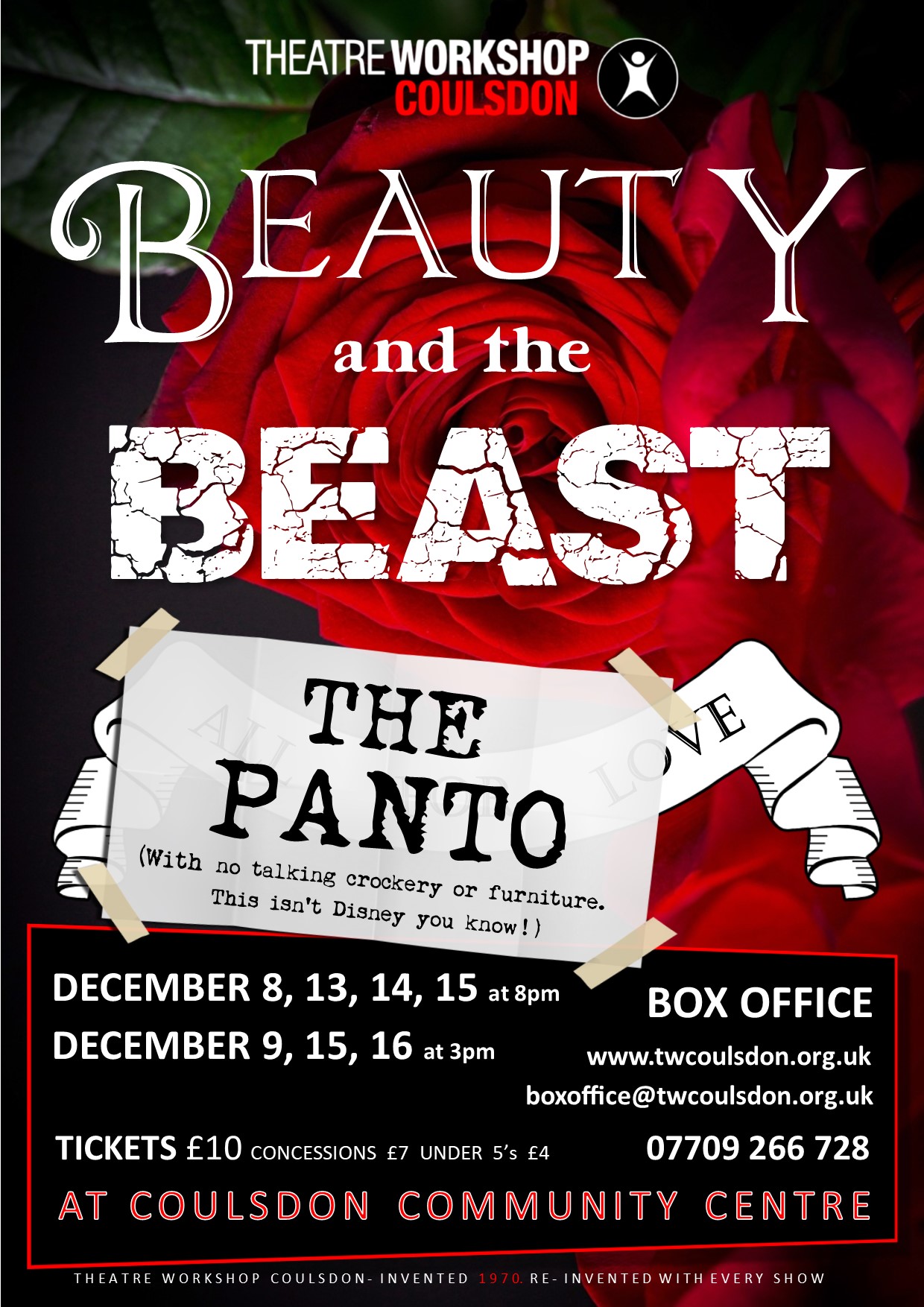
Theatre Workshop Coulsdon’s Christmas 2018 production is an all-new, original pantomime based on the much-loved fairy tale, ‘Beauty and the Beast’. This classic tale, and its underlying message that you shouldn’t judge a book by its cover, has been transformed into a full-fat panto, rocket fuel for the winter season, chock-full of larger than life characters, sing-along songs and audience participation, as the lovely Beauty finds that the monstrous Beast is not what she was expecting. A full band and a large ensemble cast (Bumbling guards, saucy maids, talking vegetation and puppet creatures) support a tale of good versus the evil that is Deadly McNightshade, the woman who puts the wicked into witch and gives it a Scottish accent. Can true love break the dread spell that has locked a handsome prince in a prison he can never escape from? Oh yes it can!

But where did the original story come from? Well, once upon a time there was a woman called Gabrielle-Suzanne Barbot de Villeneuve (They had some cracking names back then) Born in Paris in 1685, she was married at 21 and widowed at 26, her aristocratic but spendthrift husband losing his life almost as swiftly as he lost their money. With her family fortune gone, she needed a way to support herself and eventually moved in with the celebrated playwright and poet Prosper Jolyot de Crebillon (See, another one!) where she began to write. From 1734 through to her death in 1755 she wrote novels and collections of fairy tales but most notably, in 1740, she wrote ‘La Belle et La Bête’, or as we know it, ‘Beauty and the Beast’. It formed part of a much larger story, and was much more complicated than we’re used to now. The simpler version is down to another Frenchwoman, Jeanne-Marie Leprince de Beaumont (and another!) who re-wrote the tale as a much shorter story and published it the year after Villeneuve’s death without acknowledging its origins. Which was a bit sneaky. Boo! Hiss!

Since then it’s become a children’s fairytale classic. Of course, that meant it got the full Disney treatment, twice now, both as a cartoon (1991) and a live-action movie (2017). But there have also been numerous other movie and TV adaptations, a stage musical, an opera, a ballet, and even songs, a disco tune and video games. Its themes of love conquering all and never judging by appearances are simple and easily relatable. And so Sheila May Bird, published children’s author (‘Pete’s Peculiar Petshop’, ‘Pirate Percy’s Parrot’ and others that don’t begin with the letter ‘P’) and long-time member of Theatre Workshop Coulsdon, decided that what had been missing all these years was a pantomime version, full of silliness, slapstick, songs, an audience participation number and the kind of ‘behind you!’ nonsense that makes going to the theatre at this time of year so much fun.
Wendy and Peter Pan

This Christmas, we’re delighted to present the perfect festive treat for all the family – the classic English childhood myth of love, loss, redemption – and pirates.

And Peter Pan, who never grows old. What’s not to like?

Winter, 1911. Snow is falling across London. Wendy Darling and her brothers sleep peacefully in their bedroom as their parents bicker downstairs. In a sudden flurry of snow their window blows open, and Peter Pan tumbles into their lives – followed by a fractious fairy called Tink. With the help of a little fairy dust, Wendy agrees to fly with Peter to Neverland, seeking an awfully big adventure and the key to her parents’ forgotten happiness – the child they once lost. Once there, Wendy will give the Lost Boys a run for their money, defeat the diabolical pirate Captain James Hook, and ultimately learn what it really means to grow up.

J.M.Barrie’s stage play, Peter Pan, delighted audiences when it premiered in 1904. His novel based on the play, Wendy and Peter, published in 1911, was a huge success. Commissioned by the Royal Shakespeare Company, Ella Hickson’s Wendy and Peter Pan premiered in December 2013, and it’s a sparkling new adaptation that puts Wendy centre stage. In a feisty take on Barrie’s much-loved tale, it never loses the charm of the original, nor any of its iconic set pieces.
It’s bittersweet, funny in places, touching in others, and brimming with action and adventure. Complete with musical accompaniment by our live band, plus our famous Christmas refreshments. It might be cold outside, but the mince pies and mulled wine will be piping hot!

The Wind In The Willows

Since 1908, this classic tale of inquisitive Mole, stolid Ratty, gruff Badger and ‘ever in trouble’ Toad has delighted children of all ages, and most adults too! This stage adaptation by Theatre Workshop Coulsdon follows their adventures from the river bank to the Wild Wood, via the open road to the deepest dungeon, with a thrilling climax at stately Toad Hall. It’s a path strewn with boats, trains, caravans and stolen cars, as our animal heroes overcome adversity and their own natures to emerge victorious. By turns charming and funny, this is a splendid way to while away a English summer’s evening.

1918 – When The Guns Fell Silent

A dramatic exploration of the final year of the Great War and its aftermath.

100 Years ago the Great War entered its final few months. Victory was close. But for who? And at what cost? The world would never be the same again. The social landscape of Britain altered forever.

Using songs, readings, poetry and drama, even humour, Theatre Workshop Coulsdon explores this final year of tears and revolution, and looks beyond to see the impact that this bloody clash of empires made on the century that followed.

And exhibition on the First World War and the fallen soldiers of Coulsdon, curated by local researchers, will accompany the production.

What are you about to see? It’s a good question. It’s not a play, but there is drama. It’s definitely not a comedy, although there is humour. It’s not a lecture either, though we do hope you go away with a better understanding of the events of a century ago. When it was proposed last December, one of the biggest drivers was that this would our last opportunity to explore the Great War and still be relevant to the centenary. We’d run ‘Oh, What A Lovely War’ some years back, and we could have just reprised that, but we didn’t want to cover old ground. And we didn’t just want to look at the war in general. This is the 100th anniversary of 1918, and so we wanted to focus as far as we could on that specific year.

            Throughout January, February and yes, even March, we wrote dramas and narratives looking at subjects that the events of 1918 brought to the fore. Topics that interested and excited us. And we hope will interest and excite you too. Over the next couple of hours you will see them, interspersed with the poems of Sassoon, Houseman and others, along with songs either of the time or looking back at it, and a number of the ‘Forgotten Voices’ of soldiers who fought during the War. And yes, an episode from ‘Oh, What A Lovely War’. We follow a rough chronology, from January 1918 through until the modern day, hopefully showing that even now, the echoes of the war to end all wars continue to affect us.

            We haven’t managed to cover everything. There’s nothing here, for instance, about the exploits of the fledgling RAF, the first London Blitz or the Spanish Flu epidemic. What we do have is, I think, an attempt to show that the soldiers of both sides were very much the same, in their hopes, expectations and experiences.

            It was a war that saw over 19 million deaths, military and civilian, and over 23 million other casualties, ultimately all for no real purpose. Maybe, even 100 years on, it’s not too late to learn the lesson of the futility of war. But as George Ellison, the last British soldier to be killed in the war, and a character you will see in our performance says, ‘if we haven’t learned from this, we’ll never bloody learn…’