The Adventures of Jason and the Argonauts

The legends of Ancient Greece have continued to weave their magic through our imaginations for over two thousand years. The capricious Gods and Goddesses of Mount Olympus playing with the fates of ordinary mortals for both good and ill. But from the ranks of those mortals came the fabled heroes, those who rose to the challenges and won out despite all. Odysseus taking on the mighty one-eyed giant Cyclops. Theseus defeating the monstrous Minotaur in the labyrinth of Crete. Jason and his Argonauts travelling far and risking everything in search of the Golden Fleece.

This last provides the basis for our winter production. But don’t worry, you won’t need a degree in the classics to work out what’s going on. This is a very loose interpretation of the myths handed down over the centuries. Jason and Medea are two mixed-up kids, an orphan and a runaway, who suddenly find themselves tasked with overthrowing the evil tyrant King Pelias. With a certain amount of divine intervention, Jason becomes the captain of the mighty ‘Argo’, a ship capable of crossing the uncharted seas, with a crew of oddball heroes including the world’s strongest (and possibly clumsiest) man, a wonderful woman warrior, a resting rock star, the least identical twins ever and a seriously streetwise cat. Now he must set off and find the Golden Fleece. If only he knew what it was. And then there are the challenges. The man-eating Harpies of Lemnos, the terrible Clashing Rocks, the fire-breathing Great Bull of Colchis, the evil Dragon Snake and Talos, the bronze giant. (Who might just be a really cool sock puppet.) Not to mention The Sirens…

Medea, Jason and his misfit Argonauts are here this December to have fun. This will be no ordinary adventure tale, but one with songs and laughter, and we’ll be encouraging you to join in, whether you’re five or sixty five. Ever fancied rowing the Argo? You’ll get your chance. Become part of the undead army of skeleton warriors? Oh yes.

The award-winning author of ‘Jason and the Argonauts’, Phil Willmott, is mainly famous around these parts for his creation of the hilariously stiff upper-lipped ‘Dick Barton – Special Agent’ spoofs that were so much a part of the sadly demised Warehouse Theatre in Croydon. But he’s written, adapted and directed numerous productions, many derived from classical sources, and we’re more than pleased to link up with him again.

Sherlock Holmes and the Sons of Anubis

From the depths of ancient Egypt an ancient evil is rising, claiming the lives of those who have ransacked its history.

Is this a curse? An occult threat from which there is no defence? Or is there another side to this mystery, something more earthly yet just as deadly? What did Lord Caerphilly’s expedition to the Valley of the Kings disturb, and most importantly, how can it be stopped?

Richard Lloyd’s second exploration into the world of Arthur Conan Doyle’s most famous creation follows on from the success of ‘Sherlock Holmes and the Vampyres of London’, in which the legendary detective faced the iconic prince of darkness, Dracula. This time, as before, real and fictional characters of the period are combined in one fiendish mystery.

Holmes and his trusted companion Dr John Watson travel the streets of Victorian London, from the hallowed British Museum to the seedy brothels of London’s West End in search of the answer to a mystery that if unsolved, may see an empire fall. Which of its denizens may hold the vital clues? Lady Mountjoy, a woman whose most fervent desire is to see the treasures of the tombs returned? Agrippina Bligh, an unscrupulous Madam in a dark trade with darker secrets? The mysterious Egyptian Afzad Azul, who may as easily be allied with demons as angels?

Time is running out…

Machinal

Regularly appearing on ‘The Best Plays of All Time’ lists, ‘Machinal’ is a vivid, unflinching portrayal of the life of a young, working-class woman in 1920’s America. Across nine tense episodes, we play witness to the key moments of her life – from marriage and motherhood, to adultery, murder, and its consequences. We see how women had to navigate a world run by men for men, in an increasingly mechanistic society demanding conformity.
Placing its young heroine at its centre, ‘Machinal’ traces her fight against the trap of a life predestined, as she hurtles toward her desperate and destructive attempt to break free.
It’s a brave, absorbing play that will stay with you long afterwards; unafraid to challenge its audience and to advance ideas that would have been seen as deeply controversial at the time, yet remain all too relevant today.

Journalist and playwright, Sophie Treadwell (1885 – 1970), placed women and marginalised voices front and centre of her stories. Today ‘Machinal’ (1928) is regarded as a masterpiece – an outstanding example of American Expressionist theatre. But in her day, Treadwell never achieved commercial success, and for much of the Twentieth Century her plays were rarely produced. Even today, her name is little known outside drama schools and histories of theatre. Slowly and rightly though, her ground-breaking early modern plays are now being rediscovered, performed and celebrated anew.

With a specially composed industrial soundscape and an accent on physical theatre this production has taken Theatre Workshop Coulsdon to places it’s not been before. Abrasive, uncomfortable, in places shocking, this is not a quiet night’s entertainment.

My Fair Lady

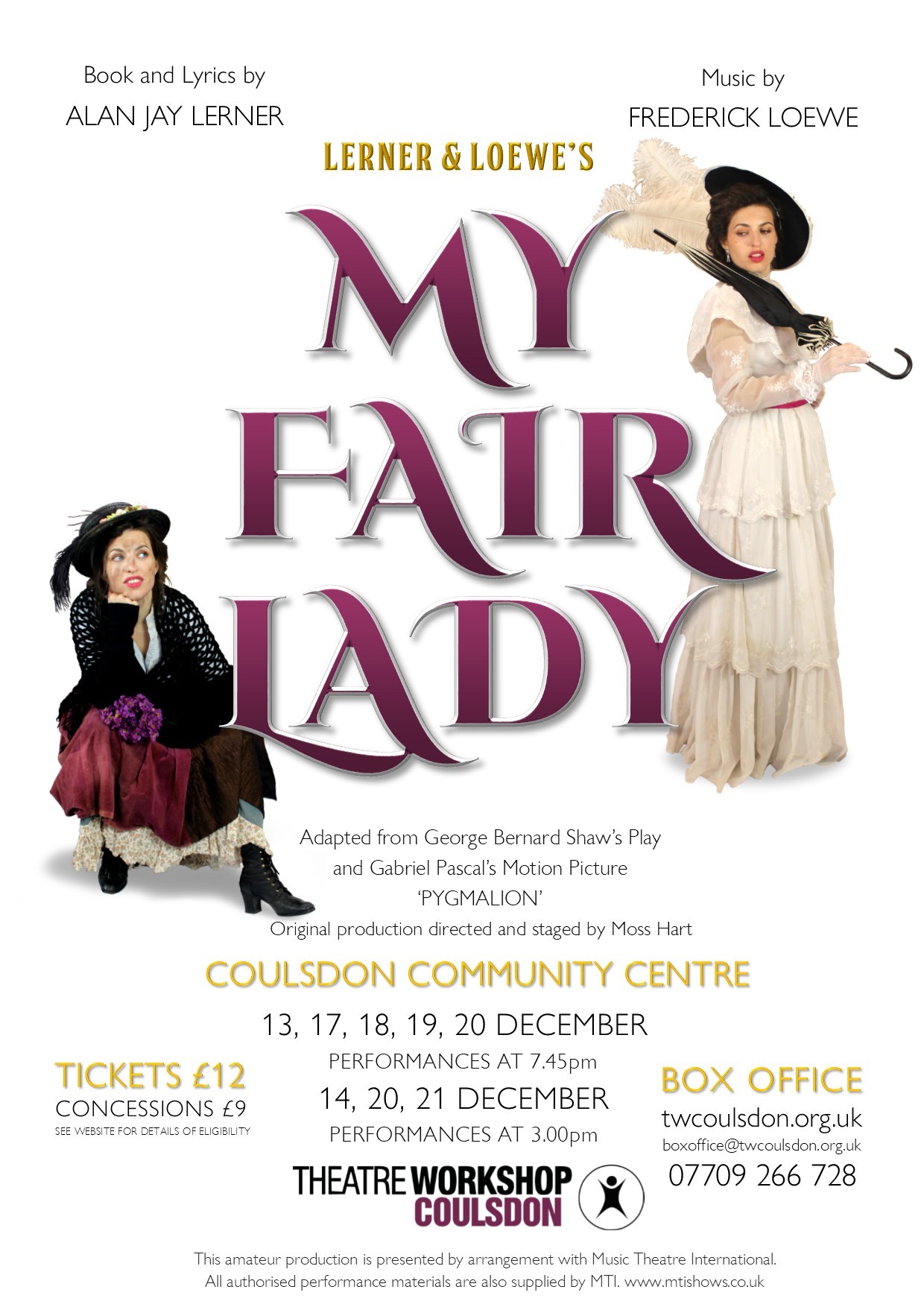
Lerner and Loewe’s celebrated stage musical adaptation of George Bernard Shaw’s ‘Pygmalion’ includes some of the best known and best loved show tunes ever written. From ‘Wouldn’t It Be Loverley’ to ‘I’m Getting Married in the Morning’, ‘I Could Have Danced All Night’ and ‘With A Little Bit Of Luck’.

It’s the story of a cockney flower girl’s transformation into the pride of London society – and its unforeseen consequences. In many places it’s very funny; in others, very poignant. When overbearing Professor Higgins stumbles on Eliza Doolittle outside Covent Garden Opera House, he recognises that her hideous vowels and lost consonants are all that separates her from the upper classes. Higgins casually makes a wager that within weeks he can pass Eliza off in polite society as a Duchess. But little does he know that beneath the dirty face and shabby clothes, young Eliza is stuffed full of human feeling. Too eloquent for a flower girl, yet lacking the breeding of the ruling classes, what on earth is to become of Eliza when the bet is over and the game has reached an end?

‘My Fair Lady’ was Lerner and Loewe’s musical adaptation of George Bernard Shaw’s ‘Pygmalion’, a much darker tale than the highly successful Broadway, West End and Hollywood show tells.

The character of ‘Pygmalion’ comes from Greek mythology, where he was sculptor who fell in love with a statue he had created, a statue that then comes to life. Bernard Shaw took that tale and twisted it, the sculptor becoming Henry Higgins, and the thing he creates, Eliza Doolittle. His play debuted in 1913 in Vienna, before going on to London and New York. Critics were generally favourable, though the ending created a certain level of controversy. A standard love story this wasn’t, and the ending was no more conventional. A film version was made in 1938, starring Leslie Howard as Higgins and Wendy Hiller as Eliza, and Shaw, initially distrustful, agreed to it being made only if he had a certain amount of creative control. This resulted in Shaw writing a whole new ballroom scene, the creation of a new character ‘Zoltan Karpathy’, and a new ending. He and his fellow screenwriters were awarded an Oscar for the screenplay, for which Shaw was characteristically dismissive, but it would be this screenplay that would be used as the basis for the musical.

The director of the movie, Gabriel Pascal, had spoken with Shaw about making it into a musical, but the author had refused. However, when Shaw died in 1950, that barrier was no longer an issue. Pascal approached lyricist Alan Jay Lerner to write the musical, with his partner, composer Frederick Loewe. At first, they couldn’t make it work but eventually they found a way, though not before Pascal had died. They called it ‘My Fair Lady’ after a provisional title to Shaw’s play ‘Pygmalion’, and it referred to the Cockney pronunciation of ‘Mayfair Lady’, helping to show Eliza’s transformation from working-class girl to upper-class woman. The part of ‘Higgins’ was initially offered to Noel Coward, who turned it down but suggested they approach Rex Harrison. ‘Eliza’ was offered to Broadway veteran Mary Martin who also turned it down, and they went instead for newcomer Julie Andrews. It opened on Broadway in March 1956 and was a massive success, going on to become, at the time, the biggest grossing Broadway show ever.

The 1964 movie was a similar success, winning eight Oscars including those for Best Picture and Best Actor (Rex Harrison). Interestingly, the Best Actress Oscar that year went to Julie Andrews for her portrayal of Mary Poppins, having been rejected for reprising the part of Eliza as not being famous enough by the studio. It went, famously, to Audrey Hepburn, whose singing voice was overdubbed by Marni Wood.

Theatre Workshop Coulsdon’s presentation of this fabulous show was directed by veteran actor/director Richard Lloyd with musical director and pianist Mark Taylor, and features Dan Carr as Professor Henry Higgins, Indianna Scorziello as flower-seller Eliza Doolittle, Paul Ford as her ne’er-do-well father Alfred, and Mike Brown as the bluff and amiable Col. Pickering.

Wendy and Peter Pan

This Christmas, we’re delighted to present the perfect festive treat for all the family – the classic English childhood myth of love, loss, redemption – and pirates.

And Peter Pan, who never grows old. What’s not to like?

Winter, 1911. Snow is falling across London. Wendy Darling and her brothers sleep peacefully in their bedroom as their parents bicker downstairs. In a sudden flurry of snow their window blows open, and Peter Pan tumbles into their lives – followed by a fractious fairy called Tink. With the help of a little fairy dust, Wendy agrees to fly with Peter to Neverland, seeking an awfully big adventure and the key to her parents’ forgotten happiness – the child they once lost. Once there, Wendy will give the Lost Boys a run for their money, defeat the diabolical pirate Captain James Hook, and ultimately learn what it really means to grow up.

J.M.Barrie’s stage play, Peter Pan, delighted audiences when it premiered in 1904. His novel based on the play, Wendy and Peter, published in 1911, was a huge success. Commissioned by the Royal Shakespeare Company, Ella Hickson’s Wendy and Peter Pan premiered in December 2013, and it’s a sparkling new adaptation that puts Wendy centre stage. In a feisty take on Barrie’s much-loved tale, it never loses the charm of the original, nor any of its iconic set pieces.
It’s bittersweet, funny in places, touching in others, and brimming with action and adventure. Complete with musical accompaniment by our live band, plus our famous Christmas refreshments. It might be cold outside, but the mince pies and mulled wine will be piping hot!

Sherlock Holmes and the Vampyres of London

London 1887. When the mortal remains of a young aristocrat vanish in the dead of night from Brompton Necropolis, Sherlock Holmes is no sooner asked to investigate than a second mystery presents itself – a beautiful young heiress afflicted by unaccountable night terrors; her vitality slipping away.

As these two strange cases resolve themselves into one, Holmes and his steadfast companion, Dr. John Watson, are plunged into a hidden London of grave-robbing grotesques, murderous Szgany gypsies, and demonic possession that obscures a diabolical conspiracy to overthrow the Crown itself.

Theatre Workshop Coulsdon’s thrilling homage to late Victorian gothic pits two of fiction’s most enduring characters against each other. But in the fog-shrouded metropolis where nothing is what it seems, which towering colossus of literary legend will triumph in this savage, epochal battle of wits?

From the author:

Indulging an occasional impulse to put something dark on stage, when ‘Sherlock Holmes and the Vampyres of London’ slid into my head, I thought I’d hit upon an original idea. Ah well. Ten minutes on Google laid bare an entire sub-culture of Holmes vs. Dracula novels, comics and essays. I guess bringing together the two pre-eminent creations of late Victorian fiction was a bit of a no-brainer. The Yin and Yang of the fin-de-siècle imagination – an epic face-off for the ages…

In the red, white and blue corner: Sherlock Holmes – arch-rationalist, buttoned-up, attractively flawed apotheosis of British pluck, doggedness, and all-round brilliance. Set against him, that epitome of lubricious, unchecked carnal desires: Dracula – the screaming antithesis of idealized Victorian manhood. Evil, hypersexualized, and downright foreign. It’s the ultimate Victorian superhero against the ultimate Victorian bogeyman. I mean, why wouldn’t you?

Holmes first appeared in 1887; Dracula 10 years later in 1897. Both characters achieved almost immediate superstar status – a dazzling supernova of global fame which has shown no sign of fading since. They are twin titans of popular culture, endlessly reimagined in movies, television, books, games and comics.

Both Arthur Conan Doyle and Bram Stoker achieved immortality of sorts thanks to their creations: a Scotsman and an Irishman giving life to two of the most famous, enduring, and built-upon characters in English fiction.

I have built upon them shamelessly in turn. It was fun bringing them together.


The Wind In The Willows

Since 1908, this classic tale of inquisitive Mole, stolid Ratty, gruff Badger and ‘ever in trouble’ Toad has delighted children of all ages, and most adults too! This stage adaptation by Theatre Workshop Coulsdon follows their adventures from the river bank to the Wild Wood, via the open road to the deepest dungeon, with a thrilling climax at stately Toad Hall. It’s a path strewn with boats, trains, caravans and stolen cars, as our animal heroes overcome adversity and their own natures to emerge victorious. By turns charming and funny, this is a splendid way to while away a English summer’s evening.

The Adventures of Dick Turpin

When Clemency Turnip’s Coffee House is closed down for ‘low morals’ and dealing in illicit liquor, her son Jack and serving-girl Polly Flinders find themselves out on the mean streets of 18th Century London and surviving on their wits. For Polly, it’s a path that may see her find her real parents. For Jack it’s a road to fame and notoriety as the land’s most celebrated highwayman!

Set in the colourful time of ‘Poldark’, ‘Tom Jones’ and Hogarth’s ‘Rake’s Progress’, this all-new pantomime adventure comes complete with outrageous Dame, girls dressed as boys, an audience participation song and every opportunity to boo the villains and cheer the heroes.

Will Turnip’s Coffee House be re-opened? Will moody and smouldering Woss Poldork regain the rights to his Cornish treacle mine? Will merchant banker Sir Beastlie Fugg get his deserved come-uppance? Will true love find its way?


A Midsummer Night’s Dream (2016)

Return to the Forest

It’s 20 years since we last put on a production of ‘A Midsummer Night’s Dream’, and here, a few of the company reflect on the play and its part in both TWC’s history and theirs…

Dan (Director)

I was 16 when I played Flute in TWC’s 1996 production. I remember coming on stage at Bewl Water and looking up at this huge sea of faces : more than 650 people had come to  see our last night. It was amazing. Later on I went to drama school, worked as an actor (and now as an agent). How strange then, but also strangely wonderful,  to be back directing the play for a new generation. Most of the current cast weren’t in our previous productions, and it’s honestly a privilege to introduce this boisterous, joyful masterpiece — often said to be the nation’s favourite play — to a new  group of young TWC actors. It’s 400 years old, and still incredibly touching, incredibly funny. Evidently the English sense of humour hasn’t changed all that much.

Rupert (Flute)

This is only my second play with TWC (my second play anywhere for that matter), and  I wasn’t sure how I’d take to Shakespearean dialogue. I didn’t even know he wrote comedies. But once I’d got the meaning sorted, it was hilarious! Full of life. A complete revelation really. The characters and their motivations are easily recognisable, even 400 years on. As for taking on Flute, well, it’s a big responsibility.  I mean, I’ve seen a recording of a baby-faced Dan playing Flute 20 years ago. I can tell I’m walking in the footsteps of giants. :^) Luckily TWC are not only a talented group, but a positive bunch of people too. Joining them has been almost life-changing. And I’m proud to be a member.

Lucy-Ann (Helena)

I grew up surrounded by Theatre Workshop, and I remember watching the 1996 production when I was just six! The fairies were magical, the mechanicals hilarious, and the lovers meant to be together. You’d have seen me then in the front row with eyes as big as saucers, longing to be involved. Now I find myself a part of the legendary love triangle/quadrangle/tangle. The fairies have all the magic, mischief and poetry, but we have the most fun. The play revolves around the lovers,. The two friends are pushed to their limits and beyond, and come out the stronger for it. The two suitors, who seem to start with the upper hand, become pawns in the greatest game of all; the desperate, crazy, selfish, blind, obsessive yet wonderful thing that is love. I love them. I love it all.

 Richard (Bottom)

I directed both the 1989 and 1996 productions of ‘Dream’ and played Oberon each time too.  Playing Bottom this time is truly going from the sublime to the ridiculous. Obnoxious yet strangely endearing, he’s one of the most famous comic characters in English theatre. I love this play because it’s such a  joyful depiction of truly English idiocy. It might pretend to be Athens, but in this play Shakespeare is showing  the English at their best and worst.  Bumbling working men with hearts of gold and brains of straw, young toffs behaving badly and yet finding themselves in the end. And the fairy kingdom, glimpsed in the shadows of the wild wood. Magical.

The Ladykillers

When Mrs Wilberforce puts an advert in the local newsagent’s window to rent out her guest bedrooms, the last thing she expects is to be overrun by a group of enthusiastic, if eccentric, amateur musicians. But despite the constant sound of a string quartet filling the house, Professor Marcus and his friends The Major, Harry, Louis and ‘One-Round’ are not what they seem, and soon she finds herself dragged into the Professor’s scheme to pull off a violent robbery. With the police unaware, only Mrs Wilberforce and her parrot, General Gordon, stand between the five desperate criminals and their ill-gotten £200,000.

Will she see justice done? Or will they keep the ‘old girl’ quiet…permanently?

Who will be forced to face the music?

November 1956. It’s over 11 years since the end of the Second World War and Britain is still coming to terms with its new position in the world. The Empire is no more, and in an attempt to restore some national pride and underline an intent to remain a major player on the global stage, Prime Minister Anthony Eden is about to launch an invasion of Egypt to recover the Suez Canal. At home, the rationing introduced in 1939 only finished a year ago, and our austerity struck country still bears the scars of the war it supposedly won, with large sections of blitz-hit London remaining derelict. But the mood is upbeat. The early strains of rock ‘n’ roll are filtering across the Atlantic and with that, the seeds of teenage ‘rebellion’. James Dean and Marilyn Monroe, Rock Hudson, Doris Day and Yul Brynner are the Hollywood stars of the day. An 18 year old Bobby Charlton scored on his debut for Manchester United just three weeks ago and the Melbourne Summer Olympics start later this month.

This is the world of The Ladykillers.

Originally a film made by Ealing Studios and released in 1955, it starred Alec Guinness as ‘Professor’ Marcus, with a young Peter Sellers as Harry and Herbert Lom as Louis.  A largely unsuccessful remake starring Tom Hanks as Marcus, with the action moved to Mississippi, came out in 2004. Graham Linehan, who had already been successful in writing for television with such programmes as ‘Father Ted, ‘Black Books’ and ‘The IT Crowd’ wrote this theatre adaptation in 2011, and after debuting in Liverpool, the production went on to a successful and extended run at the Gielgud Theatre in London’s West End starring Peter Capaldi as ‘Professor’Marcus.

Interestingly, there is a theory that the story of The Ladykillers is more than simply a black comedy, and holds a mirror up to the times it was set in. Thus Mrs Wilberforce is the embodiment of Britannia, an aging defender of proper British values, while her house is the Empire, ramshackle and falling apart, full of the memories of one-time glories now faded. Arrayed against her are the con-man ‘Major’ representing the British ruling classes, with pill-popping wide-boy Harry as dissolute youth, punch-drunk ‘One-Round’ as the oafish masses and knife-wielding Louis the dangerous immigrant. Where ‘Professor’ Marcus fits in, the theory doesn’t say. Perhaps he represents intellectuals, pseudo-intellectuals, academics or even politicians. You can make up your own mind.

Graham Linehan sees it as demonstrating that even the worst of men have a little good in them…and that it is this that ultimately dooms them.Whatever its deeper meanings, if it has them, The Ladykillers is a classic black comedy. Enjoy.