My Fair Lady
About the Production
Lerner and Loewe’s celebrated stage musical adaptation of George Bernard Shaw’s ‘Pygmalion’ includes some of the best known and best loved show tunes ever written. From ‘Wouldn’t It Be Loverley’ to ‘I’m Getting Married in the Morning’, ‘I Could Have Danced All Night’ and ‘With A Little Bit Of Luck’.
It’s the story of a cockney flower girl’s transformation into the pride of London society – and its unforeseen consequences. In many places it’s very funny; in others, very poignant. When overbearing Professor Higgins stumbles on Eliza Doolittle outside Covent Garden Opera House, he recognises that her hideous vowels and lost consonants are all that separates her from the upper classes. Higgins casually makes a wager that within weeks he can pass Eliza off in polite society as a Duchess. But little does he know that beneath the dirty face and shabby clothes, young Eliza is stuffed full of human feeling. Too eloquent for a flower girl, yet lacking the breeding of the ruling classes, what on earth is to become of Eliza when the bet is over and the game has reached an end?
‘My Fair Lady’ was Lerner and Loewe’s musical adaptation of George Bernard Shaw’s ‘Pygmalion’, a much darker tale than the highly successful Broadway, West End and Hollywood show tells.
The character of ‘Pygmalion’ comes from Greek mythology, where he was sculptor who fell in love with a statue he had created, a statue that then comes to life. Bernard Shaw took that tale and twisted it, the sculptor becoming Henry Higgins, and the thing he creates, Eliza Doolittle. His play debuted in 1913 in Vienna, before going on to London and New York. Critics were generally favourable, though the ending created a certain level of controversy. A standard love story this wasn’t, and the ending was no more conventional. A film version was made in 1938, starring Leslie Howard as Higgins and Wendy Hiller as Eliza, and Shaw, initially distrustful, agreed to it being made only if he had a certain amount of creative control. This resulted in Shaw writing a whole new ballroom scene, the creation of a new character ‘Zoltan Karpathy’, and a new ending. He and his fellow screenwriters were awarded an Oscar for the screenplay, for which Shaw was characteristically dismissive, but it would be this screenplay that would be used as the basis for the musical.
The director of the movie, Gabriel Pascal, had spoken with Shaw about making it into a musical, but the author had refused. However, when Shaw died in 1950, that barrier was no longer an issue. Pascal approached lyricist Alan Jay Lerner to write the musical, with his partner, composer Frederick Loewe. At first, they couldn’t make it work but eventually they found a way, though not before Pascal had died. They called it ‘My Fair Lady’ after a provisional title to Shaw’s play ‘Pygmalion’, and it referred to the Cockney pronunciation of ‘Mayfair Lady’, helping to show Eliza’s transformation from working-class girl to upper-class woman. The part of ‘Higgins’ was initially offered to Noel Coward, who turned it down but suggested they approach Rex Harrison. ‘Eliza’ was offered to Broadway veteran Mary Martin who also turned it down, and they went instead for newcomer Julie Andrews. It opened on Broadway in March 1956 and was a massive success, going on to become, at the time, the biggest grossing Broadway show ever.
The 1964 movie was a similar success, winning eight Oscars including those for Best Picture and Best Actor (Rex Harrison). Interestingly, the Best Actress Oscar that year went to Julie Andrews for her portrayal of Mary Poppins, having been rejected for reprising the part of Eliza as not being famous enough by the studio. It went, famously, to Audrey Hepburn, whose singing voice was overdubbed by Marni Wood.
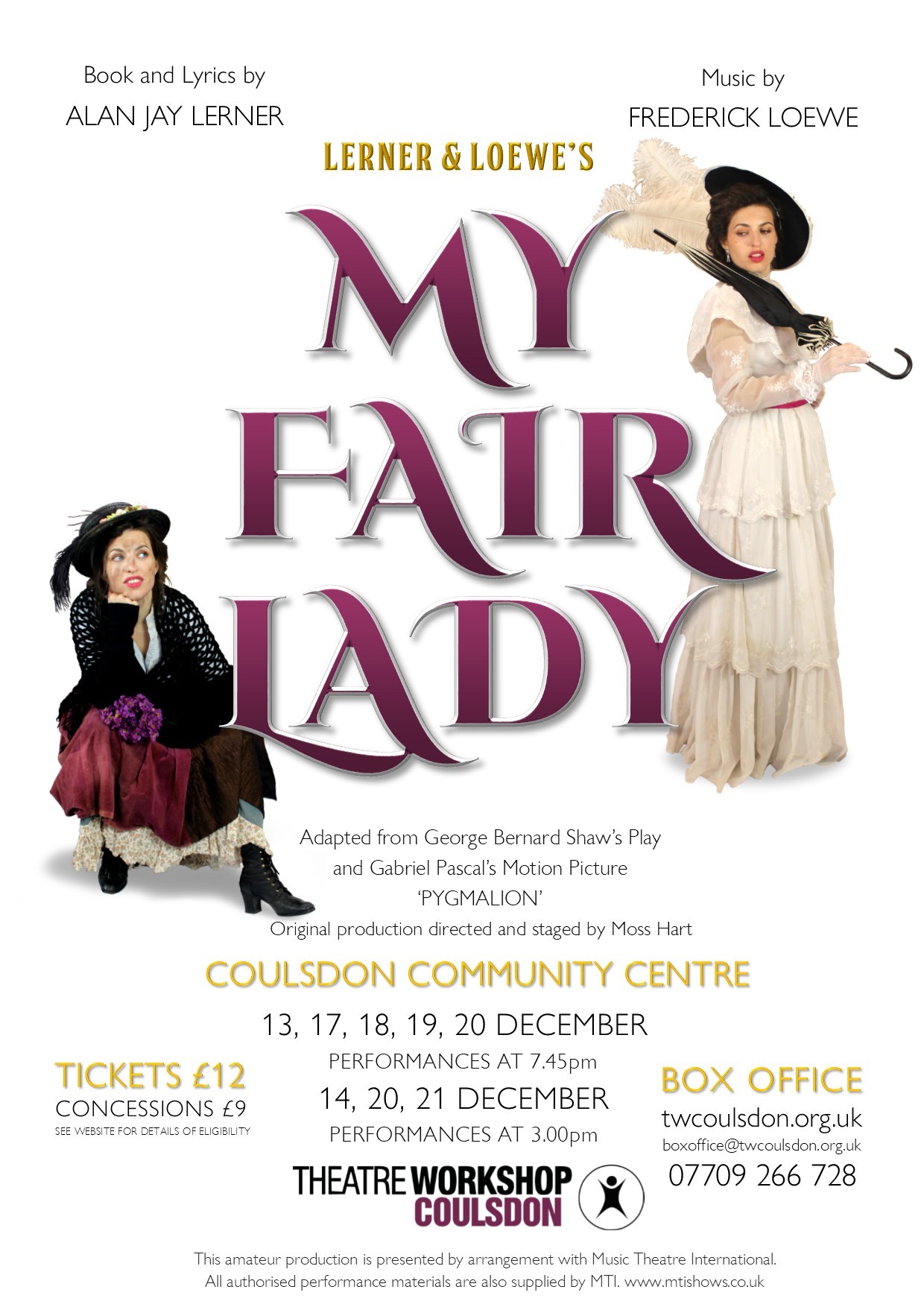
Theatre Workshop Coulsdon’s presentation of this fabulous show was directed by veteran actor/director Richard Lloyd with musical director and pianist Mark Taylor, and features Dan Carr as Professor Henry Higgins, Indianna Scorziello as flower-seller Eliza Doolittle, Paul Ford as her ne’er-do-well father Alfred, and Mike Brown as the bluff and amiable Col. Pickering.
The Cast
Behind the Scenes
Image Gallery


The Reviews
‘By George! She’s Got it!’ My Fair Lady’s a triumph for Scorziello
FIRST NIGHT REVIEW: The classic Lerner and Loewe musical can be a challenge to stage even for the biggest theatre companies on the West End or Broadway. In Coulsdon this week, the local community centre is staging ‘a lavish, fast-paced show… full of heart and soul’, says KEN TOWL
Musical theatre is a serious business.
Lerner and Loewe’s songs for My Fair Lady are witty, wordy and poignant. Based on George Bernard Shaw’s Pygmalion, the musical therefore has well-developed characters who are also mouthpieces for political satire. There is much for the actors to play with here. In the summer, at Theatre Workshop Coulsdon’s production of Animal Farm, Richard Lloyd, as lead villain Napoleon, convinced as a “strong leader”. As the director of My Fair Lady, Lloyd has put his stamp on a lavish, fast-paced show that is full of heart and soul. He is ably aided by Francesca Auletta in charge of “movement and choreography”, in a very physical and demanding production.
The bar is set high early on with Dan Carr’s performance, as Henry Higgins, of “Why Can’t the English?”, setting up the character as a man who is all brain and no heart. A man, we learn, who believes that the lower classes have no soul. All this is about to change with the arrival in his life of flower girl Eliza Doolittle, and if Carr has set the bar high, Indianna Scorziello raises it. Her performance of “Wouldn’t it be Loverly?” is, indeed, loverly. The first night audience’s response was a realisation that we were in for something special.The chemistry between Scorziello as Eliza and Carr as Higgins is palpable, to the extent that when he sings, “I’d be equally as willing for a dentist to be drilling as let a woman in my life” we start to believe that the man protests too much. Likewise, when Eliza sings “Just You Wait, Henry Higgins” there is as much promise as there is threat in her words. We watch them bond over vowels, as the Covent Garden flower girl becomes the Mayfair Lady. If these Higgins and Eliza can’t get on, this will be a tragedy rather than a musical comedy.
And of course, it is a comedy, and this production leans as heavily into the laughs as it does the social satire. Colonel Hugh Pickering, Professor Higgins’ friend, is the kinder, more socially adept foil that Henry needs to keep him grounded. Mike Brown’s portrayal is subtly funny, with hidden depth. There are occasional hints of something behind the smart, happy façade. A petticoat, perhaps?
Another character who brings heart and humanity to the Higgins household is Mrs Pearce, played by the redoubtable Anya Destiney, who manages to bring layers of depth to the role, deftly skipping between common-sense and comic send up. Her singing is fun, too.
Leader of the laughs department, though, is Paul Ford as Eliza’s father, Alfred, a self-declared member of the “undeserving poor”, who eventually prospers “with a little bit of luck”. Ford’s in-yer-face ‘Cor-blimey-guvnor’ performance works well as a raucous live-for-the-moment counterpoint to the tribulations of his daughter, who wonders what will happen to her after Higgins’s human experiment is over. His reluctant acceptance of “middle-class morality” and consequent exhortations to “Get Me To The Church On Time” set the right comic tone.
One of the songs from the show is “Poor Henry Higgins” but perhaps there should be a “Poor Freddie Eynsford-Hill”, Eliza’s unsuitable suitor. While he is besotted with her, and out of desperation, she considers him as potential husband material, we can see that this relationship is going nowhere. Scorziello makes it clear that Eliza is as repulsed by the hapless Freddie as she is captivated by the apparently heartless Henry. Poor Freddie indeed, left to hang around on the street where she lives and pine. “On The Street Where You Live” is a tricky one to pull off and Aldo Piscina manages to wring enough emotion out of it so that we can empathise with a character that otherwise in this production is played as a clown.
Overall, the cast is strong. But this is a triumph for Scorziello.
The audience seemed to clap and cheer just a little bit louder at the end of numbers like “The Rain In Spain” and “I Could Have Danced All Night”. When Scorziello entered the stage at the Embassy Ball in a sparkling white dress, done up like a duchess, there was an audible collective intake of breath from the audience, just as when a bride enters her wedding venue.
As Professor Higgins said, “By George! She’s got it!”
Musical theatre demands, of course, musicians, and a word should go, too, to the septet who provided just the right amount of oomph to complement the acting and choreography on the stage and propel the numbers along. Mark Taylor’s piano led and Katherine Lemieux’s clarinet added texture, but they were all good, and, quite rightly, the audience showed their appreciation.
Ken Towl for Inside Croydon on 14 December 2025
Other Productions