The Sweet Science of Bruising

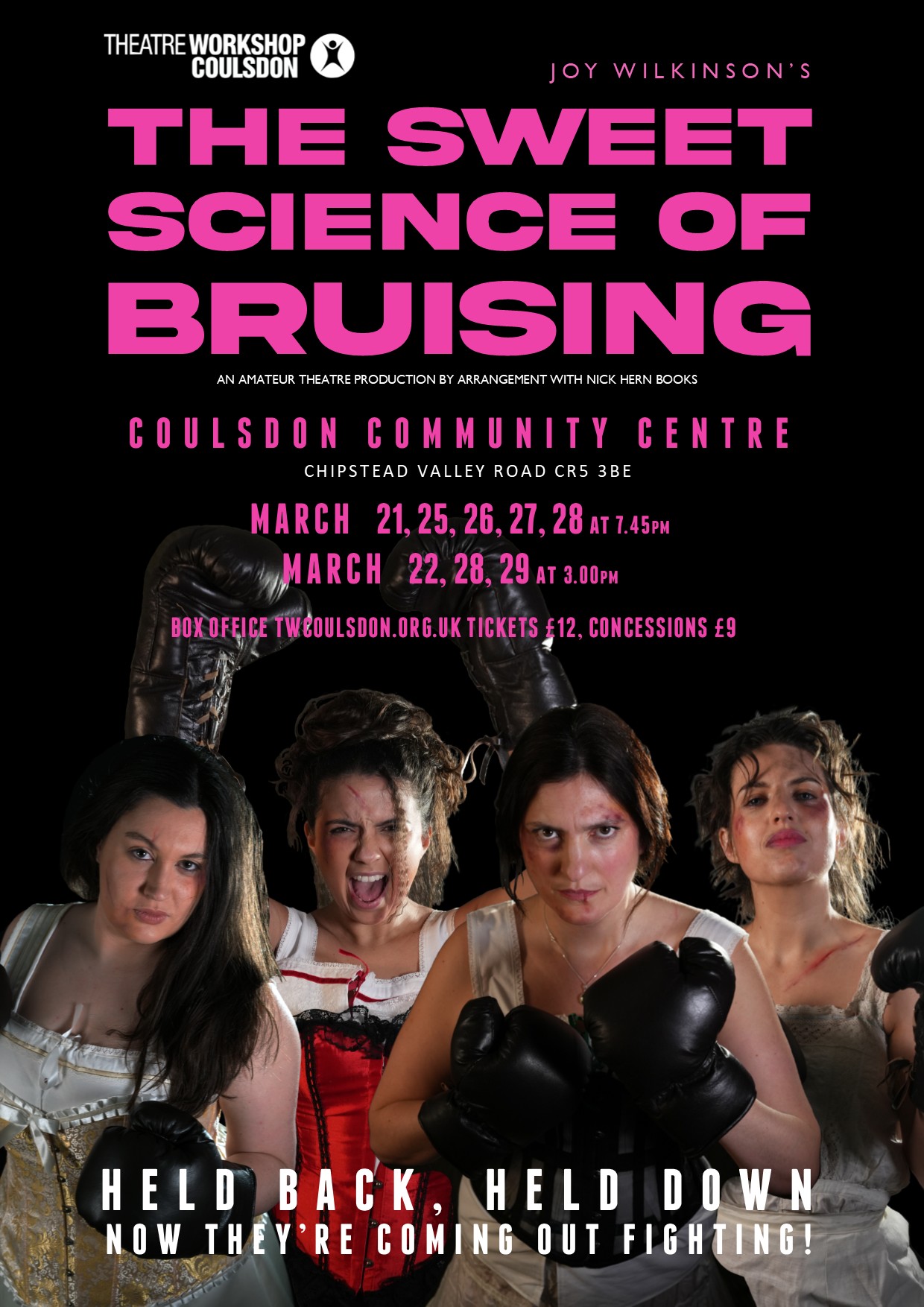
Victorian London, 1869. The shadowy world of female boxing provides the opportunity for four very different women to break away from the lives that have been ordained for them by society.

Polly Stokes is a fighter, has been ever since she was abandoned on a doorstep as a babe. Irish-born Mattie Blackwell lives on the streets, her life a constant battle to survive. Violet Hunter wants to be a doctor but no man will let her, and Anna Lamb seems to have it all, a husband, children, a house, servants… but in truth, she has nothing.

Held in by corsets, held back by men, the violent release they find in the boxing ring brings them a form of freedom they’ve never known, but at the final bell, there can only be one Lady Boxing Champion of the World.

An epic tale of passion, power, politics and pugilism from the pen of Joy Wilkinson and performed with verve by TWC.

Burnley-born Joy Wilkinson is an accomplished and prize-winning author who has written several plays (Now is the Time, Fair and Britain’s Best Recruiting Sergeant among others), plus numerous TV and film scripts covering a range from sci-fi/fantasy such as Doctor Who and Lockwood & Co. through to thrilling dramas Suspect and The Pact, via Holby City, Casualty and Land Girls.

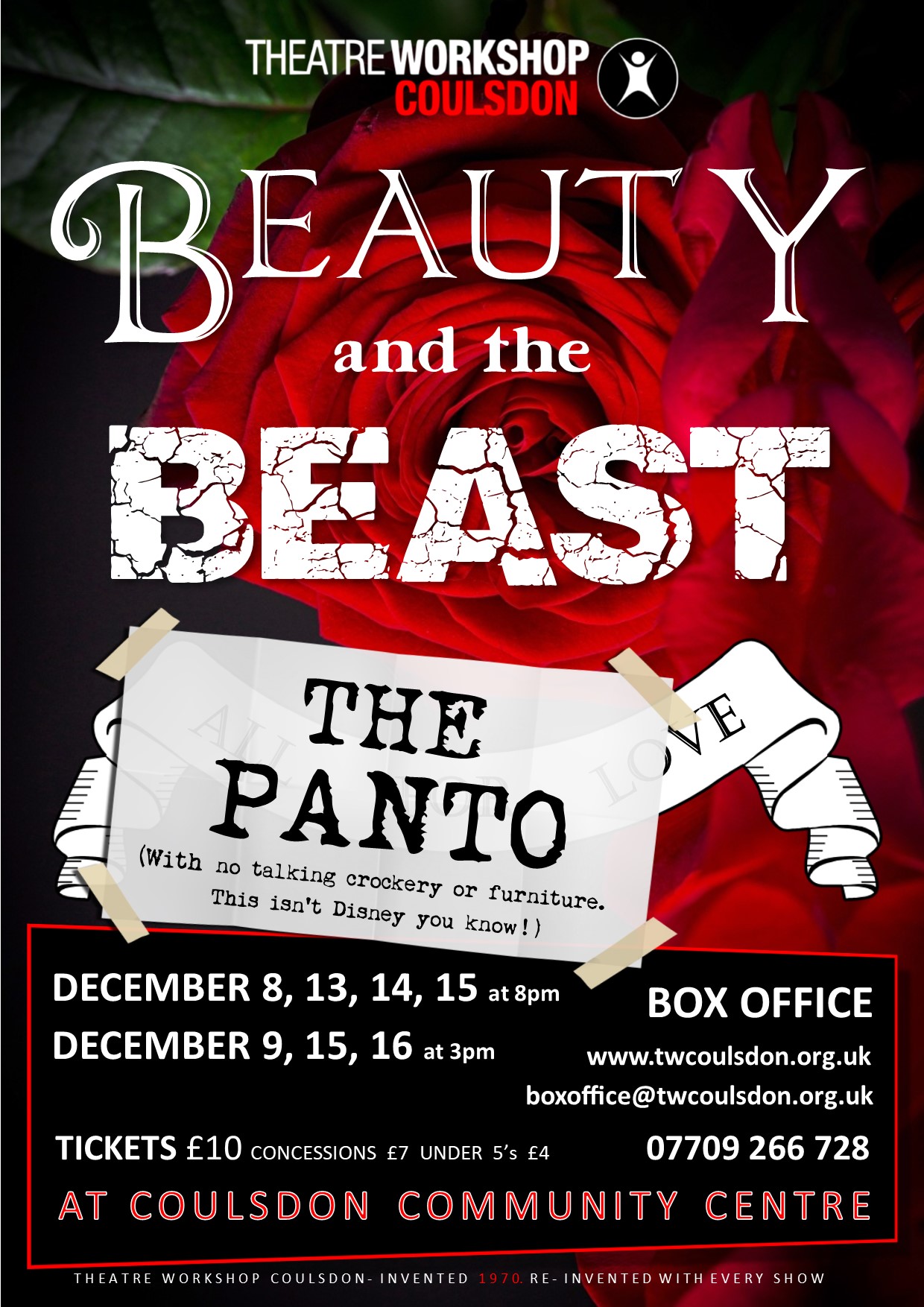
Beauty and The Beast – The Panto

Theatre Workshop Coulsdon’s Christmas 2018 production is an all-new, original pantomime based on the much-loved fairy tale, ‘Beauty and the Beast’. This classic tale, and its underlying message that you shouldn’t judge a book by its cover, has been transformed into a full-fat panto, rocket fuel for the winter season, chock-full of larger than life characters, sing-along songs and audience participation, as the lovely Beauty finds that the monstrous Beast is not what she was expecting. A full band and a large ensemble cast (Bumbling guards, saucy maids, talking vegetation and puppet creatures) support a tale of good versus the evil that is Deadly McNightshade, the woman who puts the wicked into witch and gives it a Scottish accent. Can true love break the dread spell that has locked a handsome prince in a prison he can never escape from? Oh yes it can!

But where did the original story come from? Well, once upon a time there was a woman called Gabrielle-Suzanne Barbot de Villeneuve (They had some cracking names back then) Born in Paris in 1685, she was married at 21 and widowed at 26, her aristocratic but spendthrift husband losing his life almost as swiftly as he lost their money. With her family fortune gone, she needed a way to support herself and eventually moved in with the celebrated playwright and poet Prosper Jolyot de Crebillon (See, another one!) where she began to write. From 1734 through to her death in 1755 she wrote novels and collections of fairy tales but most notably, in 1740, she wrote ‘La Belle et La Bête’, or as we know it, ‘Beauty and the Beast’. It formed part of a much larger story, and was much more complicated than we’re used to now. The simpler version is down to another Frenchwoman, Jeanne-Marie Leprince de Beaumont (and another!) who re-wrote the tale as a much shorter story and published it the year after Villeneuve’s death without acknowledging its origins. Which was a bit sneaky. Boo! Hiss!

Since then it’s become a children’s fairytale classic. Of course, that meant it got the full Disney treatment, twice now, both as a cartoon (1991) and a live-action movie (2017). But there have also been numerous other movie and TV adaptations, a stage musical, an opera, a ballet, and even songs, a disco tune and video games. Its themes of love conquering all and never judging by appearances are simple and easily relatable. And so Sheila May Bird, published children’s author (‘Pete’s Peculiar Petshop’, ‘Pirate Percy’s Parrot’ and others that don’t begin with the letter ‘P’) and long-time member of Theatre Workshop Coulsdon, decided that what had been missing all these years was a pantomime version, full of silliness, slapstick, songs, an audience participation number and the kind of ‘behind you!’ nonsense that makes going to the theatre at this time of year so much fun.

The Adventures of Jason and the Argonauts

The legends of Ancient Greece have continued to weave their magic through our imaginations for over two thousand years. The capricious Gods and Goddesses of Mount Olympus playing with the fates of ordinary mortals for both good and ill. But from the ranks of those mortals came the fabled heroes, those who rose to the challenges and won out despite all. Odysseus taking on the mighty one-eyed giant Cyclops. Theseus defeating the monstrous Minotaur in the labyrinth of Crete. Jason and his Argonauts travelling far and risking everything in search of the Golden Fleece.

This last provides the basis for our winter production. But don’t worry, you won’t need a degree in the classics to work out what’s going on. This is a very loose interpretation of the myths handed down over the centuries. Jason and Medea are two mixed-up kids, an orphan and a runaway, who suddenly find themselves tasked with overthrowing the evil tyrant King Pelias. With a certain amount of divine intervention, Jason becomes the captain of the mighty ‘Argo’, a ship capable of crossing the uncharted seas, with a crew of oddball heroes including the world’s strongest (and possibly clumsiest) man, a wonderful woman warrior, a resting rock star, the least identical twins ever and a seriously streetwise cat. Now he must set off and find the Golden Fleece. If only he knew what it was. And then there are the challenges. The man-eating Harpies of Lemnos, the terrible Clashing Rocks, the fire-breathing Great Bull of Colchis, the evil Dragon Snake and Talos, the bronze giant. (Who might just be a really cool sock puppet.) Not to mention The Sirens…

Medea, Jason and his misfit Argonauts are here this December to have fun. This will be no ordinary adventure tale, but one with songs and laughter, and we’ll be encouraging you to join in, whether you’re five or sixty five. Ever fancied rowing the Argo? You’ll get your chance. Become part of the undead army of skeleton warriors? Oh yes.

The award-winning author of ‘Jason and the Argonauts’, Phil Willmott, is mainly famous around these parts for his creation of the hilariously stiff upper-lipped ‘Dick Barton – Special Agent’ spoofs that were so much a part of the sadly demised Warehouse Theatre in Croydon. But he’s written, adapted and directed numerous productions, many derived from classical sources, and we’re more than pleased to link up with him again.

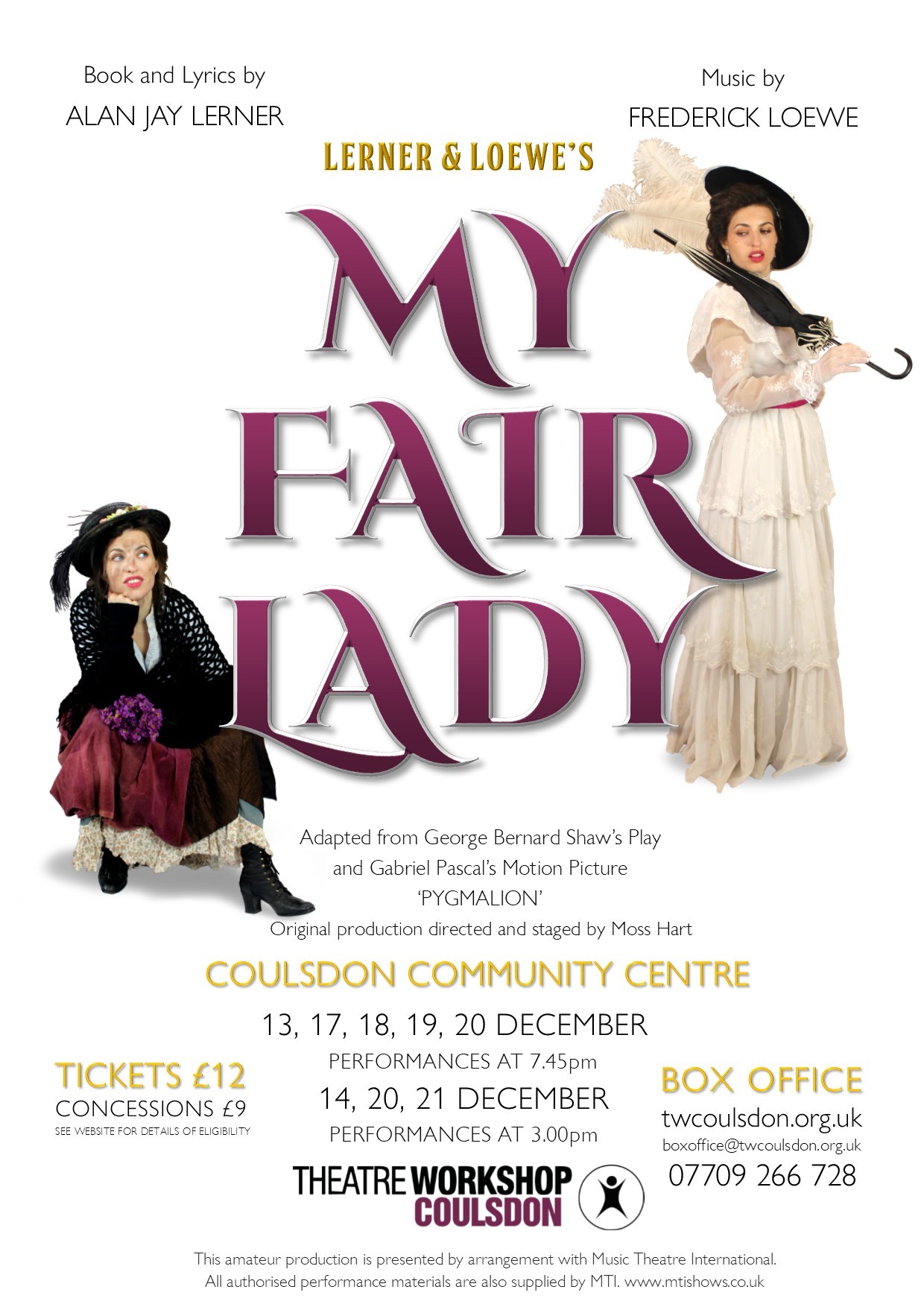
My Fair Lady

Lerner and Loewe’s celebrated stage musical adaptation of George Bernard Shaw’s ‘Pygmalion’ includes some of the best known and best loved show tunes ever written. From ‘Wouldn’t It Be Loverley’ to ‘I’m Getting Married in the Morning’, ‘I Could Have Danced All Night’ and ‘With A Little Bit Of Luck’.

It’s the story of a cockney flower girl’s transformation into the pride of London society – and its unforeseen consequences. In many places it’s very funny; in others, very poignant. When overbearing Professor Higgins stumbles on Eliza Doolittle outside Covent Garden Opera House, he recognises that her hideous vowels and lost consonants are all that separates her from the upper classes. Higgins casually makes a wager that within weeks he can pass Eliza off in polite society as a Duchess. But little does he know that beneath the dirty face and shabby clothes, young Eliza is stuffed full of human feeling. Too eloquent for a flower girl, yet lacking the breeding of the ruling classes, what on earth is to become of Eliza when the bet is over and the game has reached an end?

‘My Fair Lady’ was Lerner and Loewe’s musical adaptation of George Bernard Shaw’s ‘Pygmalion’, a much darker tale than the highly successful Broadway, West End and Hollywood show tells.

The character of ‘Pygmalion’ comes from Greek mythology, where he was sculptor who fell in love with a statue he had created, a statue that then comes to life. Bernard Shaw took that tale and twisted it, the sculptor becoming Henry Higgins, and the thing he creates, Eliza Doolittle. His play debuted in 1913 in Vienna, before going on to London and New York. Critics were generally favourable, though the ending created a certain level of controversy. A standard love story this wasn’t, and the ending was no more conventional. A film version was made in 1938, starring Leslie Howard as Higgins and Wendy Hiller as Eliza, and Shaw, initially distrustful, agreed to it being made only if he had a certain amount of creative control. This resulted in Shaw writing a whole new ballroom scene, the creation of a new character ‘Zoltan Karpathy’, and a new ending. He and his fellow screenwriters were awarded an Oscar for the screenplay, for which Shaw was characteristically dismissive, but it would be this screenplay that would be used as the basis for the musical.

The director of the movie, Gabriel Pascal, had spoken with Shaw about making it into a musical, but the author had refused. However, when Shaw died in 1950, that barrier was no longer an issue. Pascal approached lyricist Alan Jay Lerner to write the musical, with his partner, composer Frederick Loewe. At first, they couldn’t make it work but eventually they found a way, though not before Pascal had died. They called it ‘My Fair Lady’ after a provisional title to Shaw’s play ‘Pygmalion’, and it referred to the Cockney pronunciation of ‘Mayfair Lady’, helping to show Eliza’s transformation from working-class girl to upper-class woman. The part of ‘Higgins’ was initially offered to Noel Coward, who turned it down but suggested they approach Rex Harrison. ‘Eliza’ was offered to Broadway veteran Mary Martin who also turned it down, and they went instead for newcomer Julie Andrews. It opened on Broadway in March 1956 and was a massive success, going on to become, at the time, the biggest grossing Broadway show ever.

The 1964 movie was a similar success, winning eight Oscars including those for Best Picture and Best Actor (Rex Harrison). Interestingly, the Best Actress Oscar that year went to Julie Andrews for her portrayal of Mary Poppins, having been rejected for reprising the part of Eliza as not being famous enough by the studio. It went, famously, to Audrey Hepburn, whose singing voice was overdubbed by Marni Wood.

Theatre Workshop Coulsdon’s presentation of this fabulous show was directed by veteran actor/director Richard Lloyd with musical director and pianist Mark Taylor, and features Dan Carr as Professor Henry Higgins, Indianna Scorziello as flower-seller Eliza Doolittle, Paul Ford as her ne’er-do-well father Alfred, and Mike Brown as the bluff and amiable Col. Pickering.

Wendy and Peter Pan

This Christmas, we’re delighted to present the perfect festive treat for all the family – the classic English childhood myth of love, loss, redemption – and pirates.

And Peter Pan, who never grows old. What’s not to like?

Winter, 1911. Snow is falling across London. Wendy Darling and her brothers sleep peacefully in their bedroom as their parents bicker downstairs. In a sudden flurry of snow their window blows open, and Peter Pan tumbles into their lives – followed by a fractious fairy called Tink. With the help of a little fairy dust, Wendy agrees to fly with Peter to Neverland, seeking an awfully big adventure and the key to her parents’ forgotten happiness – the child they once lost. Once there, Wendy will give the Lost Boys a run for their money, defeat the diabolical pirate Captain James Hook, and ultimately learn what it really means to grow up.

J.M.Barrie’s stage play, Peter Pan, delighted audiences when it premiered in 1904. His novel based on the play, Wendy and Peter, published in 1911, was a huge success. Commissioned by the Royal Shakespeare Company, Ella Hickson’s Wendy and Peter Pan premiered in December 2013, and it’s a sparkling new adaptation that puts Wendy centre stage. In a feisty take on Barrie’s much-loved tale, it never loses the charm of the original, nor any of its iconic set pieces.
It’s bittersweet, funny in places, touching in others, and brimming with action and adventure. Complete with musical accompaniment by our live band, plus our famous Christmas refreshments. It might be cold outside, but the mince pies and mulled wine will be piping hot!

Radio Days Transmission Two : The War Years

After the success of our first Radio Days showcase in 2015, set in the golden days of wireless broadcasting, we’re leaping aboard our dramatic time machine and going back still further.

Transmission Two : The War Years sees us clutching our gas masks and ration books, with one ear listening to the radio and the other waiting for the air raid siren. A collection of songs, sketches and playlets, from the deadly serious to the downright funny, and all inspired by the period, means an excellent evening of new yet nostalgic entertainment for everyone.

So on with your siren suits, use gravy browning and an eye pencil if you can’t afford nylons, and make your way with care through the black-out to Coulsdon Community Centre. And put that light out!

On the BBC Home Service tonight, the following schedule will be broadcast on 668 kHz (South) and 767 kHz (North).

Welcome to tonight’s show.  Like our previous ‘Radio Days’ presentation back in 2015, this is very much a project that attempts to achieve a number of different goals. On one level we will try to evoke some of the feeling of living and surviving through the turbulent times of the Second World War. There was danger, but there was also community as people worked, and played, together to get through the storm. And a sense of humour was one of the strongest defences against a sea of troubles, from rationing, shortages and petty bureaucracy to death and loss.

On another level, this is a grand experiment, harking back to the early days of Theatre Workshop Coulsdon. All of the pieces you’ll see on stage tonight were written or adapted by members of the group. For some it’s their first time attempt at creative writing. It’s a big leap. And we’re very proud of what they’ve achieved. Almost nothing had been written when we started our rehearsals and workshops in January.  Each short play has evolved over the last three months, some easily and with grace, some more awkwardly, in fits and starts. But they are ready now, and all represent time, effort and imagination on the part of not just the writer but all the people at Workshop who’ve contributed ideas. This has been very much a team effort.

And let’s not forget the music. We have some glorious songs and voices for you tonight, accompanied by our ‘BBC Very Light Orchestra’, three talented, creative and endlessly patient musicians.

So close your eyes and be taken back in time again. And enjoy.

Warning. We are expecting atmospheric disturbances during latter part of this broadcast, which may interrupt the programme. We do hope your enjoyment won’t be too badly affected.

Treasure Island (2010)

Long before Jack Sparrow was ever dreamt of, an even more irredeemable rogue bestrode the rolling quarter-deck of pirate fiction. A one-legged villain by the name of Silver…

When Robert Louis Stevenson wrote ‘Treasure Island’ in 1883, he created not only the most famous adventure story in the English language, but an entire genre. Maps marked with crosses, buried treasure chests, one-legged seafarers with parrots, tropical islands full of mystery and danger, black spots and ‘Yo-ho-ho’s – all these commonplaces of pirate fiction were entirely Stevenson’s invention. He was writing about a world 150 years before his own time, about which he knew very little. That didn’t stop him writing a thrilling story that also held a wry commentary on coming of age and the ambiguity of morality – in the maimed shape of Long John Silver – unusual for children’s literature both then and now.

In our 40th year, choosing Treasure Island for our summer, open-air production seemed both obvious and fitting. It marks the fourth time we’ve set sail with this tale of derring-do, having done so previously in 1974 and 1989, as well as spoofing it with a panto version in 1995. One tradition has remained throughout, the trademark of TWC. In the absence of female characters (with the exception of Mrs Hawkins) we have the heroes played by women and the villainous pirates played by men. Now that might sound a little strange perhaps, but believe me, it works well.

The songs in this production are traditional sea songs and shanties, a rousing accompaniment for life and adventure aboard the Hispaniola. Several hundred of these traditional songs are known, with literally thousands of versions, many blurred into hybrids of several different songs They formed a constantly evolving oral tradition passed on by seamen around the world during the great age of sail. The songs took their influences from different languages and cultures: from Gaelic and Scandinavian dialect song to Wild West ballads; from the rhythms of the South Sea Islands to Negro Spirituals. They were only ever sung on merchant ships though, not the Royal Navy, who frowned on the practice.

Traditional sea songs divide into two main types: the shanty, a chanted work song with a repetitive chorus designed to help gangs of men synchronise the heavy tasks hauling, heaving or pumping aboard ship, and the foc’sle ballad – songs composed and sung just for entertainment. The divide is far from hard and fast however, and many shanties have, over time, developed a more lyrical form.

Our band for the production, pressganged into service of course, are called ‘Ninepence Three Farthings’. Enjoy.

Lords and Ladies

It’s a hot midsummer’s night in the tiny kingdom of Lancre, up in the far northern hill country of Discworld. Crop circles are turning up everywhere, bursting like raindrops, a portent of wayward magic leaking into the land from between the standing stones known as ‘The Dancers’.

Magrat Garlick, witch, is getting married in the morning – to King Verence of Lancre no less. The wizards of the Unseen University are journeying north from the great city of Ankh-Morpork to bless the union, and the Lancre All-Comers Morris Team have been lined up to stage a rustic entertainment for the happy couple. In short, everything should be going like a dream.

But all is not well in Lancre. Elves, long banished from the human realm are pushing at the iron boundaries of their barren winter land, bringing with them all those things traditionally associated with the magical, glittering realm of faerie: cruelty, kidnapping, malice and murder.

‘The Dancers’ form the gateway between the two worlds, and for many years, Granny Weatherwax and her tiny argumentative coven have worked to keep that portal tightly closed. But now a new coven, led by the young, ambitious and wilful Diamanda (real name Lucy Tockley, but Diamanda sounds so much better) are determined to overturn the old order…

And when the Lancre morris team gets seriously drunk on a fairy mound, all Hell is ready to break loose. In short, it’s a festival of dwarves, wizards, trolls, morris dancers – plus an orang-utan, with a fair helping of hey-nonny-nonny and blood all over the place… We hope you enjoy tonight’s performance!

A big thank you to Debbie Bradshaw and Katy Tupholme at Bluetree Design and Print of Rotherham for designing our posters for the production, and to Mark Lewis and Nick Hewson at Mastercolour of Tunbridge Wells for printing them.

‘Lords and Ladies’ (1992) is adapted from the comic fantasy novel by prolific author Terry Pratchett, his fourteenth set on Discworld, and the fourth to feature the Lancre coven of witches led by the redoubtable Esmerelda ‘Esme’ Weatherwax, a character who Pratchett clearly enjoyed revisiting. Astonishingly successful, he sold over 100 million copies of his books, forty-one of which were Discworld novels, and he was awarded first the OBE in 1998 and then a knighthood in 2009. He died at the age 66, from complications relating to Alzheimer’s Disease, which he had been diagnosed with in 2007.
 
Following on from ‘Wyrd Sisters’ in 1995 and ‘Mort’ in 1997, ‘Lords and Ladies’ is the third stage adaptation of a Discworld novel that Theatre Workshop Coulsdon have undertaken, and any similarities to Shakespeare’s ‘A Midsummer Night’s Dream’ are purely intentional. Nor is it a coincidence that all three have been directed by Mike Brown.

Sinbadaladdin

Sinbad sails into panto peril with Aladdin on board for laughs!

Sinbad the sailor, or Sinbad of the sea, was the hero of a series of stories outlining his seven voyages across and around the Indian Ocean. He came from Baghdad, now capital of Iraq, then the capital of the sprawling Abbasid Empire that stretched from Tunisia in the west to Pakistan in the East. The original tale of Aladdin is also set in the Middle East. And yet, in panto, this tale of a poor boy made good is landed in a Chinese laundry, surrounded by absurd cod-Chinese names and a mother, Widow Twankey, closer to the East End of London than the Far East. This has long been the case, since 1788 in fact, when John O’Keefe staged the first Aladdin pantomime at the Theatre Royal, Drury Lane.

Richard Lloyd has leant into the exotic influence, with his new pantomime mash-up featuring a significant flavour of the Orient (not the Leyton version). Wizards, pirates, genies, beautiful heroines and brave heroes abound, even if these last do look a lot like girls. Widow Twankee gets up to her usual mischief as manageress of the laundry – not so ably assisted by slopper-out Wishee-Washee, while the feisty Princess Jasmine steals Aladdin’s heart and risks the wrath of her father, the Sultan Ming the Mirthless and her ghastly mother, the Sultana No-Lo-Fat. The terrifying magician Abanazar, meanwhile, proves a formidable rival for Jasmine’s hand in marriage.

Songs, sorcery and silliness, with a touch or two of derring-do. Now that’s a pantomime, wherever it comes from.

The Hunchback Of Notre Dame – The Panto


‘The Hunchback of Notre Dame’ was originally a novel by celebrated French writer Victor Hugo, first published in 1831. Set in 15th Century Paris, it centres on the unrequited love that Quasimodo, the deformed bell-ringer of the famous cathedral, has for Esmerelda, a beautiful Romani dancer. Sadly, she only has eyes for the handsome captain Phoebus of the King’s archers, but unknown to the young girl, Phoebus is vain, untrustworthy and a womanizer. Esmeralda’s beauty has also attracted two other men, a poet, Gringoire, and the darkly motivated arch-deacon of Notre Dame Cathedral, Claude Frollo, who is also Quasimodo’s guardian. It’s an epic tale of misplaced love, exploring themes on social marginalisation and even the power of architecture, and ends in tragedy. So, absolutely perfect for a TWC panto then!

With the addition of broker’s men Ratatouille and Cassoulet, not to mention the uproarious Frottez LaToilette well and truly putting the Dame into Madame, this is great French literature as you’ve never seen it before! (let’s not even talk about the Disney cartoon, eh?) Oh, and the goat? Jingli Jangli? Not Mr Lloyd’s invention. Victor Hugo gave us Djali the goat (we changed the name to protect the innocent) on whom Gringoire becomes oddly fixated, with tragic results. Ah, the French. Qu’est-ce que c’est?