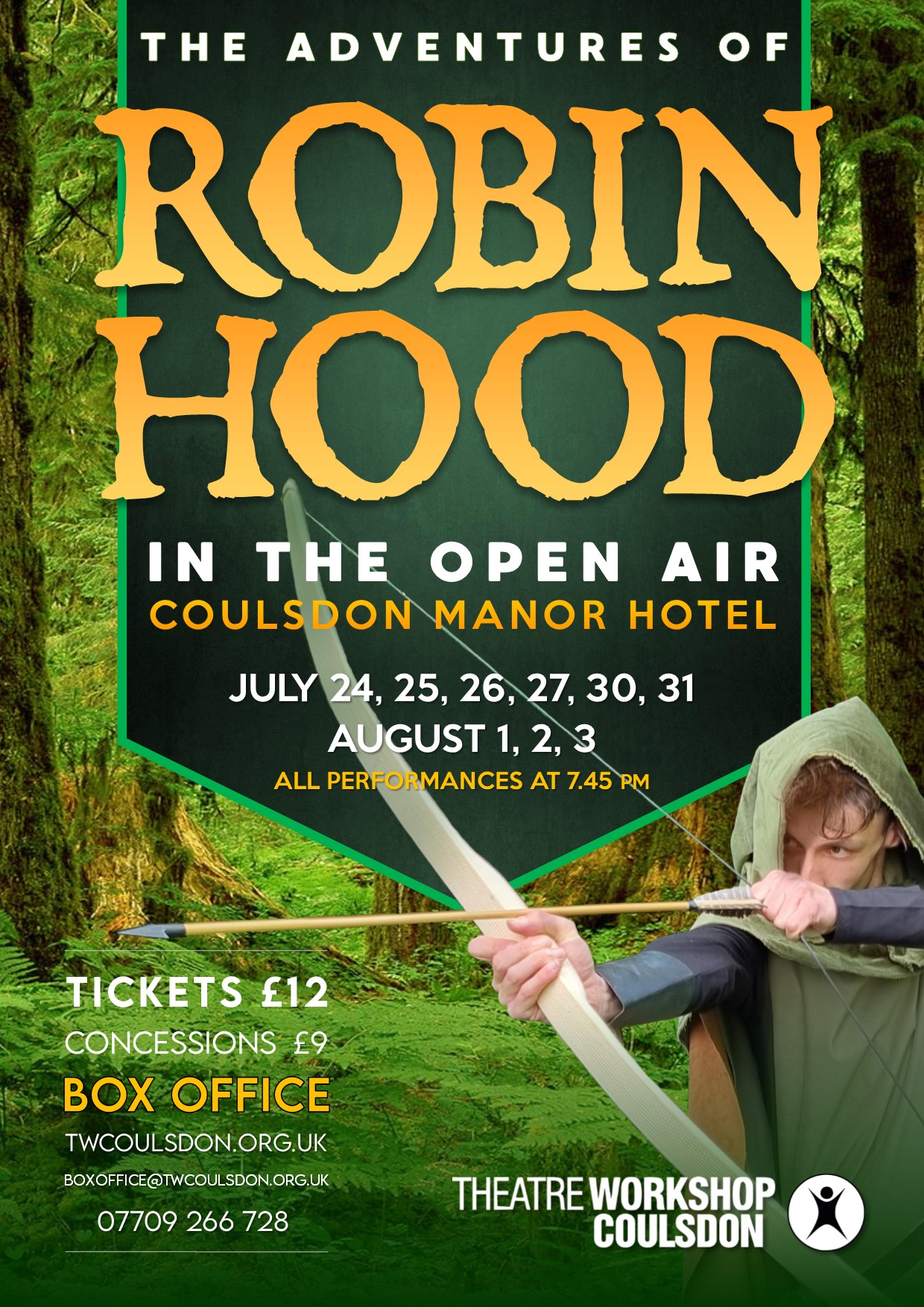
The Adventures of Robin Hood

Good King Richard is dead, and the throne is now held by his brother John, a man determined to make his mark no matter what the cost to the people he rules. In Nottingham, the evil Sheriff brutally extorts higher and higher taxes for his royal master, putting dissenters to the sword. The land has never been in greater need of a hero.

This Summer, we’re back in our idyllic woodland glade at the Coulsdon Manor Hotel with that most celebrated icon of English folklore, Robin Hood. Alongside his outlaw allies, Little John, Will Scarlet, Alan A’Dale and Friar Tuck, aided by the fearless Marian Fitzwalter, they’re going to challenge the tyranny and injustice that the Sheriff and his royal patron are imposing on the good people of England, and tear the whole rotten edifice down. Or die trying.

High adventure and fun on a Summer’s  evening – among the trees in the good company of the free men of Sherwood, witnessing thrilling and entertaining encounters as the fight for freedom begins, with sword, with bow, with quarterstaff and with laughter.

Sherlock Holmes and the Vampyres of London

London 1887. When the mortal remains of a young aristocrat vanish in the dead of night from Brompton Necropolis, Sherlock Holmes is no sooner asked to investigate than a second mystery presents itself – a beautiful young heiress afflicted by unaccountable night terrors; her vitality slipping away.

As these two strange cases resolve themselves into one, Holmes and his steadfast companion, Dr. John Watson, are plunged into a hidden London of grave-robbing grotesques, murderous Szgany gypsies, and demonic possession that obscures a diabolical conspiracy to overthrow the Crown itself.

Theatre Workshop Coulsdon’s thrilling homage to late Victorian gothic pits two of fiction’s most enduring characters against each other. But in the fog-shrouded metropolis where nothing is what it seems, which towering colossus of literary legend will triumph in this savage, epochal battle of wits?

From the author:

Indulging an occasional impulse to put something dark on stage, when ‘Sherlock Holmes and the Vampyres of London’ slid into my head, I thought I’d hit upon an original idea. Ah well. Ten minutes on Google laid bare an entire sub-culture of Holmes vs. Dracula novels, comics and essays. I guess bringing together the two pre-eminent creations of late Victorian fiction was a bit of a no-brainer. The Yin and Yang of the fin-de-siècle imagination – an epic face-off for the ages…

In the red, white and blue corner: Sherlock Holmes – arch-rationalist, buttoned-up, attractively flawed apotheosis of British pluck, doggedness, and all-round brilliance. Set against him, that epitome of lubricious, unchecked carnal desires: Dracula – the screaming antithesis of idealized Victorian manhood. Evil, hypersexualized, and downright foreign. It’s the ultimate Victorian superhero against the ultimate Victorian bogeyman. I mean, why wouldn’t you?

Holmes first appeared in 1887; Dracula 10 years later in 1897. Both characters achieved almost immediate superstar status – a dazzling supernova of global fame which has shown no sign of fading since. They are twin titans of popular culture, endlessly reimagined in movies, television, books, games and comics.

Both Arthur Conan Doyle and Bram Stoker achieved immortality of sorts thanks to their creations: a Scotsman and an Irishman giving life to two of the most famous, enduring, and built-upon characters in English fiction.

I have built upon them shamelessly in turn. It was fun bringing them together.


The Wind In The Willows

Since 1908, this classic tale of inquisitive Mole, stolid Ratty, gruff Badger and ‘ever in trouble’ Toad has delighted children of all ages, and most adults too! This stage adaptation by Theatre Workshop Coulsdon follows their adventures from the river bank to the Wild Wood, via the open road to the deepest dungeon, with a thrilling climax at stately Toad Hall. It’s a path strewn with boats, trains, caravans and stolen cars, as our animal heroes overcome adversity and their own natures to emerge victorious. By turns charming and funny, this is a splendid way to while away a English summer’s evening.

Dick Barton and the Slaves of the Sultan

Good evening. This is the BBC Light Programme broadcasting from London. It’s 6.45 and time for the next thrilling episode of ‘Dick Barton and the Slaves of The Sultan’!”

When Dick Barton, Boy’s Own adventurer, all-English hero and teatime wireless star, is called upon by MI5 to track down a wealthy socialite missing off the Horn of Africa, little does he know the can of worms he’s about to open. Before you can say ‘I say, that’s not cricket!’ our hero is mixed up in a fiendish foreign plot to seize control of our upright and principled British armaments industry. Good heavens!

With his loyal working class sidekicks, Jock and Snowy, by his side, Barton sallies forth encountering a nefarious criminal syndicate called the X Faction; an hypnotic femme fatale; and a run-in with that other national treasure, Squadron Leader James ‘Biggles’ Bigglesworth of the Special Air Police.

Will Barton, side-parting and moral certainty intact, win the day through British pluck and determination? Will gorgeous heiress, Felicity Buff-Orpington, escape the steamy seraglio of Zanzibar; and if she does, will the pure un-distilled manliness of the Barton ideal wilt in the face of her manifold charms? Or will assorted foreign Johnnies and homegrown villains consign Barton to an improbable cliffhanger ending from which there can be no possible escape?!

There’s only one way to find out, tune in to the next exciting instalment of: ‘Dick Barton, Special Agent…’


The Adventures of Dick Turpin

When Clemency Turnip’s Coffee House is closed down for ‘low morals’ and dealing in illicit liquor, her son Jack and serving-girl Polly Flinders find themselves out on the mean streets of 18th Century London and surviving on their wits. For Polly, it’s a path that may see her find her real parents. For Jack it’s a road to fame and notoriety as the land’s most celebrated highwayman!

Set in the colourful time of ‘Poldark’, ‘Tom Jones’ and Hogarth’s ‘Rake’s Progress’, this all-new pantomime adventure comes complete with outrageous Dame, girls dressed as boys, an audience participation song and every opportunity to boo the villains and cheer the heroes.

Will Turnip’s Coffee House be re-opened? Will moody and smouldering Woss Poldork regain the rights to his Cornish treacle mine? Will merchant banker Sir Beastlie Fugg get his deserved come-uppance? Will true love find its way?


A Midsummer Night’s Dream (2016)

Return to the Forest

It’s 20 years since we last put on a production of ‘A Midsummer Night’s Dream’, and here, a few of the company reflect on the play and its part in both TWC’s history and theirs…

Dan (Director)

I was 16 when I played Flute in TWC’s 1996 production. I remember coming on stage at Bewl Water and looking up at this huge sea of faces : more than 650 people had come to  see our last night. It was amazing. Later on I went to drama school, worked as an actor (and now as an agent). How strange then, but also strangely wonderful,  to be back directing the play for a new generation. Most of the current cast weren’t in our previous productions, and it’s honestly a privilege to introduce this boisterous, joyful masterpiece — often said to be the nation’s favourite play — to a new  group of young TWC actors. It’s 400 years old, and still incredibly touching, incredibly funny. Evidently the English sense of humour hasn’t changed all that much.

Rupert (Flute)

This is only my second play with TWC (my second play anywhere for that matter), and  I wasn’t sure how I’d take to Shakespearean dialogue. I didn’t even know he wrote comedies. But once I’d got the meaning sorted, it was hilarious! Full of life. A complete revelation really. The characters and their motivations are easily recognisable, even 400 years on. As for taking on Flute, well, it’s a big responsibility.  I mean, I’ve seen a recording of a baby-faced Dan playing Flute 20 years ago. I can tell I’m walking in the footsteps of giants. :^) Luckily TWC are not only a talented group, but a positive bunch of people too. Joining them has been almost life-changing. And I’m proud to be a member.

Lucy-Ann (Helena)

I grew up surrounded by Theatre Workshop, and I remember watching the 1996 production when I was just six! The fairies were magical, the mechanicals hilarious, and the lovers meant to be together. You’d have seen me then in the front row with eyes as big as saucers, longing to be involved. Now I find myself a part of the legendary love triangle/quadrangle/tangle. The fairies have all the magic, mischief and poetry, but we have the most fun. The play revolves around the lovers,. The two friends are pushed to their limits and beyond, and come out the stronger for it. The two suitors, who seem to start with the upper hand, become pawns in the greatest game of all; the desperate, crazy, selfish, blind, obsessive yet wonderful thing that is love. I love them. I love it all.

 Richard (Bottom)

I directed both the 1989 and 1996 productions of ‘Dream’ and played Oberon each time too.  Playing Bottom this time is truly going from the sublime to the ridiculous. Obnoxious yet strangely endearing, he’s one of the most famous comic characters in English theatre. I love this play because it’s such a  joyful depiction of truly English idiocy. It might pretend to be Athens, but in this play Shakespeare is showing  the English at their best and worst.  Bumbling working men with hearts of gold and brains of straw, young toffs behaving badly and yet finding themselves in the end. And the fairy kingdom, glimpsed in the shadows of the wild wood. Magical.

The Ladykillers

When Mrs Wilberforce puts an advert in the local newsagent’s window to rent out her guest bedrooms, the last thing she expects is to be overrun by a group of enthusiastic, if eccentric, amateur musicians. But despite the constant sound of a string quartet filling the house, Professor Marcus and his friends The Major, Harry, Louis and ‘One-Round’ are not what they seem, and soon she finds herself dragged into the Professor’s scheme to pull off a violent robbery. With the police unaware, only Mrs Wilberforce and her parrot, General Gordon, stand between the five desperate criminals and their ill-gotten £200,000.

Will she see justice done? Or will they keep the ‘old girl’ quiet…permanently?

Who will be forced to face the music?

November 1956. It’s over 11 years since the end of the Second World War and Britain is still coming to terms with its new position in the world. The Empire is no more, and in an attempt to restore some national pride and underline an intent to remain a major player on the global stage, Prime Minister Anthony Eden is about to launch an invasion of Egypt to recover the Suez Canal. At home, the rationing introduced in 1939 only finished a year ago, and our austerity struck country still bears the scars of the war it supposedly won, with large sections of blitz-hit London remaining derelict. But the mood is upbeat. The early strains of rock ‘n’ roll are filtering across the Atlantic and with that, the seeds of teenage ‘rebellion’. James Dean and Marilyn Monroe, Rock Hudson, Doris Day and Yul Brynner are the Hollywood stars of the day. An 18 year old Bobby Charlton scored on his debut for Manchester United just three weeks ago and the Melbourne Summer Olympics start later this month.

This is the world of The Ladykillers.

Originally a film made by Ealing Studios and released in 1955, it starred Alec Guinness as ‘Professor’ Marcus, with a young Peter Sellers as Harry and Herbert Lom as Louis.  A largely unsuccessful remake starring Tom Hanks as Marcus, with the action moved to Mississippi, came out in 2004. Graham Linehan, who had already been successful in writing for television with such programmes as ‘Father Ted, ‘Black Books’ and ‘The IT Crowd’ wrote this theatre adaptation in 2011, and after debuting in Liverpool, the production went on to a successful and extended run at the Gielgud Theatre in London’s West End starring Peter Capaldi as ‘Professor’Marcus.

Interestingly, there is a theory that the story of The Ladykillers is more than simply a black comedy, and holds a mirror up to the times it was set in. Thus Mrs Wilberforce is the embodiment of Britannia, an aging defender of proper British values, while her house is the Empire, ramshackle and falling apart, full of the memories of one-time glories now faded. Arrayed against her are the con-man ‘Major’ representing the British ruling classes, with pill-popping wide-boy Harry as dissolute youth, punch-drunk ‘One-Round’ as the oafish masses and knife-wielding Louis the dangerous immigrant. Where ‘Professor’ Marcus fits in, the theory doesn’t say. Perhaps he represents intellectuals, pseudo-intellectuals, academics or even politicians. You can make up your own mind.

Graham Linehan sees it as demonstrating that even the worst of men have a little good in them…and that it is this that ultimately dooms them.Whatever its deeper meanings, if it has them, The Ladykillers is a classic black comedy. Enjoy.

 

The Whispering Wood

Welcome to the Whispering Wood.

In our performance tonight, it’s a clearing where two bands of roving actors meet, and find themselves competing to tell the best tale. In real life, it reflects an age-old English tradition of travelling theatre that we’ve supported for the last twenty years, entertaining people from Coulsdon and beyond with our open air productions. This isn’t the first time we’ve performed folk and fairy-tale based plays, having previously stage ‘Grimm Tales’ in 2003 and ‘More Grimm Tales’ in 2006. But many of tonight’s stories will probably be less familiar to you. Our author, Lucy-Ann Martin, has always been fascinated by folk tales, and she spent a year reading several hundred of them from cultures all over the globe, while travelling the world herself. She then collected her favourites and ended up with more than sixty possible tales to included in a performance. We’ve whittled these down to the final dozen or so stories that we’ll perform for you this evening. They come from all over the planet. Some are many hundreds of years old, some are far more recent, but what is amazing is just how universal the themes are.

Storytelling is a skill and a challenge we relish, and the perfect way (we thought!) to make sure the production was truly innovative was to arrange the telling of the tales as being part of a competition. The Great North Players taking on the Little Sackville Players, each trying their utmost to amuse and entertain you and ultimately gain your favour. A vote for whichever group of players did best will take place at the end of the evening, and you, the audience, will decide the outcome!

First a few thanks though. To Jeannie Lewis, who has for the second year running led the choice and arrangement of all the live music you’ll hear tonight. She and her husband Keith will be playing live at every performance, along with Simeon Dawes and Ryan Newby, just as musicians would have done in times long past. Thanks too for Jenny Moorcroft who designed the programme for us. And finally thanks to you, the audience, for coming and supporting us. Every play is a contract between the audience and the actors, this one a little more explicitly than most, perhaps. And we sincerely hope you enjoy it!


As You Like It

Ever been young and in love? Shakespeare must have been, because this is a play that understands the sheer giddy joy of love, and the desperate lengths it can drive us to. ‘As You Like It’ is sometimes seen as a counterpoint to ‘Romeo and Juliet’ – love as comedy rather than tragedy. Rosalind is certainly no pale and wan Juliet, but arguably Shakespeare’s most memorable heroine. She has more lines than Juliet, Cleopatra, Beatrice and Portia, any of them. Maybe Shakespeare was just a little in love with his own creation. And who could blame him? She’s the kind of girl you’d want to spend time with, vital; brave; clever; funny and devoted. Oh, a bit of a liability too, of course, but fun to be around.

So, what’s the story? Well, firstly, there are two Dukes. The ‘good’ Duke, called Senior, has been toppled from power by his very own brother, the ‘bad’ Duke, Ferdinand. Senior is then exiled to the nearby Forest of Arden, where he seems to enjoy a carefree life hunting, shooting, fishing and singing. It seems that banishment has been more of a blessing than a curse. Meanwhile his brother’s court is an altogether darker place, full of gossip, scheming and suspicion. Now, each of the Dukes has a daughter, and the two girls are inseparable friends. It’s this that has initially prevented Rosalind from being exiled along with her father, but when Ferdinand finally casts her out, both she and Ferdinand’s daughter Celia run away. Of course, by this point, love has raised its head, and Rosalind has fallen for Orlando, a young man at court being persecuted by his less than pleasant older brother. Thankfully, he’s in love with her too, so when she leaves court for the Forest, he follows. However, Rosalind has now disguised herself a boy, calling herself ‘Ganymede’, and it’s in this form that Orlando finds her and in classic style, doesn’t recognise her. To make things more convoluted, Sylvius the shepherd boy is besotted with Phoebe, who in turn only has eyes for Ganymede!

Themes such as the liberating power of love, sibling rivalry and restitution, the healing force of nature and the simple pleasures of country life are all explored here, despite the plot being frankly ludicrous at times. And there’s a happy ending. Several in fact, as brothers are no longer at odds, lovers have put aside disguise and all is well. Except perhaps for Jaques, who has been melancholy throughout and decides ultimately to go off and be miserable in a monastery. You can’t please everyone.

The text has been trimmed in TWC’s version. Many topical gags that no doubt had them rolling in the groundlings back in 1599 are now impenetrable, and worse, not funny. If you’re a purist, prepare for disappointment, but it’s for the greater good.

There are more songs in ‘As You Like It’ than any other Shakespeare play. We’ve kept them and set them to traditional tunes. One of them, ‘What Shall He have That Killed The Deer’, shares many of its lyrics with ‘Hal-An’Tow’, the traditional Cornish May song. The version here is an amalgam of the two, complete with its reference to defeating the Spanish Armada, which at the time the play was first performed had happened just ten years previously. Many thanks are due to Jeannie Lewis who led the arrangement of all the songs and incidental music, and with the other musicians will be playing live on stage throughout the run of the show.

The Return Of The Three Musketeers

Twenty years on from his greatest adventure, D’Artagnan is disillusioned. Still only a lowly-paid lieutenant in the musketeers, his friends long gone, forgotten by the powerful people he once rescued from death and dishonour. But where once he saved a queen, a chance turn of events gives D’Artagnan the opportunity to save a King, and a King of England at that! But he can’t do it alone. Can he recruit his old comrades Porthos, Athos and Aramis from retirement? And can they save themselves from the vengeful agent of death that follows their every move?

Freely adapted from Alexandre Dumas’ own stirring Musketeers sequel ‘Twenty Years After’, this is a colourful new story of swashbuckling high adventure, fun and derring-do!

All for one, and one for all, once more!

There are two stories to be told here. One is the best part of two hundred years old, the other just sixteen.

1844. The French author Alexandre Dumas published ‘The Three Musketeers’ as a serial in a magazine. It was an immediate success, and a sequel came out a year later, and a third and final instalment two years after that. ‘The Three Musketeers’ seized the public’s imagination and to one degree or another, has continued to do so ever since.

The four great friends, Athos, Porthos, Aramis and the younger D’Artagnan became over the course of the books embroiled in plots and plans that changed history. Dumas was an avid historian and liked to show off to his readers how much he knew. Mind you, that didn’t stop him riding rough-shod over history when it suited the story!

It’s arguably the most successful piece of French literature ever. (Let’s draw a discreet veil over ‘Les Miserables’ please) There have been movies (lots of them, the first in 1903, the last one just last year), musicals (one part-written by P G Wodehouse of all people) and operas, television series and even cartoons. (those of a certain age may fondly remember ‘Dogtanian and the Three Muskehounds’ though others might run screaming from the room…) One such version was a play written by Willis Hall, which caught the eye of Theatre Workshop Coulsdon founder member and director Chris Argles.

1996, and TWC first comes to grips with the original action-heroes. Richard Lloyd played Athos, Mike Brown was Porthos and I played Aramis. We swashed buckles, waved swords and saved the day. Mike even ran across the stage naked (except for a large musketeer hat!) but only of course because the script demanded it… His grandmother was never quite the same after seeing it!

2011. We’re looking for a follow-up to the open-air success of ‘The Canterbury Tales’. ‘The Three Musketeers’ is suggested, but we really don’t want to revisit the same script because, well, we’ve done it before. Why don’t we do the sequel? Because no-one’s written one. ‘I’ll write one’ says I. The fact I’ve never written a play in my life before seemingly not a stumbling block. Ahem.

2012. Here we are. The play is written, we’ve taken the same three actors to play the original Three Musketeers, and that’s deliberate. The sequel to the first book was called ‘Twenty Years After’ and it’s not far off that between our productions. We’re all older. Probably a bit slower and a bit heavier, maybe even a little wiser. But are we growing old gracefully? Are the Musketeers? Probably not. But is that a bad thing? I don’t think so. Oh, and a note for any Dumas purists out there. I have taken huge liberties with the book. And if you have a problem with that, I’ll meet you outside…with my three friends! All for one, and one for all!