Much Ado About Nothing

‘Much Ado About Nothing’ is a comedy of love nearly thwarted by villainy, and tragedy narrowly averted. It is held by many to be one of the most verbally dextrous of Shakespeare’s works, and the dialogue fairly sparkles with witty repartee, chiefly from Benedick and Beatrice, two of his most compelling and human creations.

The setting is a Sicily at war. Don Pedro, the Prince of Aragon, returns from the fighting, with his entourage, to stay with his old friend Leonato, the Governor of Messina.

While there, Claudio, a member of Don Pedro’s retinue, quickly falls in love with Leonato’s daughter, Hero. It’s a cause for much celebration, in most parts. However, Don John, Don Pedro’s bastard brother, sees only a chance to sew discord, and with the help of his two henchmen, Conrade and Borachio, they plot to break up the loving pair and ruin Hero’s reputation..

Elsewhere, another scheme is put into place, but his time it’s with chiefly good intentions. Benedick, a good comrade to Don Pedro, and Beatrice, Leonato’s niece, have known each other for some time. They trade insults, they verbally spar whenever they are together. All but they can see the spark of something special between them. And so the plan is hatched by Don Pedro to push the warring duo away from conflict and into loving reconciliation, getting the two to see each other as others see them. 

When all is said and done both couples find themselves together, but not before they run a gauntlet of lies and confusion, flirting with each other and disaster.

‘Much Ado About Nothing’ is undoubtedly one of Shakespeare’s finer plays, possibly his best comedy, edged only by ‘A Midsummer Night’s Dream’. Much of it though, if you look hard enough, makes no sense. Don Pedro is a Spanish warlord, with two of his closest companions coming from rival Italian city states, Padua and Florence. For no explained reason, they’re fighting in Sicily. Leonato at least sounds Italian, but Beatrice and Hero, not to mention servants Margaret and Ursula, don’t. And the whole of the watch, Dogberry, Verges, Hugh Oatcake etc. have clearly been parachuted in from England. Best not to dwell on it.

Talking of which, TWC has edited the Bard’s script. I know, how dare we! Well, if it was good enough for Kenneth Branagh in his 1992 film adaptation, it’s good enough for us. Really, it had to be done. A lot, and we mean a lot, of references to cuckolds and horns needed to go, and there are only so many allusions to obscure classical mythology any audience can take. And cast for that matter.

So, sit back and relax. Be taken to an island in the Mediterranean, and treated to some of Shakespeare’s finest prose. And maybe a pint or two…

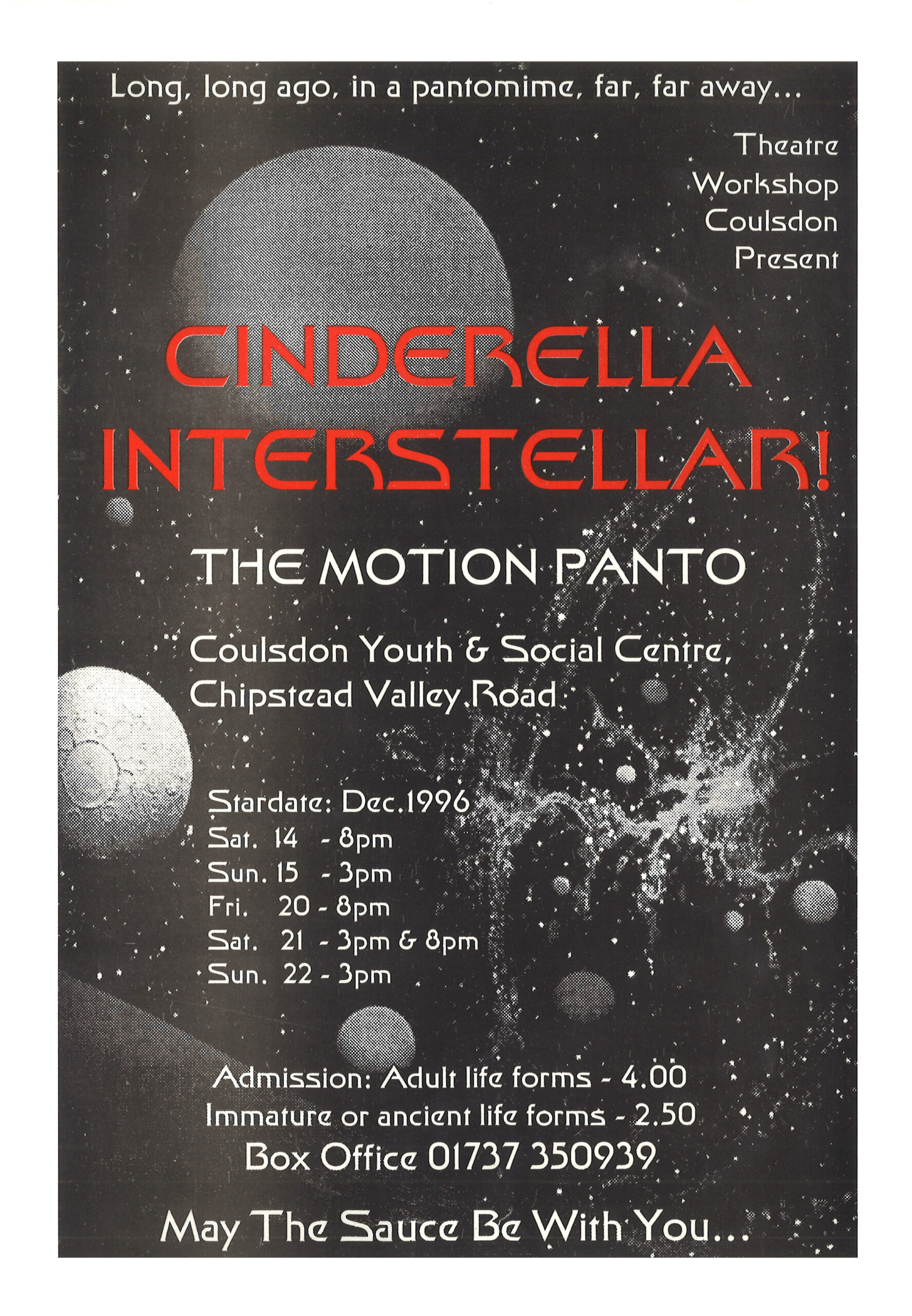
Cinderella Interstellar!

A long time ago, in a galaxy far, far away, there was a pantomime that looked quite a lot like ‘Star Wars’…

Take Cinderella and her ugly sisters and then thrust them into a world of science-fiction adventure, inhabited by characters that are nearly, but not quite, those from the epic blockbuster trilogy of the late 1970’s and early 1980’s.

A cocky, star-faring smuggler and his hairy co-pilot, a kid who’s a whiz behind the controls of space fighter, a monk-like individual wise in the ways of the Source, a black-clad villain in a full-face helmet with breathing difficulties and an army of soldiers who can’t hit a Death Star at close range. They’re all there, just not as you knew them.

Throw in the best Cantina band this side of Tatooine to help belt out some brilliant songs, and you’ve got a powered up panto ready to do the Kessel run in less than 12 parsecs.

This is the panto you were looking for.

A Midsummer Night’s Dream

This is the second time that Theatre Workshop have visited the strangely English forest that exists just outside Shakespeare’s Athens. Peter Quince and his band of tradesmen cum would-be actors have wandered out from the city to ensure they’re not overlooked as they go about their amateur thespian labours, but either they’ve wandered much further than they intended from the busy streets of London, or there’s a thriving English enclave of ex-pat artisans tucked away in the shadow of the Parthenon. 

There are changes. Not least in the location of our endeavours. Having seized the opportunity to take the group from its home and perform in the open-air just three years previously, we’ve gone further, and at the invitation of Southern Water, will take the production to the shores of the Bewl Water reservoir, near Lamberhurst in Kent. Though the setting is idyllic, this represents no small undertaking, especially for an amateur group whose members are mostly in full-time employment. So we can feel for Messrs Starveling, Bottom, Snug, Snout and co., as we do a full day’s work and then barrel down the A21.

But we’ve not given up on our first open-air home, and will perform first at The Woodman before packing up and heading for Bewl. We could hardly do otherwise, given that it’s our regular watering-hole.

Let’s talk about the music for a moment. Most of the music you’ll hear will be played live by Mark Taylor, though there are a couple of passages that are pre-recorded. He’s composed most of it himself too, because he’s a talented gentleman. Exceptions include the fairy and bergomask dances in Act IV and V which are set to traditional tunes. He’s also composed the music for ‘Philomel with Melody’, whose lyrics are by Shakespeare, and given that Shakespeare’s own lyrics to the fairy benediction at the end of the play are lost to us, we’ve used a 5th Century Celtic blessing as the basis for a song, which again will be accompanied by Mark Taylor’s music.

One last thing. The production is dedicated to the memory of Lesley Argles, a member of Theatre Workshop almost since the beginning. She died aged just 44, as the result of a tragic accident on the 13th July, only two weeks before curtain up. Her husband, Chris, who she met through the group, as well as her son, Luke, and daughter Kimberley, are all on stage here tonight. They were united in their decision that the production should go ahead with their full participation, despite grievous personal loss. They are certain it was what she would have wanted.