Much Ado About Nothing
About the Production
‘Much Ado About Nothing’ is a comedy of love nearly thwarted by villainy, and tragedy narrowly averted. It is held by many to be one of the most verbally dextrous of Shakespeare’s works, and the dialogue fairly sparkles with witty repartee, chiefly from Benedick and Beatrice, two of his most compelling and human creations.
The setting is a Sicily at war. Don Pedro, the Prince of Aragon, returns from the fighting, with his entourage, to stay with his old friend Leonato, the Governor of Messina.
While there, Claudio, a member of Don Pedro’s retinue, quickly falls in love with Leonato’s daughter, Hero. It’s a cause for much celebration, in most parts. However, Don John, Don Pedro’s bastard brother, sees only a chance to sew discord, and with the help of his two henchmen, Conrade and Borachio, they plot to break up the loving pair and ruin Hero’s reputation..
Elsewhere, another scheme is put into place, but his time it’s with chiefly good intentions. Benedick, a good comrade to Don Pedro, and Beatrice, Leonato’s niece, have known each other for some time. They trade insults, they verbally spar whenever they are together. All but they can see the spark of something special between them. And so the plan is hatched by Don Pedro to push the warring duo away from conflict and into loving reconciliation, getting the two to see each other as others see them.
When all is said and done both couples find themselves together, but not before they run a gauntlet of lies and confusion, flirting with each other and disaster.
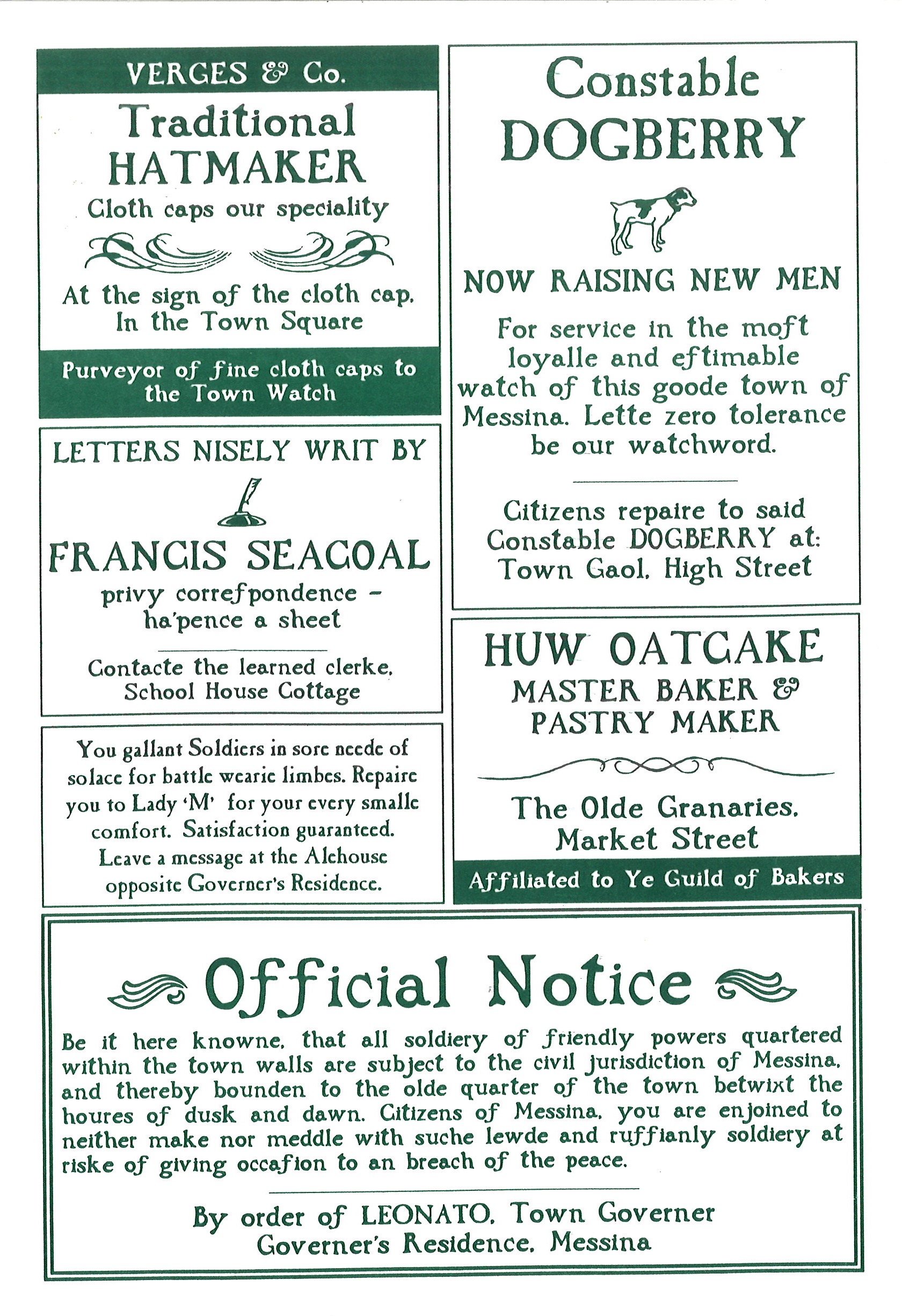
‘Much Ado About Nothing’ is undoubtedly one of Shakespeare’s finer plays, possibly his best comedy, edged only by ‘A Midsummer Night’s Dream’. Much of it though, if you look hard enough, makes no sense. Don Pedro is a Spanish warlord, with two of his closest companions coming from rival Italian city states, Padua and Florence. For no explained reason, they’re fighting in Sicily. Leonato at least sounds Italian, but Beatrice and Hero, not to mention servants Margaret and Ursula, don’t. And the whole of the watch, Dogberry, Verges, Hugh Oatcake etc. have clearly been parachuted in from England. Best not to dwell on it.
Talking of which, TWC has edited the Bard’s script. I know, how dare we! Well, if it was good enough for Kenneth Branagh in his 1992 film adaptation, it’s good enough for us. Really, it had to be done. A lot, and we mean a lot, of references to cuckolds and horns needed to go, and there are only so many allusions to obscure classical mythology any audience can take. And cast for that matter.
So, sit back and relax. Be taken to an island in the Mediterranean, and treated to some of Shakespeare’s finest prose. And maybe a pint or two…

The Cast
Behind the Scenes
Image Gallery





The Reviews
The open-air production by Theatre Workshop Coulsdon in the garden of The Woodman pub maintains a tradition, begun in 1993, of providing quality entertainment under the summer sky.
About three-quarters of Shakespeare’s enigmatic comedy is in prose, mainly exemplified by the witty verbal fencing of Beatrice and Benedick, which are at the heart and soul of Tina Bretman’s vivacious production, and the most interesting part of it. Mark Taylor and Tatiana Allison play the embattled lovers, she flashing like a rapier in the sunlight and drawing him on to deeds of emulation. But if it be not churlish to mention it – she is after all the assistant director – she does scant justice to what are arguably the two most startling words in the entire Folio: “Kill Claudio!” Mark Taylor is also busy in another direction, as composer of a colourful score, dramatic or stately as the occasion requires, and amusingly pompous for Dogberry and his companions of the Watch.
The dark plotting of Don John and his associates (which incidentally was altogether omitted by Berlioz from his opera Beatrice et Benedict) sometimes verges on the tiresome. Here we find, in Michael Brown’s genial Don Pedro and the saturnine Don John of Paul M Ford, a pair of brothers of remarkable similarity of appearance from where we sit. Paul Breden and Daniel Ireson are a suitably sinister pair as the latter’s followers.
Sinead Russell’s guileless innocence as the wronged Hero puts to shame the surly arrogance of Neil Grew’s Claudio, and shows up the unthinking prejudice which leads even the great and good to jump to the wrong conclusions. Leonato is played with expansive benevolence by Chris Argles, matched by the warm brotherly regard of Pete Gregory as Antonio. Rachel Handler’s native wit as Margaret also pulls it full weight and more.
“Sixth and lastly”, Richard Lloyd’s Dogberry is a glorious aberration of absurdities, a muddle of malapropisms with a Brian Glover accent: and Tim Young gives excellent support as his blockish sidekick Verges.
The scenes in which they and the watch appear are low comedy indeed, played to a high standard.
Reviewed by Donald Madgwick for The Croydon Advertiser, Friday 1 August 1997
Bit of ado in the pub's backyard
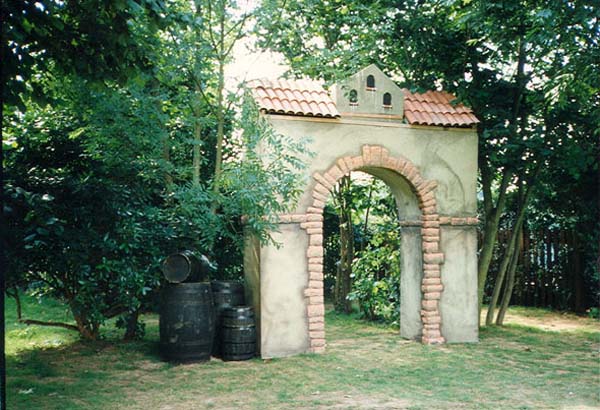
Reviewing an open-air production of Much Ado About Nothing is a God-given opportunity to bill and coo about the natural setting. However, the garden of the Woodman pub bears little resemblance to war-torn Sicily. You’ll need a bit of imagination, or perhaps a pint of bitter to hand, before you sit back and prepare to be engrossed.
The main plot revolves around a seemingly perfect romance. It is clear that Claudio, a young nobleman, and hero, the daughter of the Governor of Messina, are devoted to one another. But while Don Pedro, the Prince of Aragon, is bent on bringing about their marriage, Don John, his bastard (in all senses of the word) brother, is intent on ruining their happiness. His plans are juxtaposed with a more laudable and certainly more laughable scheme: that of tricking Benedick and Beatrice, apparent enemies, to acknowledge that they are in love.
Tina Bretman has made some cuts in the text and, generally speaking, this improves the clarity. My reservations relate to what she has introduced, rather than removed. During the final reconciliations, Don John is usually kept firmly in the background, his fate relayed by messenger. Bretman has him actually appear on stage, albeit briefly, and this jars the harmony.
She has, though, assembled an impressive cast. Mark Taylor makes an agreeable benedick, mimicking Claudio far more effectively than he woos Beatrice. She is played by Tatiana Allison, who begins rather tamely but soon captures her character’s exuberance. Sinead Russell’s Hero manages to be sweet without being sickly and Richard Lloyd’s bungling Constable Dogberry is priceless. Music is used to electrifying effect and the costumes are beautiful – I’m not making much ado about nothing.
Reviewed by Joanna Dodd for The Surrey Mirror, Thursday July 31 1997
Other Productions