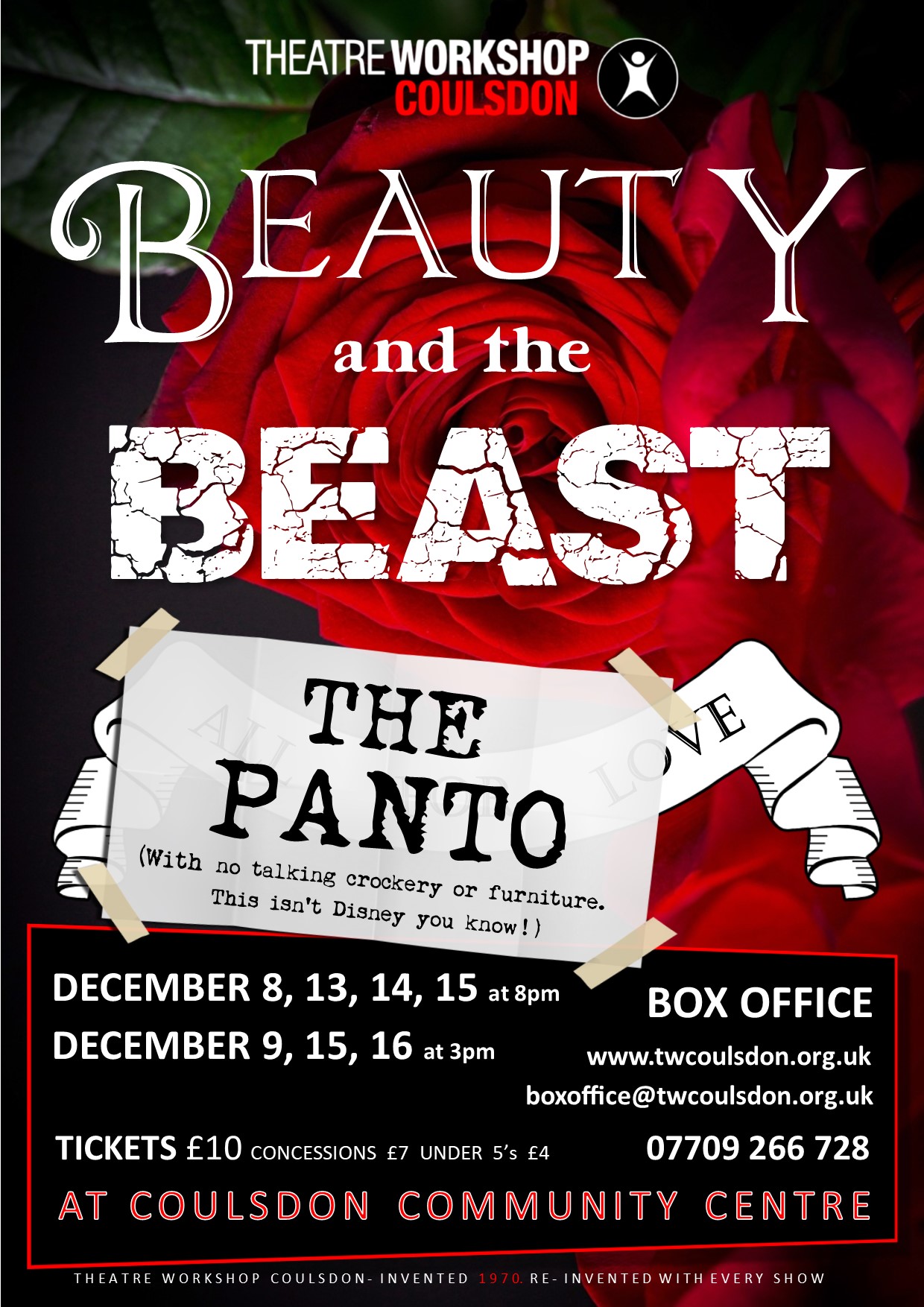
Beauty and The Beast – The Panto

Theatre Workshop Coulsdon’s Christmas 2018 production is an all-new, original pantomime based on the much-loved fairy tale, ‘Beauty and the Beast’. This classic tale, and its underlying message that you shouldn’t judge a book by its cover, has been transformed into a full-fat panto, rocket fuel for the winter season, chock-full of larger than life characters, sing-along songs and audience participation, as the lovely Beauty finds that the monstrous Beast is not what she was expecting. A full band and a large ensemble cast (Bumbling guards, saucy maids, talking vegetation and puppet creatures) support a tale of good versus the evil that is Deadly McNightshade, the woman who puts the wicked into witch and gives it a Scottish accent. Can true love break the dread spell that has locked a handsome prince in a prison he can never escape from? Oh yes it can!

But where did the original story come from? Well, once upon a time there was a woman called Gabrielle-Suzanne Barbot de Villeneuve (They had some cracking names back then) Born in Paris in 1685, she was married at 21 and widowed at 26, her aristocratic but spendthrift husband losing his life almost as swiftly as he lost their money. With her family fortune gone, she needed a way to support herself and eventually moved in with the celebrated playwright and poet Prosper Jolyot de Crebillon (See, another one!) where she began to write. From 1734 through to her death in 1755 she wrote novels and collections of fairy tales but most notably, in 1740, she wrote ‘La Belle et La Bête’, or as we know it, ‘Beauty and the Beast’. It formed part of a much larger story, and was much more complicated than we’re used to now. The simpler version is down to another Frenchwoman, Jeanne-Marie Leprince de Beaumont (and another!) who re-wrote the tale as a much shorter story and published it the year after Villeneuve’s death without acknowledging its origins. Which was a bit sneaky. Boo! Hiss!

Since then it’s become a children’s fairytale classic. Of course, that meant it got the full Disney treatment, twice now, both as a cartoon (1991) and a live-action movie (2017). But there have also been numerous other movie and TV adaptations, a stage musical, an opera, a ballet, and even songs, a disco tune and video games. Its themes of love conquering all and never judging by appearances are simple and easily relatable. And so Sheila May Bird, published children’s author (‘Pete’s Peculiar Petshop’, ‘Pirate Percy’s Parrot’ and others that don’t begin with the letter ‘P’) and long-time member of Theatre Workshop Coulsdon, decided that what had been missing all these years was a pantomime version, full of silliness, slapstick, songs, an audience participation number and the kind of ‘behind you!’ nonsense that makes going to the theatre at this time of year so much fun.
Dick Barton and the Carnival of Chaos

“Good evening. This is the BBC Light Programme broadcasting from London. It’s 6.45 and time for the next thrilling episode of ‘Dick Barton and the Carnival of Chaos’!”

Yes, Barton is back, and in his toughest assignment yet!

London. 1949. Wartime rationing remains in force, and only marmalade – that nutritious, morale-boosting foodstuff – continues to fortify our island nation’s grit, spunk, vim and pluck after six long years facing down the Nazi peril.
But now there’s a fiendish foreign conspiracy afoot to kidnap Tiggy Zesty-Peel, heiress to the Zesty-Peel preserves empire, and only Dick Barton can stop it. But who has evil designs on the Marmalade Millionairess? And just what is their nefarious purpose?

Meanwhile, Snowy White and Jock Anderson, Barton’s salt-of-the-earth working class assistants, are each in a jam of their own. Snowy’s been injected with bonobo serum during a brush with a batty Bulgarian ballerina, and has gone more than a little ape. And Jock has fallen for the charms of ex-Nazi filmmaker and flaxen femme fatale, Leni Fuchs.
Throw in the homegrown villainy of the Crayfish Twins (the East End’s favourite lovable cockney mass murderers) and mysterious Italian yoga swami, Contessa Bianca Di Scalzo, and the plot is thicker than a jar of rough-cut.
Can Barton unravel the mystery and save Britain’s marmalade? Or will our favourite spread succumb to the spread of evil? To find out, tune in to the next thrilling instalment of ‘Dick Barton and the Carnival of Chaos’!

Theatre Workshop Coulsdon’s third outing for Dick Barton, Boy’s Own adventurer, all-English hero and teatime wireless star, is another ripping comedy adventure, full of improbable characters, glorious gags, and a cheeky sprinkling of spiffing song and dance numbers. Pip pip!

Sherlock Holmes and the Vampyres of London

London 1887. When the mortal remains of a young aristocrat vanish in the dead of night from Brompton Necropolis, Sherlock Holmes is no sooner asked to investigate than a second mystery presents itself – a beautiful young heiress afflicted by unaccountable night terrors; her vitality slipping away.

As these two strange cases resolve themselves into one, Holmes and his steadfast companion, Dr. John Watson, are plunged into a hidden London of grave-robbing grotesques, murderous Szgany gypsies, and demonic possession that obscures a diabolical conspiracy to overthrow the Crown itself.

Theatre Workshop Coulsdon’s thrilling homage to late Victorian gothic pits two of fiction’s most enduring characters against each other. But in the fog-shrouded metropolis where nothing is what it seems, which towering colossus of literary legend will triumph in this savage, epochal battle of wits?

From the author:

Indulging an occasional impulse to put something dark on stage, when ‘Sherlock Holmes and the Vampyres of London’ slid into my head, I thought I’d hit upon an original idea. Ah well. Ten minutes on Google laid bare an entire sub-culture of Holmes vs. Dracula novels, comics and essays. I guess bringing together the two pre-eminent creations of late Victorian fiction was a bit of a no-brainer. The Yin and Yang of the fin-de-siècle imagination – an epic face-off for the ages…

In the red, white and blue corner: Sherlock Holmes – arch-rationalist, buttoned-up, attractively flawed apotheosis of British pluck, doggedness, and all-round brilliance. Set against him, that epitome of lubricious, unchecked carnal desires: Dracula – the screaming antithesis of idealized Victorian manhood. Evil, hypersexualized, and downright foreign. It’s the ultimate Victorian superhero against the ultimate Victorian bogeyman. I mean, why wouldn’t you?

Holmes first appeared in 1887; Dracula 10 years later in 1897. Both characters achieved almost immediate superstar status – a dazzling supernova of global fame which has shown no sign of fading since. They are twin titans of popular culture, endlessly reimagined in movies, television, books, games and comics.

Both Arthur Conan Doyle and Bram Stoker achieved immortality of sorts thanks to their creations: a Scotsman and an Irishman giving life to two of the most famous, enduring, and built-upon characters in English fiction.

I have built upon them shamelessly in turn. It was fun bringing them together.


The Snow Queen

Kai and Gerda have been friends all their lives. So when Kai is stolen away from their village by the dreaded Snow Queen, Gerda sets out to bring him back, despite the impossible odds. Across frozen lands where the Snow Queen and her dark companion Jack Frost are increasing their icy grip, brave Gerda makes her way north, encountering friends, foes and the fantastic. But nothing will stop her finding Kai. Nothing can break the bonds of true friendship.

Written by Lucy-Ann Martin, adapted from the classic fairy tale by Hans Christian Andersen, this delightful and uplifting tale is a magical adventure for all ages.

Fall under the spell of the Snow Queen this winter….

The Adventures of Dick Turpin

When Clemency Turnip’s Coffee House is closed down for ‘low morals’ and dealing in illicit liquor, her son Jack and serving-girl Polly Flinders find themselves out on the mean streets of 18th Century London and surviving on their wits. For Polly, it’s a path that may see her find her real parents. For Jack it’s a road to fame and notoriety as the land’s most celebrated highwayman!

Set in the colourful time of ‘Poldark’, ‘Tom Jones’ and Hogarth’s ‘Rake’s Progress’, this all-new pantomime adventure comes complete with outrageous Dame, girls dressed as boys, an audience participation song and every opportunity to boo the villains and cheer the heroes.

Will Turnip’s Coffee House be re-opened? Will moody and smouldering Woss Poldork regain the rights to his Cornish treacle mine? Will merchant banker Sir Beastlie Fugg get his deserved come-uppance? Will true love find its way?


Dracula

A bloody, poetic and sexually-charged interpretation of the world’s most infamous horror story!

Bram Stoker’s ‘Dracula’ wasn’t the first Gothic Horror tale (that honour falls to Horace Walpole’s ‘The Castle of Otranto’ published over a century before) but it is, arguably, the most famous exponent of the genre, though it has stiff competition in Mary Shelley’s ‘Frankenstein’, R L Stevenson’s ‘Strange Case of Dr Jekyll and Mister Hyde’ and Oscar Wilde’s ‘The Picture of Dorian Gray’. However, none have quite the strange sexual allure that the Transylvanian aristocrat has, even to this day. This creature, for human he most certainly isn’t, should be repulsive, but yet the opposite is true. The vampire has taken on an eerie glamour, coupled with a sense of tragedy. Hence the success of Anne Rice’s ‘Vampire Lestat’ books and the ‘Twilight’ series by Stephanie Meyer.

Of course, folkloric vampires predate Dracula by centuries, with demons showing what we would consider to be vampiric ways and practices noted by the Romans, Mesopotamians and the Ancient Greeks. But these creatures were ruddy, or purplish in colour, and bloated from the drinking of blood, a far cry from the slim, pale skinned figures we associate with the term now. And frankly a lot less sexy.

Liz Lochead is a Scottish playwright and poet who adapted ‘Dracula’ for the stage in 1985. She made a number of changes to the tale, but then reducing a novel of several hundred pages down to a workable two act play was always going to require that. Lucy Westernra and Mina Murray became sisters sharing the surname Westerman. Arthur Holmwood, also known as Lord Godalming, and American Quincey Morris, two of Lucy Westernra’s suitors, are excised from the script while Renfield’s part is expanded on. In come new characters, such as Nurses Grice and Nisbett, as well as Orderly Drinkwater, at Dr Seward’s asylum, and to add a working class voice to the narrative, Florrie Hathersage, the Westerman’s maid. Across the whole script, the language has been updated to provide a level of humour and innuendo, while focusing on female sexuality and madness.

Do the changes work? Certainly Renfield’s character, and the story, benefits from the extra time spent with him. He’s more articulate, even sympathetic. A victim who can see his own doom coming. Mina though is something less in this version. Pared back, she’s no longer the architect of Dracula’s downfall, nor is Lucy any the stronger for having been reshaped for the late 20th Century. Dracula remains however, untouched, his presence throughout underlined by over a century of cultural familiarity.

Sinbadaladdin

Sinbad sails into panto peril with Aladdin on board for laughs!

Sinbad the sailor, or Sinbad of the sea, was the hero of a series of stories outlining his seven voyages across and around the Indian Ocean. He came from Baghdad, now capital of Iraq, then the capital of the sprawling Abbasid Empire that stretched from Tunisia in the west to Pakistan in the East. The original tale of Aladdin is also set in the Middle East. And yet, in panto, this tale of a poor boy made good is landed in a Chinese laundry, surrounded by absurd cod-Chinese names and a mother, Widow Twankey, closer to the East End of London than the Far East. This has long been the case, since 1788 in fact, when John O’Keefe staged the first Aladdin pantomime at the Theatre Royal, Drury Lane.

Richard Lloyd has leant into the exotic influence, with his new pantomime mash-up featuring a significant flavour of the Orient (not the Leyton version). Wizards, pirates, genies, beautiful heroines and brave heroes abound, even if these last do look a lot like girls. Widow Twankee gets up to her usual mischief as manageress of the laundry – not so ably assisted by slopper-out Wishee-Washee, while the feisty Princess Jasmine steals Aladdin’s heart and risks the wrath of her father, the Sultan Ming the Mirthless and her ghastly mother, the Sultana No-Lo-Fat. The terrifying magician Abanazar, meanwhile, proves a formidable rival for Jasmine’s hand in marriage.

Songs, sorcery and silliness, with a touch or two of derring-do. Now that’s a pantomime, wherever it comes from.

The Hunchback Of Notre Dame – The Panto


‘The Hunchback of Notre Dame’ was originally a novel by celebrated French writer Victor Hugo, first published in 1831. Set in 15th Century Paris, it centres on the unrequited love that Quasimodo, the deformed bell-ringer of the famous cathedral, has for Esmerelda, a beautiful Romani dancer. Sadly, she only has eyes for the handsome captain Phoebus of the King’s archers, but unknown to the young girl, Phoebus is vain, untrustworthy and a womanizer. Esmeralda’s beauty has also attracted two other men, a poet, Gringoire, and the darkly motivated arch-deacon of Notre Dame Cathedral, Claude Frollo, who is also Quasimodo’s guardian. It’s an epic tale of misplaced love, exploring themes on social marginalisation and even the power of architecture, and ends in tragedy. So, absolutely perfect for a TWC panto then!

With the addition of broker’s men Ratatouille and Cassoulet, not to mention the uproarious Frottez LaToilette well and truly putting the Dame into Madame, this is great French literature as you’ve never seen it before! (let’s not even talk about the Disney cartoon, eh?) Oh, and the goat? Jingli Jangli? Not Mr Lloyd’s invention. Victor Hugo gave us Djali the goat (we changed the name to protect the innocent) on whom Gringoire becomes oddly fixated, with tragic results. Ah, the French. Qu’est-ce que c’est?


Jack The Ripper (2006)

Is it lazy to return to a play that you’ve staged before?

Or maybe – like revisiting a favourite book or film – there’s more to be explored and enjoyed a second, or even third time around?

Theatre Workshop Coulsdon first staged Ron Pember and Denis De Marne’s ‘Jack the Ripper’ back in 1983. We went back to it just eight years later in 1991. Cumulatively, we’ve probably paid enough in licencing fees to send the two authors on a good long holiday. Many of the 1991 cast are performing again is this production. Three of the 1983 cast are here too, young theatre pups now turned grizzled stage veterans. Richard Lloyd has played the ruffian Daniel Mendoza in all three!

So why do we keep coming back? Frankly, because it’s an exhilarating show to be a part of. It’s got great songs, songs you remember and hum along to, or even sing out loud, long after the final curtain has dropped. Mainly though, it’s just a very TWC kind of show. It’s brash, irreverent and a little (little?) over the top. It feels as if it were written for us.
 
When we first put ‘Jack the Ripper’ on, it was considered an obscure and somewhat controversial choice. Since then, it’s become something of regular staple on the amateur theatre circuit, but we haven’t let that put us off. This show was meant to treated in the rough and ready manner of the seedy East End it portrays, not with the polite diffidence of a well-trained light-operatic group. It’s rumbustiuous, down and dirty, leaning into the coarser side of the music hall tradition. We’ve seen others take this on, and when they’ve treated it as a finely sung choral piece, it loses its heart, and almost inevitably falls flat.
 
Of course, the subject matter might not be to everyone’s taste. Making a musical out of history’s most notorious serial-killer must count as an act of potentially dubious taste, even after well over a century. The original West End run of the show was cruelly short, perhaps for that very reason. And yet the mystery and murders of Jack the Ripper remain very much part of the cultural psyche of Britain, and probably further afield. Fresh films, documentaries, TV series, radio dramas appear on a regular basis. The hunger for ‘Jack’ is insatiable, or so it seems. The criminal, who most claim was never caught, has moved from simple mystery to almost the stuff of legend.
 
So, tonight, step in to the Steam Packet Music Hall and be hideously entertained. But watch your step on the way home, alright?