The Adventures of Jason and the Argonauts

The legends of Ancient Greece have continued to weave their magic through our imaginations for over two thousand years. The capricious Gods and Goddesses of Mount Olympus playing with the fates of ordinary mortals for both good and ill. But from the ranks of those mortals came the fabled heroes, those who rose to the challenges and won out despite all. Odysseus taking on the mighty one-eyed giant Cyclops. Theseus defeating the monstrous Minotaur in the labyrinth of Crete. Jason and his Argonauts travelling far and risking everything in search of the Golden Fleece.

This last provides the basis for our winter production. But don’t worry, you won’t need a degree in the classics to work out what’s going on. This is a very loose interpretation of the myths handed down over the centuries. Jason and Medea are two mixed-up kids, an orphan and a runaway, who suddenly find themselves tasked with overthrowing the evil tyrant King Pelias. With a certain amount of divine intervention, Jason becomes the captain of the mighty ‘Argo’, a ship capable of crossing the uncharted seas, with a crew of oddball heroes including the world’s strongest (and possibly clumsiest) man, a wonderful woman warrior, a resting rock star, the least identical twins ever and a seriously streetwise cat. Now he must set off and find the Golden Fleece. If only he knew what it was. And then there are the challenges. The man-eating Harpies of Lemnos, the terrible Clashing Rocks, the fire-breathing Great Bull of Colchis, the evil Dragon Snake and Talos, the bronze giant. (Who might just be a really cool sock puppet.) Not to mention The Sirens…

Medea, Jason and his misfit Argonauts are here this December to have fun. This will be no ordinary adventure tale, but one with songs and laughter, and we’ll be encouraging you to join in, whether you’re five or sixty five. Ever fancied rowing the Argo? You’ll get your chance. Become part of the undead army of skeleton warriors? Oh yes.

The award-winning author of ‘Jason and the Argonauts’, Phil Willmott, is mainly famous around these parts for his creation of the hilariously stiff upper-lipped ‘Dick Barton – Special Agent’ spoofs that were so much a part of the sadly demised Warehouse Theatre in Croydon. But he’s written, adapted and directed numerous productions, many derived from classical sources, and we’re more than pleased to link up with him again.

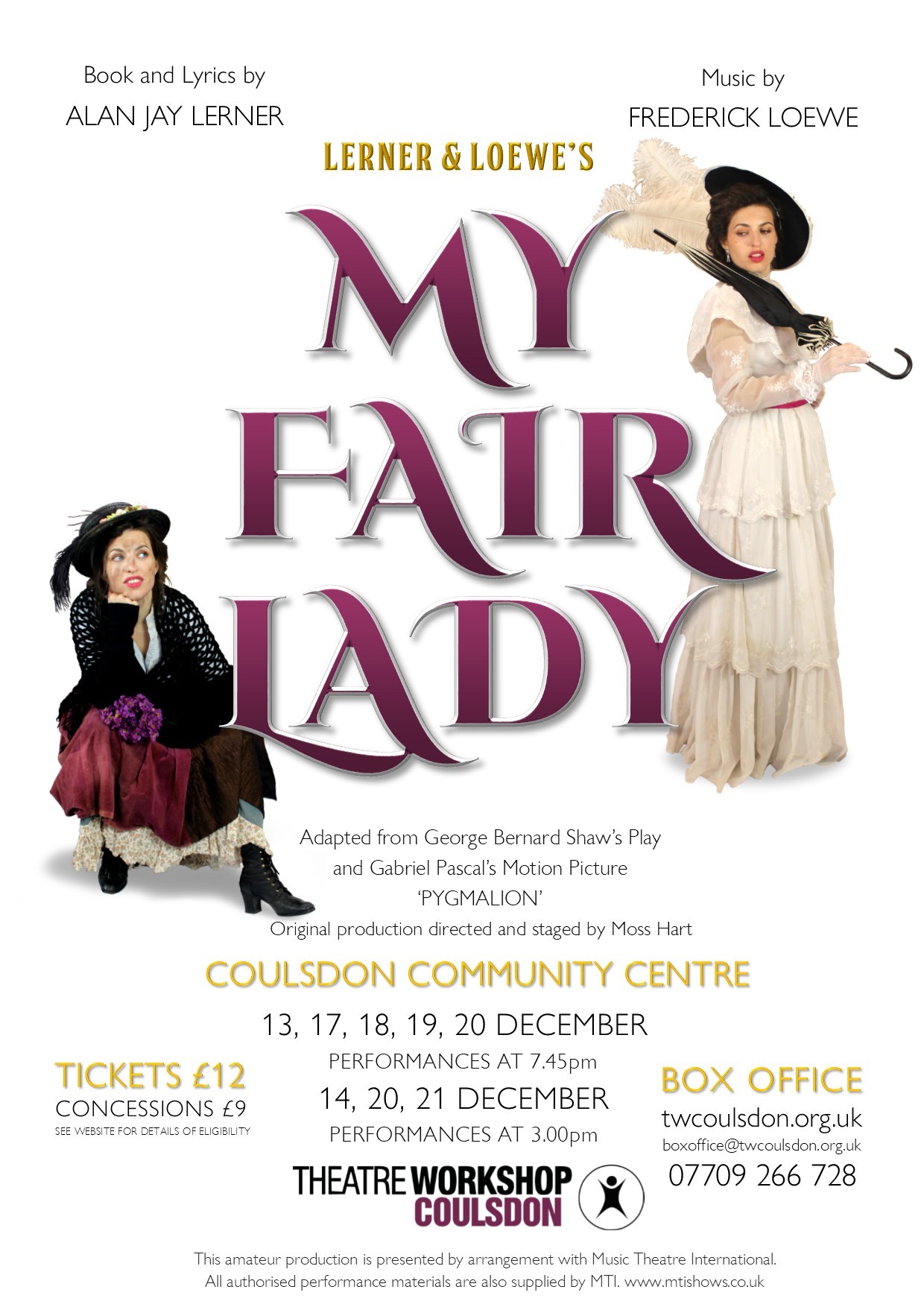
My Fair Lady

Lerner and Loewe’s celebrated stage musical adaptation of George Bernard Shaw’s ‘Pygmalion’ includes some of the best known and best loved show tunes ever written. From ‘Wouldn’t It Be Loverley’ to ‘I’m Getting Married in the Morning’, ‘I Could Have Danced All Night’ and ‘With A Little Bit Of Luck’.

It’s the story of a cockney flower girl’s transformation into the pride of London society – and its unforeseen consequences. In many places it’s very funny; in others, very poignant. When overbearing Professor Higgins stumbles on Eliza Doolittle outside Covent Garden Opera House, he recognises that her hideous vowels and lost consonants are all that separates her from the upper classes. Higgins casually makes a wager that within weeks he can pass Eliza off in polite society as a Duchess. But little does he know that beneath the dirty face and shabby clothes, young Eliza is stuffed full of human feeling. Too eloquent for a flower girl, yet lacking the breeding of the ruling classes, what on earth is to become of Eliza when the bet is over and the game has reached an end?

‘My Fair Lady’ was Lerner and Loewe’s musical adaptation of George Bernard Shaw’s ‘Pygmalion’, a much darker tale than the highly successful Broadway, West End and Hollywood show tells.

The character of ‘Pygmalion’ comes from Greek mythology, where he was sculptor who fell in love with a statue he had created, a statue that then comes to life. Bernard Shaw took that tale and twisted it, the sculptor becoming Henry Higgins, and the thing he creates, Eliza Doolittle. His play debuted in 1913 in Vienna, before going on to London and New York. Critics were generally favourable, though the ending created a certain level of controversy. A standard love story this wasn’t, and the ending was no more conventional. A film version was made in 1938, starring Leslie Howard as Higgins and Wendy Hiller as Eliza, and Shaw, initially distrustful, agreed to it being made only if he had a certain amount of creative control. This resulted in Shaw writing a whole new ballroom scene, the creation of a new character ‘Zoltan Karpathy’, and a new ending. He and his fellow screenwriters were awarded an Oscar for the screenplay, for which Shaw was characteristically dismissive, but it would be this screenplay that would be used as the basis for the musical.

The director of the movie, Gabriel Pascal, had spoken with Shaw about making it into a musical, but the author had refused. However, when Shaw died in 1950, that barrier was no longer an issue. Pascal approached lyricist Alan Jay Lerner to write the musical, with his partner, composer Frederick Loewe. At first, they couldn’t make it work but eventually they found a way, though not before Pascal had died. They called it ‘My Fair Lady’ after a provisional title to Shaw’s play ‘Pygmalion’, and it referred to the Cockney pronunciation of ‘Mayfair Lady’, helping to show Eliza’s transformation from working-class girl to upper-class woman. The part of ‘Higgins’ was initially offered to Noel Coward, who turned it down but suggested they approach Rex Harrison. ‘Eliza’ was offered to Broadway veteran Mary Martin who also turned it down, and they went instead for newcomer Julie Andrews. It opened on Broadway in March 1956 and was a massive success, going on to become, at the time, the biggest grossing Broadway show ever.

The 1964 movie was a similar success, winning eight Oscars including those for Best Picture and Best Actor (Rex Harrison). Interestingly, the Best Actress Oscar that year went to Julie Andrews for her portrayal of Mary Poppins, having been rejected for reprising the part of Eliza as not being famous enough by the studio. It went, famously, to Audrey Hepburn, whose singing voice was overdubbed by Marni Wood.

Theatre Workshop Coulsdon’s presentation of this fabulous show was directed by veteran actor/director Richard Lloyd with musical director and pianist Mark Taylor, and features Dan Carr as Professor Henry Higgins, Indianna Scorziello as flower-seller Eliza Doolittle, Paul Ford as her ne’er-do-well father Alfred, and Mike Brown as the bluff and amiable Col. Pickering.

Twelfth Night – The Panto

We’re sticking to a Shakespearean theme for Christmas, with another original TWC panto, this time based (very loosely) on “Twelfth Night”, but with added slapstick, men dressed as women (dressed as men), “oh no it isn’t”, and “oh yes it is”. It’s a riotously funny pantomime full of unexpected twists and turns. Forget Illyria – a freak storm blows a day-trip to Boulogne way off course. Six months later it’s shipwrecked on the coast of Australia. Auntie Podees and her niece, Sheila, have to find work disguised as men to earn their passage back to Coulsdon. Meanwhile, Lord Sydney Opera-House unsuccessfully pursues the love of his life, Lady Alice-Springs (most beautiful lady in the world – and incidentally, the wealthiest). Can Sheila help? Will the principal boys win the hearts of the principal girls? Will the barbie be a success? Are there any gags about Aussies we haven’t plundered and mercilessly exploited? And will the three witches be too evil to be allowed onstage and exiled forever to make tea and serve mince pies? To find the answers to these and many other mosquitoes (sorry, misquotes) don’t miss Coulsdon’s bonza pantomime, a show so big, it needs two dames…

The Fairytale of New York

Melodrama, magic and mystery set in the riotous world of 1930’s Vaudeville.

A festive treat with a difference. A dash of ‘Annie’, a twist of ‘Cabaret’, and great big helpings of melodrama, mystery and rip-snorting comedy. Plus some of the greatest songs from the shows you could ever wish for. A great family entertainment for all ages.Macey Maguire has a dream – she’s going to make it big on Broadway. Arriving penniless in New York, Macey gets a break at Delancey’s, the city’s last Vaudeville theater. Soon she’s rubbing shoulders with the troupe of variety artists who ply their trade in the old music hall. But the public’s appetite for burlesque is on the wane, the theater’s finances are on the rocks, and the entertainers are squabbling like rats in a sack. Organised crime wants the real estate the theater’s built on, and worse still, members of the company keep disappearing into thin air… And nobody – not the theater management nor the New York Police Department – can figure out where they go. But they’ve all reckoned without Macey Maguire…