The Canterbury Tales (2011)

It is the 14th Century, and in the bustling courtyard of The Tabard Inn, Southwark, men and women from all walks of life gather for a pilgrimage to the cathedral at Canterbury. Friars and priests, pardoners and summoners, millers and good wives. In order to entertain these good folk, the host of the inn asks that each traveller tells a story as they make their way across Kent. And so they, and we, begin our journey.

In this joyous adaptation of Geoffrey Chaucer’s classic work by Richard Lloyd, Theatre Workshop Coulsdon present six of the best and most colourful tales, creating an exuberant and and often hilarious portrait of ordinary folk preoccupied with petty jealousies, mundane squabbles and simple pleasures. Bold and often bawdy, these tales bring home vividly just how little the English people have really changed over the last six hundred years!

The stories presented are The Nun’s Priest’s Tale, The Wife of Bath’s Tale, The Friar’s Tale, The Pardoner’s Tale, The Miller’s Tale and The Reeves Tale, neatly wrapped in an engaging background as host and landlord Harry Bailey attempts to maintain order amongst his boisterous and often wayward charges.

Chaucer (1343 – 1400) is widely considered to be the greatest English poet of the Middle Ages, and was the first poet to be buried in Poet’s Corner at Westminster Abbey. While he achieved fame during his lifetime as an author, philosopher, alchemist and astronomer, Chaucer also maintained an active career in the civil service as a bureaucrat, diplomat and courtier. His many works include ‘The Book of the Duchess’, ‘The House of Fame’, ‘The Legend of Good Women’ and ‘Troilus and Criseyde’, but it is ‘The Canterbury Tales’, in which he uses the tales to paint an ironic and critical picture of English society, for which he will always be remembered.

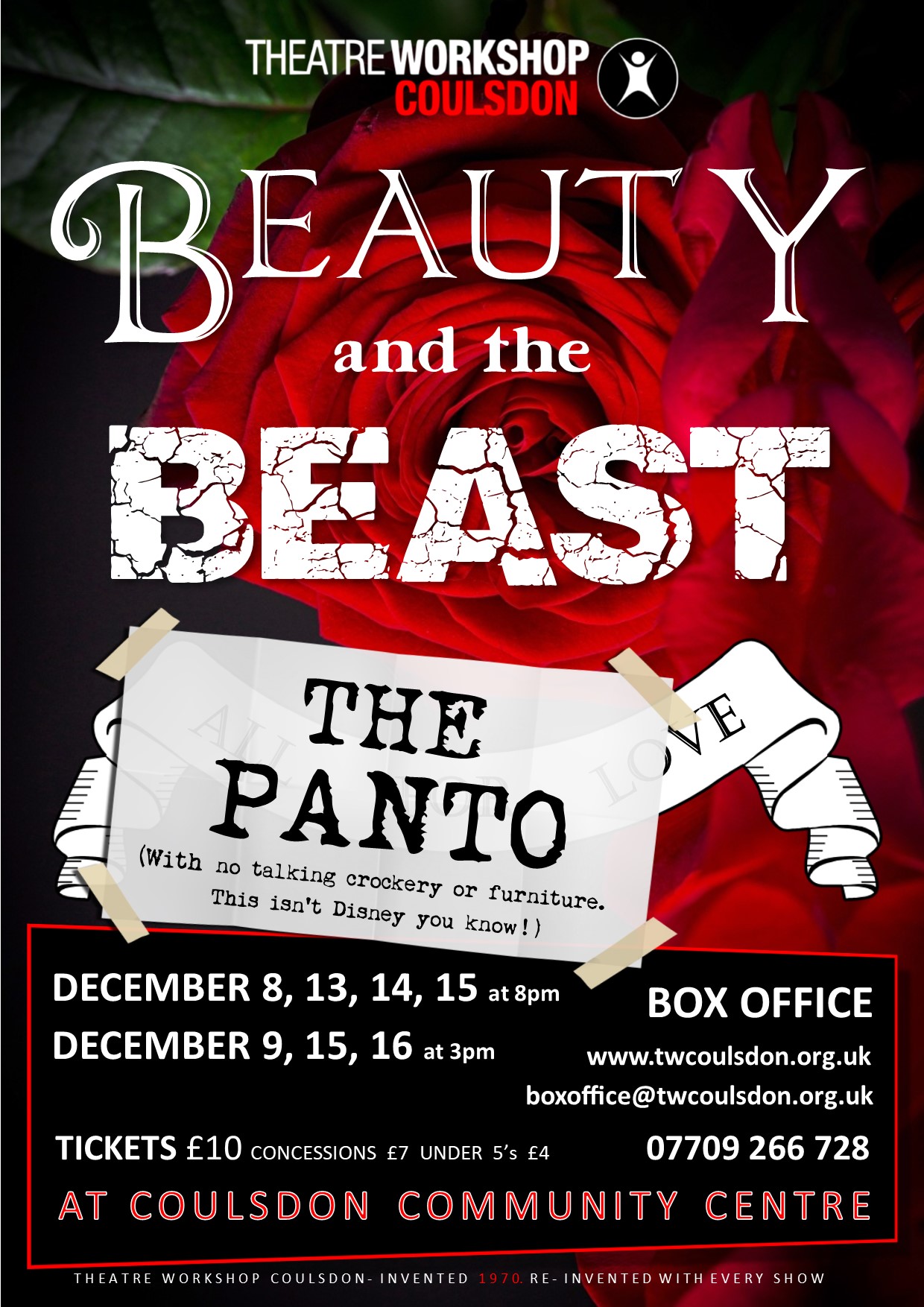
Beauty and The Beast – The Panto

Theatre Workshop Coulsdon’s Christmas 2018 production is an all-new, original pantomime based on the much-loved fairy tale, ‘Beauty and the Beast’. This classic tale, and its underlying message that you shouldn’t judge a book by its cover, has been transformed into a full-fat panto, rocket fuel for the winter season, chock-full of larger than life characters, sing-along songs and audience participation, as the lovely Beauty finds that the monstrous Beast is not what she was expecting. A full band and a large ensemble cast (Bumbling guards, saucy maids, talking vegetation and puppet creatures) support a tale of good versus the evil that is Deadly McNightshade, the woman who puts the wicked into witch and gives it a Scottish accent. Can true love break the dread spell that has locked a handsome prince in a prison he can never escape from? Oh yes it can!

But where did the original story come from? Well, once upon a time there was a woman called Gabrielle-Suzanne Barbot de Villeneuve (They had some cracking names back then) Born in Paris in 1685, she was married at 21 and widowed at 26, her aristocratic but spendthrift husband losing his life almost as swiftly as he lost their money. With her family fortune gone, she needed a way to support herself and eventually moved in with the celebrated playwright and poet Prosper Jolyot de Crebillon (See, another one!) where she began to write. From 1734 through to her death in 1755 she wrote novels and collections of fairy tales but most notably, in 1740, she wrote ‘La Belle et La Bête’, or as we know it, ‘Beauty and the Beast’. It formed part of a much larger story, and was much more complicated than we’re used to now. The simpler version is down to another Frenchwoman, Jeanne-Marie Leprince de Beaumont (and another!) who re-wrote the tale as a much shorter story and published it the year after Villeneuve’s death without acknowledging its origins. Which was a bit sneaky. Boo! Hiss!

Since then it’s become a children’s fairytale classic. Of course, that meant it got the full Disney treatment, twice now, both as a cartoon (1991) and a live-action movie (2017). But there have also been numerous other movie and TV adaptations, a stage musical, an opera, a ballet, and even songs, a disco tune and video games. Its themes of love conquering all and never judging by appearances are simple and easily relatable. And so Sheila May Bird, published children’s author (‘Pete’s Peculiar Petshop’, ‘Pirate Percy’s Parrot’ and others that don’t begin with the letter ‘P’) and long-time member of Theatre Workshop Coulsdon, decided that what had been missing all these years was a pantomime version, full of silliness, slapstick, songs, an audience participation number and the kind of ‘behind you!’ nonsense that makes going to the theatre at this time of year so much fun.

The Snow Queen

Kai and Gerda have been friends all their lives. So when Kai is stolen away from their village by the dreaded Snow Queen, Gerda sets out to bring him back, despite the impossible odds. Across frozen lands where the Snow Queen and her dark companion Jack Frost are increasing their icy grip, brave Gerda makes her way north, encountering friends, foes and the fantastic. But nothing will stop her finding Kai. Nothing can break the bonds of true friendship.

Written by Lucy-Ann Martin, adapted from the classic fairy tale by Hans Christian Andersen, this delightful and uplifting tale is a magical adventure for all ages.

Fall under the spell of the Snow Queen this winter….

Dick Barton and the Slaves of the Sultan

Good evening. This is the BBC Light Programme broadcasting from London. It’s 6.45 and time for the next thrilling episode of Dick Barton and the Slaves of The Sultan’!”

When Dick Barton, Boy’s Own adventurer, all-English hero and teatime wireless star, is called upon by MI5 to track down a wealthy socialite missing off the Horn of Africa, little does he know the can of worms he’s about to open. Before you can say ‘I say, that’s not cricket!’ our hero is mixed up in a fiendish foreign plot to seize control of our upright and principled British armaments industry. Good heavens!

With his loyal working class sidekicks, Jock and Snowy, by his side, Barton sallies forth encountering a nefarious criminal syndicate called the X Faction; an hypnotic femme fatale; and a run-in with that other national treasure, Squadron Leader James ‘Biggles’ Bigglesworth of the Special Air Police.

Will Barton, side-parting and moral certainty intact, win the day through British pluck and determination? Will gorgeous heiress, Felicity Buff-Orpington, escape the steamy seraglio of Zanzibar; and if she does, will the pure un-distilled manliness of the Barton ideal wilt in the face of her manifold charms? Or will assorted foreign Johnnies and homegrown villains consign Barton to an improbable cliffhanger ending from which there can be no possible escape?!

There’s only one way to find out, tune in to the next exciting instalment of: ‘Dick Barton, Special Agent…’


As You Like It

Ever been young and in love? Shakespeare must have been, because this is a play that understands the sheer giddy joy of love, and the desperate lengths it can drive us to. ‘As You Like It’ is sometimes seen as a counterpoint to ‘Romeo and Juliet’ – love as comedy rather than tragedy. Rosalind is certainly no pale and wan Juliet, but arguably Shakespeare’s most memorable heroine. She has more lines than Juliet, Cleopatra, Beatrice and Portia, any of them. Maybe Shakespeare was just a little in love with his own creation. And who could blame him? She’s the kind of girl you’d want to spend time with, vital; brave; clever; funny and devoted. Oh, a bit of a liability too, of course, but fun to be around.

So, what’s the story? Well, firstly, there are two Dukes. The ‘good’ Duke, called Senior, has been toppled from power by his very own brother, the ‘bad’ Duke, Ferdinand. Senior is then exiled to the nearby Forest of Arden, where he seems to enjoy a carefree life hunting, shooting, fishing and singing. It seems that banishment has been more of a blessing than a curse. Meanwhile his brother’s court is an altogether darker place, full of gossip, scheming and suspicion. Now, each of the Dukes has a daughter, and the two girls are inseparable friends. It’s this that has initially prevented Rosalind from being exiled along with her father, but when Ferdinand finally casts her out, both she and Ferdinand’s daughter Celia run away. Of course, by this point, love has raised its head, and Rosalind has fallen for Orlando, a young man at court being persecuted by his less than pleasant older brother. Thankfully, he’s in love with her too, so when she leaves court for the Forest, he follows. However, Rosalind has now disguised herself a boy, calling herself ‘Ganymede’, and it’s in this form that Orlando finds her and in classic style, doesn’t recognise her. To make things more convoluted, Sylvius the shepherd boy is besotted with Phoebe, who in turn only has eyes for Ganymede!

Themes such as the liberating power of love, sibling rivalry and restitution, the healing force of nature and the simple pleasures of country life are all explored here, despite the plot being frankly ludicrous at times. And there’s a happy ending. Several in fact, as brothers are no longer at odds, lovers have put aside disguise and all is well. Except perhaps for Jaques, who has been melancholy throughout and decides ultimately to go off and be miserable in a monastery. You can’t please everyone.

The text has been trimmed in TWC’s version. Many topical gags that no doubt had them rolling in the groundlings back in 1599 are now impenetrable, and worse, not funny. If you’re a purist, prepare for disappointment, but it’s for the greater good.

There are more songs in ‘As You Like It’ than any other Shakespeare play. We’ve kept them and set them to traditional tunes. One of them, ‘What Shall He have That Killed The Deer’, shares many of its lyrics with ‘Hal-An’Tow’, the traditional Cornish May song. The version here is an amalgam of the two, complete with its reference to defeating the Spanish Armada, which at the time the play was first performed had happened just ten years previously. Many thanks are due to Jeannie Lewis who led the arrangement of all the songs and incidental music, and with the other musicians will be playing live on stage throughout the run of the show.

Cinderella’s Puss In Boots

Take the classic story of Cinderella, add the bluff and swagger of Puss in Boots, and you get two much-loved seasonal tales woven into one sparkling festive show.

Yes, we’ve put panto favourites Cinderella and Puss on stage together for the first time, in an irreverent mash-up of two much-loved seasonal tales. That means you get two principal boys for the thigh-slapping price of one, the most deliciously appalling Ugly Sisters ever to grace the stage, and the ultimate in hissable baddies – King Rat, evil lord of the underworld. Plus, of course, Puss-in-Boots at his irresistible, swashbuckling best. Beautiful Cinderella undergoes the usual series of traumas, trials and torments – until her Ab-Fab style fairy godmothers and fashion gurus breeze in to save the day with a haute couture transformation guaranteed to catch a prince’s heart. This is a top-notch Cinderella, with just that little bit extra panto goodness thrown into the mix.

Set in, and under, the fairy-tale land of Cornucopia, ruled by good(ish) King Egbert, the action starts with something evil stirring in the darkness below, and it’s got a tail, whiskers and cheap crown…

Deaf on the Nile

Look out! He’s… Behind You! (Oh no he isn’t!)

Take a priceless diamond necklace, a luxury Christmas cruise down the Nile, a collection of very suspicious characters and add… a pantomime dame?

Theatre Workshop Coulsdon present a pantomime with a difference!

Comedy is guaranteed as the mystery unfolds. Can you unmask the villain before the familiar-looking Belgian detective, Hercules Toilet, does? Or will you be too busy laughing?

Is it Shelby and Lara Smythe-Rotter, the elegant Riviera thieves?

Lady Pokingham-Proditt, whose last five husbands have all met untimely ends?

Hesketh and Petunia, the runaway lovers with a dark secret?

The seedy Reverend Pinchme and his secretary Miss Chaste, on the run from blackmailers?

All will be revealed!                                                                                         

A festive show of songs, slapstick and skull-duggery! Not to mention a show-stopping turn from Mrs Eliza Wallop, our dame with a difference, as ‘she’ powers out a truly operatic rendition of ‘Nessun Dorma’!