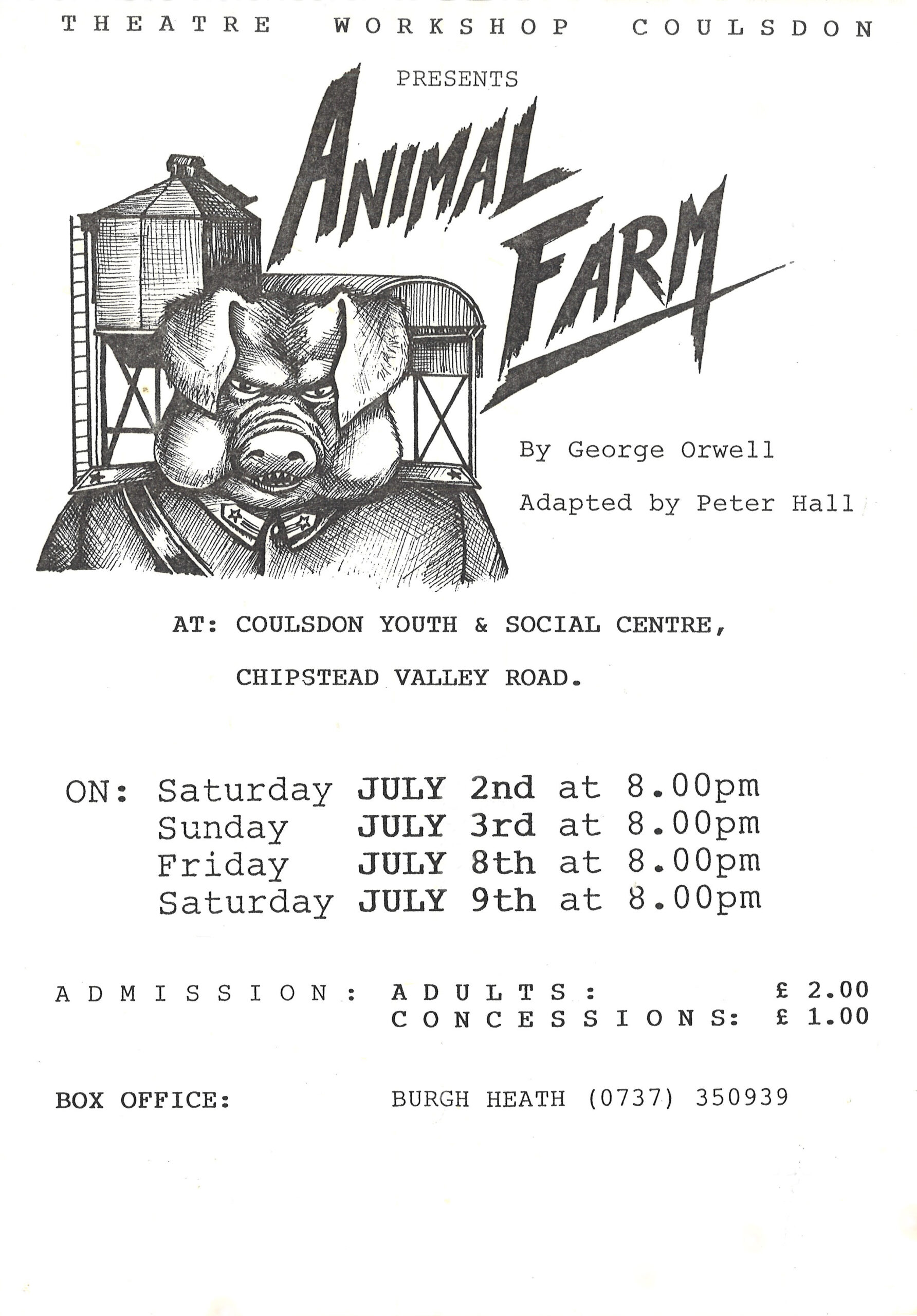
Animal Farm

One night, all the animals at Manor Farm gather in the barn to hear ‘Old Major’, a pig, describe a dream he had about a world where all animals live free from the tyranny of their human masters. The elderly pig dies soon after the meeting, but the animals — inspired by his philosophy of Animalism — plot a rebellion against the farmer, Jones. When Jones drunkenly forgets to feed the animals, they rise up, and Jones and his farmhands are chased away. Manor Farm is renamed Animal Farm, and the Seven Commandments of Animalism are painted on the barn wall. But what follows is far from the dream that Old Major promised…

‘All Animals Are Equal – But Some Are More Equal Than Others’

George Orwell’s ‘Animal Farm’ is a powerful and uncompromising allegory of the Russian revolution, with every character and event that takes place in his tale mirroring Russian history from October 1917 through to the Teheran Conference of 1943.

The succession of steps through which, by persuasion, propaganda, lies and force, Napoleon rises to power in ‘Animal Farm’ are a bitter parody of Josef Stalin’s ascent to dictatorship, and what Orwell saw as the ultimate betrayal of the Russian people.

A fable, a satire, a fairy story, ‘Animal Farm’ is one of the great works of English literature, and a revealing study of the effects of power.

The evocative, and by association, now chilling music chosen by the director to open the production was ‘Fantasia on a theme by Thomas Tallis’ written by Ralph Vaughan Williams. The same composer’s ‘Five variants of Dives and Lazarus’ was used to maintain the mood during the interval.

A Midsummer Night’s Dream

Theatre Workshop Coulsdon’s first flirtation with Shakespeare was, somewhat inevitably, ‘A Midsummer Night’s Dream’. Although it seems such a staple of the theatre, both professional and amateur, its attractions are many and not the least of those is the ability to mould it, change it and make it unique to the group and the actors performing in it. Which suits TWC. The show itself, though undeniably funny, is an oddity, if you look at it with anything more than a scant glance. The event that draws it all together is the marriage of Theseus and Hippolyta, one the legendary slayer of the Minotaur, the other the Queen of the Amazons, and yes, in some versions of the myth of Theseus, these two characters did marry. But for all their lauded provenance, here they are ciphers, showing little real character in the few lines that they have at their disposal. The four lovers bear classical Greek names, all in accord with their part in the court of Athens, but the rude mechanicals do not despite being subjects of Theseus and working within Athens. Shakespeare drops the facade for these clowns, and calls them as they are, English tradesmen. One does wonder why, in Shakespeare’s mind, this division should exist, where the nobility have exotic names and the working classes not. Was he attempting to make them more identifiable to the groundlings? We may never know.

Two of the rude mechanicals would remain rude across two further TWC productions of ‘A Midsummer Night’s Dream’. Chris Argles, here showing us his ‘Bottom’, would go on to play ‘Peter Quince’ in 1996, and then ‘Tom Snout’, the tinker in 2016. Tim Young would move from playing ‘Peter Quince’, carpenter and frustrated amateur director and impresario, to ‘Snug the joiner’ in 1996. Clearly a part he enjoyed, he reprised it in 2016 too.

One other thing remained a constant. The donkey head. Created for this show by Caroline Dawe using chicken wire, papier mache and fur fabric, it adorned the heads of Chris Argles, Paul Ford and Richard Lloyd in successive productions, and remains in readiness for the next revival.

The overture to ‘A Midsummer Night’s Dream’ was the Cello Concerto in E Minor by Edward Elgar. The interval music was ‘The Lark Ascending’ by Ralph Vaughan Williams.

All incidental music used during the production was traditional, arranged by Theatre Workshop Coulsdon, with the exception of ‘Philomel with Lullaby’, the music for which was composed by Mark Taylor.

The Christmas Cavalier

The Witchfinder-General, Roundheads and Cavaliers in a festive panto of Olde England!

From 1642 to 1651, there was a war between the King and his Parliament. Parliament won the war, and King Charles lost his head…

Set in the time when the puritan Lord Protector, Oliver Cromwell, ruled England, this lively and magical panto opens with the arrival of dastardly Witchfinder-General Nicholas Grimnasty in a local village, intent on suppressing frivolous and ungodly Christmas festivities – and rooting out a few witches at the same time!

Grimnasty and his gormless Roundhead sidekicks, Matthew Smallpiece and the Stupid brothers, soon tangle with the outrageous Dame Dumplings, driving force behind the village Christmas party! Unfortunately, it’s not long before Dame Dumplings’ lovely niece Emma Sweetly has fallen foul of the wicked Witchfinder, and is thrown into Grimnasty’s grisly dungeon.

But the Witchfinder-General’s villainy comes to an extremely sticky end, after his efforts to spoil Christmas are thwarted by an unlikely alliance of Sir Daniel Dash, a bold and gallant cavalier, a dancing bear named Bottom, and three real witches, who could almost have wandered in from a certain blasted Scottish heath…

A brisk yet enchanting pantomime, offering a traditional festive flavour of Olde England, but played out before a very appealing and colourful new historical backdrop, with lots of excellent opportunities for most attractive costumes and settings.

Santa In Space

This out-of-this-world pantomime starts in the depths of outer space, where the evil Vileun the Vile is celebrating the culmination of his plan to bring the entire Universe / Galaxy / Solar System (We don’t think he’s dreadfully bright, as he doesn’t seem to realise they’re very different things) under his dominion. His muddled mystic, Astra the Astrologer, lists all his successes, before finally telling him that the job is not yet done. The planet Earth remains unconquered. And the key to its downfall and Vileun’s ultimate success? The kidnapping of Santa Claus!

Meanwhile, in the little village of Merrydale, Dame Dangle and the village children are preparing for the upcoming seasonal celebrations when two visitors arrive. One is the Dame’s nephew, Captain Dick Daring, on leave from his regiment to visit his favourite aunt. The other is Crystal, a young lady who’s come all the way from the North Pole to speak with the village’s friendly inventor, Professor Atnas. The Professor is, of course, not what he appears, but is actually Santa Claus himself, and when Crystal informs him that he must return to the North Pole to resolve an issue with the Elves, he begins to quickly pack up his things, including his robot, Roberta.

But it’s too late. Before he can leave, Vileun and his henchmen Null and Void land their spaceship in Merrydale, and with the aid of a hypnotised Dame Dangle succeed in kidnapping the jovial giver of presents and take him back to Varbos!

Can Captain Daring, Dame Dangle, Roberta the Robot, the lovely Crystal and a rag-tag collection of village children fly to the rescue? Can they save Christmas? And the world? Of course they can!

R.U.R.

When idealistic young Helena Glory arrives at the remote island headquarters of Rossum’s Universal Robots (R.U.R.) with vague ideas about liberating the robots the company manufactures from their lives of enforced servitude, she is unprepared for what she finds. Overwhelmed by the almost evangelistic Harry Domain, she remains on the island, and inadvertently sews the seeds of her and mankind’s destruction…

Written by Čapek in 1920 and set at the end of the 20th Century, ‘R.U.R.’ premiered not on the stage in Prague as was originally intended, but with an amateur group in the far smaller town of Hradec Králové in January 1921. Ahead of its time in its depiction of human-like artificial beings, Čapek’s play introduced the word ‘Robot’ into the English language, derived from the Czech word ‘robota’ which means ‘forced labour’. In their creation, assembled from artificial bones, flesh and organs rather than mechanical parts, we would more likely refer to them as androids, or even (borrowing from Philip K Dick’s ‘Blade Runner’) ‘replicants’. The script was translated into English by Paul Selver later in 1921, and adapted for the stage by Nigel Playfair the following year, but it was far from faithful to the original. Many lines were cut, others added, a robot character removed entirely and his lines given to another. This version, or something similar to it, debuted in New York in October 1922 (featuring, in his Broadway debut, actor Spencer Tracy), and at St Martin’s Theatre in London in April 1923. Čapek complained that his original ending had been suppressed. It would not be until 1989 that a new unabridged translation, by Claudia Novack-Jones would actually appear,

Paul Ford’s first foray into directing also saw him tentatively try to adapt the script for a more modern audience. He started with a 1973 imported American edition of the script, by the Washington Square Press, of the Selver/Playfair adaptation and it was clear that what might have made sense in 1923 was jarring over sixty years on. (Dr Helman, practically the last man standing and desperately shoring up a barricade against the coming army of robot insurgents hears an explosion and says ‘The damned rascals, they’ve got bombs.’ with not so much as an exclamation mark to indicate shock or urgency.) Changes were made, but as the comments of the critic attest, he could have and should have been bolder in his alterations. However, the production did provide a showcase for the remarkable talents of Mark Taylor, who composed here a full original music score for the show, the first time he had done so, as well as performing on stage as Dr Gall.

Circles

Chris Argles decided to look at the cycle of life with an ambitious collage of music, readings and dance aided by a series of projected images, from the first screams of birth through schooldays, work, first love, marriage, parenthood and the inevitable effects of aging through to the last breath and the long silence of death.

Commencing with Louis MacNiece’s ‘Prayer Before Birth’ is a far from happy or even optimistic start. Written in 1944, while the Second World War still raged, the author lays out all the pitfalls and horrors that may await this newborn, who in the poem calls out to some higher power to protect them, or else kill them.

‘The Font’, from Clive Sansom’s ‘The Cathedral’ verse sequence is used here to represent the child’s Christening, while Barry Tebb’s poem ‘School Smell’ from 1942 invokes a remembrance of schooldays past, but not a fond one, recounting memories of unlovely shell-shocked teachers and bullying. ‘Not To Sleep’ by Robert Graves is used here, seemingly, to help demonstrate the delights of first love when it is really a far more whimsical piece about the wonders of sleep and the anticipation of waking up. The musical counterpoint that followed, the Moody Blues’ ‘Nights in White Satin’, may be a little ponderous, but is imbued with more romance.

Richard Kell’s ‘The Pay Is Good’ is similarly paired with Cat Stevens’ paean to the endless and soul-less grind of the 9 to 5 office existence, ‘Matthew and Son’, where ‘…the work’s never done, there’s always something new. The files in your head, you take them to bed, you’re never ever through’. The first act is finished with a wedding, or rather an extract from beat poet Gregory Corso’s 1960 poem ‘Marriage’, whose full-length 111-line ramble over the advantages and disadvantages of the wedded state was wisely abbreviated, and as a result was much the funnier for it, leaving the audience going into the interval on welcome upbeat note.

Betjeman’s ‘The Cockney Amorist’ starts the second half’s readings, following on from Holst’s ‘Jupiter’, telling us of the old London haunts of he and his partner, forever changed now that she has left him. Clearly the marriage didn’t last long. Elton John’s instrumental piece, the heavily synthesizer-driven ‘Funeral For A Friend’ from his album ‘Goodbye Yellow Brick Road’, then leads us to ‘Old Man Asleep’ by Elizabeth Jennings, a portrait of a man who despite his loneliness, rejects an offer of companionship out of pride and subsequently waits only for a death that cannot come soon enough. John Denver’s bittersweet ‘My Sweet Lady’ follows, before the final reading of the evening, taken from the song ‘The Weaver’s Answer’, written by Roger Chapman and Charles Whitney and originally performed by their band, Family. The lyrics recount the tale of an old blind man asking the ‘weaver of life’ to show him his own story from childhood. As the tale comes closer to the present day, the man’s eyesight returns, just in time to for him to realise his death is imminent. And on that cheery note, Richard Strauss’ ‘Also sprach Zarathustra’ rings out, and the show is brought to an end.

The production is unique in that it saw the involvement of a scholarship student from the Guildhall School of Music and Drama, who had been working on a temporary basis with Chris Argles at Hertz cars. Chris enticed the then 23 year old Art Malik to assist with the choreography and other aspects of ‘Circles’, and quickly endeared himself to the cast as well as significantly improving the show. The programme shows ‘Grateful Acknowledgements to our Super Art from the Guildhall.’