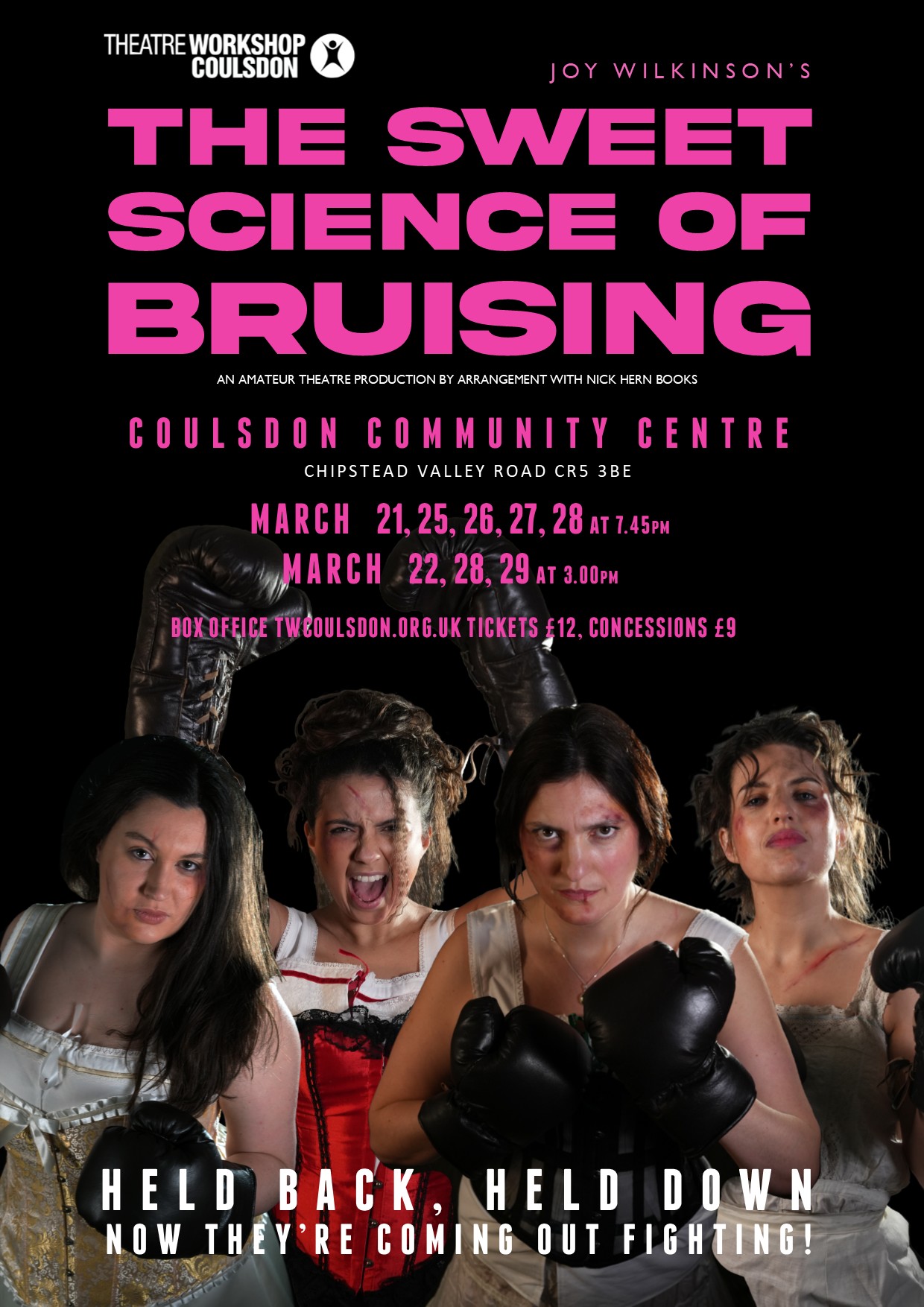
The Sweet Science of Bruising

Victorian London, 1869. The shadowy world of female boxing provides the opportunity for four very different women to break away from the lives that have been ordained for them by society.

Polly Stokes is a fighter, has been ever since she was abandoned on a doorstep as a babe. Irish-born Mattie Blackwell lives on the streets, her life a constant battle to survive. Violet Hunter wants to be a doctor but no man will let her, and Anna Lamb seems to have it all, a husband, children, a house, servants… but in truth, she has nothing.

Held in by corsets, held back by men, the violent release they find in the boxing ring brings them a form of freedom they’ve never known, but at the final bell, there can only be one Lady Boxing Champion of the World.

An epic tale of passion, power, politics and pugilism from the pen of Joy Wilkinson and performed with verve by TWC.

Burnley-born Joy Wilkinson is an accomplished and prize-winning author who has written several plays (Now is the Time, Fair and Britain’s Best Recruiting Sergeant among others), plus numerous TV and film scripts covering a range from sci-fi/fantasy such as Doctor Who and Lockwood & Co. through to thrilling dramas Suspect and The Pact, via Holby City, Casualty and Land Girls.

The Canterbury Tales (2011)

It is the 14th Century, and in the bustling courtyard of The Tabard Inn, Southwark, men and women from all walks of life gather for a pilgrimage to the cathedral at Canterbury. Friars and priests, pardoners and summoners, millers and good wives. In order to entertain these good folk, the host of the inn asks that each traveller tells a story as they make their way across Kent. And so they, and we, begin our journey.

In this joyous adaptation of Geoffrey Chaucer’s classic work by Richard Lloyd, Theatre Workshop Coulsdon present six of the best and most colourful tales, creating an exuberant and and often hilarious portrait of ordinary folk preoccupied with petty jealousies, mundane squabbles and simple pleasures. Bold and often bawdy, these tales bring home vividly just how little the English people have really changed over the last six hundred years!

The stories presented are The Nun’s Priest’s Tale, The Wife of Bath’s Tale, The Friar’s Tale, The Pardoner’s Tale, The Miller’s Tale and The Reeves Tale, neatly wrapped in an engaging background as host and landlord Harry Bailey attempts to maintain order amongst his boisterous and often wayward charges.

Chaucer (1343 – 1400) is widely considered to be the greatest English poet of the Middle Ages, and was the first poet to be buried in Poet’s Corner at Westminster Abbey. While he achieved fame during his lifetime as an author, philosopher, alchemist and astronomer, Chaucer also maintained an active career in the civil service as a bureaucrat, diplomat and courtier. His many works include ‘The Book of the Duchess’, ‘The House of Fame’, ‘The Legend of Good Women’ and ‘Troilus and Criseyde’, but it is ‘The Canterbury Tales’, in which he uses the tales to paint an ironic and critical picture of English society, for which he will always be remembered.

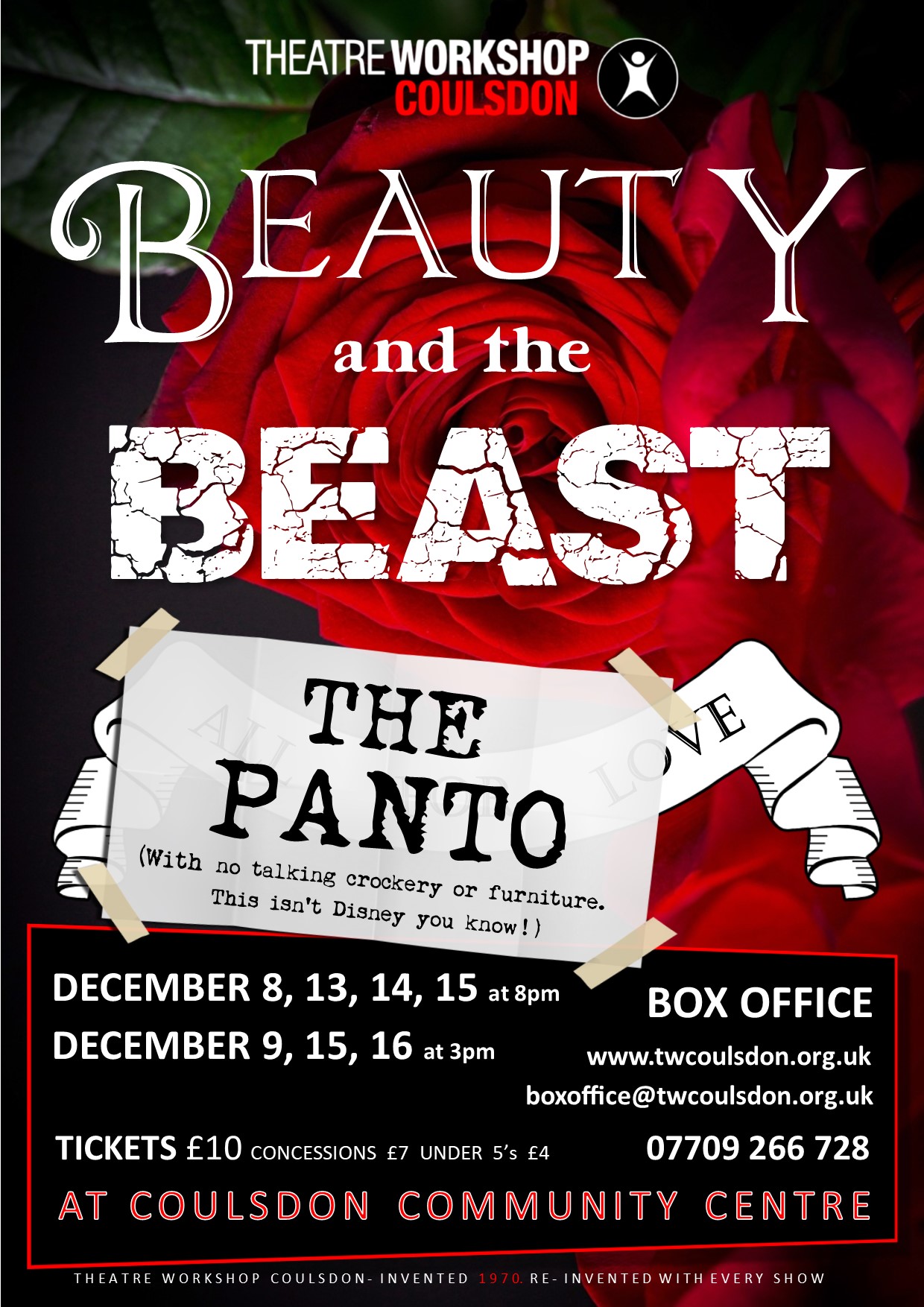
Beauty and The Beast – The Panto

Theatre Workshop Coulsdon’s Christmas 2018 production is an all-new, original pantomime based on the much-loved fairy tale, ‘Beauty and the Beast’. This classic tale, and its underlying message that you shouldn’t judge a book by its cover, has been transformed into a full-fat panto, rocket fuel for the winter season, chock-full of larger than life characters, sing-along songs and audience participation, as the lovely Beauty finds that the monstrous Beast is not what she was expecting. A full band and a large ensemble cast (Bumbling guards, saucy maids, talking vegetation and puppet creatures) support a tale of good versus the evil that is Deadly McNightshade, the woman who puts the wicked into witch and gives it a Scottish accent. Can true love break the dread spell that has locked a handsome prince in a prison he can never escape from? Oh yes it can!

But where did the original story come from? Well, once upon a time there was a woman called Gabrielle-Suzanne Barbot de Villeneuve (They had some cracking names back then) Born in Paris in 1685, she was married at 21 and widowed at 26, her aristocratic but spendthrift husband losing his life almost as swiftly as he lost their money. With her family fortune gone, she needed a way to support herself and eventually moved in with the celebrated playwright and poet Prosper Jolyot de Crebillon (See, another one!) where she began to write. From 1734 through to her death in 1755 she wrote novels and collections of fairy tales but most notably, in 1740, she wrote ‘La Belle et La Bête’, or as we know it, ‘Beauty and the Beast’. It formed part of a much larger story, and was much more complicated than we’re used to now. The simpler version is down to another Frenchwoman, Jeanne-Marie Leprince de Beaumont (and another!) who re-wrote the tale as a much shorter story and published it the year after Villeneuve’s death without acknowledging its origins. Which was a bit sneaky. Boo! Hiss!

Since then it’s become a children’s fairytale classic. Of course, that meant it got the full Disney treatment, twice now, both as a cartoon (1991) and a live-action movie (2017). But there have also been numerous other movie and TV adaptations, a stage musical, an opera, a ballet, and even songs, a disco tune and video games. Its themes of love conquering all and never judging by appearances are simple and easily relatable. And so Sheila May Bird, published children’s author (‘Pete’s Peculiar Petshop’, ‘Pirate Percy’s Parrot’ and others that don’t begin with the letter ‘P’) and long-time member of Theatre Workshop Coulsdon, decided that what had been missing all these years was a pantomime version, full of silliness, slapstick, songs, an audience participation number and the kind of ‘behind you!’ nonsense that makes going to the theatre at this time of year so much fun.

And Then There Were None

August 1939. Dark clouds are gathering over Europe, and off the coast of South Devon, a remote island becomes the setting for a series of sinister killings.

‘And Then There Were None’ has provided the model for innumerable ‘locked room’ mysteries. It’s also one of Christie’s very few works where there is no ingenious detective – no Poirot or Miss Marple – to solve the case. Just a group of extraordinary characters marooned together on an island, where one of them is deranged killer. But which one?

In some ways, it’s the purest mystery Christie ever wrote. Ten strangers are invited to Soldier Island, but on arrival, their hosts, Mr and Mrs U.N. Owen, are strangely absent.

As the evening unfolds, the fragile atmosphere of forced good humour is broken by the sudden accusation that they are all guilty of murder. Then one by one, members of the party begin to die, with the manner of their killing linked to a seemingly innocent nursery rhyme. Fear, suspicion and paranoia take hold of the remaining survivors as they realise the killer must be one of them.

Christie, who wrote the stage adaptation herself, provided a more upbeat ending than her novel. But a 2015 adaptation followed the novel more closely. Which have we used? You’ll have to find out…

The Adventures of Jason and the Argonauts

The legends of Ancient Greece have continued to weave their magic through our imaginations for over two thousand years. The capricious Gods and Goddesses of Mount Olympus playing with the fates of ordinary mortals for both good and ill. But from the ranks of those mortals came the fabled heroes, those who rose to the challenges and won out despite all. Odysseus taking on the mighty one-eyed giant Cyclops. Theseus defeating the monstrous Minotaur in the labyrinth of Crete. Jason and his Argonauts travelling far and risking everything in search of the Golden Fleece.

This last provides the basis for our winter production. But don’t worry, you won’t need a degree in the classics to work out what’s going on. This is a very loose interpretation of the myths handed down over the centuries. Jason and Medea are two mixed-up kids, an orphan and a runaway, who suddenly find themselves tasked with overthrowing the evil tyrant King Pelias. With a certain amount of divine intervention, Jason becomes the captain of the mighty ‘Argo’, a ship capable of crossing the uncharted seas, with a crew of oddball heroes including the world’s strongest (and possibly clumsiest) man, a wonderful woman warrior, a resting rock star, the least identical twins ever and a seriously streetwise cat. Now he must set off and find the Golden Fleece. If only he knew what it was. And then there are the challenges. The man-eating Harpies of Lemnos, the terrible Clashing Rocks, the fire-breathing Great Bull of Colchis, the evil Dragon Snake and Talos, the bronze giant. (Who might just be a really cool sock puppet.) Not to mention The Sirens…

Medea, Jason and his misfit Argonauts are here this December to have fun. This will be no ordinary adventure tale, but one with songs and laughter, and we’ll be encouraging you to join in, whether you’re five or sixty five. Ever fancied rowing the Argo? You’ll get your chance. Become part of the undead army of skeleton warriors? Oh yes.

The award-winning author of ‘Jason and the Argonauts’, Phil Willmott, is mainly famous around these parts for his creation of the hilariously stiff upper-lipped ‘Dick Barton – Special Agent’ spoofs that were so much a part of the sadly demised Warehouse Theatre in Croydon. But he’s written, adapted and directed numerous productions, many derived from classical sources, and we’re more than pleased to link up with him again.

Sherlock Holmes and the Sons of Anubis

From the depths of ancient Egypt an ancient evil is rising, claiming the lives of those who have ransacked its history.

Is this a curse? An occult threat from which there is no defence? Or is there another side to this mystery, something more earthly yet just as deadly? What did Lord Caerphilly’s expedition to the Valley of the Kings disturb, and most importantly, how can it be stopped?

Richard Lloyd’s second exploration into the world of Arthur Conan Doyle’s most famous creation follows on from the success of ‘Sherlock Holmes and the Vampyres of London’, in which the legendary detective faced the iconic prince of darkness, Dracula. This time, as before, real and fictional characters of the period are combined in one fiendish mystery.

Holmes and his trusted companion Dr John Watson travel the streets of Victorian London, from the hallowed British Museum to the seedy brothels of London’s West End in search of the answer to a mystery that if unsolved, may see an empire fall. Which of its denizens may hold the vital clues? Lady Mountjoy, a woman whose most fervent desire is to see the treasures of the tombs returned? Agrippina Bligh, an unscrupulous Madam in a dark trade with darker secrets? The mysterious Egyptian Afzad Azul, who may as easily be allied with demons as angels?

Time is running out…

Twelfth Night

‘Some are born great, some achieve greatness, and some have greatness thrust upon ’em.’ And ‘Twelfth Night’ is surely Shakespeare’s greatest rom-com.

In Illyria, disguised Viola becomes a reluctant go-between in the unrequited courtship of disdainful Lady Olivia by Illyria’s Duke, the lovesick Orsino. This gives rise to perhaps the most famous love triangle in English literature: Uptight Olivia falls madly for the impudent ‘Cesario’; who is desperately in love with wistful romantic Orsino; who is besotted with haughty Olivia. The secondary plot concerns the antics of Olivia’s disreputable uncle, Sir Toby Belch, and his band of ne’er-do-well accomplices from Olivia’s peculiar household. These deplorables embark on a spiteful ruse to humiliate Olivia’s insufferably overstuffed steward, Malvolio, but get their comeuppance when drawn into the Viola / Sebastian mix-ups.

Historical Illyria roughly corresponds to present-day Croatia, but this ostensibly foreign setting (as in most of Shakespeare’s comedies), is not remotely real nor realised. It’s merely a conveniently far-flung land where strange things can happen, yet firmly rooted in a familiar Tudor world of great houses and box hedges, butts of ale and casks of sweet Spanish wine. Shakespeare’s Illyria is clearly within hailing distance of the Thames Watermen, with visitors from Messaline putting up ‘in the south suburbs, at The Elephant’ – as did many visitors to London (hence the Elephant & Castle).

So while Sir Toby Belch and Sir Andrew Aguecheek, a brace of obviously Anglo-Saxon buffoons, rub shoulders with exotically named characters like Orsino, Antonio, and Malvolio, these would all have been instantly recognisable types to the groundlings packed into the playhouse yard of The Rose or The Globe… Orsino, the effete, capricious aristocrat; Antonio, the seaman-adventurer struck from the mould of Hawkins, Drake and Raleigh; and Malvolio, the killjoy puritan stuffed-shirt.

In the interests of duration (about an hour in each half) and clarity, we’ve made some cuts to the text here and there, notably to many of Feste’s extended quips. These were no doubt hugely funny to an Elizabethan audience, but 400 years later many of these jokes, topical references, and allusions to classical mythology have lost all meaning and will simply puzzle a modern-day audience.

Our aim is to present Twelfth Night in the spirit in which we guess it was intended to be played – an exhilarating romantic romp, shot through with a vein of wistful lyricism, full of music and song, and rounded off with a quicksilver exuberance and delight in life.

With more songs than any other Shakespeare play, as Orsino says, ‘If music be the food of love, play on’

Machinal

Regularly appearing on ‘The Best Plays of All Time’ lists, ‘Machinal’ is a vivid, unflinching portrayal of the life of a young, working-class woman in 1920’s America. Across nine tense episodes, we play witness to the key moments of her life – from marriage and motherhood, to adultery, murder, and its consequences. We see how women had to navigate a world run by men for men, in an increasingly mechanistic society demanding conformity.
Placing its young heroine at its centre, ‘Machinal’ traces her fight against the trap of a life predestined, as she hurtles toward her desperate and destructive attempt to break free.
It’s a brave, absorbing play that will stay with you long afterwards; unafraid to challenge its audience and to advance ideas that would have been seen as deeply controversial at the time, yet remain all too relevant today.

Journalist and playwright, Sophie Treadwell (1885 – 1970), placed women and marginalised voices front and centre of her stories. Today ‘Machinal’ (1928) is regarded as a masterpiece – an outstanding example of American Expressionist theatre. But in her day, Treadwell never achieved commercial success, and for much of the Twentieth Century her plays were rarely produced. Even today, her name is little known outside drama schools and histories of theatre. Slowly and rightly though, her ground-breaking early modern plays are now being rediscovered, performed and celebrated anew.

With a specially composed industrial soundscape and an accent on physical theatre this production has taken Theatre Workshop Coulsdon to places it’s not been before. Abrasive, uncomfortable, in places shocking, this is not a quiet night’s entertainment.

Dick Barton and the Carnival of Chaos

“Good evening. This is the BBC Light Programme broadcasting from London. It’s 6.45 and time for the next thrilling episode of ‘Dick Barton and the Carnival of Chaos’!”

Yes, Barton is back, and in his toughest assignment yet!

London. 1949. Wartime rationing remains in force, and only marmalade – that nutritious, morale-boosting foodstuff – continues to fortify our island nation’s grit, spunk, vim and pluck after six long years facing down the Nazi peril.
But now there’s a fiendish foreign conspiracy afoot to kidnap Tiggy Zesty-Peel, heiress to the Zesty-Peel preserves empire, and only Dick Barton can stop it. But who has evil designs on the Marmalade Millionairess? And just what is their nefarious purpose?

Meanwhile, Snowy White and Jock Anderson, Barton’s salt-of-the-earth working class assistants, are each in a jam of their own. Snowy’s been injected with bonobo serum during a brush with a batty Bulgarian ballerina, and has gone more than a little ape. And Jock has fallen for the charms of ex-Nazi filmmaker and flaxen femme fatale, Leni Fuchs.
Throw in the homegrown villainy of the Crayfish Twins (the East End’s favourite lovable cockney mass murderers) and mysterious Italian yoga swami, Contessa Bianca Di Scalzo, and the plot is thicker than a jar of rough-cut.
Can Barton unravel the mystery and save Britain’s marmalade? Or will our favourite spread succumb to the spread of evil? To find out, tune in to the next thrilling instalment of ‘Dick Barton and the Carnival of Chaos’!

Theatre Workshop Coulsdon’s third outing for Dick Barton, Boy’s Own adventurer, all-English hero and teatime wireless star, is another ripping comedy adventure, full of improbable characters, glorious gags, and a cheeky sprinkling of spiffing song and dance numbers. Pip pip!

A Christmas Carol (2023)

The Past Is Forfeit. The Future In Peril. The Present In The Balance. All That Matters Is Now.

It’s Christmas Eve! A time for joyful anticipation, celebration and goodwill to all!

Perhaps not all. To the poor and the hungry in Victorian London, Christmas Day is just another day to struggle through. And for Ebenezer Scrooge it’s a day lost, with business left undone and money misspent. Happy Christmas? Bah, Humbug! But tonight, at midnight, Scrooge will be forced to confront the choices he has made, the opportunities he’s missed and the bleak future that lies ahead, unless he can change…

Although Charles Dickens wrote many classic stories, from Oliver Twist to Great Expectations, there is surely no tale of his more famous, or heart-warming, than ‘A Christmas Carol’. Written in 1843, Dickens paints his protagonist in dreary colours. Ebeneezer Scrooge is a mean-spirited, grasping and bitter individual, shorn of all the things that make a life worth living by choice. Though wealthy, his existence is impoverished, begrudging spending his hard earned coin on anything that might provide a crumb of comfort, either to himself or those around him. He treats his employee with disdain, his nephew as a fool. But on one Christmas Eve, he is forced to look hard at what he has done with his life, and what his actions have meant for others. Three spirits, the ghosts of Christmas Past, Present and Future, show Ebeneezer where he has come from, where he is now, and the cold, unloved end of his days on the path he is destined to take. Will he change his ways? Can he change?

A time-honoured story of redemption, with love, laughter, song and a warmth to melt even the meanest misers’ heart, Theatre Workshop Coulsdon is proud to present ‘A Christmas Carol’.

Theatre Workshop Coulsdon is also pleased to be able to partner with the Purley Food Hub for this production. Dickens was very much a social reformer and the plight of families and children with little food, especially at Christmas, was a source of concern reflected in his writings and emphasised in this version of his story. A Purley Food Hub collection point for voluntary food donations will be set up at the Coulson Community Centre for the duration of the run of the show, from December 9 through to December 17.

Come along, enjoy the show and perhaps make Christmas a little better for someone else too.