The Dracula Spectacula

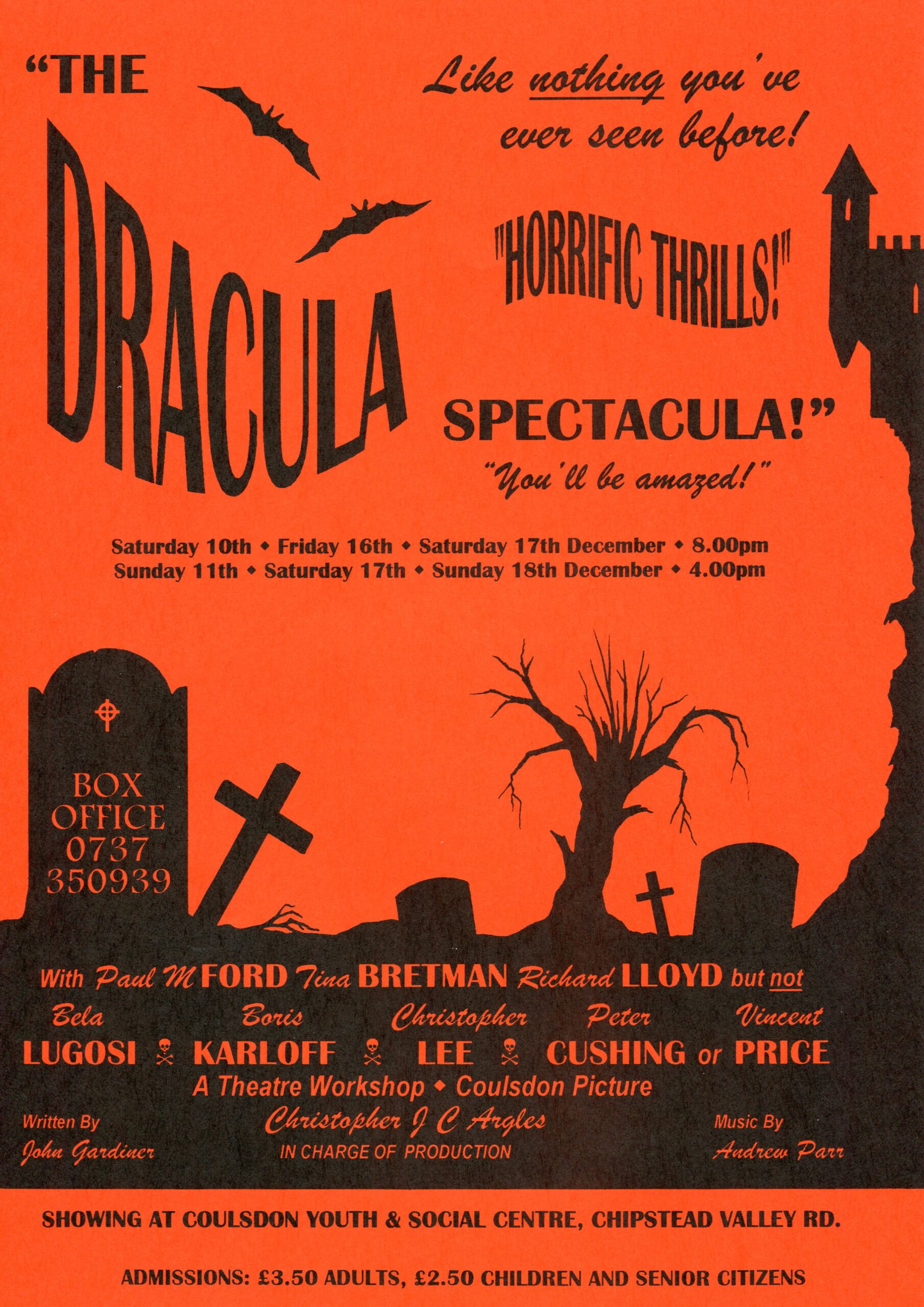
It’s been seventeen years since Theatre Workshop Coulsdon first staged ‘The Dracula Spectacula’. At the time it was regarded by the group as probably the biggest and best production that had been performed by them up to that point (we’d only been in existence seven years by that time), involving over 50 people and having a full band.

1995 will be our 25th anniversary year, and we decided that we’d start the celebrations early, by revisiting what was a landmark production for the group.

Amazingly only two of those fifty members who were involved in the 1977 production are actively talking part this time – those being Chris Argles, the director who played Dracula in the original production, and Tim Young, who will recreate his role as Hans, the Innkeeper.

So, how well has ‘The Dracula Spectacula’ stood the test of time? Was it really the terrific show that we fondly remembered, or have the rose-tinted glasses of nostalgia left us with a false impression? Well, let’s be honest, we had to make some changes to the script. Seventeen years doesn’t seem like a long time, but its enough to make some of the dialogue, and the characterisations, sound dated. A number of the songs too, which may have knocked them un-dead back in the day, really don’t cut it now, and so we’ve replaced them with exuberant pastiches of songs that you might just have heard before.

What you see tonight then is very much a brand-new incarnation – albeit of an old favourite, resurrected and rising from its dusty resting place with a whole new lease of life.

Whether this is the first or second time you’ve seen Theatre Workshop Coulsdon perform ‘The Dracula Spectacula’ we hope you enjoy the experience, and live to tell the tale!
Twelfth Night – The Panto

We’re sticking to a Shakespearean theme for Christmas, with another original TWC panto, this time based (very loosely) on “Twelfth Night”, but with added slapstick, men dressed as women (dressed as men), “oh no it isn’t”, and “oh yes it is”. It’s a riotously funny pantomime full of unexpected twists and turns. Forget Illyria – a freak storm blows a day-trip to Boulogne way off course. Six months later it’s shipwrecked on the coast of Australia. Auntie Podees and her niece, Sheila, have to find work disguised as men to earn their passage back to Coulsdon. Meanwhile, Lord Sydney Opera-House unsuccessfully pursues the love of his life, Lady Alice-Springs (most beautiful lady in the world – and incidentally, the wealthiest). Can Sheila help? Will the principal boys win the hearts of the principal girls? Will the barbie be a success? Are there any gags about Aussies we haven’t plundered and mercilessly exploited? And will the three witches be too evil to be allowed onstage and exiled forever to make tea and serve mince pies? To find the answers to these and many other mosquitoes (sorry, misquotes) don’t miss Coulsdon’s bonza pantomime, a show so big, it needs two dames…

Treasure Island (2010)

Long before Jack Sparrow was ever dreamt of, an even more irredeemable rogue bestrode the rolling quarter-deck of pirate fiction. A one-legged villain by the name of Silver…

When Robert Louis Stevenson wrote ‘Treasure Island’ in 1883, he created not only the most famous adventure story in the English language, but an entire genre. Maps marked with crosses, buried treasure chests, one-legged seafarers with parrots, tropical islands full of mystery and danger, black spots and ‘Yo-ho-ho’s – all these commonplaces of pirate fiction were entirely Stevenson’s invention. He was writing about a world 150 years before his own time, about which he knew very little. That didn’t stop him writing a thrilling story that also held a wry commentary on coming of age and the ambiguity of morality – in the maimed shape of Long John Silver – unusual for children’s literature both then and now.

In our 40th year, choosing Treasure Island for our summer, open-air production seemed both obvious and fitting. It marks the fourth time we’ve set sail with this tale of derring-do, having done so previously in 1974 and 1989, as well as spoofing it with a panto version in 1995. One tradition has remained throughout, the trademark of TWC. In the absence of female characters (with the exception of Mrs Hawkins) we have the heroes played by women and the villainous pirates played by men. Now that might sound a little strange perhaps, but believe me, it works well.

The songs in this production are traditional sea songs and shanties, a rousing accompaniment for life and adventure aboard the Hispaniola. Several hundred of these traditional songs are known, with literally thousands of versions, many blurred into hybrids of several different songs They formed a constantly evolving oral tradition passed on by seamen around the world during the great age of sail. The songs took their influences from different languages and cultures: from Gaelic and Scandinavian dialect song to Wild West ballads; from the rhythms of the South Sea Islands to Negro Spirituals. They were only ever sung on merchant ships though, not the Royal Navy, who frowned on the practice.

Traditional sea songs divide into two main types: the shanty, a chanted work song with a repetitive chorus designed to help gangs of men synchronise the heavy tasks hauling, heaving or pumping aboard ship, and the foc’sle ballad – songs composed and sung just for entertainment. The divide is far from hard and fast however, and many shanties have, over time, developed a more lyrical form.

Our band for the production, pressganged into service of course, are called ‘Ninepence Three Farthings’. Enjoy.

Sinbadaladdin

Sinbad sails into panto peril with Aladdin on board for laughs!

Sinbad the sailor, or Sinbad of the sea, was the hero of a series of stories outlining his seven voyages across and around the Indian Ocean. He came from Baghdad, now capital of Iraq, then the capital of the sprawling Abbasid Empire that stretched from Tunisia in the west to Pakistan in the East. The original tale of Aladdin is also set in the Middle East. And yet, in panto, this tale of a poor boy made good is landed in a Chinese laundry, surrounded by absurd cod-Chinese names and a mother, Widow Twankey, closer to the East End of London than the Far East. This has long been the case, since 1788 in fact, when John O’Keefe staged the first Aladdin pantomime at the Theatre Royal, Drury Lane.

Richard Lloyd has leant into the exotic influence, with his new pantomime mash-up featuring a significant flavour of the Orient (not the Leyton version). Wizards, pirates, genies, beautiful heroines and brave heroes abound, even if these last do look a lot like girls. Widow Twankee gets up to her usual mischief as manageress of the laundry – not so ably assisted by slopper-out Wishee-Washee, while the feisty Princess Jasmine steals Aladdin’s heart and risks the wrath of her father, the Sultan Ming the Mirthless and her ghastly mother, the Sultana No-Lo-Fat. The terrifying magician Abanazar, meanwhile, proves a formidable rival for Jasmine’s hand in marriage.

Songs, sorcery and silliness, with a touch or two of derring-do. Now that’s a pantomime, wherever it comes from.

The She-Wolves Of Doctor Schlock

But if we fail, we will sink into the abyss of a new dark age made more sinister by the lights of perverted science.”        Sir Winston Churchill, 18th June 1940

Wilkommen zu der Schloss Schlockhöfen… an eerie, isolated fortress, perched on a precipitous crag rising from the trackless Bavarian forest. The retreat and laboratory of the mysterious, reclusive Doktor Hieronymus Schlock, sometime scientific genius of the long fallen Reich…

That’s the setting for this B-movie musical schlock horrorfest – a hearty soup of pulp-horror goodness. A tongue-in-cheek melange of mad scientists, zombies, nymphomanic werewolves and gung-ho lost patrols. All spiced up with a risqué dash of sub-S&M gender-bending!

Barney Bridgework and Diane Dentine of CDBDBN Broadcast News are filming an investigation into mysterious disappearances around Schlockhöfen. But having lost the keys to their jeep, they are forced to knock at the castle door…

Can they survive the night within its forbidding walls with only Herr Doktor and his weird household for company? The denizens of Der Schloss include Beauty, a handmade nymphomaniac S&M junkie; Beast, who makes Frankenstein’s Monster look a complete pussy; Otto Plügbutt, Herr Doktor’s devoted batman, and his terrifying yet drop-dead gorgeous She-Wolves – an all singing, all dancing troupe of PVC-clad lycanthropes – the ultimate security detail to die for…

And dropping (quite literally) into this freakshow, a gung-ho squad of U.S. Airborne rangers, attempting to snatch Herr Doktor for a top-secret CIA programme…

The scene is set for a rip-roaring, rock n’ rolling evening of gothic devilment and pure pulp horror wickedness. So sit back, relax, and place yourselves in the horribly capable hands of Herr Doktor and his lethal, latex-clad lady friends…

More Grimm Tales

The root of all theatre is storytelling, and the unfolding of a simple tale in the space between the teller and the listener is arguably the purest form of theatre.

Theatre Workshop has visited the stories of Jacob and Wilhelm Grimm, best known as the Brothers Grimm, before. Just three years ago we put on ‘Grimm Tales’ here in the pub beer-garden of The Woodman. That time we used a script taken from Tim Supple and the Young Vic Theatre Company, based on translations of the original German text by no less than Carol-Ann Duffy, the Scottish poet (who went on to become Poet Laureate in 2009). This time though we’re taking the project into our own hands, and the adaptation of the tales has been done by Richard Lloyd, with Heidi Bush and Mike Brown. This has the advantage of a script that plays to our company’s strengths. At least, that’s the plan. And though the tales hark back to some of the darker aspects of folklore, indeed we’ve leant into that idea, it remains a family show in more ways than one. The Lloyd family entire will be on stage this evening, as will three quarters of the Martin family, while the remaining quarter will have undoubtedly given you ‘The best seat in the house’ as you entered the auditorium area. So it can’t be that scary, can it?

The stories we have selected for your entertainment are;

Little Snow White

Briar Rose

The Robber Bridegroom

Clever Hans

The Musicians of Bremen

The Spirit in the Bottle

The Devil and his Mother

The Frog Prince

Now listener, make yourself comfortable and we shall let the tales unfold.

Return To The Forbidden Planet

Since its debut in an inflatable tent on Blackheath back in May 1983, this strange, hybrid ‘juke-box’ musical, ‘Return to the Forbidden Planet’, has acquired something of a cult following, similar in some ways to its far raunchier predecessor ‘The Rocky Horror Show’. The Bubble Theatre Company used a cast of ten who acted, sang and played all the instruments. For a number of reasons, TWC have decided to spread the workload a bit further.

Writer and director Bob Carlton took as his inspiration the 1956 science fiction movie ‘Forbidden Planet’ (Starring Leslie Neilsen as John J Adams, commander of the United Planets starship ‘C-57D’), itself drawn on loosely on William Shakespeare’s ‘The Tempest’. He’s then plundered several of the Bard’s works for dialogue, and then added a score composed of numerous songs from the 1950s and 1960s, such as ‘Wipe Out’, ‘Great Balls of Fire’, ‘Shakin’ All Over’, ‘Good Vibrations’, ‘Oh, Pretty Woman’ and ‘Born to be Wild’. It probably shouldn’t work. The story only just about makes sense. But is it fun? Heck, yeah!

So join Captain Tempest, commander of the starship ‘Albatross’, and his crew, on a routine scientific survey flight across the stars that becomes anything but routine. A meteor shower drives the ship down toward the planet D’Illyria, where they encounter the enigmatic Doctor Prospero and his daughter Miranda, along with Ariel the robot. They have been marooned on the planet for years, having been sent into space by Prospero’s scheming wife Gloria, but now they are rescued, and everything will be fine. Won’t it?

Warning. As passengers on the ‘Albatross’, you will be required, when the order is given, to undertake the Reverse Polarity manoeuvre to ensure the ongoing safety of the ship.

Step 1 Put both your hands in the air

Step 2 Place your hands on the top of your head

Step 3 Press, using a downward motion, several times

Step 4 On the command ‘Polarity Reverse!’, equalise the external equilibrium by quickly raising both hands and arms and exhaling thus – ‘Phewwwww!!’

Hamlet

Once upon a time there lived a Prince Amleth, whose father, the King of Jutland, was killed by his own brother, the prince’s uncle… 

This was a story told by the wonderfully named Saxo Grammaticus, a thirteenth century Danish historian. The tale was picked up in the mid-1500s by Matteo Bandello, an Italian writer of short stories, and adapted to his needs, and then the French writer and translator, Francois de Belleforest, took Bandello’s version and did much the same in 1570. He expanded the original story in his version and introduced the main character’s famous melancholia, and it’s almost certain that Shakespeare took his inspiration for Hamlet from this version, translated into English. (‘Cymbeline’, ‘Much Ado About Nothing’ and ‘Romeo and Juliet’ almost certainly trace their roots in much the same way, as does John Webster’s ‘The Duchess of Malfi’.). 

Shakespeare’s play was published in 1601, though it had been in existence, and performed, before then. It’s even thought that a early version of it existed as far back as 1589, written by either playwright Thomas Kyd or Shakespeare himself, but the script has been lost. It’s thought that the ‘Ghost’ made its debut in this version, but to date, that remains unproven.

Our script is not as Shakespeare wrote it. It’s simply far too long for our needs. Branagh’s film adaptation (1996) retained every word and ran for over four hours and a standard stage version will easily run to three and a half. In our version we’ve edited the text significantly, taking out fully a third of what was there. However, we’ve not been so foolish as to endanger the story proper. The key plot components, important speeches and oh, so quotable lines are all there. Gone are many of the political aspects, and (purists look away now) some of the flights of poetic fancy. We believe we’ve struck the proper balance here between art and comfort. We’ll leave the decision as to whether we called it right down to you.

‘Hamlet’ is part of the English revenge play tradition. A crime or wrong-doing has taken place and the drama proceeds from the protagonist/s attempting to seek some form of justice, either by simply disclosing the offence or exacting revenge upon the perpetrator. The history of revenge plays goes back at least as far as Aeschylus and his Oresteian trilogy in 500BC, which were translated into Latin by Seneca half a millennia later and from Latin into English over a thousand years after that. These then provided the model from which English playwrights would craft their own stories. Thomas Kyd’s ‘The Spanish Tragedie’ (1588), John Marston’s ‘Antonio’s Revenge’ (1599), Cyril Tourneur’s ‘The Revenger’s Tragedy (1607) are classics of their kind. Of all of them, however, ‘Hamlet’ remains the exemplar, for its depth, its questioning of the human condition, its ability, centuries on, to make itself so clearly understood. 

A final note. In Old Norse, in which the original tale was told, the name ‘Amleth’ meant ‘Not sane’. Which of course throws into question any and all of the protagonist’s considerations and actions. Perhaps think on that.


The Three Musketeers

France 1625.

A young nobleman called D’Artagnan leaves his family in Gascony, south-west France, and makes his way to Paris to seek his fortune and join the King’s Musketeers. Unfortunately he encounters Rochefort, Captain of the Cardinal’s guard at a rural inn, and after an ill-advised confrontation, loses his letter of introduction to M.de Treville, (the captain of the King’s Musketeers), his money and his sword. So, when he finally arrives at the French capital, his welcome is far from warm. Things take a turn for the even worse when his first meetings with Athos, Porthos and Aramis, the best of the Musketeers, result in him challenging each of them to duels. Finally, taken under the wing of the Three Musketeers rather than being killed by them, the young Gascon finds himself embroiled in the machinations of the cunning Cardinal Richelieu and his deadly agent, Milady de Winter, with plans to dishonour the Queen of France herself. A tale of high adventure, full of fun, swordplay and affairs of the heart…

Originally written by Alexandre Dumas (in collaboration with his regular ghost writer Auguste Maquet) and published in 1844, this swashbuckling historical tale became one of the most enduring adventures in literature, challenged only by, perhaps, ‘Treasure Island’. Numerous adaptations have been made, for stage and screen, including musicals, animation, and even an opera. The script that Chris Argles chose to direct was by Willis Hall, and had been published just the previous year, 1995. Although it keeps to the story, more or less, inevitably some liberties are taken and Hall leans into the humour, no doubt one reason for its selection.

It has passed into Workshop legend that Mike Brown, playing, or rather completely inhabiting the role of Porthos, at one point during the production ran across the stage completely naked, except for a strategically placed broad-brimmed musketeer hat (with a large feather). The part demanded it, obviously.

The Canterbury Tales

Geoffrey Chaucer (c. 1340 – 1400) has been called the father of English Literature. Certainly there is nothing quite like his epic ‘The Canterbury Tales’ to put the present-day observer in touch with the ordinary life of our medieval forebears. Nothing to match the unflinching realism of Chaucer’s portraits of his fellow men. And nothing quite so effectively holds up a mirror, not only to the England of his times – but to the unchanging nature of human experience.

We considered four different published playscripts before creating our own adaptation of ‘The Canterbury Tales’. In the end we decided against paying royalty fees to use someone else’s script. After all, Chaucer is part of our shared heritage – his words should belong to all of us.

Across the different playscripts there had been a range of selections made regarding which tales were best to tell. Clearly, given that there are 28 tales in all, you can’t use all of them in one two hour show (and note that Chaucer had intended for there to be 120!), so a choice has to be made. However, most seemed to go for the stories with classical settings, such as The Knight’s Tale, The Franklin’s Tale and The Merchant’s tale.

Focused on the nobility, and concentrating on stories of courtly love and mortal combat as they are, we decided that these rarified tales were not the ones we wanted to tell. We wanted to hear from the ordinary people, engaged in the medieval day-to-day of simple pleasures, petty jealousies and mundane squabbles. Exuberant and resilient folk, yet dominated by an overbearing Church. So, these are the stories we chose:

The Nun’s Priest’s Tale

The Wife of Bath’s Tale

The Friar’s Tale

The Pardoner’s Tale

The Miller’s Tale

The Reeve’s Tale

Our adaptation is actually based on the 1985 Oxford University Press translation by David Wright, though we’ve edited out much of the narrative in favour of dialogue. This is a drama after all, not a story telling, and that has meant some minor amendments in order to make sense of the editing. Regardless, we’ve actually added or rewritten very little. So the words you’ll hear spoken are Chaucer’s own, translated with fidelity into modern English by one of the foremost scholars in this field. If you take any pleasure from the tales we unfold for you today, reflect for a moment on the fact that these are the same stories that entertained your ancestors, some 600 years ago.