The Recruiting Officer (1998)

Written in 1706 by Irish writer George Farquhar, ‘The Recruiting Officer’ is a comedy set in and around the town of Shrewsbury in Shropshire. As the War of the Spanish Succession rumbles on in Europe, two recruiting officers, the womanising Captain Plume and the effete and cowardly Captain Brazen, attempt to entice the men of the town into the army and the women into their beds. Plume has an advantage here, for on his side is the redoubtable Sergeant Kite, who will use any means, fair or foul, to get men to join up.

Life is complicated by the women in their lives, who are far more independently minded, and smarter, than they can honestly cope with. Plume is promised to Sylvia, the daughter of a local Justice, Balance, but he’s also the father to a bastard born of a local girl, who Sylvia knows about and is caring for. Melinda, Sylvia’s cousin, was the amour of Plume’s friend Worthy, but he refused to marry her and instead proposed that she become his mistress, because she was too poor. Now she’s inherited a fortune, he’s back, but Melinda’s going to have a little fun with Worthy, by playing up to Captain Brazen. And then there’s Lucy, Melinda’s maid, who by subterfuge intends to wed Brazen too.

Hidden motives, trickery, miscommunication and disguise, all go towards making this boisterous romantic comedy laugh out loud funny, and it’s been doing it for over 300 years. It was the first play ever performed in New York City, at the Theatre on Nassau Street, on 11 December, 1732 (by amateurs too!). However, Farquhar didn’t benefit from its success. Heavily in debt and made ill with worry, he died in April 1707, not two months after the debut of his last play, ‘The Beaux Stratagem’.

Raiders Of The Lost Shark

An unashamed tribute / spoof / homage of the Indiana Jones’ movies that made the 1980s such fun, Richard Lloyd’s comedy adventure draws most heavily on the second of the series, ‘Indiana Jones and Temple of Doom’ (1984). (the first chronologically, being a prequel, set a year before ‘Raiders of the Lost Ark’). Although the inevitable Nazi villains are still in the mix (they are so irredeemably bad and easy to dislike), the far Eastern settings, ranging from India to the South China Sea, plus the inclusion of a young Chinese sidekick and a plucky cabaret singer, have clear parallels with the follow-up film.

But if Harrison Ford was only the second choice to play our favourite adventuring archaeologist, behind Tom Selleck, there was only one choice for us. Neil Grew, who had at that time cornered the market (at TWC) in somewhat knowing heroic leading-man characters (He played Robin Hood in 1993, and would go on to play James Bond in 2004). His donning of the trademark (Lucasfilm, that is) battered fedora, leather jacket and bullwhip was pretty obvious casting.

So, beware of the deadly traps, look out for the evil villains and the deliciously duplicitous femme fatales, jump in the seaplane and head due east for excitement and laughter, as Alabama, Frenchy and Hoi-Sin go in search for the fabled Jewel of Munkipore!

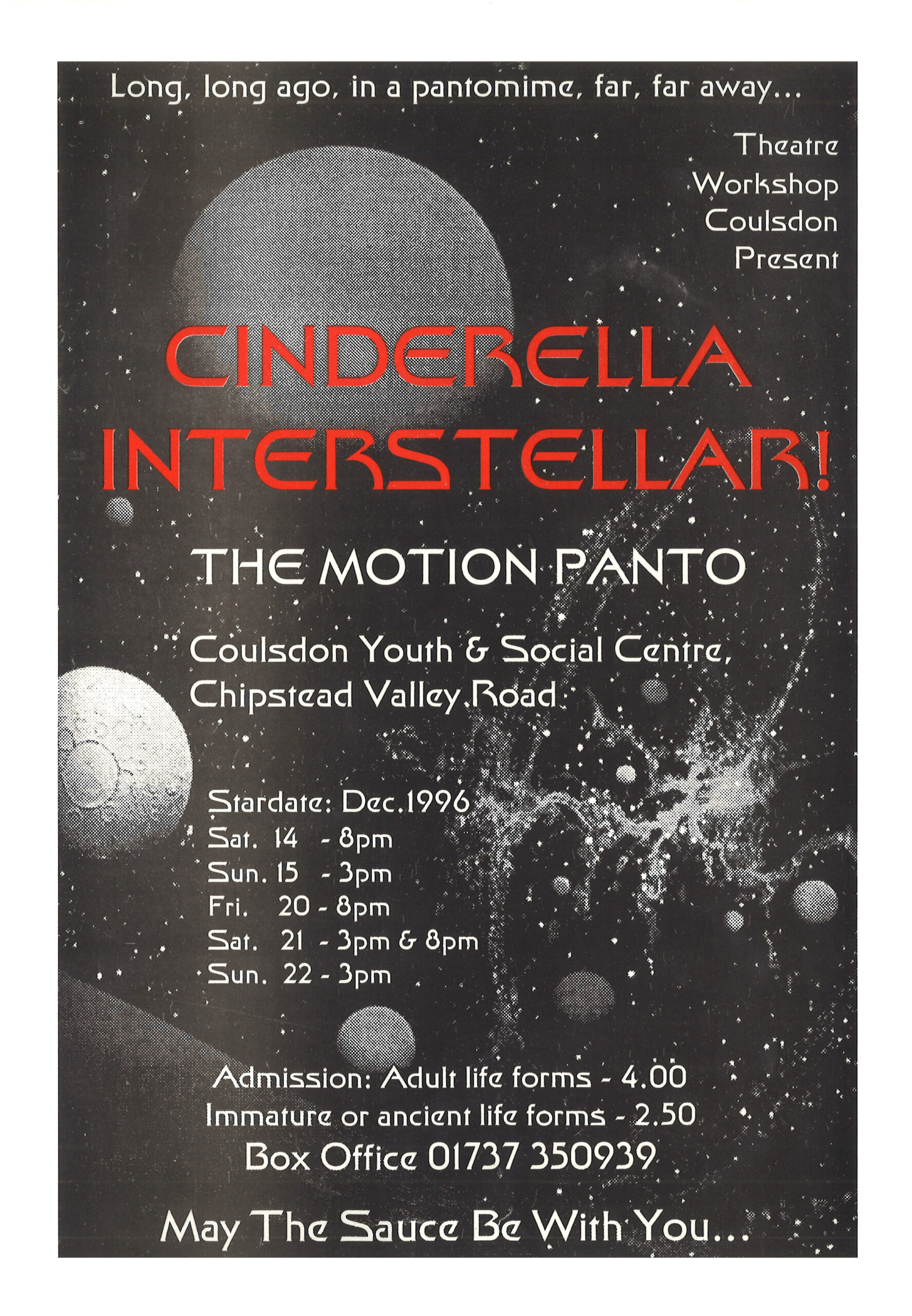
Cinderella Interstellar!

A long time ago, in a galaxy far, far away, there was a pantomime that looked quite a lot like ‘Star Wars’…

Take Cinderella and her ugly sisters and then thrust them into a world of science-fiction adventure, inhabited by characters that are nearly, but not quite, those from the epic blockbuster trilogy of the late 1970’s and early 1980’s.

A cocky, star-faring smuggler and his hairy co-pilot, a kid who’s a whiz behind the controls of space fighter, a monk-like individual wise in the ways of the Source, a black-clad villain in a full-face helmet with breathing difficulties and an army of soldiers who can’t hit a Death Star at close range. They’re all there, just not as you knew them.

Throw in the best Cantina band this side of Tatooine to help belt out some brilliant songs, and you’ve got a powered up panto ready to do the Kessel run in less than 12 parsecs.

This is the panto you were looking for.

The Canterbury Tales

Geoffrey Chaucer (c. 1340 – 1400) has been called the father of English Literature. Certainly there is nothing quite like his epic ‘The Canterbury Tales’ to put the present-day observer in touch with the ordinary life of our medieval forebears. Nothing to match the unflinching realism of Chaucer’s portraits of his fellow men. And nothing quite so effectively holds up a mirror, not only to the England of his times – but to the unchanging nature of human experience.

We considered four different published playscripts before creating our own adaptation of ‘The Canterbury Tales’. In the end we decided against paying royalty fees to use someone else’s script. After all, Chaucer is part of our shared heritage – his words should belong to all of us.

Across the different playscripts there had been a range of selections made regarding which tales were best to tell. Clearly, given that there are 28 tales in all, you can’t use all of them in one two hour show (and note that Chaucer had intended for there to be 120!), so a choice has to be made. However, most seemed to go for the stories with classical settings, such as The Knight’s Tale, The Franklin’s Tale and The Merchant’s tale.

Focused on the nobility, and concentrating on stories of courtly love and mortal combat as they are, we decided that these rarified tales were not the ones we wanted to tell. We wanted to hear from the ordinary people, engaged in the medieval day-to-day of simple pleasures, petty jealousies and mundane squabbles. Exuberant and resilient folk, yet dominated by an overbearing Church. So, these are the stories we chose:

The Nun’s Priest’s Tale

The Wife of Bath’s Tale

The Friar’s Tale

The Pardoner’s Tale

The Miller’s Tale

The Reeve’s Tale

Our adaptation is actually based on the 1985 Oxford University Press translation by David Wright, though we’ve edited out much of the narrative in favour of dialogue. This is a drama after all, not a story telling, and that has meant some minor amendments in order to make sense of the editing. Regardless, we’ve actually added or rewritten very little. So the words you’ll hear spoken are Chaucer’s own, translated with fidelity into modern English by one of the foremost scholars in this field. If you take any pleasure from the tales we unfold for you today, reflect for a moment on the fact that these are the same stories that entertained your ancestors, some 600 years ago.

Lark Rise

Welcome to the tiny hamlet of Lark Rise. It is the first day of the harvest, one summer early in the 1880’s…

Flora Thompson’s autobiographical trilogy ‘Lark Rise’, ‘Over To Candleford’ and ‘Candleford Green’, describing her childhood in a remote Oxfordshire farming community has been termed English Literature’s classic masterpiece of a lost way of village life – a vivid and moving account, rich in fascinating detail.

In 1978, Keith Dewhurst’s acclaimed adaptation for The National Theatre took characters and episodes, songs and scenes directly from the books, to create two composite plays – ‘Lark Rise’ and ‘Candleford’. Each of the plays also featured a wealth of traditional music contributed by the influential British folk-rock group, The Albion Band. (John Tams and Ashley Hutchings, both members of the band, acted as musical directors for the play.)

The result is an enchanting play which, while lacking a strong narrative, does offer an evocative and entertaining glimpse into how our ancestors lived and worked in the years before The Great War, and the machine age that finally succeeded in sweeping England’s rural innocence away forever. In place of The Albion Band we have The Royal Borough Band, led by Dave Hankey, with a few of our own members helping to provide vocals.

We hope you will accept our production of ‘Lark Rise’ as a pleasant diversion fit for a summer’s evening – especially in the garden of what is still, very much, a village pub.