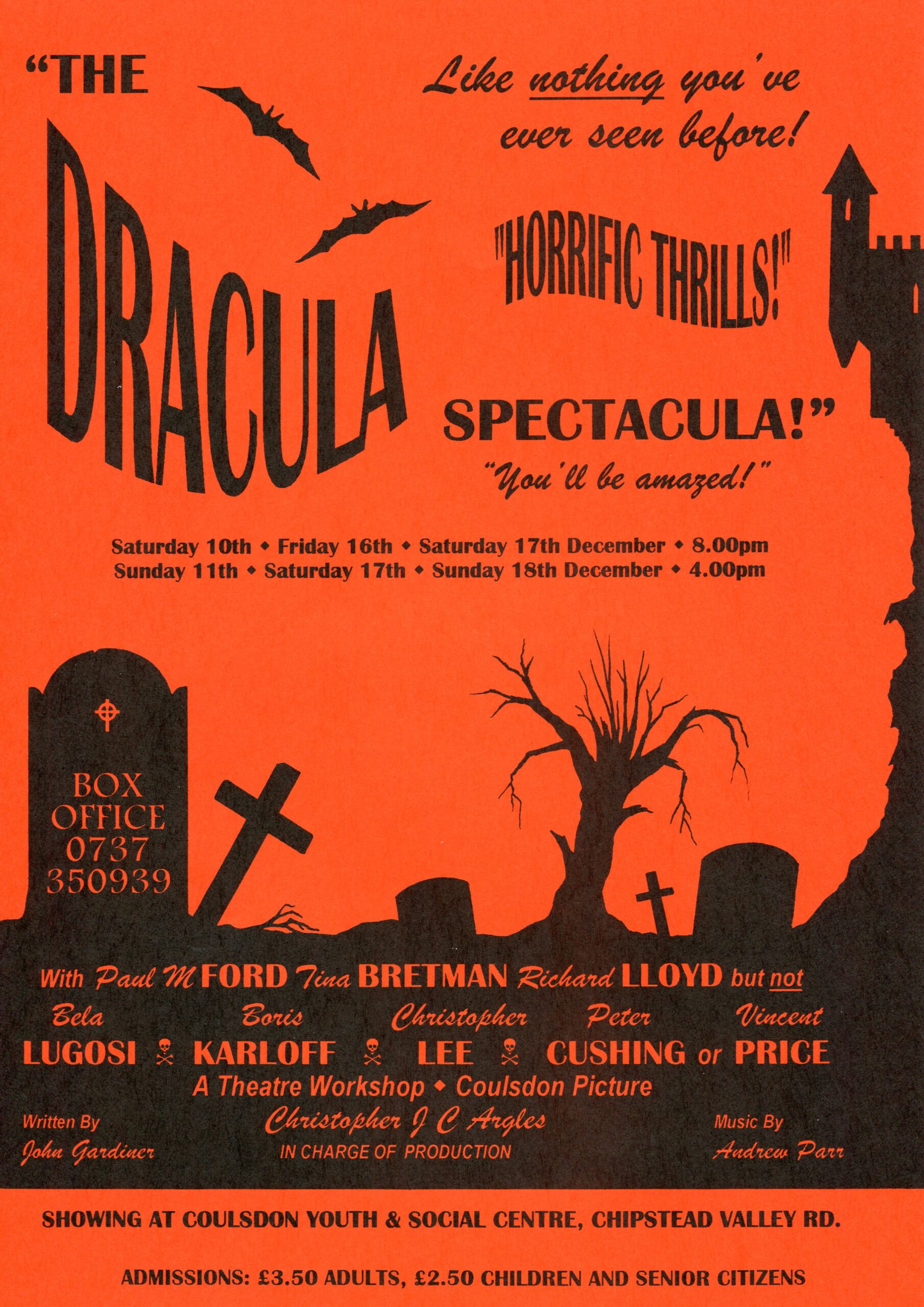
The Dracula Spectacula

It’s been seventeen years since Theatre Workshop Coulsdon first staged ‘The Dracula Spectacula’. At the time it was regarded by the group as probably the biggest and best production that had been performed by them up to that point (we’d only been in existence seven years by that time), involving over 50 people and having a full band.

1995 will be our 25th anniversary year, and we decided that we’d start the celebrations early, by revisiting what was a landmark production for the group.

Amazingly only two of those fifty members who were involved in the 1977 production are actively talking part this time – those being Chris Argles, the director who played Dracula in the original production, and Tim Young, who will recreate his role as Hans, the Innkeeper.

So, how well has ‘The Dracula Spectacula’ stood the test of time? Was it really the terrific show that we fondly remembered, or have the rose-tinted glasses of nostalgia left us with a false impression? Well, let’s be honest, we had to make some changes to the script. Seventeen years doesn’t seem like a long time, but its enough to make some of the dialogue, and the characterisations, sound dated. A number of the songs too, which may have knocked them un-dead back in the day, really don’t cut it now, and so we’ve replaced them with exuberant pastiches of songs that you might just have heard before.

What you see tonight then is very much a brand-new incarnation – albeit of an old favourite, resurrected and rising from its dusty resting place with a whole new lease of life.

Whether this is the first or second time you’ve seen Theatre Workshop Coulsdon perform ‘The Dracula Spectacula’ we hope you enjoy the experience, and live to tell the tale!
Wyrd Sisters

Terry Pratchett is rightly regarded as one of the fantasy genre’s most popular and successful authors. He is without doubt one of its most prolific, with a string of best-selling novels set on his imaginary Discworld, a planet-sized disc that sits on the backs of four huge elephants, who in turn stand on the back of an enormous turtle called the Great A’Tuin as it swims through interstellar space.

His books frequently parody the vast body of ‘sword and sorcery’ literature that has been spawned by generations of Tolkien imitators, but he doesn’t stop there. Social comment is often interwoven into his humorous tales, and then there’s Shakespeare, whose plots and themes have been known to appear. ‘Wyrd Sisters’, for instance, seems to resemble at times a certain Scottish play, at others ‘Hamlet’. ‘As You Like It’ and ‘King Lear’ get a look in too.

‘Wyrd Sisters’ was Pratchett’s sixth Discworld novel, written in 1988, and the first to feature the Lancre coven of witches, composed of Magrat Garlick, Gytha ‘Nanny’ Ogg and Esmerelda or Esme ‘Granny’ Weatherwax. Favourites of both the readership and Pratchett himself, they would go on to feature in a number of his other books. In neopagan traditions, there exists the Triple Goddess, the maiden, the mother and the crone, and Pratchett has knowingly taken this as a model.

In the play, adapted from the novel by long-time Pratchett collaborator Stephen Briggs, King Verence I of Lancre is murdered by his scheming cousin, Leonal, Duke Felmet, after his ambitious wife persuades him to do so. However, a fleeing servant manages to rescue Verence’s son and heir, along with the King’s crown, and both are given to the witches, who in turn pass them onto a troupe of travelling actors. The crown is hidden in the props box and the boy will be brought up as the actor/manager Olwyn Vitoller’s son. The witches understand that in the fullness of time, destiny will take its course and the child, Tomjon, will grow up to defeat Duke Felmet and take his rightful place as king. Of course, it doesn’t turn out like quite like that…

We’d like to give our particular thanks to both Stephen Briggs and Terry Pratchett for giving us permission to stage ‘Wyrd Sisters’ now. The authorised adaptation hasn’t actually been published yet, so we’re grateful to get a head start on the rest of the amateur theatre brigade. 

Panto Goes West

Saddle up your horses and load your six-guns! This rootin’ tootin’ script (also known as ‘The Ballad of Hamster Gulch’) is headin’ back to the Old West for a rip-roaring pantomime adventure. All the very best of traditional pantomime, including custard pies, explosions, amazing costumes, and masses of audience participation, but with the added attraction of a brand new story and setting, way out on the prairie! From quick draws to man-eating saloon doors, and from bandidos to baked beans, not a Wild West cliché is omitted, and no opportunity missed to lasso the audience into the action!

Our tall tale relates the fiendish efforts of Badman Jake McCabe and his redskin sidekick, Speaks Like A Rattlesnake, to set Big Chief Running Buffet on the warpath – all in order to spark off a range war and get the Indians driven onto a reservation. With Running Buffet and his people out of the way, McCabe and his mad, bad hombrés, Dopey Hobart and The Cactus Kid, can get their sticky hands on the gold buried beneath them thar ancient burial grounds of the Magwumpa Sioux.

Fortunately, McCabe’s wicked plot is thwarted by an unlikely alliance of Clint Cougar of the Texas Rangers, Red Indian maiden Sings Like Mountain Stream, ornery ol’ timer Gus Varmint, and Clint’s outrageous auntie over from England – Calamity Dame!

Robin Hood

The Woodman has been Theatre Workshop Coulsdon’s ‘local’ for the last fifteen years now – the nearest decent pub to our home base, the Coulsdon Youth and Social Centre in Chipstead Valley Road. Every Monday and Wednesday evening, TWC members can be found quenching their thirst in The Woodman after a hard evening’s rehearsing!

So when we set ourselves a challenge – staging a play in the open air, the gardens of our favourite hostelry seeming like an obvious choice. Fortunately our obliging hosts, Chris and Linda Matthews, (although probably not quite realising what they were letting them selves in for) fully embraced the idea, and you could hardly choose a more appropriate play to be presented in the open air than ‘Robin Hood’.

A ‘Robin Hood’ staged in the open air among real trees and under real stars is quite a different, and very special, proposition to one staged in a theatre or hall.

Although the popular mythology of a medieval Robin had evolved over many centuries, his origins as a powerful manifestation of the Wildwood can be traced back in time, beyond any supposed historical roots, to pre-Christian folklore. Folk plays on the theme of Robin Hood have an ancient pedigree stretching back to at least the thirteenth century. Such plays would have been a familiar entertainment to the common people of the time – and were of course customarily presented in the open air.

Our current production is a free adaptation of a quite recent American script – which in turn was a fairly straight retelling of what we consider to be the most common elements in any recounting of the legend of Robin Hood.

And so began what became our traditional open-air summer production. We would perform in the beer garden at The Woodman every summer until 2010, our last production in 2009 being an adaptation of Terry Pratchett’s ‘Lord and Ladies’. A number of unsympathetic landlords who simply failed to understand the numbers of additional people we were bringing to the pub to eat and drink each year, a remodelling of the beer garden that didn’t seem to help the pub and certainly worked against us, and then the building of a new cricket pavilion next door with floodlighting that overspilled into the area we were using – all contributed to us taking the decision to move elsewhere. But in 1993, it was a marvellous new experience and one we enjoyed, and would continue to enjoy, for many years.

Oliver!

‘Oliver!’ is a stage musical written by Lionel Bart, and adapted from Charles Dickens’ 1838 novel ‘Oliver Twist’. The tale of a young, innocent, orphaned workhouse boy, who falls in with thieves and pickpockets before finding his fortune, it premiered at the Wimbledon Theatre in 1960 before transferring to the New Theatre in St Martin’s Lane (Now the Noel Coward Theatre), opening on the 30 June that year and running for what was then a record 2,618 performances. It was the first musical based on a Charles Dickens story that had actually been a success in any real sense.

The musical, very much simplified from the book, contains song after song that will stay with you, catchy beyond belief, from ‘Food, Glorious Food’, ‘Consider Yourself’ and ‘I’d Do Anything’ to ‘Oom-Pah-Pah!’, ‘You’ve Got To Pick A Pocket Or Two’ and ‘Reviewing the Situation’. ‘As Long As He Needs Me’ is as powerfully emotional as anything that has ever been sung on a West End stage.

Bart, real name Lionel Begleiter and descended from Galician Jews, was called a musical genius at the age of just six. He started his songwriting in amateur theatre, and was eventually talent-spotted by Joan Littlewood and joined her Theatre Workshop. His golden era was the late fifties and early sixties, when he wrote hit records for Cliff Richard, Tommy Steele and Anthony Newley, picking up numerous Ivor Novello awards. He wrote the theme to the James Bond film ‘From Russia With Love’ in 1963. But despite earlier successes, it was ‘Oliver!’ that made him a truly household name. Funnily enough, Bart couldn’t read or write music. The music for ‘Oliver’ was transcribed by a man called Eric Rogers, famous for writing the music scores for twenty one of the ‘Carry On’ movies. Bart would would hum the tunes while Rogers wrote down the notes.

In 1969 the movie of ‘Oliver!’ was released, and one might have thought life was good for the composer. However, Bart’s follow-up musicals had failed to recapture the glory of his most famous show, with ‘Twang!!’ (opening in late 1965) closing after awful reviews, mostly empty houses, and only 43 performances. It was the most expensive flop the West End had ever seen up to that point and wiped out Bart’s personal fortune. Nor could ‘Oliver!’ help him out. He had sold the past and future rights to his show to entertainer Max Bygraves in 1959 for just £350.

Dazzle

In a world of multi-million dollar science-fiction movies, it’s a brave amateur theatre group who takes on a supposed ‘out of this world’ musical play that was intended to parody the much-loved TV series (and subsequent movies) of ‘Star Trek’. John Gardiner also wrote ‘The Dracula Spectacula’ which Workshop performed back in 1977, and would again, no doubt (at least in part) why Chris Argles chose it to direct. However, like its predecessor, the story is only very loosely based on its source material.

At some point in a far-flung future, Sam Galactic of the Star Blade Squadron is welcomed as a hero by Sekurikor, the President of Homeworld, and entrusted with his first command, that of the starship Sunburster One. He and his crew are then given the relatively mundane task of taking the president’s daughter, Dazzle Star, to a finishing school on Procyon. En route, they are intercepted by a Red Star vessel commanded by Big Olga, and then have Dazzle Star kidnapped by spacefaring Irish pirates, before finding out the true purpose of the mission. To complete it, and guarantee the future of mankind, Sam and Dazzle Star must throw themselves back in time to the 1960’s and survive an unlikely encounter with a greasy, leather-clad motorcycle gang led by the daunting Sue Zuki.

Of course, that’s only how it started out. Though the story may have remained much the same, Workshop took exception to a lot of the treatment meted out to the various characters. In the script, the ship’s doctor inexplicably sounded like one-time world champion boxer Muhammad Ali. That went. The random Irish pirates were ditched in favour of the classic Trek villains, Klingons, with all the gags that you can imagine the name entails, and their song became a spoof of ‘Pink Elephants On Parade’ from Walt Disney’s ‘Dumbo’ (Why? Ask Mark Taylor. But it was great fun.).The captain developed a middle initial to become Sam T Galactic. The ship lost a number and gained a ‘USS’ prefix, and the set of the ship’s bridge was as close to an exact copy of the original Enterprise as our limited budget could manage. The wardrobe guidelines were thrown out too, and in came fairly faithful reproductions of the classic Starfleet uniforms.

We boldly went where Samuel French didn’t expect us to go.

The Recruiting Officer (1992)

It’s been said that ‘The Recruiting Officer’ reflects the warm afterglow of Blenheim’, and certainly, for a play written in a time of war, it is a confident and optimistic work. The War of the Spanish Succession had begun in May 1702, the latest in a series of European wars triggered by the ambitions of Louis XIV, ‘The Sun King’, ruler of France. Queen Anne had succeeded to the throne of England, Scotland and Ireland just two months previously, and she immediately appointed the John Churchill, the Earl of Marlborough, as the Captain-General of her armies. As war began, Marlborough was made supreme commander of the combined Anglo-Dutch army, and the campaign began well for him. So well that in December 1702, Queen Anne made him a Duke. The apex of his success however, lay at Blenheim, in Bavaria, on 13 August 1704, where a masterclass of planning and logistics paired with tactical and operational brilliance saw his forces defeat the Franco-Bavarian army so heavily that Bavaria was no longer capable of continuing the war. Patriotic fervour reached a crescendo, with even his enemies at court acknowledging the scale of his triumph. The Queen gave him the royal manor of Woodstock, on which Blenheim Palace would be built. And it is into this atmosphere that the play invites its audience.

George Farquhar, in 1704, was a soldier, having taken a commission as a Lieutenant of Grenadiers in the Earl of Orrery’s Infantry Regiment as a means of earning money. His recent plays had been unsuccessful, and he’d married a woman the previous year who already had three children from a prior marriage. He was practically penniless. That summer, his duties took him to Shrewsbury for a recruitment drive, and it was his experiences there that led to his writing of ‘The Recruiting Officer’. Supposedly he even wrote it in Shrewsbury, while staying in his lodgings at The Raven Inn.

The play, when it opened on the 8 April 1706 was a huge and immediate success, but his share of the income from the play was barely enough to cover his outstanding debts. Worse, he had contracted tuberculosis, and had to resign his commission in the army. Weakened by illness, he wrote one last play, ‘The Beaux Stratagem’ in just six weeks during the autumn of that year, and it opened on Drury Lane in March 1707 to universal acclaim. Sadly, its success came too late, and in May 1707 he died, aged just 30 years old.

‘The Recruiting Officer’, played in the traverse along the length of the main hall at the Coulsdon Youth and Social Centre, turned out to be the last, to date, summer production to take place there. From the following summer of 1993, Theatre Workshop Coulsdon would take its shows out into the open air. ‘The Recruiting Officer’ too would see the open air, being revisited by the group only six years on, in 1998.

Bugsy Malone

Based on the 1976 movie written and directed by Alan Parker, ‘Bugsy Malone’ is a comedy / musical about gangsters, an unlikely combination.

Set in New York during the prohibition era, ‘Fat’ Sam Staccetto runs a criminal empire, running illicit sarsaparilla and other rackets, as well as the ‘Grand Slam’ Speakeasy. When Roxy Robinson, one of Sam’s best men, is taken out by rapid-fire, whipped-cream shooting ‘Splurge’ guns, Staccetto puts the blame on the up-and-coming rival gang boss Dandy Dan, and all too quickly he’s proven right. Soon the city is gripped by a major gang war, and caught in the middle is Bugsy Malone, a none-too-successful boxing promoter, written off by Sam as ‘a nice guy…but a little too popular with the broads’. Bugsy has fallen for would-be singing star Blousey Brown, and between them they plan to leave town and head for California, but there’s the little matter of raising the money for the train tickets…

Mike Brown’s first stab at direction brought in a wealth of new young talent, with the ‘veterans’ dropped back to supporting and character roles. Containing big ensemble singalong numbers like ‘Fat Sam’s Grand Slam’, ballads such as ‘I’m Feeling Fine’ and ‘Ordinary Fool’ from Blousey Brown (Rachel Handler), not to mention ‘My Name Is Talullah’ from Kimberley Argles’ eponymous speakeasy chanteuse, the production provided a rousing evening’s entertainment and a springboard for Workshop’s younger talent.

Smut’s Saga, or Santa and the Vikings!

Panto Viking fun. Nordic myth runs riot: valkyries, trolls, dwarves – and Father Christmas!

Long centuries divide the epic Norse saga from traditional pantomime, but the two genres share some similarities. Both are ritual entertainments in which time-honoured tales of derring-do, featuring a habitual cast of larger than life characters, are performed to delight a deeply involved audience.

This is an epic Norse saga set in a land of icy fjords and cold, grey seas. A tale of longships and trolls, Valkyries and Valhalla – but incorporating all the essential ingredients of traditional panto. Boundless audience participation, corny double-entendres, ingenious special effects, men dressed up as women, women dressed up as men. And all with the added bonus of a new story set against the vivid backdrop of Norse tradition – with no opportunity missed to exploit every Viking gag imaginable!

Wicked Viking Jarl, Smut the Smug, crosses the northern sea to ravage the coast of England, only to encounter rival Viking, Svein, Prince of the Blue Fjords, searching England for his Princess bride. The villain flees with no booty, except for three exceedingly naughty children, Tum, Dickon and Harald. But Smut is pursued back to his lair in Smutland by the children’s outraged and outrageous guardian, the indomitable Dame Dustpan, joined by Prince Svein, who agrees to help rescue the children in return for help tracking down his princess. But before they can complete their quest, our heroes have to outwit the monstrous Stoneheart, Lord of the Rock Trolls, and deal with Smut’s dotty but deadly accomplice, the witch, Helga Forkbeard.

Complete with mountains and fjords, dragonships, dwarves and giants, not to mention Santa Claus, the whole rich tapestry of Viking folklore is here. Skilfully blended with the enchantment, slapstick and audience participation of traditional pantomime.

The Crucible

Arthur Miller’s ‘The Crucible’ is one of the classics of 20th Century theatre. A fictionalised (or at least in part) account of the witch trials that took place between 1692 and 1693 in the small settlement of Salem, in the Province of Massachusetts Bay, New England. Miller wrote it in 1953 not as a historical piece, but as an allegory for McCarthyism, rampant at the time of his writing, where people were shamelessly persecuted for alleged Communist ties, without evidence. The accusation in and of itself was considered damning enough regardless of its origin, and there was the link to that earlier, dark time.

At best, ‘The Crucible’ was an ambitious reach for Workshop, but this was a ‘troubled’ production, as they call it in some circles. Originally slated to be the Spring 1990 production, it had been proposed by Christine Blake and Wendy Cole, who, it was intended, would co-direct. However, the project was almost completely derailed when both of them left the group. This left Paul Ford, who had been drafted in as an assistant director, to carry on in their stead but with no real vision for what the show should look like. One of the immediate difficulties was the presence in the cast of the key character of Tituba. Although her ultimate origin is disputed, it was thought that she was Barbadian, i.e. from the island of Barbados. No-one in the existing membership of the time could pass themselves off as such, and even in 1991, ‘blackface’ was a no-go. And so Paul elected to shift the entire thing into space. Salem became a settlement of puritan theocratic colony on a planet orbiting a distant star. It covered off the Tituba problem, but of course caused others.

The staging was abstract, geometric shapes painted to look as if they’d been scavenged from old starship hull-plating. They could be moved to form different combinations, which would represent various rooms and locations. An over-sized fan behind a grill turned throughout, with a ever-present ‘tic’ as its malformed blades hit the grill.

Despite some eventual outstanding performances, not least from the young girls in the cast, it nearly didn’t make it. The first weekend’s performances were billed as ‘previews’ as even at that last stage, the production was not pulling together. The review picked out that there were beautiful moments, and as ever, Madgwick was right. When it worked, there were some truly excellent scenes, but overall it really didn’t do the script justice.