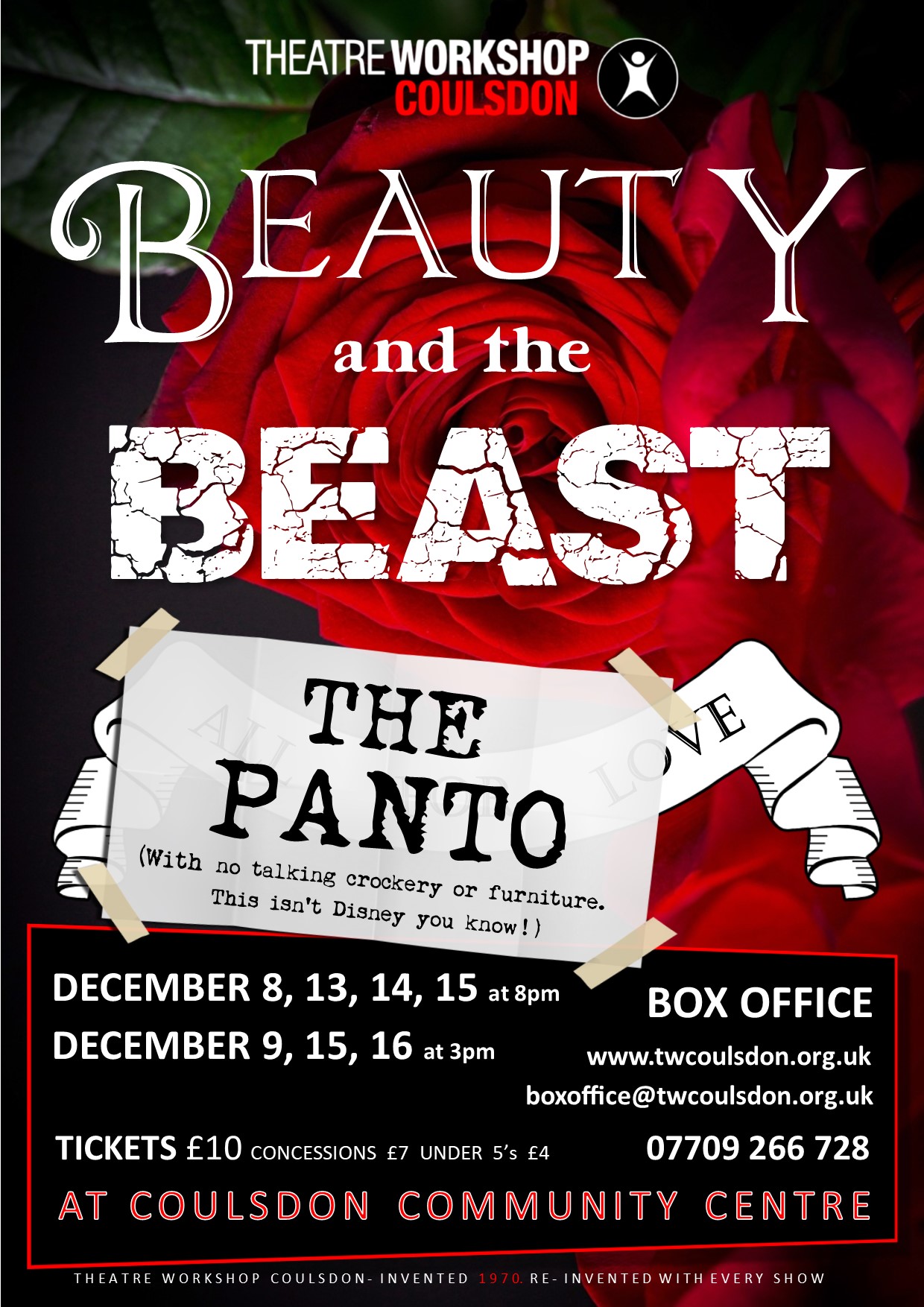
Beauty and The Beast – The Panto

Theatre Workshop Coulsdon’s Christmas 2018 production is an all-new, original pantomime based on the much-loved fairy tale, ‘Beauty and the Beast’. This classic tale, and its underlying message that you shouldn’t judge a book by its cover, has been transformed into a full-fat panto, rocket fuel for the winter season, chock-full of larger than life characters, sing-along songs and audience participation, as the lovely Beauty finds that the monstrous Beast is not what she was expecting. A full band and a large ensemble cast (Bumbling guards, saucy maids, talking vegetation and puppet creatures) support a tale of good versus the evil that is Deadly McNightshade, the woman who puts the wicked into witch and gives it a Scottish accent. Can true love break the dread spell that has locked a handsome prince in a prison he can never escape from? Oh yes it can!

But where did the original story come from? Well, once upon a time there was a woman called Gabrielle-Suzanne Barbot de Villeneuve (They had some cracking names back then) Born in Paris in 1685, she was married at 21 and widowed at 26, her aristocratic but spendthrift husband losing his life almost as swiftly as he lost their money. With her family fortune gone, she needed a way to support herself and eventually moved in with the celebrated playwright and poet Prosper Jolyot de Crebillon (See, another one!) where she began to write. From 1734 through to her death in 1755 she wrote novels and collections of fairy tales but most notably, in 1740, she wrote ‘La Belle et La Bête’, or as we know it, ‘Beauty and the Beast’. It formed part of a much larger story, and was much more complicated than we’re used to now. The simpler version is down to another Frenchwoman, Jeanne-Marie Leprince de Beaumont (and another!) who re-wrote the tale as a much shorter story and published it the year after Villeneuve’s death without acknowledging its origins. Which was a bit sneaky. Boo! Hiss!

Since then it’s become a children’s fairytale classic. Of course, that meant it got the full Disney treatment, twice now, both as a cartoon (1991) and a live-action movie (2017). But there have also been numerous other movie and TV adaptations, a stage musical, an opera, a ballet, and even songs, a disco tune and video games. Its themes of love conquering all and never judging by appearances are simple and easily relatable. And so Sheila May Bird, published children’s author (‘Pete’s Peculiar Petshop’, ‘Pirate Percy’s Parrot’ and others that don’t begin with the letter ‘P’) and long-time member of Theatre Workshop Coulsdon, decided that what had been missing all these years was a pantomime version, full of silliness, slapstick, songs, an audience participation number and the kind of ‘behind you!’ nonsense that makes going to the theatre at this time of year so much fun.
The Adventures of Jason and the Argonauts

The legends of Ancient Greece have continued to weave their magic through our imaginations for over two thousand years. The capricious Gods and Goddesses of Mount Olympus playing with the fates of ordinary mortals for both good and ill. But from the ranks of those mortals came the fabled heroes, those who rose to the challenges and won out despite all. Odysseus taking on the mighty one-eyed giant Cyclops. Theseus defeating the monstrous Minotaur in the labyrinth of Crete. Jason and his Argonauts travelling far and risking everything in search of the Golden Fleece.

This last provides the basis for our winter production. But don’t worry, you won’t need a degree in the classics to work out what’s going on. This is a very loose interpretation of the myths handed down over the centuries. Jason and Medea are two mixed-up kids, an orphan and a runaway, who suddenly find themselves tasked with overthrowing the evil tyrant King Pelias. With a certain amount of divine intervention, Jason becomes the captain of the mighty ‘Argo’, a ship capable of crossing the uncharted seas, with a crew of oddball heroes including the world’s strongest (and possibly clumsiest) man, a wonderful woman warrior, a resting rock star, the least identical twins ever and a seriously streetwise cat. Now he must set off and find the Golden Fleece. If only he knew what it was. And then there are the challenges. The man-eating Harpies of Lemnos, the terrible Clashing Rocks, the fire-breathing Great Bull of Colchis, the evil Dragon Snake and Talos, the bronze giant. (Who might just be a really cool sock puppet.) Not to mention The Sirens…

Medea, Jason and his misfit Argonauts are here this December to have fun. This will be no ordinary adventure tale, but one with songs and laughter, and we’ll be encouraging you to join in, whether you’re five or sixty five. Ever fancied rowing the Argo? You’ll get your chance. Become part of the undead army of skeleton warriors? Oh yes.

The award-winning author of ‘Jason and the Argonauts’, Phil Willmott, is mainly famous around these parts for his creation of the hilariously stiff upper-lipped ‘Dick Barton – Special Agent’ spoofs that were so much a part of the sadly demised Warehouse Theatre in Croydon. But he’s written, adapted and directed numerous productions, many derived from classical sources, and we’re more than pleased to link up with him again.

Sherlock Holmes and the Sons of Anubis

From the depths of ancient Egypt an ancient evil is rising, claiming the lives of those who have ransacked its history.

Is this a curse? An occult threat from which there is no defence? Or is there another side to this mystery, something more earthly yet just as deadly? What did Lord Caerphilly’s expedition to the Valley of the Kings disturb, and most importantly, how can it be stopped?

Richard Lloyd’s second exploration into the world of Arthur Conan Doyle’s most famous creation follows on from the success of ‘Sherlock Holmes and the Vampyres of London’, in which the legendary detective faced the iconic prince of darkness, Dracula. This time, as before, real and fictional characters of the period are combined in one fiendish mystery.

Holmes and his trusted companion Dr John Watson travel the streets of Victorian London, from the hallowed British Museum to the seedy brothels of London’s West End in search of the answer to a mystery that if unsolved, may see an empire fall. Which of its denizens may hold the vital clues? Lady Mountjoy, a woman whose most fervent desire is to see the treasures of the tombs returned? Agrippina Bligh, an unscrupulous Madam in a dark trade with darker secrets? The mysterious Egyptian Afzad Azul, who may as easily be allied with demons as angels?

Time is running out…

Dick Barton and the Carnival of Chaos

“Good evening. This is the BBC Light Programme broadcasting from London. It’s 6.45 and time for the next thrilling episode of ‘Dick Barton and the Carnival of Chaos’!”

Yes, Barton is back, and in his toughest assignment yet!

London. 1949. Wartime rationing remains in force, and only marmalade – that nutritious, morale-boosting foodstuff – continues to fortify our island nation’s grit, spunk, vim and pluck after six long years facing down the Nazi peril.
But now there’s a fiendish foreign conspiracy afoot to kidnap Tiggy Zesty-Peel, heiress to the Zesty-Peel preserves empire, and only Dick Barton can stop it. But who has evil designs on the Marmalade Millionairess? And just what is their nefarious purpose?

Meanwhile, Snowy White and Jock Anderson, Barton’s salt-of-the-earth working class assistants, are each in a jam of their own. Snowy’s been injected with bonobo serum during a brush with a batty Bulgarian ballerina, and has gone more than a little ape. And Jock has fallen for the charms of ex-Nazi filmmaker and flaxen femme fatale, Leni Fuchs.
Throw in the homegrown villainy of the Crayfish Twins (the East End’s favourite lovable cockney mass murderers) and mysterious Italian yoga swami, Contessa Bianca Di Scalzo, and the plot is thicker than a jar of rough-cut.
Can Barton unravel the mystery and save Britain’s marmalade? Or will our favourite spread succumb to the spread of evil? To find out, tune in to the next thrilling instalment of ‘Dick Barton and the Carnival of Chaos’!

Theatre Workshop Coulsdon’s third outing for Dick Barton, Boy’s Own adventurer, all-English hero and teatime wireless star, is another ripping comedy adventure, full of improbable characters, glorious gags, and a cheeky sprinkling of spiffing song and dance numbers. Pip pip!

Grimm Tales (2022)

Dare you go down to the woods today?

Theatre Workshop Coulsdon has adapted ten of the most famous tales from the Brothers Grimm into a single play. By turns magical, terrifying comic and profound, our ‘Grimm Tales’ is a festive theatrical treat for all the family (well, almost), delving as deep as the dwarves into a rich dark seam of lost European folklore.

The tales we’ve included, from ‘Hansel and Gretel’ to ‘Little Red Cap’, ‘Snow White’ and ‘Rumpelstiltskin’, are stripped back to their origins, freed from layers of Victorian prudery and Disney schmaltz, revealing the simple, undiluted truths of these ancient stories. Often funny, sometimes brutal, occasionally touching – they’re familiar yet strange, like something you’ve always known, but are only now seeing them for the first time.

Some of them include some old-fashioned fairy tale revenge, mayhem and a modest amount of gore. In other words, just the kind of things that generations of kids have grown up loving! That said, it’s probably not really suitable for toddlers and the very young. Or those of a particularly nervous disposition.

So join us on a journey to the dark heart of the forest. It all starts with ‘Once upon a time…’

About the Brothers Grimm

The root of all theatre is storytelling. Our performance of ‘Grimm Tales’ is based on some of the best-known stories of Jacob and Wilhelm Grimm – those avid collectors of folk tales from across the German-speaking lands of central Europe.

The brothers grew up in the late Eighteenth Century – the flowering of the period of European Romanticism.  The German romantics sought Der Volkseele or ‘folk-psyche’, and returned to the folksongs, ballads, and folk tales of earlier centuries to find it. The simplicity and truth of these folk traditions, despised by the highbrow thinkers of the Enlightenment, suddenly acquired a new value. They pointed to a rich, oral, pan-Germanic cultural legacy.

This quest for a distinctive German identity was given huge impetus in the early Nineteenth Century, when the patchwork of German states, great and small, had been laid waste by Napoleon, and all things German had been crushed under the ascendancy of all things French. For the Grimms, collecting old stories from across the German-speaking lands, became a mission to reinvent a distinctive German culture. Der Volkseele would reinvigorate and bind together the disparate peoples and states of the German nation – culturally, if not politically. In this, the work of the Brothers Grimm foreshadowed German unification, which followed in 1870.

The brothers travelled all over Europe to collect their tales, from the Baltics to Bohemia, Switzerland to Schleswig-Holstein, hoovering up every scrap and morsel of part-remembered fable, coaxed from nobleman and peasant alike. They transcribed these contributions as faithfully as possible, binding in authentic bits of nonsense, dialect words, old sayings, arcane rhymes and doggerel, just as they had been told to them.

In their devoted search for origins, the brothers invented the modern science of folklorism. By the 1850s they’d published seven editions of their two volumes of collected tales. By the end of the Nineteenth century, their 200 or so tales had been translated so widely that they were renowned around the world. Today, they remain the most popular and famous collection of folk stories in the Western world.


Wendy and Peter Pan

This Christmas, we’re delighted to present the perfect festive treat for all the family – the classic English childhood myth of love, loss, redemption – and pirates.

And Peter Pan, who never grows old. What’s not to like?

Winter, 1911. Snow is falling across London. Wendy Darling and her brothers sleep peacefully in their bedroom as their parents bicker downstairs. In a sudden flurry of snow their window blows open, and Peter Pan tumbles into their lives – followed by a fractious fairy called Tink. With the help of a little fairy dust, Wendy agrees to fly with Peter to Neverland, seeking an awfully big adventure and the key to her parents’ forgotten happiness – the child they once lost. Once there, Wendy will give the Lost Boys a run for their money, defeat the diabolical pirate Captain James Hook, and ultimately learn what it really means to grow up.

J.M.Barrie’s stage play, Peter Pan, delighted audiences when it premiered in 1904. His novel based on the play, Wendy and Peter, published in 1911, was a huge success. Commissioned by the Royal Shakespeare Company, Ella Hickson’s Wendy and Peter Pan premiered in December 2013, and it’s a sparkling new adaptation that puts Wendy centre stage. In a feisty take on Barrie’s much-loved tale, it never loses the charm of the original, nor any of its iconic set pieces.
It’s bittersweet, funny in places, touching in others, and brimming with action and adventure. Complete with musical accompaniment by our live band, plus our famous Christmas refreshments. It might be cold outside, but the mince pies and mulled wine will be piping hot!

Sherlock Holmes and the Vampyres of London

London 1887. When the mortal remains of a young aristocrat vanish in the dead of night from Brompton Necropolis, Sherlock Holmes is no sooner asked to investigate than a second mystery presents itself – a beautiful young heiress afflicted by unaccountable night terrors; her vitality slipping away.

As these two strange cases resolve themselves into one, Holmes and his steadfast companion, Dr. John Watson, are plunged into a hidden London of grave-robbing grotesques, murderous Szgany gypsies, and demonic possession that obscures a diabolical conspiracy to overthrow the Crown itself.

Theatre Workshop Coulsdon’s thrilling homage to late Victorian gothic pits two of fiction’s most enduring characters against each other. But in the fog-shrouded metropolis where nothing is what it seems, which towering colossus of literary legend will triumph in this savage, epochal battle of wits?

From the author:

Indulging an occasional impulse to put something dark on stage, when ‘Sherlock Holmes and the Vampyres of London’ slid into my head, I thought I’d hit upon an original idea. Ah well. Ten minutes on Google laid bare an entire sub-culture of Holmes vs. Dracula novels, comics and essays. I guess bringing together the two pre-eminent creations of late Victorian fiction was a bit of a no-brainer. The Yin and Yang of the fin-de-siècle imagination – an epic face-off for the ages…

In the red, white and blue corner: Sherlock Holmes – arch-rationalist, buttoned-up, attractively flawed apotheosis of British pluck, doggedness, and all-round brilliance. Set against him, that epitome of lubricious, unchecked carnal desires: Dracula – the screaming antithesis of idealized Victorian manhood. Evil, hypersexualized, and downright foreign. It’s the ultimate Victorian superhero against the ultimate Victorian bogeyman. I mean, why wouldn’t you?

Holmes first appeared in 1887; Dracula 10 years later in 1897. Both characters achieved almost immediate superstar status – a dazzling supernova of global fame which has shown no sign of fading since. They are twin titans of popular culture, endlessly reimagined in movies, television, books, games and comics.

Both Arthur Conan Doyle and Bram Stoker achieved immortality of sorts thanks to their creations: a Scotsman and an Irishman giving life to two of the most famous, enduring, and built-upon characters in English fiction.

I have built upon them shamelessly in turn. It was fun bringing them together.