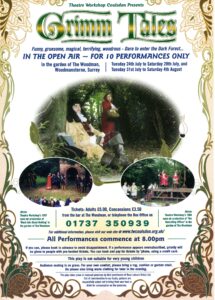
Grimm Tales (2022)
About the Production
Dare you go down to the woods today?
Theatre Workshop Coulsdon has adapted ten of the most famous tales from the Brothers Grimm into a single play. By turns magical, terrifying comic and profound, our ‘Grimm Tales’ is a festive theatrical treat for all the family (well, almost), delving as deep as the dwarves into a rich dark seam of lost European folklore.
The tales we’ve included, from ‘Hansel and Gretel’ to ‘Little Red Cap’, ‘Snow White’ and ‘Rumpelstiltskin’, are stripped back to their origins, freed from layers of Victorian prudery and Disney schmaltz, revealing the simple, undiluted truths of these ancient stories. Often funny, sometimes brutal, occasionally touching – they’re familiar yet strange, like something you’ve always known, but are only now seeing them for the first time.
Some of them include some old-fashioned fairy tale revenge, mayhem and a modest amount of gore. In other words, just the kind of things that generations of kids have grown up loving! That said, it’s probably not really suitable for toddlers and the very young. Or those of a particularly nervous disposition.
So join us on a journey to the dark heart of the forest. It all starts with ‘Once upon a time…’
About the Brothers Grimm
The root of all theatre is storytelling. Our performance of ‘Grimm Tales’ is based on some of the best-known stories of Jacob and Wilhelm Grimm – those avid collectors of folk tales from across the German-speaking lands of central Europe.
The brothers grew up in the late Eighteenth Century – the flowering of the period of European Romanticism. The German romantics sought Der Volkseele or ‘folk-psyche’, and returned to the folksongs, ballads, and folk tales of earlier centuries to find it. The simplicity and truth of these folk traditions, despised by the highbrow thinkers of the Enlightenment, suddenly acquired a new value. They pointed to a rich, oral, pan-Germanic cultural legacy.
This quest for a distinctive German identity was given huge impetus in the early Nineteenth Century, when the patchwork of German states, great and small, had been laid waste by Napoleon, and all things German had been crushed under the ascendancy of all things French. For the Grimms, collecting old stories from across the German-speaking lands, became a mission to reinvent a distinctive German culture. Der Volkseele would reinvigorate and bind together the disparate peoples and states of the German nation – culturally, if not politically. In this, the work of the Brothers Grimm foreshadowed German unification, which followed in 1870.
The brothers travelled all over Europe to collect their tales, from the Baltics to Bohemia, Switzerland to Schleswig-Holstein, hoovering up every scrap and morsel of part-remembered fable, coaxed from nobleman and peasant alike. They transcribed these contributions as faithfully as possible, binding in authentic bits of nonsense, dialect words, old sayings, arcane rhymes and doggerel, just as they had been told to them.
In their devoted search for origins, the brothers invented the modern science of folklorism. By the 1850s they’d published seven editions of their two volumes of collected tales. By the end of the Nineteenth century, their 200 or so tales had been translated so widely that they were renowned around the world. Today, they remain the most popular and famous collection of folk stories in the Western world.

The Cast
Behind the Scenes
Image Gallery


The Reviews
These Grimm Tales can lift the mood on the greyest of days
Stories of fairies and witches, goblins and wolves are being re-told red in tooth and claw, as BELLA BARTOCK, our arts correspondent, found out at the Theatre Workshop Coulsdon’s winter production.
It was only three o’clock in the afternoon on Sunday, but it was already grim grey, with the cold clouds reaching all the way down to the chill frosted leaves of the trees and bushes in the garden as I stepped out to get into the Rolls for our latest dramatic adventure. Nephew Kenny had already driven over to collect my companion, Claudia de Boozy, who was waiting, sunk deep into the back seat’s soft leather upholstery, as I got in beside her. Before I could say a word, Claudia signalled to me urgently, putting a finger to her lips in the time-honoured style of someone seeking silence.And then she pulled an exaggerated sad face – exaggerated even by her usual standards. I shrugged, as it to ask, “What?!”, and Claudia just pointed ahead, to Kenny in the driving seat.
“What’s the matter, Kenny?” I asked. “You look grim.” “Harry,” he said, sounding close to tears. “England… and…”
“And St George, dear? No, we’re not off to Shakespeare this time,” I assured him, since I knew he was no great fan of sitting in the back of an auditorium while Claudia and I enjoyed the works of the bard.
“No, aunt. Harry Kane, England and the football,” he said.
I was none the wiser. Claudia leaned towards me and whispered something about a “whirl klopp”, which I took to mean she had been doing some research into German folklore before our latest excursion.
But as Kenny had pulled out onto the road towards Woodcote and Coulsdon, I got out my little hip flask, took a swig of the not-too-dry sherry, offered the flask to Claudia and thought no more about it. “Now Claudia, what do you know about the legends and folk stories of central Europe?” I was shocked by what I heard next. Rumpelstiltskin, Claudia told me, the title of one of the Grimm brothers’ fairy stories which have been told and re-told to generations of young children as a bed-time story, was in fact derived from the German rumpelstilzchen. “And that,” Claudia announced with a flourish, “means shrivelled foreskin.” She screwed up her face as she said it.
We were on our way to the splendid Coulsdon Community Centre, where Theatre Workshop Coulsdon, now in their 52nd year, were performing Grimm Tales, a collection of some of the best and best-known fairy stories that we all think that we know, having heard versions of many of them on our mother’s knee. And most of which, as I was about to discover, we barely know at all…
I know that I was particularly curious about the big, or not-so-big, reveal in the re-telling of Rumpelstiltskin now.
Wilhelm and Jacob Grimm had spent much of the 18th Century travelling from the Baltic to Bohemia, from Switzerland to Schleswig-Holstein, collecting and collating the Germanic folk stories of the spoken tradition. Their take on nursery tales was very much darker than their Danish contemporary, Hans Christian Andersen, with his cuddly morality stories about ugly ducklings and naked kings. By the turn of the 20th Century, the Grimms’ 200 or so tales had been translated so widely that they had become woven into the popular imagination of generations, many of whom had been dispersed around the world in the wave of emigration from Europe in the previous century. At least two of the 10 stories in the TWC show – Ashputtel, what we know better as Cinderella, and Snow White – are embedded in our British Christmas-time psyche as pantomimes.
And what Grimm Tales demonstrates with each changing scene is that we really don’t know any of the stories at all! “I don’t remember that in the film,” Claudia whispered to me more than once during the matinee.
All those stories that we thought we knew, having been adapted, embellished, neutered or sanitised, are far removed from the real tales told by the Grimms – and now re-told here with gusto by Coulsdon’s premier am-dram group. Director Mike Brown – take a bow, young man – has stripped back the stories to something far closer to the originals. Where else might you expect to see a donkey shitting gold coins on stage?
“Peeling away the layers of Victorian sanitisation and twee Disneyfication which have clouded and diluted the true nature of these remarkable and other-worldly ancient tales, to uncover something both intriguing and unsettling, familiar, yet altered, simpler, yet darker and altogether more compelling,” the programme notes say. “For when you scratch the surface of these stories, humanity’s deepest hopes and darkest fears are laid bare.” Wooohoooohaaa-argh! I was reminded of Neil Jordan and Angela Carter’s The Company of Wolves movie from the 1980s in its reworking of Little Red Riding Hood, or as it was played out in Coulsdon as Little Red Cap, played by Daisy Worby. This version is all red in tooth and claw. Anyone who sees this will probably be put off re-wilding schemes forever more.
What Brown, assisted by Lucy-Ann Bird, Pete Bird and Richard Lloyd, and the rest of the team have done in Coulsdon, on stage and behind the scenes, is a mammoth achievement – acting out 10 Jackanory-style episodes with humour and panache.I counted more than 80 characters involved in all, with actors playing multiple parts throughout, a team of “Sprites” to move the scenery and provide the “special” effects and quick costume changes, and then another eighty names listed on the credits page performing various tasks behind the scenes and front of house. “Better organised than the council,” Claudia said out loud as she handed her second empty gluhwein glass to one of the team who was clearing away down the aisle in the interval.
Almost all the tales had a strong moral ending – who knew that DIY podiatry was a thing in medieval Germany? – and all of them were full of laughs, mostly intentional. But Claudia and I agreed that our favourite, and funniest, was probably The Golden Goose, as Aldo Piscina’s Dummling and his entourage parade manically around the whole theatre. TWC’s cast has some familiar members who yet again deliver convincing performances, even given the fantastical nature of the works. Hannah Montgomery and Indianna Scorziello as the wicked sisters in Ashputtel could put some pro panto dames out of work, especially in our age of gender fluidity, while Nina Amos is a Cinderella for the ages. And when Scorziello returns later as Snow White, she wins over the audience as her singing voice capably reminds us of that Disneyfication of the story.
Richard Lloyd, Paul Ford and Dawn Ford in their various narrator and acting roles provide the glue to hold several of the stories together. Bruce Montgomery is believably evil as the greedy landlord in The Magic Table, in which Hannah Montgomery is the best goat ever to be seen on stage.Connor Nestor does the goblin thing rather well in Rumplestiltskin, and Dawn Ford, as the iciest of Queens in Snow White, provides adequate amounts of menace with her Mirror, Mirror routines. Anya Destiney is the evilest of Stepmothers in Hansel and Gretel. There are always challenges in a live staging of stories which we have all come to know from seeing multi-million-dollar movies with ample access to CGI.
“How, in this woke age, are they going to cope with this?” Claudia said in the interval, her bony finger prodding towards Snow White, which in the programme makes no mention of the Seven Dwarves. That big reveal is very much worth waiting for.
Grimm Tales is being performed at 7.45pm from tomorrow evening (Wednesday, December 14) through to Saturday, December 17, with a matinee at 3pm on Saturday. It was a full house when Claudia and I were there last Sunday, though as she told me later, there was no football on… The matinee for Sunday December 18 is already sold out. So there’s probably no football on then, either. As we made for the exit, there were more “Ooohs” and “Aaahs” from the audience. Snow was falling outside in the evening gloom, sprinkling a little more wintry fairy dust over what had already been a magical couple of hours, when for a brief while, things had seemed not quite so grim.
Bella Bartock for Inside Croydon, December 13, 2022
Other Productions