The Box of Delights

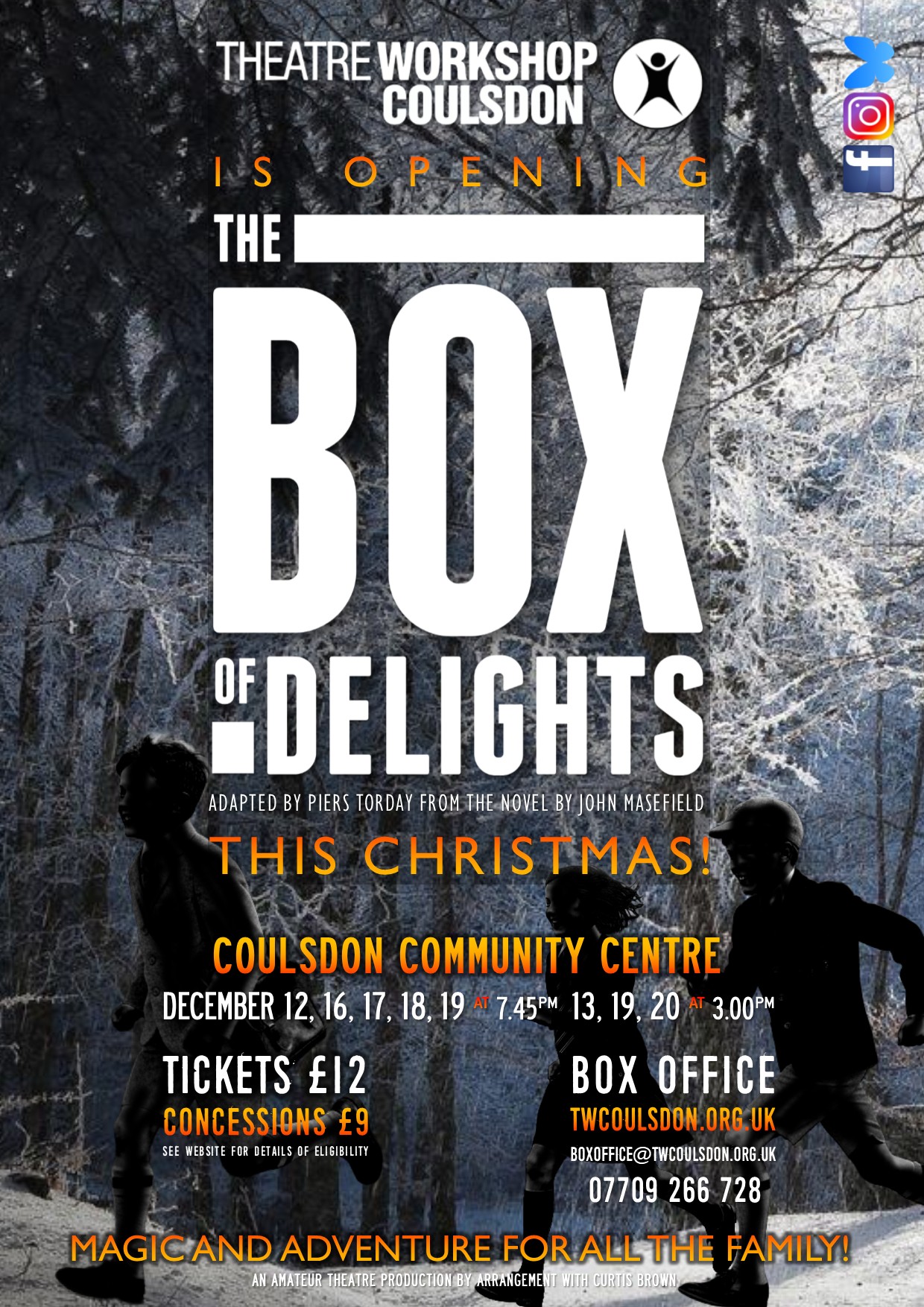
Just days before Christmas, young Kay Harker is travelling home by train from boarding school, to spend the festive season with his guardian Caroline Louisa. Seemingly by chance, he makes friends with a dog and then the dog’s mysterious master, but when they vanish and two suspicious-looking men board the train looking for them, Kay finds himself caught up in a struggle between good and evil for the possession of the most powerful magical artefact the world has ever seen, The Box of Delights.

The murderous magician Abner Brown has been hunting for the Box for years and will stop at nothing to get it. His wolves, and the villainous high-society thief Sylvia Daisy Pouncer and her crew, have been tasked to find it at all costs. As the snow falls on the little town of Condicote, can Kay and his friends Maria and Peter really stop them?

Magic, adventure and spectacle abound in this seasonal tale as the three children find themselves in a desperate race against time to save Christmas and just possibly the world.

Written by the then Poet Laureate John Masefield in 1935, the original story was a sequel to an earlier book of his ‘The Midnight Folk’. Elegantly whimsical at times, the tale of children becoming involved in a magical world was a precursor to other stories that have become far more famous, such as C S Lewis’ ‘Chronicles of Narnia’ (‘The Lion, The Witch and The Wardrobe’ et al) which was first published in 1950, and J K Rowling’s cultural behemoth ‘Harry Potter’, which first saw light of day in 1997. There are definitely echoes of Masefield’s creations in both, and if you’re a fan of either, you’ll find much here to entertain you.

Piers Torday adapted ‘The Box of Delights’ for the stage in 2017, when it was performed at Wilton’s Music Hall. The production was subsequently picked up by the RSC and a far grander, and undoubtedly expensive version was put on in 2023.

From Christmas carols to flying cars, this is festive family adventure at its finest.

Tickets on sale now!

An amateur theatre production by arrangement with Curtis Brown.

‘Harry Potter’ is a copyright work of J K Rowling. ‘Narnia’ is a copyright work of C S Lewis, now owned by the C S Lewis Company Ltd.
Oh What A Lovely War

Our open air Summer 2026 production will be the musical entertainment that is ‘Oh What a Lovely War’.

Created by Joan Littlewood’s Theatre Workshop in 1963, ‘Oh What a Lovely War’ tells the story of the First World War through popular songs and music of the period. Known as ‘The Great War’ and even ‘The War To End All Wars’ (sadly so very wrong) the four years of bloody conflict between August 1914 and November 1918 resulted in the deaths of millions and changed the entire global landscape. Old empires fell, new ones began to rise, and the seeds were sewn not for lasting peace, but for conflict to come.

This is not a tale of bravery and heroism. By balancing music hall songs such as ‘Roses of Picardy‘, ‘Hold Your Hand Out, You Naughty Boy‘, ‘I’ll Make A Man Out Of You‘ and ‘Keep The Home Fires Burning‘ with tunes from the trenches such as ‘I Don’t Want To Be A Soldier‘, ‘Gassed Last Night‘, ‘When This Lousy War Is Over‘ and of course ‘Oh What A Lovely War‘, with sketches shedding light on what went on both on the front lines and behind them, the play lays bare the stupidity, corruption and futility of the war, at the same time sending up mercilessly the upper echelons of Britain’s military, more concerned with prestige and position and outdated ideology, unable or unwanting to change in the face of new technologies such as the machine gun, poison gas, aeroplane or tank, capable of dispensing death on a new, industrial scale.

With the men in the frontline being ordered to do the impossible, their best, and sometimes their only, armour was a sense of humour, and this production showcases that brilliantly. Come and see us, join in the songs (you’ll know more than you think) and laugh along with the Tommies, the lions led by donkeys…

The Sweet Science of Bruising

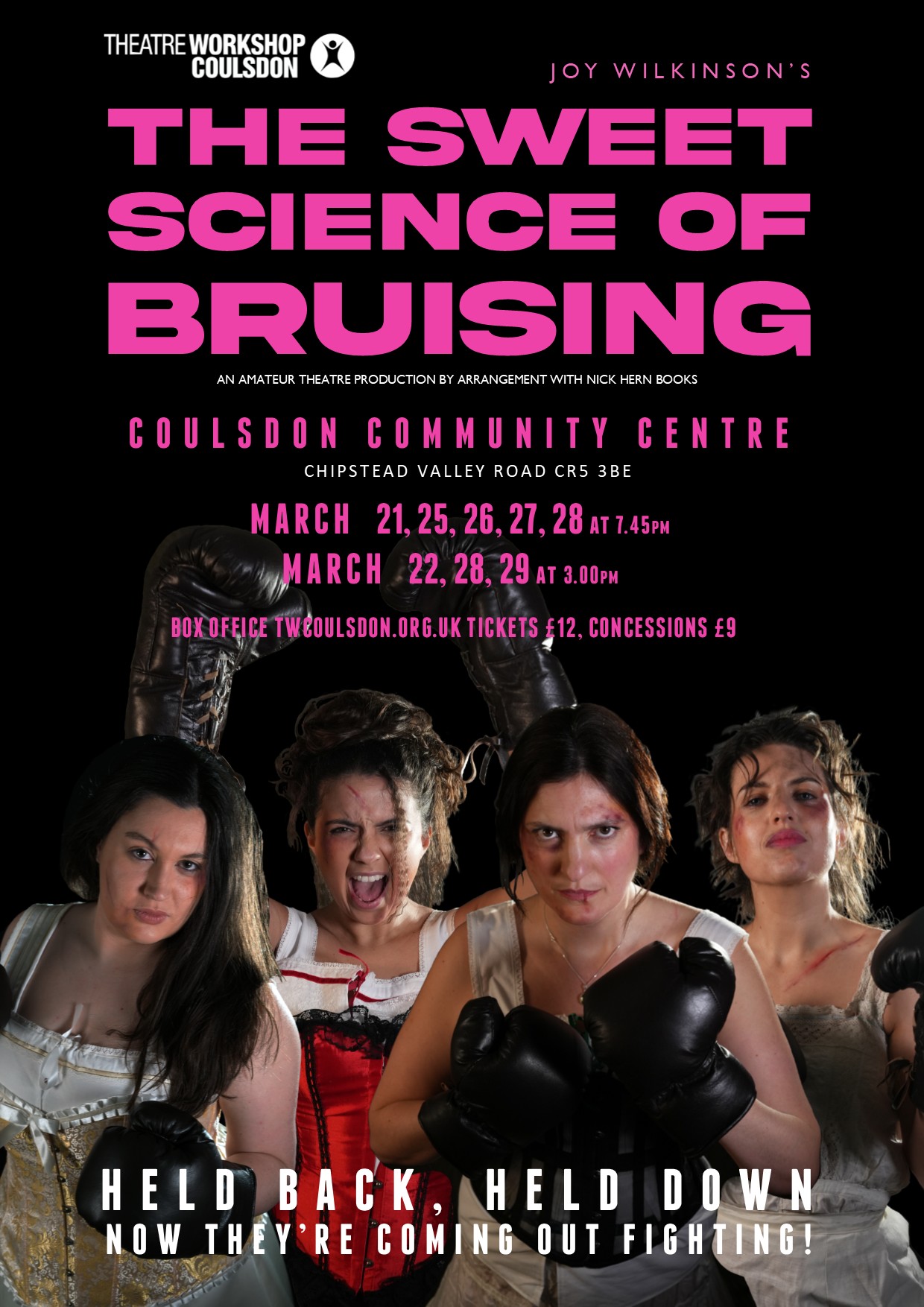
Victorian London, 1869. The shadowy world of female boxing provides the opportunity for four very different women to break away from the lives that have been ordained for them by society.

Polly Stokes is a fighter, has been ever since she was abandoned on a doorstep as a babe. Irish-born Mattie Blackwell lives on the streets, her life a constant battle to survive. Violet Hunter wants to be a doctor but no man will let her, and Anna Lamb seems to have it all, a husband, children, a house, servants… but in truth, she has nothing.

Held in by corsets, held back by men, the violent release they find in the boxing ring brings them a form of freedom they’ve never known, but at the final bell, there can only be one Lady Boxing Champion of the World.

An epic tale of passion, power, politics and pugilism from the pen of Joy Wilkinson and performed with verve by TWC.

Burnley-born Joy Wilkinson is an accomplished and prize-winning author who has written several plays (Now is the Time, Fair and Britain’s Best Recruiting Sergeant among others), plus numerous TV and film scripts covering a range from sci-fi/fantasy such as Doctor Who and Lockwood & Co. through to thrilling dramas Suspect and The Pact, via Holby City, Casualty and Land Girls.

My Fair Lady

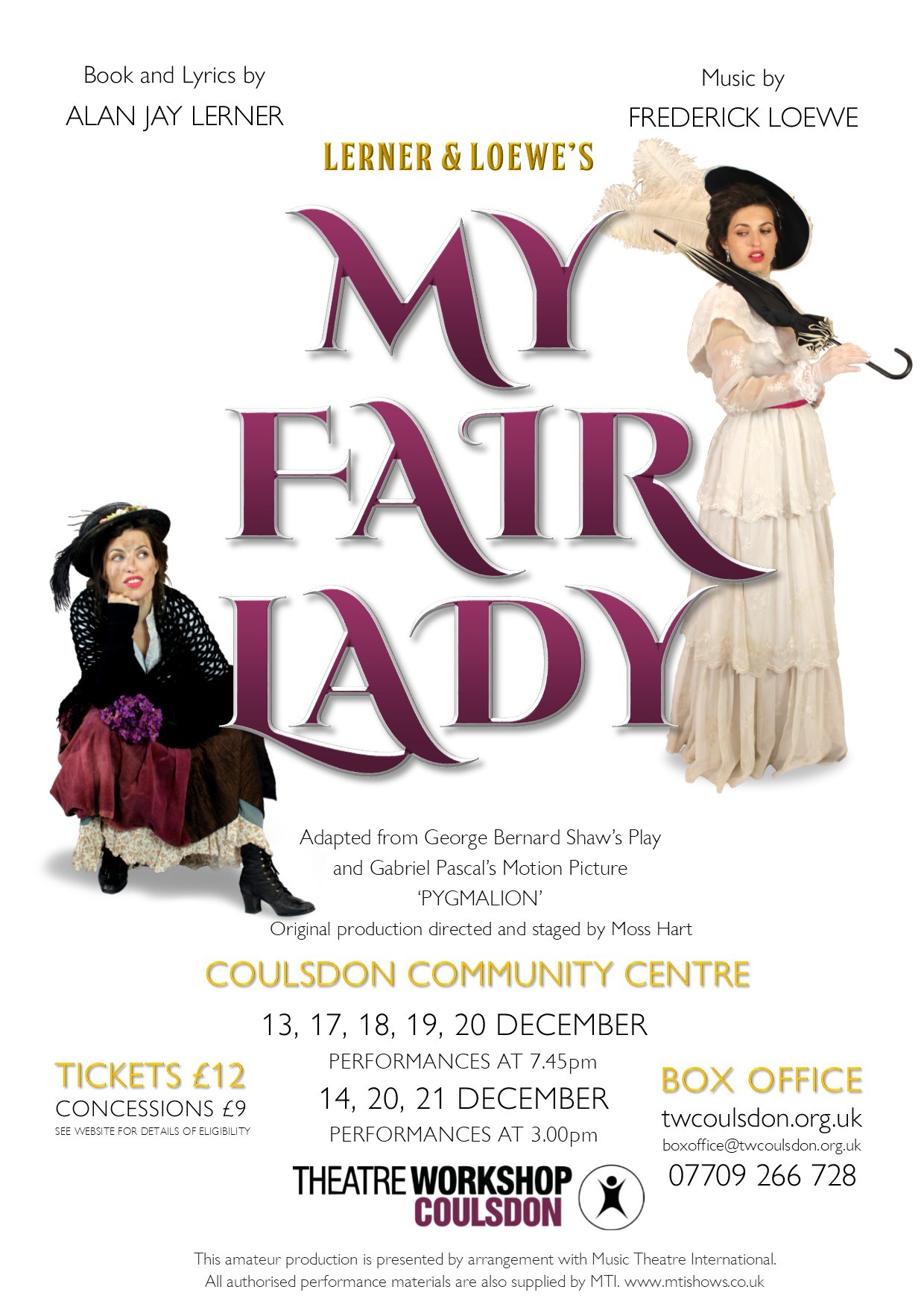
Lerner and Loewe’s celebrated stage musical adaptation of George Bernard Shaw’s ‘Pygmalion’ includes some of the best known and best loved show tunes ever written. From ‘Wouldn’t It Be Loverley’ to ‘I’m Getting Married in the Morning’, ‘I Could Have Danced All Night’ and ‘With A Little Bit Of Luck’.

It’s the story of a cockney flower girl’s transformation into the pride of London society – and its unforeseen consequences. In many places it’s very funny; in others, very poignant. When overbearing Professor Higgins stumbles on Eliza Doolittle outside Covent Garden Opera House, he recognises that her hideous vowels and lost consonants are all that separates her from the upper classes. Higgins casually makes a wager that within weeks he can pass Eliza off in polite society as a Duchess. But little does he know that beneath the dirty face and shabby clothes, young Eliza is stuffed full of human feeling. Too eloquent for a flower girl, yet lacking the breeding of the ruling classes, what on earth is to become of Eliza when the bet is over and the game has reached an end?

‘My Fair Lady’ was Lerner and Loewe’s musical adaptation of George Bernard Shaw’s ‘Pygmalion’, a much darker tale than the highly successful Broadway, West End and Hollywood show tells.

The character of ‘Pygmalion’ comes from Greek mythology, where he was sculptor who fell in love with a statue he had created, a statue that then comes to life. Bernard Shaw took that tale and twisted it, the sculptor becoming Henry Higgins, and the thing he creates, Eliza Doolittle. His play debuted in 1913 in Vienna, before going on to London and New York. Critics were generally favourable, though the ending created a certain level of controversy. A standard love story this wasn’t, and the ending was no more conventional. A film version was made in 1938, starring Leslie Howard as Higgins and Wendy Hiller as Eliza, and Shaw, initially distrustful, agreed to it being made only if he had a certain amount of creative control. This resulted in Shaw writing a whole new ballroom scene, the creation of a new character ‘Zoltan Karpathy’, and a new ending. He and his fellow screenwriters were awarded an Oscar for the screenplay, for which Shaw was characteristically dismissive, but it would be this screenplay that would be used as the basis for the musical.

The director of the movie, Gabriel Pascal, had spoken with Shaw about making it into a musical, but the author had refused. However, when Shaw died in 1950, that barrier was no longer an issue. Pascal approached lyricist Alan Jay Lerner to write the musical, with his partner, composer Frederick Loewe. At first, they couldn’t make it work but eventually they found a way, though not before Pascal had died. They called it ‘My Fair Lady’ after a provisional title to Shaw’s play ‘Pygmalion’, and it referred to the Cockney pronunciation of ‘Mayfair Lady’, helping to show Eliza’s transformation from working-class girl to upper-class woman. The part of ‘Higgins’ was initially offered to Noel Coward, who turned it down but suggested they approach Rex Harrison. ‘Eliza’ was offered to Broadway veteran Mary Martin who also turned it down, and they went instead for newcomer Julie Andrews. It opened on Broadway in March 1956 and was a massive success, going on to become, at the time, the biggest grossing Broadway show ever.

The 1964 movie was a similar success, winning eight Oscars including those for Best Picture and Best Actor (Rex Harrison). Interestingly, the Best Actress Oscar that year went to Julie Andrews for her portrayal of Mary Poppins, having been rejected for reprising the part of Eliza as not being famous enough by the studio. It went, famously, to Audrey Hepburn, whose singing voice was overdubbed by Marni Wood.

Theatre Workshop Coulsdon’s presentation of this fabulous show was directed by veteran actor/director Richard Lloyd with musical director and pianist Mark Taylor, and features Dan Carr as Professor Henry Higgins, Indianna Scorziello as flower-seller Eliza Doolittle, Paul Ford as her ne’er-do-well father Alfred, and Mike Brown as the bluff and amiable Col. Pickering.