Oh What A Lovely War

Our open air Summer 2026 production will be the musical entertainment that is ‘Oh What a Lovely War’.

Created by Joan Littlewood’s Theatre Workshop in 1963, ‘Oh What a Lovely War’ tells the story of the First World War through popular songs and music of the period. Known as ‘The Great War’ and even ‘The War To End All Wars’ (sadly so very wrong) the four years of bloody conflict between August 1914 and November 1918 resulted in the deaths of millions and changed the entire global landscape. Old empires fell, new ones began to rise, and the seeds were sewn not for lasting peace, but for conflict to come.

This is not a tale of bravery and heroism. By balancing music hall songs such as ‘Roses of Picardy‘, ‘Hold Your Hand Out, You Naughty Boy‘, ‘I’ll Make A Man Out Of You‘ and ‘Keep The Home Fires Burning‘ with tunes from the trenches such as ‘I Don’t Want To Be A Soldier‘, ‘Gassed Last Night‘, ‘When This Lousy War Is Over‘ and of course ‘Oh What A Lovely War‘, with sketches shedding light on what went on both on the front lines and behind them, the play lays bare the stupidity, corruption and futility of the war, at the same time sending up mercilessly the upper echelons of Britain’s military, more concerned with prestige and position and outdated ideology, unable or unwanting to change in the face of new technologies such as the machine gun, poison gas, aeroplane or tank, capable of dispensing death on a new, industrial scale.

With the men in the frontline being ordered to do the impossible, their best, and sometimes their only, armour was a sense of humour, and this production showcases that brilliantly. Come and see us, join in the songs (you’ll know more than you think) and laugh along with the Tommies, the lions led by donkeys…

It’s A Wonderful Life

Bedford Falls is a small town in a big country, and for as long as he can remember, George Bailey had wanted to leave it behind and see the world, make a real difference. Somehow though, he never got the chance. Now, on a cold Christmas Eve, he stands on a snow-clad bridge parapet, looking down into the dark, icy river below. He faces ruin, but perhaps one last sacrifice can salvage some small hope for those he loves. But kind eyes are watching, and on the edge of tragedy, George is given a divine opportunity to see how his life has changed so many others.

This new adaptation of ‘It’s A Wonderful Life’ by Mary Elliot Nelson follows George and many of the other inhabitants of Bedford Falls from the end of the Great War, through the Depression of the 1930’s, to the end of the Second World War. From high school prom to happy marriage, the wins and the losses, the smiles and heartbreak, the characters both good and bad that make up life in Bedford Falls.

This play is based on the now classic 1946 movie directed by Frank Capra and starring James Stewart and Donna Reed. It’s an uplifting, moving story of love, redemption and community. It’s also a brilliant, evocative slice of period small town Americana.

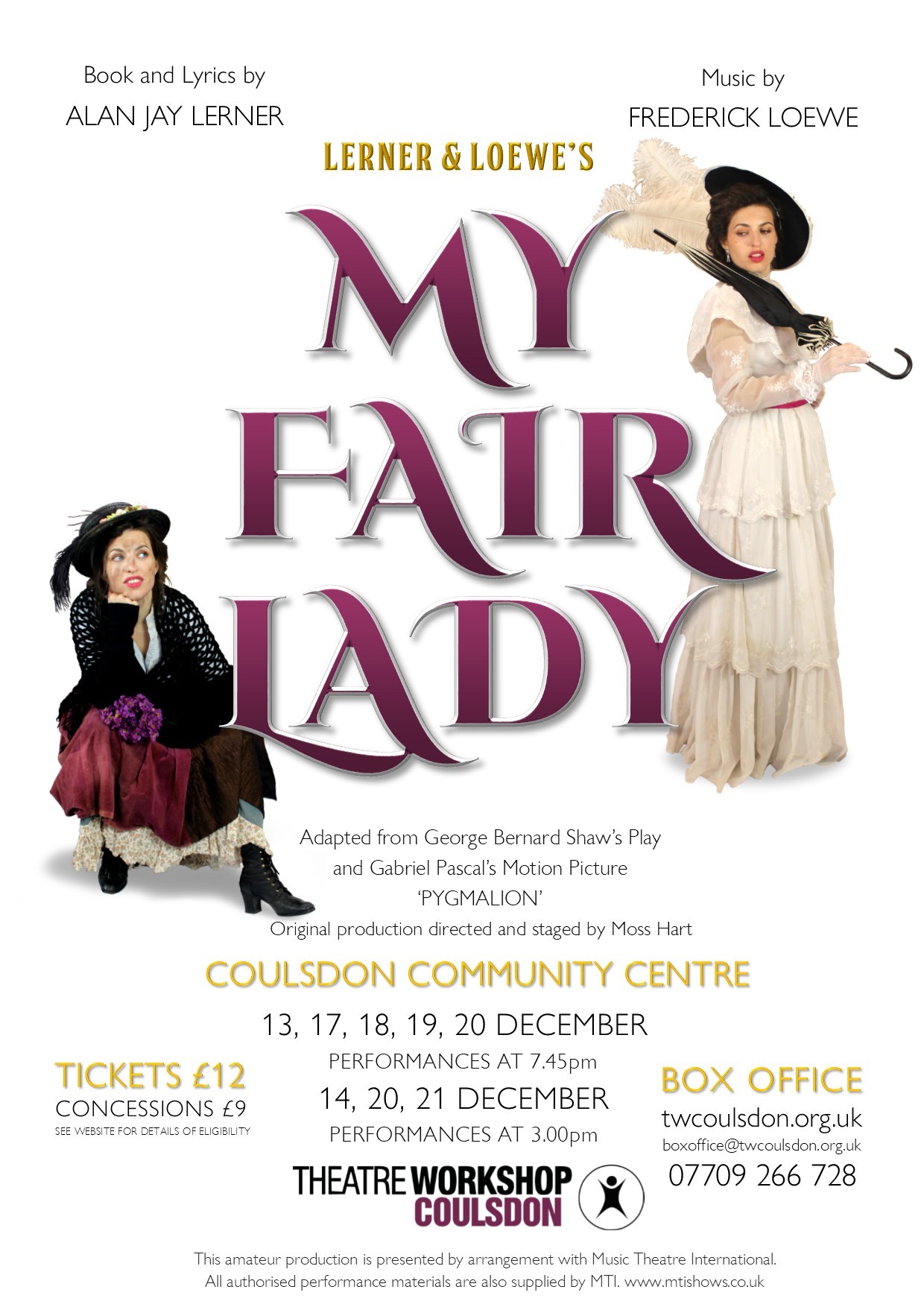
My Fair Lady

Lerner and Loewe’s celebrated stage musical adaptation of George Bernard Shaw’s ‘Pygmalion’ includes some of the best known and best loved show tunes ever written. From ‘Wouldn’t It Be Loverley’ to ‘I’m Getting Married in the Morning’, ‘I Could Have Danced All Night’ and ‘With A Little Bit Of Luck’.

It’s the story of a cockney flower girl’s transformation into the pride of London society – and its unforeseen consequences. In many places it’s very funny; in others, very poignant. When overbearing Professor Higgins stumbles on Eliza Doolittle outside Covent Garden Opera House, he recognises that her hideous vowels and lost consonants are all that separates her from the upper classes. Higgins casually makes a wager that within weeks he can pass Eliza off in polite society as a Duchess. But little does he know that beneath the dirty face and shabby clothes, young Eliza is stuffed full of human feeling. Too eloquent for a flower girl, yet lacking the breeding of the ruling classes, what on earth is to become of Eliza when the bet is over and the game has reached an end?

‘My Fair Lady’ was Lerner and Loewe’s musical adaptation of George Bernard Shaw’s ‘Pygmalion’, a much darker tale than the highly successful Broadway, West End and Hollywood show tells.

The character of ‘Pygmalion’ comes from Greek mythology, where he was sculptor who fell in love with a statue he had created, a statue that then comes to life. Bernard Shaw took that tale and twisted it, the sculptor becoming Henry Higgins, and the thing he creates, Eliza Doolittle. His play debuted in 1913 in Vienna, before going on to London and New York. Critics were generally favourable, though the ending created a certain level of controversy. A standard love story this wasn’t, and the ending was no more conventional. A film version was made in 1938, starring Leslie Howard as Higgins and Wendy Hiller as Eliza, and Shaw, initially distrustful, agreed to it being made only if he had a certain amount of creative control. This resulted in Shaw writing a whole new ballroom scene, the creation of a new character ‘Zoltan Karpathy’, and a new ending. He and his fellow screenwriters were awarded an Oscar for the screenplay, for which Shaw was characteristically dismissive, but it would be this screenplay that would be used as the basis for the musical.

The director of the movie, Gabriel Pascal, had spoken with Shaw about making it into a musical, but the author had refused. However, when Shaw died in 1950, that barrier was no longer an issue. Pascal approached lyricist Alan Jay Lerner to write the musical, with his partner, composer Frederick Loewe. At first, they couldn’t make it work but eventually they found a way, though not before Pascal had died. They called it ‘My Fair Lady’ after a provisional title to Shaw’s play ‘Pygmalion’, and it referred to the Cockney pronunciation of ‘Mayfair Lady’, helping to show Eliza’s transformation from working-class girl to upper-class woman. The part of ‘Higgins’ was initially offered to Noel Coward, who turned it down but suggested they approach Rex Harrison. ‘Eliza’ was offered to Broadway veteran Mary Martin who also turned it down, and they went instead for newcomer Julie Andrews. It opened on Broadway in March 1956 and was a massive success, going on to become, at the time, the biggest grossing Broadway show ever.

The 1964 movie was a similar success, winning eight Oscars including those for Best Picture and Best Actor (Rex Harrison). Interestingly, the Best Actress Oscar that year went to Julie Andrews for her portrayal of Mary Poppins, having been rejected for reprising the part of Eliza as not being famous enough by the studio. It went, famously, to Audrey Hepburn, whose singing voice was overdubbed by Marni Wood.

Theatre Workshop Coulsdon’s presentation of this fabulous show was directed by veteran actor/director Richard Lloyd with musical director and pianist Mark Taylor, and features Dan Carr as Professor Henry Higgins, Indianna Scorziello as flower-seller Eliza Doolittle, Paul Ford as her ne’er-do-well father Alfred, and Mike Brown as the bluff and amiable Col. Pickering.

Animal Farm (2025)

All is not well on Manor Farm. The animals are neglected and abused by their drunken owner, and anger and a sense of injustice are growing. They dare to dream of taking their destinies into their own hooves, paws and claws. When man is gone, fairness and equality for all animals shall be the rule! Won’t it?

TWC’s Summer 2025 open air production is a new, fast-paced, occasionally frightening and sometimes bleakly comic adaptation of one of the most celebrated novels of the Twentieth Century – George Orwell’s ‘Animal Farm’.

An army of downtrodden farm animals rises up to overthrow their human oppressors. But their dream of a society where all animals are equal soon collides with the seductive allure of privilege and the corrupting nature of political power. Orwell’s famous fable – a brilliant satire on the Russian revolution and the rise of Stalin – is a gripping tale of rebellion, heroism and ultimate betrayal. The writing is on the wall – literally:

ALL ANIMALS ARE EQUAL, BUT SOME ANIMALS ARE MORE EQUAL THAN OTHERS

Accidental Death of an Anarchist

Dario Fo’s dark comedy was based on the real life events in the aftermath of a terrorist bombing in Milan. While in custody, one of the suspects, ultimately found to be innocent, ‘fell’ from a window on the fourth floor of the police station.

In this new adaptation by Tom Basden, he shifts the spotlight from 1970s Milan to London and today’s Metropolitan Police, which in recent years has staggered from crisis to crisis, with incidents and allegations of inappropriate behaviour, abuse of power, racism and misogyny, all too frequently covered up or brushed under the carpet.

The coppers in the show no doubt believe that what they’re doing is right, or at least that their possibly dubious actions are defensible, under the circumstances. Honest, guv. The maniac, our main protagonist, is out to get to the truth or something close to the truth, and on the way show the complete absurdity of the situation. The play, is, first and foremost, a farce, fast-moving, funny and frantic. You’ll find yourself laughing out loud, and then later, thinking about why…

Please note this play does include some use of strong adult language. Parents may deem it unsuitable for younger children.