Animal Farm (2025)
About the Production
All is not well on Manor Farm. The animals are neglected and abused by their drunken owner, and anger and a sense of injustice are growing. They dare to dream of taking their destinies into their own hooves, paws and claws. When man is gone, fairness and equality for all animals shall be the rule! Won’t it?
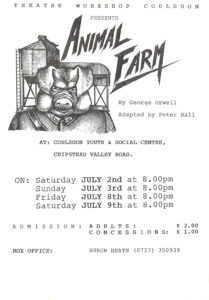
TWC’s Summer 2025 open air production is a new, fast-paced, occasionally frightening and sometimes bleakly comic adaptation of one of the most celebrated novels of the Twentieth Century – George Orwell’s ‘Animal Farm’.
An army of downtrodden farm animals rises up to overthrow their human oppressors. But their dream of a society where all animals are equal soon collides with the seductive allure of privilege and the corrupting nature of political power. Orwell’s famous fable – a brilliant satire on the Russian revolution and the rise of Stalin – is a gripping tale of rebellion, heroism and ultimate betrayal. The writing is on the wall – literally:
ALL ANIMALS ARE EQUAL, BUT SOME ANIMALS ARE MORE EQUAL THAN OTHERS

The Cast
Behind the Scenes
Image Gallery


The Reviews
There's A Revolution Going On In A Wooded Glade In Coulsdon
‘Man is the only creature that consumes without producing’ wrote George Orwell 80 years ago, but as Theatre Workshop Coulsdon has shown once more, they certainly know how to produce compelling drama. KEN TOWL was at the opening night of Animal Farm in the grounds of the Coulsdon Manor Hotel.
In a sylvan glade in the grounds of the Coulsdon Manor Hotel, Theatre Workshop Coulsdon pulls no punches in a fast-paced and knowing performance of George Orwell’s Animal Farm. The idyllic surrounding is, in itself, loaded with irony. The wooded space that borders the manicured lawns of the hotel are far from either the terrors of Stalin’s Soviet Union or the muck and stench of the farmyard. However, as we have seen from their productions of ‘Machinal’, ‘A Christmas Carol’ and ‘Accidental Death of an Anarchist’, TWC are ready to get down and get dirty and focus on the meeting place between the personal and the political. Orwell’s own explanation of where he got the idea for his allegory from, his observation that “men exploit animals in much the same way that the rich exploit the proletariat”, is explicit in this staging. This was to be no pantomime with animal masks or costumes.
I spoke to neophyte director Indianna Scorziello before curtains-up and she explained that the animals were suggested through movement and other elements, allowing the audience to focus on the characters and what they stood for. That this is allegory, and that the animals stand for individuals or social classes, is set out clearly in the programme. Thus, for example, under Napoleon/Richard Lloyd, we read in the programme notes not a potted history of Lloyd’s acting experience, as might be expected, but instead a bio of Joseph Stalin. Similarly, Dan Carr is Snowball is Leon Trotsky, just as surely as Daisy Worby’s flighty, self-obsessed Mollie “represents the petit bourgeoisie” and Mike Brown’s noble and stalwart Boxer ”stands for the Russian peasantry”.
Scorziello, herself a veteran TWC performer, has created a challenge for her actors. They have to convey both their individual “personalities” and the idiosyncrasies of their species without distracting us from the storyline. This is achieved, subtly, by all the actors so that we, the audience, can immerse ourselves in a world in which chickens, sheep, cows and horses can hold debates about revolution, egg production and the distribution of manure.
While all the actors add something ovine, bovine, equestrian or porcine to this production, a few stand out because of their pivotal roles. Without a strong lead (or, indeed, “strong leader” as he is alluded to in the play, in one of several references to the present day), the play would flop, and, fortunately, Richard Lloyd is convincing as Napoleon, the ruthless plotter, the “pig of few words”, who broods and grunts and threatens his way to power. His performance is a masterclass in acting without having to say very much.
Hannah Montgomery, too, carries a lot of weight in this production. She is the horse, Clover, and every movement she makes is suggestive of the animal, but she is also Russian womanhood, imbued with a sense of decency and wish for a fairer world, knowing instinctively that the revolution is failing the animals. Montgomery places Clover at the heart of the play. Her suffering at the farm gate, when she understands her comrade Boxer’s fate, is no less than chilling and reminds us that this is not just a snapshot of the past, but a representation of a present world in which man-made tragedies are happening and people feel powerless to do anything about it.
Honourable mentions, too, go to Daisy Worby for her tragi-comic Mollie, who thrives on sugar lumps and attention and really isn’t cut out for farm work, as well as the feline Emma Thornton whose apolitical cat doesn’t need revolution or anyone, or anything, as long as there are mice to be had, and the odd sparrow. Francesca Auletta and Joe Wilson’s chickens were fun, too, a comic turn to leaven the darkness – and there was a lot of darkness in Stalin’s Russia. Their innate chicken-ness is suggested by the odd pun, a few jerky head movements, a chicken-like gait and a couple of red woolly hats. They were not happy when their output was ‘eggs-propriated’ by the state to provide luxury goods for the ‘nomenklatura’.
All in all, Scorziello has created a powerful piece of actor-led theatre, although the set-design, sound and effects all enhanced the achievement. Should you go, this Animal Farm will surely stay with you for some time. To paraphrase George Orwell, all amateur theatre groups are equal, but some are more equal than others. Theatre Workshop Coulsdon continues to prove that it is more than equal to putting on revolutionary coups de théâtre.
Written by Ken Towl for Inside Croydon – July 31 2025.
Other Productions