Grimm Tales (2001)

A collection of traditional European folk tales are here given a new lease of life, stripping away much of the saccharine coating so many have accumulated through adaptation for children’s books, TV and film. Yes, we’re looking at you, Disney.

We’ve chosen nine tales all told, each with it’s own director and unique music composition, from one of three talented musicians, Pete Bird, Dominic Russell and Mark Taylor. See the programme for full details. The nine stories are;

Ashputtel

The Golden Goose

The Lady and the Lion

A Riddling Tale

The Hare and the Hedgehogs

Hansel and Gretel

Little Red Cap

Rumplestiltskin

The Magic Table

We like to finish our open air shows with a song, where we can. For this production, we’ve chosen ‘Who’s The Fool Now?’, an old song, first published in 1580 but most certainly far older than that. It doesn’t come from a Grimm tale, but it is a song about tall tales, and it’s also a drinking song, which given we’re sitting in a pub beer garden seems very appropriate. Join in the chorus if you fancy.

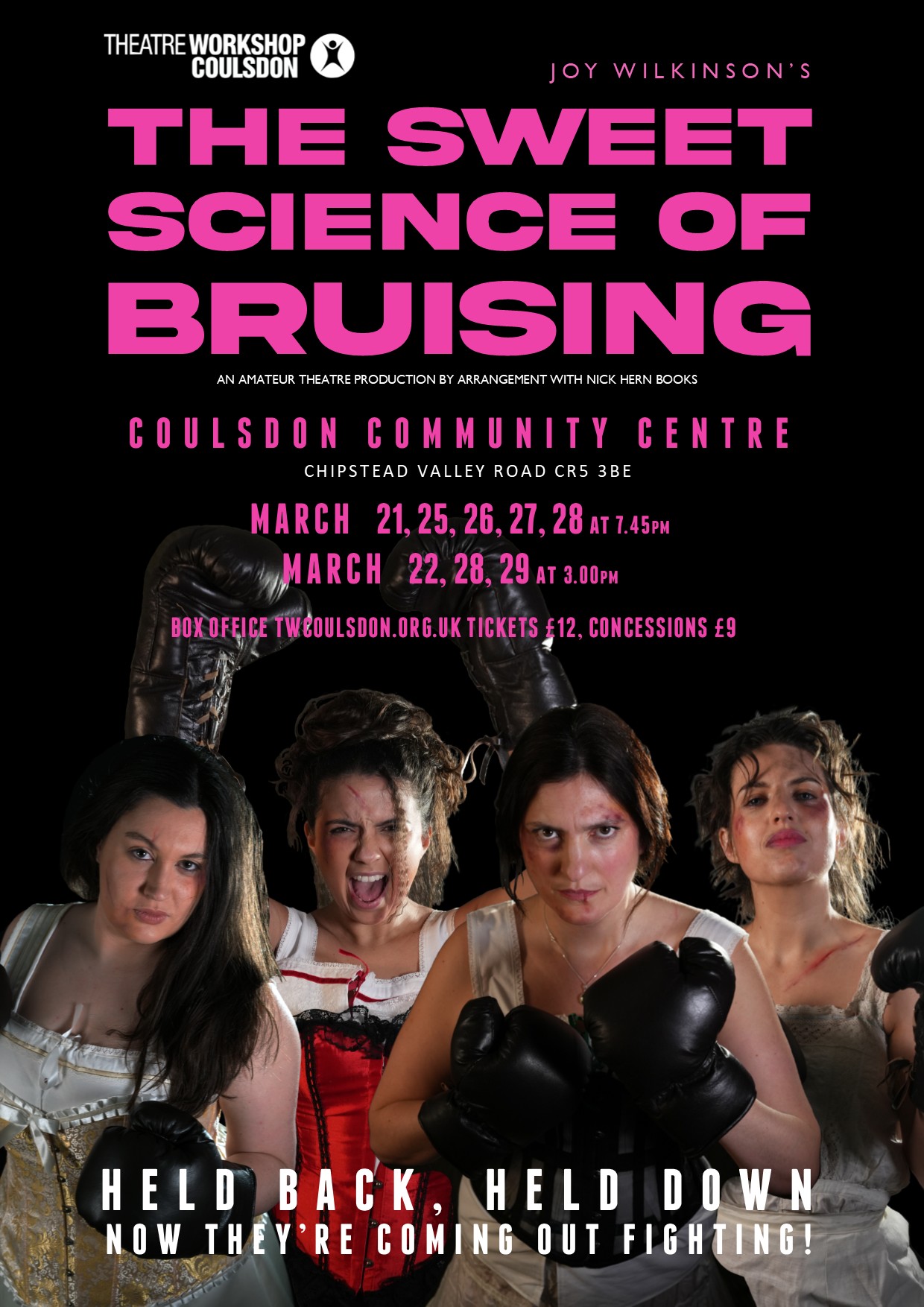
The Sweet Science of Bruising

Victorian London, 1869. The shadowy world of female boxing provides the opportunity for four very different women to break away from the lives that have been ordained for them by society.

Polly Stokes is a fighter, has been ever since she was abandoned on a doorstep as a babe. Irish-born Mattie Blackwell lives on the streets, her life a constant battle to survive. Violet Hunter wants to be a doctor but no man will let her, and Anna Lamb seems to have it all, a husband, children, a house, servants… but in truth, she has nothing.

Held in by corsets, held back by men, the violent release they find in the boxing ring brings them a form of freedom they’ve never known, but at the final bell, there can only be one Lady Boxing Champion of the World.

An epic tale of passion, power, politics and pugilism from the pen of Joy Wilkinson and performed with verve by TWC.

Burnley-born Joy Wilkinson is an accomplished and prize-winning author who has written several plays (Now is the Time, Fair and Britain’s Best Recruiting Sergeant among others), plus numerous TV and film scripts covering a range from sci-fi/fantasy such as Doctor Who and Lockwood & Co. through to thrilling dramas Suspect and The Pact, via Holby City, Casualty and Land Girls.

The Canterbury Tales (2011)

It is the 14th Century, and in the bustling courtyard of The Tabard Inn, Southwark, men and women from all walks of life gather for a pilgrimage to the cathedral at Canterbury. Friars and priests, pardoners and summoners, millers and good wives. In order to entertain these good folk, the host of the inn asks that each traveller tells a story as they make their way across Kent. And so they, and we, begin our journey.

In this joyous adaptation of Geoffrey Chaucer’s classic work by Richard Lloyd, Theatre Workshop Coulsdon present six of the best and most colourful tales, creating an exuberant and and often hilarious portrait of ordinary folk preoccupied with petty jealousies, mundane squabbles and simple pleasures. Bold and often bawdy, these tales bring home vividly just how little the English people have really changed over the last six hundred years!

The stories presented are The Nun’s Priest’s Tale, The Wife of Bath’s Tale, The Friar’s Tale, The Pardoner’s Tale, The Miller’s Tale and The Reeves Tale, neatly wrapped in an engaging background as host and landlord Harry Bailey attempts to maintain order amongst his boisterous and often wayward charges.

Chaucer (1343 – 1400) is widely considered to be the greatest English poet of the Middle Ages, and was the first poet to be buried in Poet’s Corner at Westminster Abbey. While he achieved fame during his lifetime as an author, philosopher, alchemist and astronomer, Chaucer also maintained an active career in the civil service as a bureaucrat, diplomat and courtier. His many works include ‘The Book of the Duchess’, ‘The House of Fame’, ‘The Legend of Good Women’ and ‘Troilus and Criseyde’, but it is ‘The Canterbury Tales’, in which he uses the tales to paint an ironic and critical picture of English society, for which he will always be remembered.

Much Ado About Nothing (2015)

The path of true love proves to be anything but smooth for not one but two sets of star-crossed lovers in ‘Much Ado About Nothing’, one of Shakespeare’s most romantic, yet comedic tales. For young Claudio and his lady Hero, their happiness is threatened by the Machiavellian scheming of the plain-dealing villain, Don John. For self-professed lifelong batchelor Benedict and the independently minded and sharp-tongued Beatrice, the biggest obstacles are…themselves!

By turns funny, touching, heart-breaking and hilarious, ‘Much Ado About Nothing’ is the perfect way to spend an English Summer evening.

Leonato, a kindly, respectable nobleman, lives in the Italian town of Messina. He shares his villa with his lovely young daughter, Hero, his clever but cynical niece, Beatrice, and his elderly brother, Antonio. As the play begins, Leonato prepares to welcome his good friend, Don Pedro, home from war. Don Pedro, a prince, is accompanied by two friends and fellow soldiers: Claudio, a well-respected young nobleman, and Benedick, a joker who delights in teasing his colleagues. With them too comes Don John, Don Pedro’s illegitimate brother, a sullen, spiteful individual who resents others’ happiness.

After the soldiers arrive, Claudio swiftly falls in love with Hero, while Benedick and Beatrice resume the war of words that they have carried on with each other for years. Claudio and Hero pledge their love to one another and decide to be married. But to pass the days before the wedding, the lovers and their friends decide to trick Beatrice and Benedick, who are obviously meant for each other, into falling in love.

However,  Don John intends to spoil everything. He plots with his followers Borachio and Conrade to ruin Hero’s reputation. And taken in by the treacherous scheme, an enraged Claudio humiliates Hero at the wedding by accusing her of lechery and abandoning her at the altar. Horrified, Hero’s family pretend that she has died of shock and grief and hide her away. Fortunately, a passing watch patrol overhear Borachio drunkenly bragging about his misdeeds to Conrade. Dogberry and Verges, the bumbling heads of the local watch, eventually arrest them and drag them in front of the local magistrate, Leonato. The truth of Don John’s plot is thus revealed, and Claudio and Don Pedro, who believe Hero is dead, are grief stricken.

Leonato tells Claudio that, as a penance for his misjudgement, he must marry his brother  Antonio’s daughter — a girl who, he says, looks much like the dead Hero. Claudio goes to church with the others, solemnly prepared to do his duty and marry the mysterious, masked woman he finds there. But when the masked woman reveals herself to be Hero, Claudio is overwhelmed with joy and all is forgiven.

Benedick then asks Beatrice if she will marry him, and after some verbal sparring,  she agrees. The joyful lovers then celebrate with a double wedding as Don John, who had attempted to escape, is dragged back to face his half-brother’s justice.

And Then There Were None

August 1939. Dark clouds are gathering over Europe, and off the coast of South Devon, a remote island becomes the setting for a series of sinister killings.

‘And Then There Were None’ has provided the model for innumerable ‘locked room’ mysteries. It’s also one of Christie’s very few works where there is no ingenious detective – no Poirot or Miss Marple – to solve the case. Just a group of extraordinary characters marooned together on an island, where one of them is deranged killer. But which one?

In some ways, it’s the purest mystery Christie ever wrote. Ten strangers are invited to Soldier Island, but on arrival, their hosts, Mr and Mrs U.N. Owen, are strangely absent.

As the evening unfolds, the fragile atmosphere of forced good humour is broken by the sudden accusation that they are all guilty of murder. Then one by one, members of the party begin to die, with the manner of their killing linked to a seemingly innocent nursery rhyme. Fear, suspicion and paranoia take hold of the remaining survivors as they realise the killer must be one of them.

Christie, who wrote the stage adaptation herself, provided a more upbeat ending than her novel. But a 2015 adaptation followed the novel more closely. Which have we used? You’ll have to find out…

Sherlock Holmes and the Sons of Anubis

From the depths of ancient Egypt an ancient evil is rising, claiming the lives of those who have ransacked its history.

Is this a curse? An occult threat from which there is no defence? Or is there another side to this mystery, something more earthly yet just as deadly? What did Lord Caerphilly’s expedition to the Valley of the Kings disturb, and most importantly, how can it be stopped?

Richard Lloyd’s second exploration into the world of Arthur Conan Doyle’s most famous creation follows on from the success of ‘Sherlock Holmes and the Vampyres of London’, in which the legendary detective faced the iconic prince of darkness, Dracula. This time, as before, real and fictional characters of the period are combined in one fiendish mystery.

Holmes and his trusted companion Dr John Watson travel the streets of Victorian London, from the hallowed British Museum to the seedy brothels of London’s West End in search of the answer to a mystery that if unsolved, may see an empire fall. Which of its denizens may hold the vital clues? Lady Mountjoy, a woman whose most fervent desire is to see the treasures of the tombs returned? Agrippina Bligh, an unscrupulous Madam in a dark trade with darker secrets? The mysterious Egyptian Afzad Azul, who may as easily be allied with demons as angels?

Time is running out…

Twelfth Night

‘Some are born great, some achieve greatness, and some have greatness thrust upon ’em.’ And ‘Twelfth Night’ is surely Shakespeare’s greatest rom-com.

In Illyria, disguised Viola becomes a reluctant go-between in the unrequited courtship of disdainful Lady Olivia by Illyria’s Duke, the lovesick Orsino. This gives rise to perhaps the most famous love triangle in English literature: Uptight Olivia falls madly for the impudent ‘Cesario’; who is desperately in love with wistful romantic Orsino; who is besotted with haughty Olivia. The secondary plot concerns the antics of Olivia’s disreputable uncle, Sir Toby Belch, and his band of ne’er-do-well accomplices from Olivia’s peculiar household. These deplorables embark on a spiteful ruse to humiliate Olivia’s insufferably overstuffed steward, Malvolio, but get their comeuppance when drawn into the Viola / Sebastian mix-ups.

Historical Illyria roughly corresponds to present-day Croatia, but this ostensibly foreign setting (as in most of Shakespeare’s comedies), is not remotely real nor realised. It’s merely a conveniently far-flung land where strange things can happen, yet firmly rooted in a familiar Tudor world of great houses and box hedges, butts of ale and casks of sweet Spanish wine. Shakespeare’s Illyria is clearly within hailing distance of the Thames Watermen, with visitors from Messaline putting up ‘in the south suburbs, at The Elephant’ – as did many visitors to London (hence the Elephant & Castle).

So while Sir Toby Belch and Sir Andrew Aguecheek, a brace of obviously Anglo-Saxon buffoons, rub shoulders with exotically named characters like Orsino, Antonio, and Malvolio, these would all have been instantly recognisable types to the groundlings packed into the playhouse yard of The Rose or The Globe… Orsino, the effete, capricious aristocrat; Antonio, the seaman-adventurer struck from the mould of Hawkins, Drake and Raleigh; and Malvolio, the killjoy puritan stuffed-shirt.

In the interests of duration (about an hour in each half) and clarity, we’ve made some cuts to the text here and there, notably to many of Feste’s extended quips. These were no doubt hugely funny to an Elizabethan audience, but 400 years later many of these jokes, topical references, and allusions to classical mythology have lost all meaning and will simply puzzle a modern-day audience.

Our aim is to present Twelfth Night in the spirit in which we guess it was intended to be played – an exhilarating romantic romp, shot through with a vein of wistful lyricism, full of music and song, and rounded off with a quicksilver exuberance and delight in life.

With more songs than any other Shakespeare play, as Orsino says, ‘If music be the food of love, play on’

Machinal

Regularly appearing on ‘The Best Plays of All Time’ lists, ‘Machinal’ is a vivid, unflinching portrayal of the life of a young, working-class woman in 1920’s America. Across nine tense episodes, we play witness to the key moments of her life – from marriage and motherhood, to adultery, murder, and its consequences. We see how women had to navigate a world run by men for men, in an increasingly mechanistic society demanding conformity.
Placing its young heroine at its centre, ‘Machinal’ traces her fight against the trap of a life predestined, as she hurtles toward her desperate and destructive attempt to break free.
It’s a brave, absorbing play that will stay with you long afterwards; unafraid to challenge its audience and to advance ideas that would have been seen as deeply controversial at the time, yet remain all too relevant today.

Journalist and playwright, Sophie Treadwell (1885 – 1970), placed women and marginalised voices front and centre of her stories. Today ‘Machinal’ (1928) is regarded as a masterpiece – an outstanding example of American Expressionist theatre. But in her day, Treadwell never achieved commercial success, and for much of the Twentieth Century her plays were rarely produced. Even today, her name is little known outside drama schools and histories of theatre. Slowly and rightly though, her ground-breaking early modern plays are now being rediscovered, performed and celebrated anew.

With a specially composed industrial soundscape and an accent on physical theatre this production has taken Theatre Workshop Coulsdon to places it’s not been before. Abrasive, uncomfortable, in places shocking, this is not a quiet night’s entertainment.

Dick Barton and the Carnival of Chaos

“Good evening. This is the BBC Light Programme broadcasting from London. It’s 6.45 and time for the next thrilling episode of ‘Dick Barton and the Carnival of Chaos’!”

Yes, Barton is back, and in his toughest assignment yet!

London. 1949. Wartime rationing remains in force, and only marmalade – that nutritious, morale-boosting foodstuff – continues to fortify our island nation’s grit, spunk, vim and pluck after six long years facing down the Nazi peril.
But now there’s a fiendish foreign conspiracy afoot to kidnap Tiggy Zesty-Peel, heiress to the Zesty-Peel preserves empire, and only Dick Barton can stop it. But who has evil designs on the Marmalade Millionairess? And just what is their nefarious purpose?

Meanwhile, Snowy White and Jock Anderson, Barton’s salt-of-the-earth working class assistants, are each in a jam of their own. Snowy’s been injected with bonobo serum during a brush with a batty Bulgarian ballerina, and has gone more than a little ape. And Jock has fallen for the charms of ex-Nazi filmmaker and flaxen femme fatale, Leni Fuchs.
Throw in the homegrown villainy of the Crayfish Twins (the East End’s favourite lovable cockney mass murderers) and mysterious Italian yoga swami, Contessa Bianca Di Scalzo, and the plot is thicker than a jar of rough-cut.
Can Barton unravel the mystery and save Britain’s marmalade? Or will our favourite spread succumb to the spread of evil? To find out, tune in to the next thrilling instalment of ‘Dick Barton and the Carnival of Chaos’!

Theatre Workshop Coulsdon’s third outing for Dick Barton, Boy’s Own adventurer, all-English hero and teatime wireless star, is another ripping comedy adventure, full of improbable characters, glorious gags, and a cheeky sprinkling of spiffing song and dance numbers. Pip pip!

The Tempest

Torn from the sky!

Returning to its homeland from a royal wedding in distant Tunis, the ‘Napoli Rex’, flagship of the King of Naples’ airfleet, is pulled from the sky by a violent and unnatural storm.

The survivors find themselves scattered across a barren island populated with magical creatures and spirits, fearing for their very lives.  And behind this seeming disaster is Prospero, an exiled sorcerer seeking vengeance…

Shakespeare’s final play is his crowning glory, a tale of magic, love, humour and redemption.

Theatre Workshop Coulsdon have placed ‘The Tempest’ in a steampunk-flavoured Victorian age, where the might of an industrial revolution with its airships, guns and steam-power is confronted with forces beyond its wildest imagining…

Years ago, Prospero forsook his duties as the Duke of Milan to study the arcane arts. With his attention elsewhere, he was unprepared for the coup that saw him dragged from his position and sent out to die alongside his baby daughter, Miranda. By merest chance they survived, crash-landing on a remote and barren island in the Mediterranean, and with the help of two servants, the sprite Ariel and the twisted creature that is Caliban, Prospero lived on and plotted revenge. Now chance again plays into his hands, as those he would mete out vengeance to have been driven to the island by a tempest, their airship torn from the skies and the passengers and crew thrown down. However, he has reckoned without Miranda (now grown to womanhood) and her response to these strange new visitors, one of whom she falls in love with…

Shakespeare’s last play is here transported to a neo-Victorian setting, played out in the traverse among the broken spars and debris of his downed airship, the ‘Milano’. Prospero’s sorcery here vies with magic lanterns and steam-powered pistols in a unique take on the bard’s farewell to the stage.