Oh What A Lovely War

Our open air Summer 2026 production will be the musical entertainment that is ‘Oh What a Lovely War’.

Created by Joan Littlewood’s Theatre Workshop in 1963, ‘Oh What a Lovely War’ tells the story of the First World War through popular songs and music of the period. Known as ‘The Great War’ and even ‘The War To End All Wars’ (sadly so very wrong) the four years of bloody conflict between August 1914 and November 1918 resulted in the deaths of millions and changed the entire global landscape. Old empires fell, new ones began to rise, and the seeds were sewn not for lasting peace, but for conflict to come.

This is not a tale of bravery and heroism. By balancing music hall songs such as ‘Roses of Picardy‘, ‘Hold Your Hand Out, You Naughty Boy‘, ‘I’ll Make A Man Out Of You‘ and ‘Keep The Home Fires Burning‘ with tunes from the trenches such as ‘I Don’t Want To Be A Soldier‘, ‘Gassed Last Night‘, ‘When This Lousy War Is Over‘ and of course ‘Oh What A Lovely War‘, with sketches shedding light on what went on both on the front lines and behind them, the play lays bare the stupidity, corruption and futility of the war, at the same time sending up mercilessly the upper echelons of Britain’s military, more concerned with prestige and position and outdated ideology, unable or unwanting to change in the face of new technologies such as the machine gun, poison gas, aeroplane or tank, capable of dispensing death on a new, industrial scale.

With the men in the frontline being ordered to do the impossible, their best, and sometimes their only, armour was a sense of humour, and this production showcases that brilliantly. Come and see us, join in the songs (you’ll know more than you think) and laugh along with the Tommies, the lions led by donkeys…

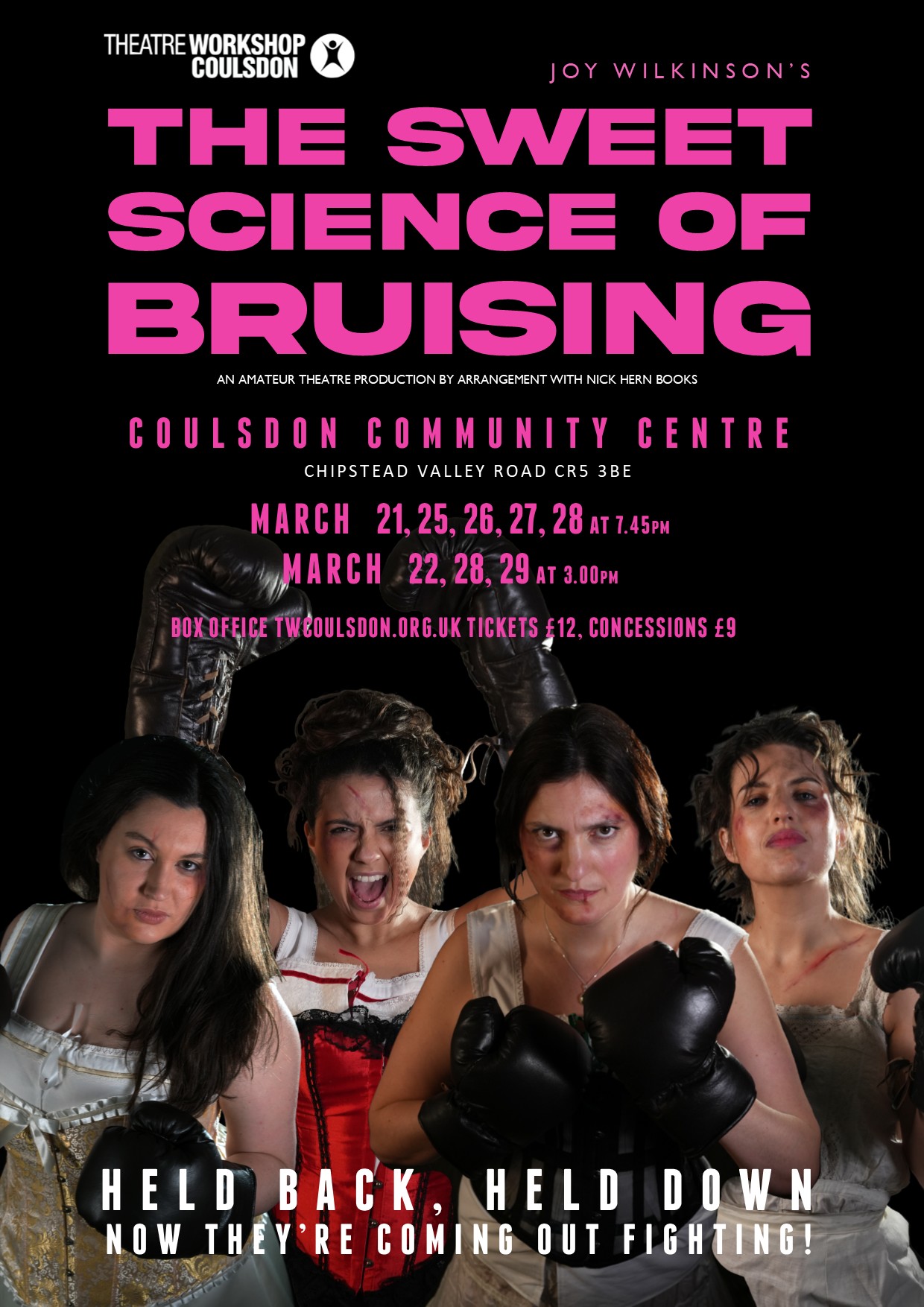
The Sweet Science of Bruising

Victorian London, 1869. The shadowy world of female boxing provides the opportunity for four very different women to break away from the lives that have been ordained for them by society.

Polly Stokes is a fighter, has been ever since she was abandoned on a doorstep as a babe. Irish-born Mattie Blackwell lives on the streets, her life a constant battle to survive. Violet Hunter wants to be a doctor but no man will let her, and Anna Lamb seems to have it all, a husband, children, a house, servants… but in truth, she has nothing.

Held in by corsets, held back by men, the violent release they find in the boxing ring brings them a form of freedom they’ve never known, but at the final bell, there can only be one Lady Boxing Champion of the World.

An epic tale of passion, power, politics and pugilism from the pen of Joy Wilkinson and performed with verve by TWC.

Burnley-born Joy Wilkinson is an accomplished and prize-winning author who has written several plays (Now is the Time, Fair and Britain’s Best Recruiting Sergeant among others), plus numerous TV and film scripts covering a range from sci-fi/fantasy such as Doctor Who and Lockwood & Co. through to thrilling dramas Suspect and The Pact, via Holby City, Casualty and Land Girls.

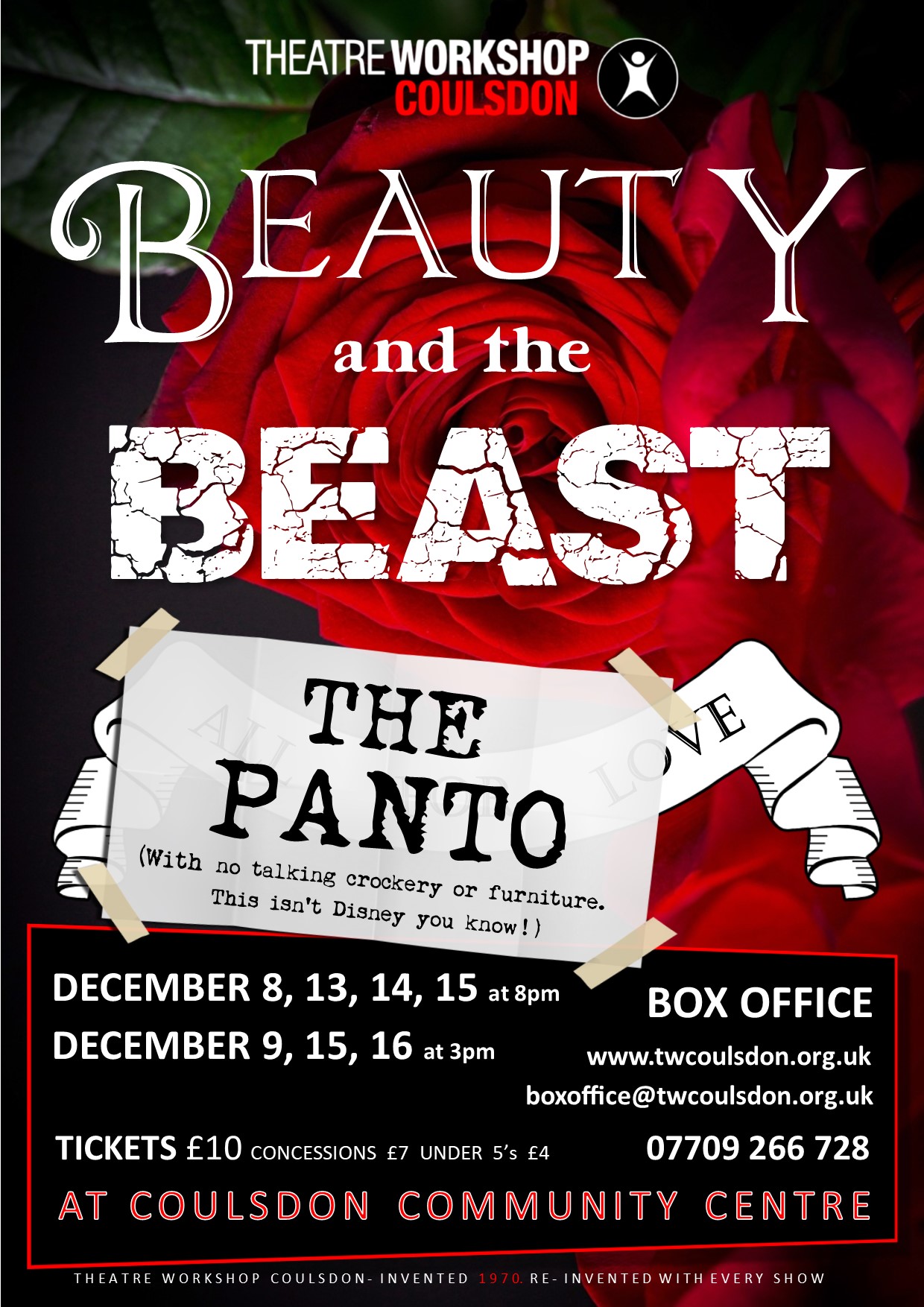
Beauty and The Beast – The Panto

Theatre Workshop Coulsdon’s Christmas 2018 production is an all-new, original pantomime based on the much-loved fairy tale, ‘Beauty and the Beast’. This classic tale, and its underlying message that you shouldn’t judge a book by its cover, has been transformed into a full-fat panto, rocket fuel for the winter season, chock-full of larger than life characters, sing-along songs and audience participation, as the lovely Beauty finds that the monstrous Beast is not what she was expecting. A full band and a large ensemble cast (Bumbling guards, saucy maids, talking vegetation and puppet creatures) support a tale of good versus the evil that is Deadly McNightshade, the woman who puts the wicked into witch and gives it a Scottish accent. Can true love break the dread spell that has locked a handsome prince in a prison he can never escape from? Oh yes it can!

But where did the original story come from? Well, once upon a time there was a woman called Gabrielle-Suzanne Barbot de Villeneuve (They had some cracking names back then) Born in Paris in 1685, she was married at 21 and widowed at 26, her aristocratic but spendthrift husband losing his life almost as swiftly as he lost their money. With her family fortune gone, she needed a way to support herself and eventually moved in with the celebrated playwright and poet Prosper Jolyot de Crebillon (See, another one!) where she began to write. From 1734 through to her death in 1755 she wrote novels and collections of fairy tales but most notably, in 1740, she wrote ‘La Belle et La Bête’, or as we know it, ‘Beauty and the Beast’. It formed part of a much larger story, and was much more complicated than we’re used to now. The simpler version is down to another Frenchwoman, Jeanne-Marie Leprince de Beaumont (and another!) who re-wrote the tale as a much shorter story and published it the year after Villeneuve’s death without acknowledging its origins. Which was a bit sneaky. Boo! Hiss!

Since then it’s become a children’s fairytale classic. Of course, that meant it got the full Disney treatment, twice now, both as a cartoon (1991) and a live-action movie (2017). But there have also been numerous other movie and TV adaptations, a stage musical, an opera, a ballet, and even songs, a disco tune and video games. Its themes of love conquering all and never judging by appearances are simple and easily relatable. And so Sheila May Bird, published children’s author (‘Pete’s Peculiar Petshop’, ‘Pirate Percy’s Parrot’ and others that don’t begin with the letter ‘P’) and long-time member of Theatre Workshop Coulsdon, decided that what had been missing all these years was a pantomime version, full of silliness, slapstick, songs, an audience participation number and the kind of ‘behind you!’ nonsense that makes going to the theatre at this time of year so much fun.

The Adventures of Jason and the Argonauts

The legends of Ancient Greece have continued to weave their magic through our imaginations for over two thousand years. The capricious Gods and Goddesses of Mount Olympus playing with the fates of ordinary mortals for both good and ill. But from the ranks of those mortals came the fabled heroes, those who rose to the challenges and won out despite all. Odysseus taking on the mighty one-eyed giant Cyclops. Theseus defeating the monstrous Minotaur in the labyrinth of Crete. Jason and his Argonauts travelling far and risking everything in search of the Golden Fleece.

This last provides the basis for our winter production. But don’t worry, you won’t need a degree in the classics to work out what’s going on. This is a very loose interpretation of the myths handed down over the centuries. Jason and Medea are two mixed-up kids, an orphan and a runaway, who suddenly find themselves tasked with overthrowing the evil tyrant King Pelias. With a certain amount of divine intervention, Jason becomes the captain of the mighty ‘Argo’, a ship capable of crossing the uncharted seas, with a crew of oddball heroes including the world’s strongest (and possibly clumsiest) man, a wonderful woman warrior, a resting rock star, the least identical twins ever and a seriously streetwise cat. Now he must set off and find the Golden Fleece. If only he knew what it was. And then there are the challenges. The man-eating Harpies of Lemnos, the terrible Clashing Rocks, the fire-breathing Great Bull of Colchis, the evil Dragon Snake and Talos, the bronze giant. (Who might just be a really cool sock puppet.) Not to mention The Sirens…

Medea, Jason and his misfit Argonauts are here this December to have fun. This will be no ordinary adventure tale, but one with songs and laughter, and we’ll be encouraging you to join in, whether you’re five or sixty five. Ever fancied rowing the Argo? You’ll get your chance. Become part of the undead army of skeleton warriors? Oh yes.

The award-winning author of ‘Jason and the Argonauts’, Phil Willmott, is mainly famous around these parts for his creation of the hilariously stiff upper-lipped ‘Dick Barton – Special Agent’ spoofs that were so much a part of the sadly demised Warehouse Theatre in Croydon. But he’s written, adapted and directed numerous productions, many derived from classical sources, and we’re more than pleased to link up with him again.

Twelfth Night

‘Some are born great, some achieve greatness, and some have greatness thrust upon ’em.’ And ‘Twelfth Night’ is surely Shakespeare’s greatest rom-com.

In Illyria, disguised Viola becomes a reluctant go-between in the unrequited courtship of disdainful Lady Olivia by Illyria’s Duke, the lovesick Orsino. This gives rise to perhaps the most famous love triangle in English literature: Uptight Olivia falls madly for the impudent ‘Cesario’; who is desperately in love with wistful romantic Orsino; who is besotted with haughty Olivia. The secondary plot concerns the antics of Olivia’s disreputable uncle, Sir Toby Belch, and his band of ne’er-do-well accomplices from Olivia’s peculiar household. These deplorables embark on a spiteful ruse to humiliate Olivia’s insufferably overstuffed steward, Malvolio, but get their comeuppance when drawn into the Viola / Sebastian mix-ups.

Historical Illyria roughly corresponds to present-day Croatia, but this ostensibly foreign setting (as in most of Shakespeare’s comedies), is not remotely real nor realised. It’s merely a conveniently far-flung land where strange things can happen, yet firmly rooted in a familiar Tudor world of great houses and box hedges, butts of ale and casks of sweet Spanish wine. Shakespeare’s Illyria is clearly within hailing distance of the Thames Watermen, with visitors from Messaline putting up ‘in the south suburbs, at The Elephant’ – as did many visitors to London (hence the Elephant & Castle).

So while Sir Toby Belch and Sir Andrew Aguecheek, a brace of obviously Anglo-Saxon buffoons, rub shoulders with exotically named characters like Orsino, Antonio, and Malvolio, these would all have been instantly recognisable types to the groundlings packed into the playhouse yard of The Rose or The Globe… Orsino, the effete, capricious aristocrat; Antonio, the seaman-adventurer struck from the mould of Hawkins, Drake and Raleigh; and Malvolio, the killjoy puritan stuffed-shirt.

In the interests of duration (about an hour in each half) and clarity, we’ve made some cuts to the text here and there, notably to many of Feste’s extended quips. These were no doubt hugely funny to an Elizabethan audience, but 400 years later many of these jokes, topical references, and allusions to classical mythology have lost all meaning and will simply puzzle a modern-day audience.

Our aim is to present Twelfth Night in the spirit in which we guess it was intended to be played – an exhilarating romantic romp, shot through with a vein of wistful lyricism, full of music and song, and rounded off with a quicksilver exuberance and delight in life.

With more songs than any other Shakespeare play, as Orsino says, ‘If music be the food of love, play on’

Machinal

Regularly appearing on ‘The Best Plays of All Time’ lists, ‘Machinal’ is a vivid, unflinching portrayal of the life of a young, working-class woman in 1920’s America. Across nine tense episodes, we play witness to the key moments of her life – from marriage and motherhood, to adultery, murder, and its consequences. We see how women had to navigate a world run by men for men, in an increasingly mechanistic society demanding conformity.
Placing its young heroine at its centre, ‘Machinal’ traces her fight against the trap of a life predestined, as she hurtles toward her desperate and destructive attempt to break free.
It’s a brave, absorbing play that will stay with you long afterwards; unafraid to challenge its audience and to advance ideas that would have been seen as deeply controversial at the time, yet remain all too relevant today.

Journalist and playwright, Sophie Treadwell (1885 – 1970), placed women and marginalised voices front and centre of her stories. Today ‘Machinal’ (1928) is regarded as a masterpiece – an outstanding example of American Expressionist theatre. But in her day, Treadwell never achieved commercial success, and for much of the Twentieth Century her plays were rarely produced. Even today, her name is little known outside drama schools and histories of theatre. Slowly and rightly though, her ground-breaking early modern plays are now being rediscovered, performed and celebrated anew.

With a specially composed industrial soundscape and an accent on physical theatre this production has taken Theatre Workshop Coulsdon to places it’s not been before. Abrasive, uncomfortable, in places shocking, this is not a quiet night’s entertainment.

Dick Barton and the Carnival of Chaos

“Good evening. This is the BBC Light Programme broadcasting from London. It’s 6.45 and time for the next thrilling episode of ‘Dick Barton and the Carnival of Chaos’!”

Yes, Barton is back, and in his toughest assignment yet!

London. 1949. Wartime rationing remains in force, and only marmalade – that nutritious, morale-boosting foodstuff – continues to fortify our island nation’s grit, spunk, vim and pluck after six long years facing down the Nazi peril.
But now there’s a fiendish foreign conspiracy afoot to kidnap Tiggy Zesty-Peel, heiress to the Zesty-Peel preserves empire, and only Dick Barton can stop it. But who has evil designs on the Marmalade Millionairess? And just what is their nefarious purpose?

Meanwhile, Snowy White and Jock Anderson, Barton’s salt-of-the-earth working class assistants, are each in a jam of their own. Snowy’s been injected with bonobo serum during a brush with a batty Bulgarian ballerina, and has gone more than a little ape. And Jock has fallen for the charms of ex-Nazi filmmaker and flaxen femme fatale, Leni Fuchs.
Throw in the homegrown villainy of the Crayfish Twins (the East End’s favourite lovable cockney mass murderers) and mysterious Italian yoga swami, Contessa Bianca Di Scalzo, and the plot is thicker than a jar of rough-cut.
Can Barton unravel the mystery and save Britain’s marmalade? Or will our favourite spread succumb to the spread of evil? To find out, tune in to the next thrilling instalment of ‘Dick Barton and the Carnival of Chaos’!

Theatre Workshop Coulsdon’s third outing for Dick Barton, Boy’s Own adventurer, all-English hero and teatime wireless star, is another ripping comedy adventure, full of improbable characters, glorious gags, and a cheeky sprinkling of spiffing song and dance numbers. Pip pip!

Orca

Midsummer. On an isolated Atlantic island, the community prepares to enact their hallowed annual ritual. The village must choose a new ‘Daughter’ to sail with the boats and bless the fishing grounds. Keeping them safe from the roaming pods orcas for another year. Fan hopes with all her heart to be chosen. But her older sister Maggie says she must never, never go with the boats. Because Maggie swears that something happened to her out there, but no-one will admit it. No-one will even talk about it. And no-one, not even Fan, believes her.

What the papers have said about ‘Orca’:

‘A world as soaked in myth and ritual as it is with salt water’.

‘Jaws meets The Wicker Man’.

‘An unnerving play about mythical ritual sacrifice that acts as a metaphor for the present’.

‘A gut-chilling reminder that the smallest communities have room for danger, and that often the biggest risks come not from nature, but from the people who claim to want to keep you safe’.

Winner of the 2016 Papatango New Writing Prize, ‘Orca’ is a dark, intense and thrilling piece of theatre – an unflinching insight into what makes a community tolerate the unthinkable.

If you enjoyed our 2023 production of ‘Machinal’ – another pitch dark and compelling play – we think you’ll love ‘Orca’.

Please note this play contains adult themes, strong language and portrayal of violence. We’d suggest it’s not suitable for children under the age of 16 – subject to parental guidance.

It’s A Wonderful Life

Bedford Falls is a small town in a big country, and for as long as he can remember, George Bailey had wanted to leave it behind and see the world, make a real difference. Somehow though, he never got the chance. Now, on a cold Christmas Eve, he stands on a snow-clad bridge parapet, looking down into the dark, icy river below. He faces ruin, but perhaps one last sacrifice can salvage some small hope for those he loves. But kind eyes are watching, and on the edge of tragedy, George is given a divine opportunity to see how his life has changed so many others.

This new adaptation of ‘It’s A Wonderful Life’ by Mary Elliot Nelson follows George and many of the other inhabitants of Bedford Falls from the end of the Great War, through the Depression of the 1930’s, to the end of the Second World War. From high school prom to happy marriage, the wins and the losses, the smiles and heartbreak, the characters both good and bad that make up life in Bedford Falls.

This play is based on the now classic 1946 movie directed by Frank Capra and starring James Stewart and Donna Reed. It’s an uplifting, moving story of love, redemption and community. It’s also a brilliant, evocative slice of period small town Americana.

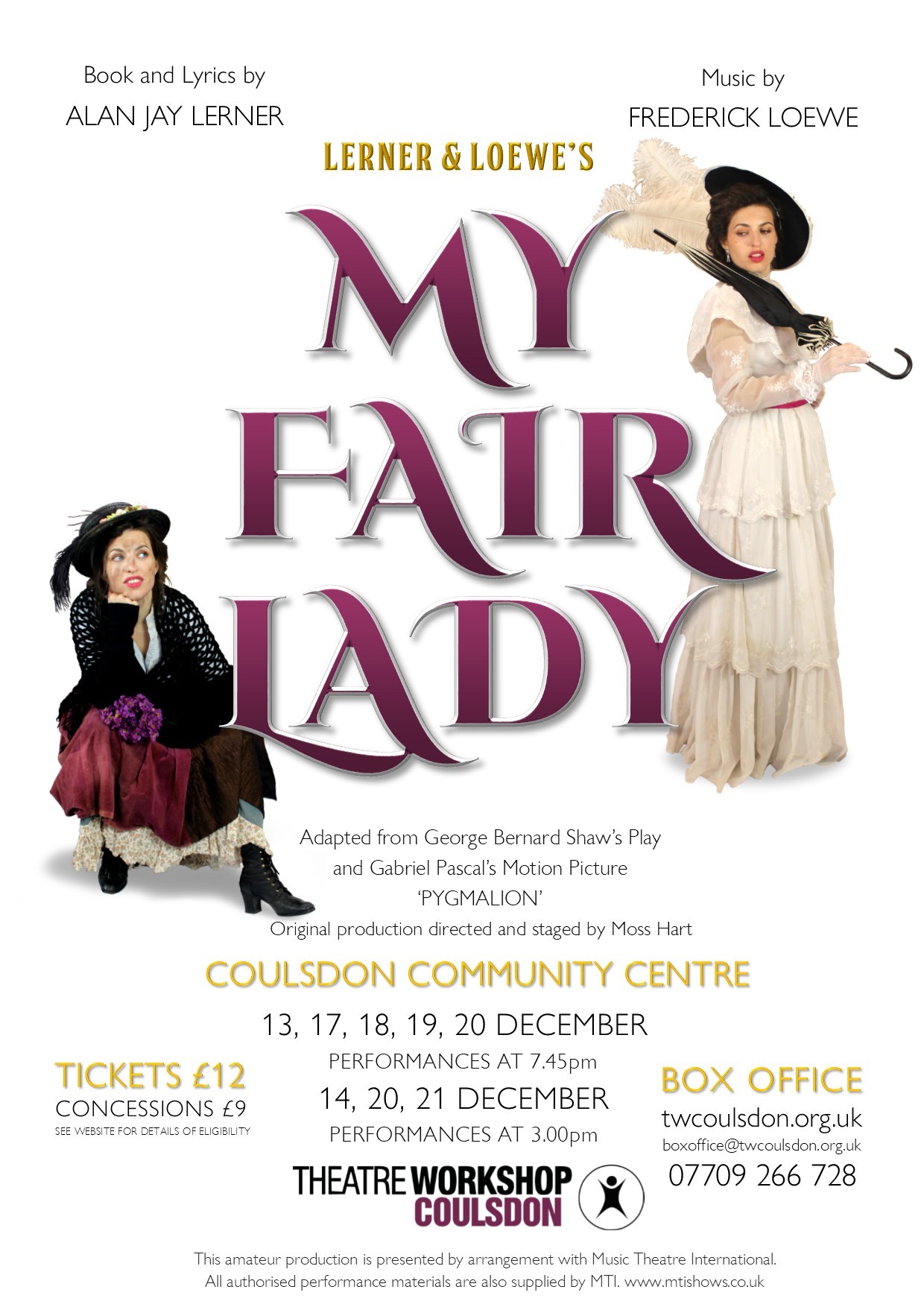
My Fair Lady

Lerner and Loewe’s celebrated stage musical adaptation of George Bernard Shaw’s ‘Pygmalion’ includes some of the best known and best loved show tunes ever written. From ‘Wouldn’t It Be Loverley’ to ‘I’m Getting Married in the Morning’, ‘I Could Have Danced All Night’ and ‘With A Little Bit Of Luck’.

It’s the story of a cockney flower girl’s transformation into the pride of London society – and its unforeseen consequences. In many places it’s very funny; in others, very poignant. When overbearing Professor Higgins stumbles on Eliza Doolittle outside Covent Garden Opera House, he recognises that her hideous vowels and lost consonants are all that separates her from the upper classes. Higgins casually makes a wager that within weeks he can pass Eliza off in polite society as a Duchess. But little does he know that beneath the dirty face and shabby clothes, young Eliza is stuffed full of human feeling. Too eloquent for a flower girl, yet lacking the breeding of the ruling classes, what on earth is to become of Eliza when the bet is over and the game has reached an end?

‘My Fair Lady’ was Lerner and Loewe’s musical adaptation of George Bernard Shaw’s ‘Pygmalion’, a much darker tale than the highly successful Broadway, West End and Hollywood show tells.

The character of ‘Pygmalion’ comes from Greek mythology, where he was sculptor who fell in love with a statue he had created, a statue that then comes to life. Bernard Shaw took that tale and twisted it, the sculptor becoming Henry Higgins, and the thing he creates, Eliza Doolittle. His play debuted in 1913 in Vienna, before going on to London and New York. Critics were generally favourable, though the ending created a certain level of controversy. A standard love story this wasn’t, and the ending was no more conventional. A film version was made in 1938, starring Leslie Howard as Higgins and Wendy Hiller as Eliza, and Shaw, initially distrustful, agreed to it being made only if he had a certain amount of creative control. This resulted in Shaw writing a whole new ballroom scene, the creation of a new character ‘Zoltan Karpathy’, and a new ending. He and his fellow screenwriters were awarded an Oscar for the screenplay, for which Shaw was characteristically dismissive, but it would be this screenplay that would be used as the basis for the musical.

The director of the movie, Gabriel Pascal, had spoken with Shaw about making it into a musical, but the author had refused. However, when Shaw died in 1950, that barrier was no longer an issue. Pascal approached lyricist Alan Jay Lerner to write the musical, with his partner, composer Frederick Loewe. At first, they couldn’t make it work but eventually they found a way, though not before Pascal had died. They called it ‘My Fair Lady’ after a provisional title to Shaw’s play ‘Pygmalion’, and it referred to the Cockney pronunciation of ‘Mayfair Lady’, helping to show Eliza’s transformation from working-class girl to upper-class woman. The part of ‘Higgins’ was initially offered to Noel Coward, who turned it down but suggested they approach Rex Harrison. ‘Eliza’ was offered to Broadway veteran Mary Martin who also turned it down, and they went instead for newcomer Julie Andrews. It opened on Broadway in March 1956 and was a massive success, going on to become, at the time, the biggest grossing Broadway show ever.

The 1964 movie was a similar success, winning eight Oscars including those for Best Picture and Best Actor (Rex Harrison). Interestingly, the Best Actress Oscar that year went to Julie Andrews for her portrayal of Mary Poppins, having been rejected for reprising the part of Eliza as not being famous enough by the studio. It went, famously, to Audrey Hepburn, whose singing voice was overdubbed by Marni Wood.

Theatre Workshop Coulsdon’s presentation of this fabulous show was directed by veteran actor/director Richard Lloyd with musical director and pianist Mark Taylor, and features Dan Carr as Professor Henry Higgins, Indianna Scorziello as flower-seller Eliza Doolittle, Paul Ford as her ne’er-do-well father Alfred, and Mike Brown as the bluff and amiable Col. Pickering.