Machinal

Regularly appearing on ‘The Best Plays of All Time’ lists, ‘Machinal’ is a vivid, unflinching portrayal of the life of a young, working-class woman in 1920’s America. Across nine tense episodes, we play witness to the key moments of her life – from marriage and motherhood, to adultery, murder, and its consequences. We see how women had to navigate a world run by men for men, in an increasingly mechanistic society demanding conformity.
Placing its young heroine at its centre, ‘Machinal’ traces her fight against the trap of a life predestined, as she hurtles toward her desperate and destructive attempt to break free.
It’s a brave, absorbing play that will stay with you long afterwards; unafraid to challenge its audience and to advance ideas that would have been seen as deeply controversial at the time, yet remain all too relevant today.

Journalist and playwright, Sophie Treadwell (1885 – 1970), placed women and marginalised voices front and centre of her stories. Today ‘Machinal’ (1928) is regarded as a masterpiece – an outstanding example of American Expressionist theatre. But in her day, Treadwell never achieved commercial success, and for much of the Twentieth Century her plays were rarely produced. Even today, her name is little known outside drama schools and histories of theatre. Slowly and rightly though, her ground-breaking early modern plays are now being rediscovered, performed and celebrated anew.

With a specially composed industrial soundscape and an accent on physical theatre this production has taken Theatre Workshop Coulsdon to places it’s not been before. Abrasive, uncomfortable, in places shocking, this is not a quiet night’s entertainment.

Dick Barton and the Carnival of Chaos

“Good evening. This is the BBC Light Programme broadcasting from London. It’s 6.45 and time for the next thrilling episode of ‘Dick Barton and the Carnival of Chaos’!”

Yes, Barton is back, and in his toughest assignment yet!

London. 1949. Wartime rationing remains in force, and only marmalade – that nutritious, morale-boosting foodstuff – continues to fortify our island nation’s grit, spunk, vim and pluck after six long years facing down the Nazi peril.
But now there’s a fiendish foreign conspiracy afoot to kidnap Tiggy Zesty-Peel, heiress to the Zesty-Peel preserves empire, and only Dick Barton can stop it. But who has evil designs on the Marmalade Millionairess? And just what is their nefarious purpose?

Meanwhile, Snowy White and Jock Anderson, Barton’s salt-of-the-earth working class assistants, are each in a jam of their own. Snowy’s been injected with bonobo serum during a brush with a batty Bulgarian ballerina, and has gone more than a little ape. And Jock has fallen for the charms of ex-Nazi filmmaker and flaxen femme fatale, Leni Fuchs.
Throw in the homegrown villainy of the Crayfish Twins (the East End’s favourite lovable cockney mass murderers) and mysterious Italian yoga swami, Contessa Bianca Di Scalzo, and the plot is thicker than a jar of rough-cut.
Can Barton unravel the mystery and save Britain’s marmalade? Or will our favourite spread succumb to the spread of evil? To find out, tune in to the next thrilling instalment of ‘Dick Barton and the Carnival of Chaos’!

Theatre Workshop Coulsdon’s third outing for Dick Barton, Boy’s Own adventurer, all-English hero and teatime wireless star, is another ripping comedy adventure, full of improbable characters, glorious gags, and a cheeky sprinkling of spiffing song and dance numbers. Pip pip!

A Christmas Carol (2023)

The Past Is Forfeit. The Future In Peril. The Present In The Balance. All That Matters Is Now.

It’s Christmas Eve! A time for joyful anticipation, celebration and goodwill to all!

Perhaps not all. To the poor and the hungry in Victorian London, Christmas Day is just another day to struggle through. And for Ebenezer Scrooge it’s a day lost, with business left undone and money misspent. Happy Christmas? Bah, Humbug! But tonight, at midnight, Scrooge will be forced to confront the choices he has made, the opportunities he’s missed and the bleak future that lies ahead, unless he can change…

Although Charles Dickens wrote many classic stories, from Oliver Twist to Great Expectations, there is surely no tale of his more famous, or heart-warming, than ‘A Christmas Carol’. Written in 1843, Dickens paints his protagonist in dreary colours. Ebeneezer Scrooge is a mean-spirited, grasping and bitter individual, shorn of all the things that make a life worth living by choice. Though wealthy, his existence is impoverished, begrudging spending his hard earned coin on anything that might provide a crumb of comfort, either to himself or those around him. He treats his employee with disdain, his nephew as a fool. But on one Christmas Eve, he is forced to look hard at what he has done with his life, and what his actions have meant for others. Three spirits, the ghosts of Christmas Past, Present and Future, show Ebeneezer where he has come from, where he is now, and the cold, unloved end of his days on the path he is destined to take. Will he change his ways? Can he change?

A time-honoured story of redemption, with love, laughter, song and a warmth to melt even the meanest misers’ heart, Theatre Workshop Coulsdon is proud to present ‘A Christmas Carol’.

Theatre Workshop Coulsdon is also pleased to be able to partner with the Purley Food Hub for this production. Dickens was very much a social reformer and the plight of families and children with little food, especially at Christmas, was a source of concern reflected in his writings and emphasised in this version of his story. A Purley Food Hub collection point for voluntary food donations will be set up at the Coulson Community Centre for the duration of the run of the show, from December 9 through to December 17.

Come along, enjoy the show and perhaps make Christmas a little better for someone else too.

Reginald Rare – Rocketeer Extraordinaire

‘Reginald Rare – Rocketeer Extraordinaire’, is an affectionate spoof on the classic sci-fi comic strip, ‘Dan Dare – Pilot of the Future’, as created by illustrator Frank Hampson and appeared in the ‘Eagle’ from 1950 through to 1967.

In 1945, WW2 Spitfire ace Squadron Leader Reginald Rare is shot down while on a top secret mission over Germany by a experimental Nazi freeze ray. Awakening after decades of cryogenic suspension, Reg finds himself in the far-flung year 2015, and a world quite unlike his own. Countries and borders are gone, merged into one united World Government. Women and men are equals. Poverty has been eradicated. But the Earth is under threat from the Venereans – fiendish alien overlords of Venus. They’re using a powerful heat ray to cause global warming, and once they’ve destroyed life on Earth, the dastardly Venereans will occupy it as their new home! The trouble is, that Earth gave up war decades ago, and no longer knows how to fight. The newly-promoted head of the armed forces can’t even tell the difference between a set of bagpipes and an instrument of torture! (Hmmm.)

As the only man in the world with combat experience, bravery and a natural air of command unsullied by knowledge or common sense, Reg – a man out of his time in so many ways – is immediately recruited by the Earth’s government to lead a mission to Venus to carry the fight to the enemy. Accompanied by a hand-picked crew of assorted misfits and weirdos (‘Oily’ Wragg, the chief engineer, Bruce McKenzie the Xenobiologist and Giuseppe Bernatelli, the weapons specialist – sorry, chef, as well as the entirely delectable but decidedly feisty physicist and astrogator Dr Mary Honeydew) – Reg heads for Venus in his brand-new untried rocket ship, with a brand-new untried weapon, to give those alien fiends what for! And save the world, obviously. What could possibly go wrong?

Spiffing adventures ensue, by turns comical and thrilling, in a fast moving yet knowing homage to the lantern-jawed sci-fi hero of yesteryear, written by Sean Young and now brought joyously to life on stage.

Special mention to director Pete Bird who with only a couple of weeks to go, had to step in and play Bruce McKenzie after Joe Wilson had fallen ill with appendicitis!

Orca

Midsummer. On an isolated Atlantic island, the community prepares to enact their hallowed annual ritual. The village must choose a new ‘Daughter’ to sail with the boats and bless the fishing grounds. Keeping them safe from the roaming pods orcas for another year. Fan hopes with all her heart to be chosen. But her older sister Maggie says she must never, never go with the boats. Because Maggie swears that something happened to her out there, but no-one will admit it. No-one will even talk about it. And no-one, not even Fan, believes her.

What the papers have said about ‘Orca’:

‘A world as soaked in myth and ritual as it is with salt water’.

‘Jaws meets The Wicker Man’.

‘An unnerving play about mythical ritual sacrifice that acts as a metaphor for the present’.

‘A gut-chilling reminder that the smallest communities have room for danger, and that often the biggest risks come not from nature, but from the people who claim to want to keep you safe’.

Winner of the 2016 Papatango New Writing Prize, ‘Orca’ is a dark, intense and thrilling piece of theatre – an unflinching insight into what makes a community tolerate the unthinkable.

If you enjoyed our 2023 production of ‘Machinal’ – another pitch dark and compelling play – we think you’ll love ‘Orca’.

Please note this play contains adult themes, strong language and portrayal of violence. We’d suggest it’s not suitable for children under the age of 16 – subject to parental guidance.

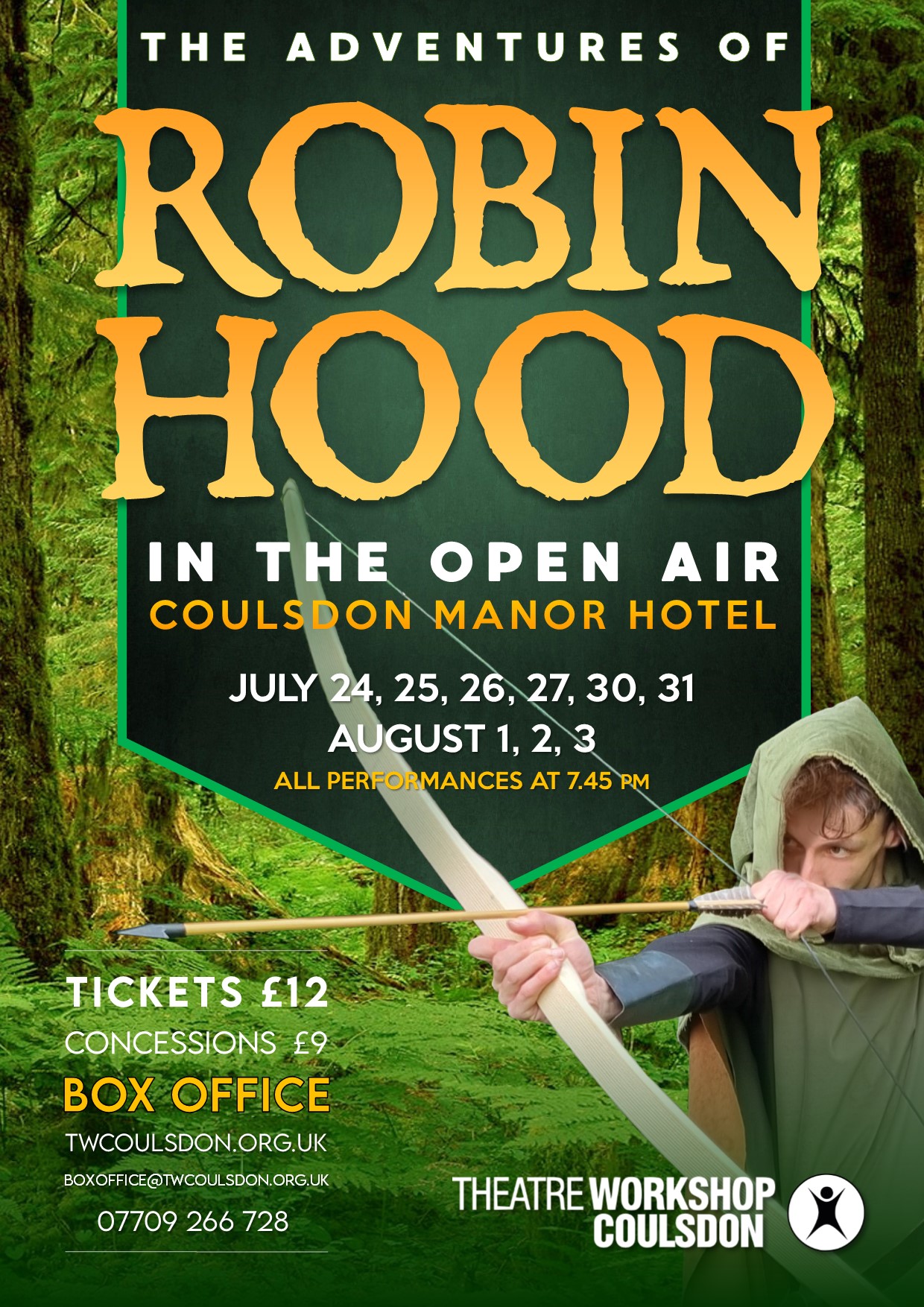
The Adventures of Robin Hood

Good King Richard is dead, and the throne is now held by his brother John, a man determined to make his mark no matter what the cost to the people he rules. In Nottingham, the evil Sheriff brutally extorts higher and higher taxes for his royal master, putting dissenters to the sword. The land has never been in greater need of a hero.

This Summer, we’re back in our idyllic woodland glade at the Coulsdon Manor Hotel with that most celebrated icon of English folklore, Robin Hood. Alongside his outlaw allies, Little John, Will Scarlet, Alan A’Dale and Friar Tuck, aided by the fearless Marian Fitzwalter, they’re going to challenge the tyranny and injustice that the Sheriff and his royal patron are imposing on the good people of England, and tear the whole rotten edifice down. Or die trying.

High adventure and fun on a Summer’s  evening – among the trees in the good company of the free men of Sherwood, witnessing thrilling and entertaining encounters as the fight for freedom begins, with sword, with bow, with quarterstaff and with laughter.

Grimm Tales (2022)

Dare you go down to the woods today?

Theatre Workshop Coulsdon has adapted ten of the most famous tales from the Brothers Grimm into a single play. By turns magical, terrifying comic and profound, our ‘Grimm Tales’ is a festive theatrical treat for all the family (well, almost), delving as deep as the dwarves into a rich dark seam of lost European folklore.

The tales we’ve included, from ‘Hansel and Gretel’ to ‘Little Red Cap’, ‘Snow White’ and ‘Rumpelstiltskin’, are stripped back to their origins, freed from layers of Victorian prudery and Disney schmaltz, revealing the simple, undiluted truths of these ancient stories. Often funny, sometimes brutal, occasionally touching – they’re familiar yet strange, like something you’ve always known, but are only now seeing them for the first time.

Some of them include some old-fashioned fairy tale revenge, mayhem and a modest amount of gore. In other words, just the kind of things that generations of kids have grown up loving! That said, it’s probably not really suitable for toddlers and the very young. Or those of a particularly nervous disposition.

So join us on a journey to the dark heart of the forest. It all starts with ‘Once upon a time…’

About the Brothers Grimm

The root of all theatre is storytelling. Our performance of ‘Grimm Tales’ is based on some of the best-known stories of Jacob and Wilhelm Grimm – those avid collectors of folk tales from across the German-speaking lands of central Europe.

The brothers grew up in the late Eighteenth Century – the flowering of the period of European Romanticism.  The German romantics sought Der Volkseele or ‘folk-psyche’, and returned to the folksongs, ballads, and folk tales of earlier centuries to find it. The simplicity and truth of these folk traditions, despised by the highbrow thinkers of the Enlightenment, suddenly acquired a new value. They pointed to a rich, oral, pan-Germanic cultural legacy.

This quest for a distinctive German identity was given huge impetus in the early Nineteenth Century, when the patchwork of German states, great and small, had been laid waste by Napoleon, and all things German had been crushed under the ascendancy of all things French. For the Grimms, collecting old stories from across the German-speaking lands, became a mission to reinvent a distinctive German culture. Der Volkseele would reinvigorate and bind together the disparate peoples and states of the German nation – culturally, if not politically. In this, the work of the Brothers Grimm foreshadowed German unification, which followed in 1870.

The brothers travelled all over Europe to collect their tales, from the Baltics to Bohemia, Switzerland to Schleswig-Holstein, hoovering up every scrap and morsel of part-remembered fable, coaxed from nobleman and peasant alike. They transcribed these contributions as faithfully as possible, binding in authentic bits of nonsense, dialect words, old sayings, arcane rhymes and doggerel, just as they had been told to them.

In their devoted search for origins, the brothers invented the modern science of folklorism. By the 1850s they’d published seven editions of their two volumes of collected tales. By the end of the Nineteenth century, their 200 or so tales had been translated so widely that they were renowned around the world. Today, they remain the most popular and famous collection of folk stories in the Western world.