Grimm Tales (2001)

A collection of traditional European folk tales are here given a new lease of life, stripping away much of the saccharine coating so many have accumulated through adaptation for children’s books, TV and film. Yes, we’re looking at you, Disney.

We’ve chosen nine tales all told, each with it’s own director and unique music composition, from one of three talented musicians, Pete Bird, Dominic Russell and Mark Taylor. See the programme for full details. The nine stories are;

Ashputtel

The Golden Goose

The Lady and the Lion

A Riddling Tale

The Hare and the Hedgehogs

Hansel and Gretel

Little Red Cap

Rumplestiltskin

The Magic Table

We like to finish our open air shows with a song, where we can. For this production, we’ve chosen ‘Who’s The Fool Now?’, an old song, first published in 1580 but most certainly far older than that. It doesn’t come from a Grimm tale, but it is a song about tall tales, and it’s also a drinking song, which given we’re sitting in a pub beer garden seems very appropriate. Join in the chorus if you fancy.

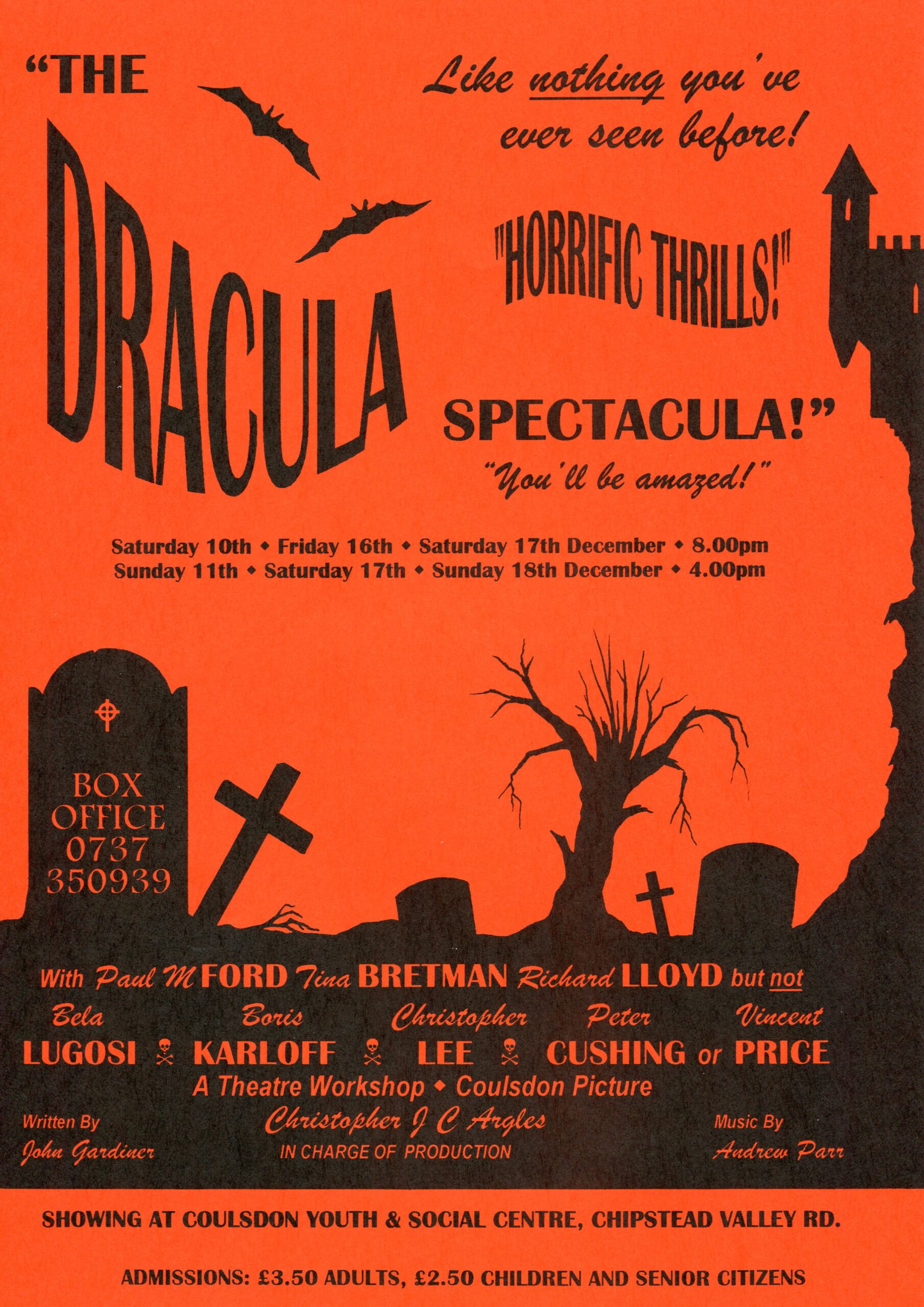
The Dracula Spectacula

It’s been seventeen years since Theatre Workshop Coulsdon first staged ‘The Dracula Spectacula’. At the time it was regarded by the group as probably the biggest and best production that had been performed by them up to that point (we’d only been in existence seven years by that time), involving over 50 people and having a full band.

1995 will be our 25th anniversary year, and we decided that we’d start the celebrations early, by revisiting what was a landmark production for the group.

Amazingly only two of those fifty members who were involved in the 1977 production are actively talking part this time – those being Chris Argles, the director who played Dracula in the original production, and Tim Young, who will recreate his role as Hans, the Innkeeper.

So, how well has ‘The Dracula Spectacula’ stood the test of time? Was it really the terrific show that we fondly remembered, or have the rose-tinted glasses of nostalgia left us with a false impression? Well, let’s be honest, we had to make some changes to the script. Seventeen years doesn’t seem like a long time, but its enough to make some of the dialogue, and the characterisations, sound dated. A number of the songs too, which may have knocked them un-dead back in the day, really don’t cut it now, and so we’ve replaced them with exuberant pastiches of songs that you might just have heard before.

What you see tonight then is very much a brand-new incarnation – albeit of an old favourite, resurrected and rising from its dusty resting place with a whole new lease of life.

Whether this is the first or second time you’ve seen Theatre Workshop Coulsdon perform ‘The Dracula Spectacula’ we hope you enjoy the experience, and live to tell the tale!

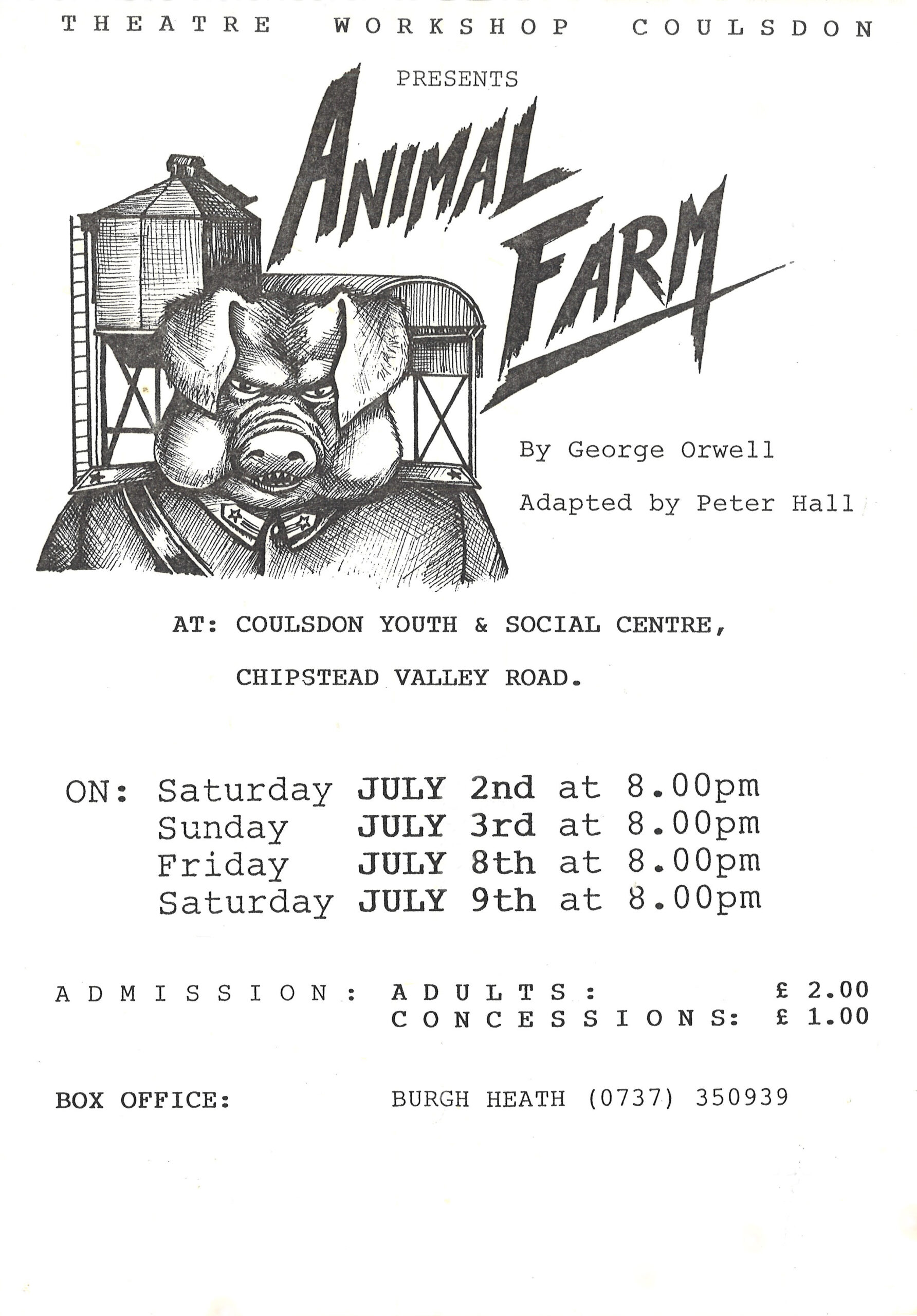
Animal Farm

One night, all the animals at Manor Farm gather in the barn to hear ‘Old Major’, a pig, describe a dream he had about a world where all animals live free from the tyranny of their human masters. The elderly pig dies soon after the meeting, but the animals — inspired by his philosophy of Animalism — plot a rebellion against the farmer, Jones. When Jones drunkenly forgets to feed the animals, they rise up, and Jones and his farmhands are chased away. Manor Farm is renamed Animal Farm, and the Seven Commandments of Animalism are painted on the barn wall. But what follows is far from the dream that Old Major promised…

‘All Animals Are Equal – But Some Are More Equal Than Others’

George Orwell’s ‘Animal Farm’ is a powerful and uncompromising allegory of the Russian revolution, with every character and event that takes place in his tale mirroring Russian history from October 1917 through to the Teheran Conference of 1943.

The succession of steps through which, by persuasion, propaganda, lies and force, Napoleon rises to power in ‘Animal Farm’ are a bitter parody of Josef Stalin’s ascent to dictatorship, and what Orwell saw as the ultimate betrayal of the Russian people.

A fable, a satire, a fairy story, ‘Animal Farm’ is one of the great works of English literature, and a revealing study of the effects of power.

The evocative, and by association, now chilling music chosen by the director to open the production was ‘Fantasia on a theme by Thomas Tallis’ written by Ralph Vaughan Williams. The same composer’s ‘Five variants of Dives and Lazarus’ was used to maintain the mood during the interval.

The Adventures of Jason and the Argonauts

The legends of Ancient Greece have continued to weave their magic through our imaginations for over two thousand years. The capricious Gods and Goddesses of Mount Olympus playing with the fates of ordinary mortals for both good and ill. But from the ranks of those mortals came the fabled heroes, those who rose to the challenges and won out despite all. Odysseus taking on the mighty one-eyed giant Cyclops. Theseus defeating the monstrous Minotaur in the labyrinth of Crete. Jason and his Argonauts travelling far and risking everything in search of the Golden Fleece.

This last provides the basis for our winter production. But don’t worry, you won’t need a degree in the classics to work out what’s going on. This is a very loose interpretation of the myths handed down over the centuries. Jason and Medea are two mixed-up kids, an orphan and a runaway, who suddenly find themselves tasked with overthrowing the evil tyrant King Pelias. With a certain amount of divine intervention, Jason becomes the captain of the mighty ‘Argo’, a ship capable of crossing the uncharted seas, with a crew of oddball heroes including the world’s strongest (and possibly clumsiest) man, a wonderful woman warrior, a resting rock star, the least identical twins ever and a seriously streetwise cat. Now he must set off and find the Golden Fleece. If only he knew what it was. And then there are the challenges. The man-eating Harpies of Lemnos, the terrible Clashing Rocks, the fire-breathing Great Bull of Colchis, the evil Dragon Snake and Talos, the bronze giant. (Who might just be a really cool sock puppet.) Not to mention The Sirens…

Medea, Jason and his misfit Argonauts are here this December to have fun. This will be no ordinary adventure tale, but one with songs and laughter, and we’ll be encouraging you to join in, whether you’re five or sixty five. Ever fancied rowing the Argo? You’ll get your chance. Become part of the undead army of skeleton warriors? Oh yes.

The award-winning author of ‘Jason and the Argonauts’, Phil Willmott, is mainly famous around these parts for his creation of the hilariously stiff upper-lipped ‘Dick Barton – Special Agent’ spoofs that were so much a part of the sadly demised Warehouse Theatre in Croydon. But he’s written, adapted and directed numerous productions, many derived from classical sources, and we’re more than pleased to link up with him again.

The Producers


The Producers was Mel Brooks’ first ever movie back in 1968. Starring Zero Mostel as Max and Gene Wilder as Leo, it became both a cult and a commercial success, and Brooks even picked up an Oscar for Best Original Screenplay. An improbable hit as a movie, it was an even less likely one as a Broadway musical, which Brooks did in 2001. A byword for tongue-in-cheek bad taste, it became the most successful Broadway show of all time, winning a record breaking 12 Tony awards and running for more than 2,500 performances over six years. And then art imitated art, as a movie of the musical based on a movie came out in 2005, starring Nathan Lane, Matthew Broderick and Uma Thurman.

Born into a German Jewish family who fled the Nazis in the 1930’s, Mel Brooks was uniquely qualified to poke merciless fun at the Third Reich. Frankly, it’s impossible to believe that anyone without his background could have got away with it. Then again, the whole premise of a couple of Jewish con-men staging a sure-fire Broadway flop based on a camp musical about Adolf Hitler is so absurd, it would be difficult for anyone to take genuine offence. Besides, Brooks has many targets for his satire in The Producers – not least the whole shallow pretentious ‘bubble’ of Broadway itself. (Which is rather ironic, as it turns out, given the huge success of the show.)

The Producers is an extraordinary musical. Set in New York in 1959, the one-time ‘King of Broadway’, Max Bialystock, sees his latest show ‘Funny Boy’ close after just one night. Down and out, dependent on playing the aging lothario to wealthy but very elderly spinsters and widows, Max is thrown a lifeline back to success and the high life in the unlikely form of timorous accountant, Leo Bloom. Bloom discovers that a flop show can make more money than a hit, and so the two set out to lie, cheat and schmooze their way to a million bucks by staging a sure-fire Broadway flop – the worst taste musical ever written: ‘Springtime For Hitler’. The rest is showbiz history. Bursting with laugh-out-loud jokes and outrageously funny musical numbers, The Producers is pure, unadulterated joy.

Now it’s fair to say that Theatre Workshop Coulsdon are not, first and foremost, a musical group. But we do like projects that are a bit unexpected. So we’ve rescued ‘The Producers’ from the cold dead clutches of of the light-operatic am-dram circuit, and given it the down-and-dirty TWC makeover it deserves. We aren’t dancers, we aren’t singers. We don’t have the required 37-piece orchestra. But we do have a bunch of talented musicians and chutzpah to spare, and what could be more in keeping with the spirit of Mel Brooks than that? We hope you enjoy the show!


The Fairytale of New York

Melodrama, magic and mystery set in the riotous world of 1930’s Vaudeville.

A festive treat with a difference. A dash of ‘Annie’, a twist of ‘Cabaret’, and great big helpings of melodrama, mystery and rip-snorting comedy. Plus some of the greatest songs from the shows you could ever wish for. A great family entertainment for all ages.Macey Maguire has a dream – she’s going to make it big on Broadway. Arriving penniless in New York, Macey gets a break at Delancey’s, the city’s last Vaudeville theater. Soon she’s rubbing shoulders with the troupe of variety artists who ply their trade in the old music hall. But the public’s appetite for burlesque is on the wane, the theater’s finances are on the rocks, and the entertainers are squabbling like rats in a sack. Organised crime wants the real estate the theater’s built on, and worse still, members of the company keep disappearing into thin air… And nobody – not the theater management nor the New York Police Department – can figure out where they go. But they’ve all reckoned without Macey Maguire…

Treasure Island (2010)

Long before Jack Sparrow was ever dreamt of, an even more irredeemable rogue bestrode the rolling quarter-deck of pirate fiction. A one-legged villain by the name of Silver…

When Robert Louis Stevenson wrote ‘Treasure Island’ in 1883, he created not only the most famous adventure story in the English language, but an entire genre. Maps marked with crosses, buried treasure chests, one-legged seafarers with parrots, tropical islands full of mystery and danger, black spots and ‘Yo-ho-ho’s – all these commonplaces of pirate fiction were entirely Stevenson’s invention. He was writing about a world 150 years before his own time, about which he knew very little. That didn’t stop him writing a thrilling story that also held a wry commentary on coming of age and the ambiguity of morality – in the maimed shape of Long John Silver – unusual for children’s literature both then and now.

In our 40th year, choosing Treasure Island for our summer, open-air production seemed both obvious and fitting. It marks the fourth time we’ve set sail with this tale of derring-do, having done so previously in 1974 and 1989, as well as spoofing it with a panto version in 1995. One tradition has remained throughout, the trademark of TWC. In the absence of female characters (with the exception of Mrs Hawkins) we have the heroes played by women and the villainous pirates played by men. Now that might sound a little strange perhaps, but believe me, it works well.

The songs in this production are traditional sea songs and shanties, a rousing accompaniment for life and adventure aboard the Hispaniola. Several hundred of these traditional songs are known, with literally thousands of versions, many blurred into hybrids of several different songs They formed a constantly evolving oral tradition passed on by seamen around the world during the great age of sail. The songs took their influences from different languages and cultures: from Gaelic and Scandinavian dialect song to Wild West ballads; from the rhythms of the South Sea Islands to Negro Spirituals. They were only ever sung on merchant ships though, not the Royal Navy, who frowned on the practice.

Traditional sea songs divide into two main types: the shanty, a chanted work song with a repetitive chorus designed to help gangs of men synchronise the heavy tasks hauling, heaving or pumping aboard ship, and the foc’sle ballad – songs composed and sung just for entertainment. The divide is far from hard and fast however, and many shanties have, over time, developed a more lyrical form.

Our band for the production, pressganged into service of course, are called ‘Ninepence Three Farthings’. Enjoy.

Dark Deeds at St. Mildred’s

Welcome to ‘Dark Deeds at St Trynian’s’ – a homage to the St Trinian’s books created by the cartoonist Ronald Searle (1920 – 2011) between 1941 and 1954. Searle’s cartoons were hugely popular – the antithesis on the Enid Blyton-type posh girl’s boarding school; its pupils are wicked and well-armed, and mayhem is rife. The Gothic cartoons often showed the dead bodies of girls who had been skewered with pitchforks, tortured by their classmates, or succumbed to violent team sports. Searle started to draw these cartoons whilst a prisoner of war of the Japanese. Perhaps it was his way of dealing with the unimaginable horror.

Four movies, based on Searle’s cartoons, were made between 1954 and 1966. There was a remake in 1980 and another in 2007. St Trinian’s is portrayed as an unorthodox girls school where sex, smoking, drinking and gambling aren’t on the curriculum – but they’re not exactly frowned upon either. The girls come in two categories: the Fourth Form, most closely resembling Searle’s original drawings of ink-stained, ungovernable pranksters, and the much older Sixth Form, sexually precocious to a degree that must have seemed alarming in 1954 (one of the girls is even married). The Fourth Form includes a number of much younger girls who are the most ferocious of all. The rule of thumb is that the smaller a St Trinian’s girl, the more dangerous she is – especially with a lacrosse or hockey stick in her hands.

Sadistic, cunning, dissolute, crooked, sordid and capable of any excess, the films implied that the girls were mainly the daughters of well-off gangsters, crooks, shady bookmakers and other low-lifes.

Our production is loosely based on some of the characters from the St Trinian’s books and movies, but with a wholly home-grown script and story. Firmly set in a comfy, non-specific era of post-war nostalgia sometime around the middle of the last century, it bears no resemblance to the recent ‘updated’ movies of St Trinian’s. (Sorry about that, if you were expecting Girls Aloud…)

Sinbadaladdin

Sinbad sails into panto peril with Aladdin on board for laughs!

Sinbad the sailor, or Sinbad of the sea, was the hero of a series of stories outlining his seven voyages across and around the Indian Ocean. He came from Baghdad, now capital of Iraq, then the capital of the sprawling Abbasid Empire that stretched from Tunisia in the west to Pakistan in the East. The original tale of Aladdin is also set in the Middle East. And yet, in panto, this tale of a poor boy made good is landed in a Chinese laundry, surrounded by absurd cod-Chinese names and a mother, Widow Twankey, closer to the East End of London than the Far East. This has long been the case, since 1788 in fact, when John O’Keefe staged the first Aladdin pantomime at the Theatre Royal, Drury Lane.

Richard Lloyd has leant into the exotic influence, with his new pantomime mash-up featuring a significant flavour of the Orient (not the Leyton version). Wizards, pirates, genies, beautiful heroines and brave heroes abound, even if these last do look a lot like girls. Widow Twankee gets up to her usual mischief as manageress of the laundry – not so ably assisted by slopper-out Wishee-Washee, while the feisty Princess Jasmine steals Aladdin’s heart and risks the wrath of her father, the Sultan Ming the Mirthless and her ghastly mother, the Sultana No-Lo-Fat. The terrifying magician Abanazar, meanwhile, proves a formidable rival for Jasmine’s hand in marriage.

Songs, sorcery and silliness, with a touch or two of derring-do. Now that’s a pantomime, wherever it comes from.

The She-Wolves Of Doctor Schlock

But if we fail, we will sink into the abyss of a new dark age made more sinister by the lights of perverted science.”        Sir Winston Churchill, 18th June 1940

Wilkommen zu der Schloss Schlockhöfen… an eerie, isolated fortress, perched on a precipitous crag rising from the trackless Bavarian forest. The retreat and laboratory of the mysterious, reclusive Doktor Hieronymus Schlock, sometime scientific genius of the long fallen Reich…

That’s the setting for this B-movie musical schlock horrorfest – a hearty soup of pulp-horror goodness. A tongue-in-cheek melange of mad scientists, zombies, nymphomanic werewolves and gung-ho lost patrols. All spiced up with a risqué dash of sub-S&M gender-bending!

Barney Bridgework and Diane Dentine of CDBDBN Broadcast News are filming an investigation into mysterious disappearances around Schlockhöfen. But having lost the keys to their jeep, they are forced to knock at the castle door…

Can they survive the night within its forbidding walls with only Herr Doktor and his weird household for company? The denizens of Der Schloss include Beauty, a handmade nymphomaniac S&M junkie; Beast, who makes Frankenstein’s Monster look a complete pussy; Otto Plügbutt, Herr Doktor’s devoted batman, and his terrifying yet drop-dead gorgeous She-Wolves – an all singing, all dancing troupe of PVC-clad lycanthropes – the ultimate security detail to die for…

And dropping (quite literally) into this freakshow, a gung-ho squad of U.S. Airborne rangers, attempting to snatch Herr Doktor for a top-secret CIA programme…

The scene is set for a rip-roaring, rock n’ rolling evening of gothic devilment and pure pulp horror wickedness. So sit back, relax, and place yourselves in the horribly capable hands of Herr Doktor and his lethal, latex-clad lady friends…