Cinderella’s Puss In Boots

Take the classic story of Cinderella, add the bluff and swagger of Puss in Boots, and you get two much-loved seasonal tales woven into one sparkling festive show.

Yes, we’ve put panto favourites Cinderella and Puss on stage together for the first time, in an irreverent mash-up of two much-loved seasonal tales. That means you get two principal boys for the thigh-slapping price of one, the most deliciously appalling Ugly Sisters ever to grace the stage, and the ultimate in hissable baddies – King Rat, evil lord of the underworld. Plus, of course, Puss-in-Boots at his irresistible, swashbuckling best. Beautiful Cinderella undergoes the usual series of traumas, trials and torments – until her Ab-Fab style fairy godmothers and fashion gurus breeze in to save the day with a haute couture transformation guaranteed to catch a prince’s heart. This is a top-notch Cinderella, with just that little bit extra panto goodness thrown into the mix.

Set in, and under, the fairy-tale land of Cornucopia, ruled by good(ish) King Egbert, the action starts with something evil stirring in the darkness below, and it’s got a tail, whiskers and cheap crown…

Dark Deeds at St. Mildred’s

Welcome to ‘Dark Deeds at St Trynian’s’ – a homage to the St Trinian’s books created by the cartoonist Ronald Searle (1920 – 2011) between 1941 and 1954. Searle’s cartoons were hugely popular – the antithesis on the Enid Blyton-type posh girl’s boarding school; its pupils are wicked and well-armed, and mayhem is rife. The Gothic cartoons often showed the dead bodies of girls who had been skewered with pitchforks, tortured by their classmates, or succumbed to violent team sports. Searle started to draw these cartoons whilst a prisoner of war of the Japanese. Perhaps it was his way of dealing with the unimaginable horror.

Four movies, based on Searle’s cartoons, were made between 1954 and 1966. There was a remake in 1980 and another in 2007. St Trinian’s is portrayed as an unorthodox girls school where sex, smoking, drinking and gambling aren’t on the curriculum – but they’re not exactly frowned upon either. The girls come in two categories: the Fourth Form, most closely resembling Searle’s original drawings of ink-stained, ungovernable pranksters, and the much older Sixth Form, sexually precocious to a degree that must have seemed alarming in 1954 (one of the girls is even married). The Fourth Form includes a number of much younger girls who are the most ferocious of all. The rule of thumb is that the smaller a St Trinian’s girl, the more dangerous she is – especially with a lacrosse or hockey stick in her hands.

Sadistic, cunning, dissolute, crooked, sordid and capable of any excess, the films implied that the girls were mainly the daughters of well-off gangsters, crooks, shady bookmakers and other low-lifes.

Our production is loosely based on some of the characters from the St Trinian’s books and movies, but with a wholly home-grown script and story. Firmly set in a comfy, non-specific era of post-war nostalgia sometime around the middle of the last century, it bears no resemblance to the recent ‘updated’ movies of St Trinian’s. (Sorry about that, if you were expecting Girls Aloud…)

The Fairy Godfather

In 1972, Francis Ford Coppola gave us the gangster epic ‘The Godfather’. Set in 1940’s New York, it centred on the criminal empire of the Corleone family, led by Marlon Brando’s iconic Don Corleone, and it single-handedly set the tone for American Mafia/Mob/Gangster movies to follow ever since. Nowhere did it say anything about pantomimes.

Richard Lloyd made us an offer we couldn’t refuse. He’d written a pantomime that less than delicately mashed up a bucket of well-used mafia gangster tropes, spread them over a comedy base, added some spicy panto sauce and served them up with side order of rollicking good songs, finishing with a rousing (everybody join in!) rendition of ‘That’s Amore!’. There are good fairies, evil villains, a dame and a gondola-full of Italian cheese gags. You just have to look at the cast list.

So we had to put it on. Really, we had to. And now you gotta to watch it, capisce?

Cut yourself in for a pizza the action tonight.

The Christmas Curse Of Fu Manchu

Created by English author Sax Rohmer back in 1910, Doctor Fu Manchu can rightly lay claim to being one of earliest ‘Super-villains’, a man whose insidious plotting and scheming would, if not stopped by his heroic rival Denis Nayland Smith and his like, have brought down Western civilisation, and ensured the final victory of ‘The Yellow Peril’. Rohmer, whose real name was the somewhat more ordinary Arthur Ward, lived for a while just down the road, in a house called Little Gatton, on Gatton Road, Reigate.

However, he could not have guessed that one day his evil creation would sink to the level that Mark Taylor has devised in his latest pantomime adventure, with the eradication of every Santa Claus on the planet!

Fu Manchu will surely not have it all his own way. Not when faced with the might of Scotland Yard’s finest, Inspector Burke, with assistance from the uniformed (or is that uninformed?) branch in the shape of WPC Shapely, along with PC Manly and Sergeant Duffem. And then there’s Lavinia. Lavinia Smythe-Bottonne to those who know, Dame to you. If you take-away just the one thing about her, it’s that she’ll not stand for any oriental skulduggery. She might sit of course, if the seat is comfortable enough, but obviously not the ones in the hall that you’re sitting on.

(The Director would like to point out that no real Santa Clauses were harmed in the course of making of this pantomime, and that all Santas appear by kind permission of the REAL Father Christmas, who is, as we all know, busily preparing for Christmas in Lapland at this very moment.)

Raiders Of The Lost Shark

An unashamed tribute / spoof / homage of the Indiana Jones’ movies that made the 1980s such fun, Richard Lloyd’s comedy adventure draws most heavily on the second of the series, ‘Indiana Jones and Temple of Doom’ (1984). (the first chronologically, being a prequel, set a year before ‘Raiders of the Lost Ark’). Although the inevitable Nazi villains are still in the mix (they are so irredeemably bad and easy to dislike), the far Eastern settings, ranging from India to the South China Sea, plus the inclusion of a young Chinese sidekick and a plucky cabaret singer, have clear parallels with the follow-up film.

But if Harrison Ford was only the second choice to play our favourite adventuring archaeologist, behind Tom Selleck, there was only one choice for us. Neil Grew, who had at that time cornered the market (at TWC) in somewhat knowing heroic leading-man characters (He played Robin Hood in 1993, and would go on to play James Bond in 2004). His donning of the trademark (Lucasfilm, that is) battered fedora, leather jacket and bullwhip was pretty obvious casting.

So, beware of the deadly traps, look out for the evil villains and the deliciously duplicitous femme fatales, jump in the seaplane and head due east for excitement and laughter, as Alabama, Frenchy and Hoi-Sin go in search for the fabled Jewel of Munkipore!

Mort

Welcome to Discworld, the light-hearted fantasy universe devised by the author Terry Pratchett and unleashed upon an unsuspecting world in 1983, with the publication of the first Discworld novel, ‘The Colour of Magic’. Contained within its pages was a fleeting appearance of Death, not as a concept but as a personification, complete with hooded robe (over a seven foot tall skeletal body), scythe, sonorous voice and riding a pale horse called… Binky.

Death would go on to become one of Pratchett’s defining creations, and appeared in all bar two of the 41 Discworld novels that Pratchett wrote before his death in 2015. In ‘Mort’, the fourth Discworld novel, published in 1987, the story focuses on Death as he takes an apprentice, the aptly named Mort (‘Mort’ meaning ‘death’ or ‘dead’ in French). Mort, who prefers to be called by his full name, Mortimer, is a gangly, inattentive but well-meaning teenager whose father is only too glad to pass on to another’s responsibility.

Mort does his best of course, but allows his feelings to get in the way. One night, while undertaking ‘The Duty’, he’s called to the bedroom of Princess Keli of Sto Lat, who is about to be assassinated by an agent of the scheming Duke of Sto Helit. Rather than simply escort her soul away in the aftermath of her death however, he prevents the assassination, which sounds great, but sadly, it doesn’t end there. She may not have been killed, but as her death was already pre-determined, people are beginning to act as if she’s not really there…

Stephen Briggs adapted ‘Mort’ for the stage in 1993, and as a frequent collaborator with the author has actually adapted over twenty of Terry Pratchett’s novels for the amateur stage. TWC have performed three of them, ‘Mort’, ‘Wyrd Sisters’ and ‘Lords and Ladies’, all directed by Mike Brown.

.

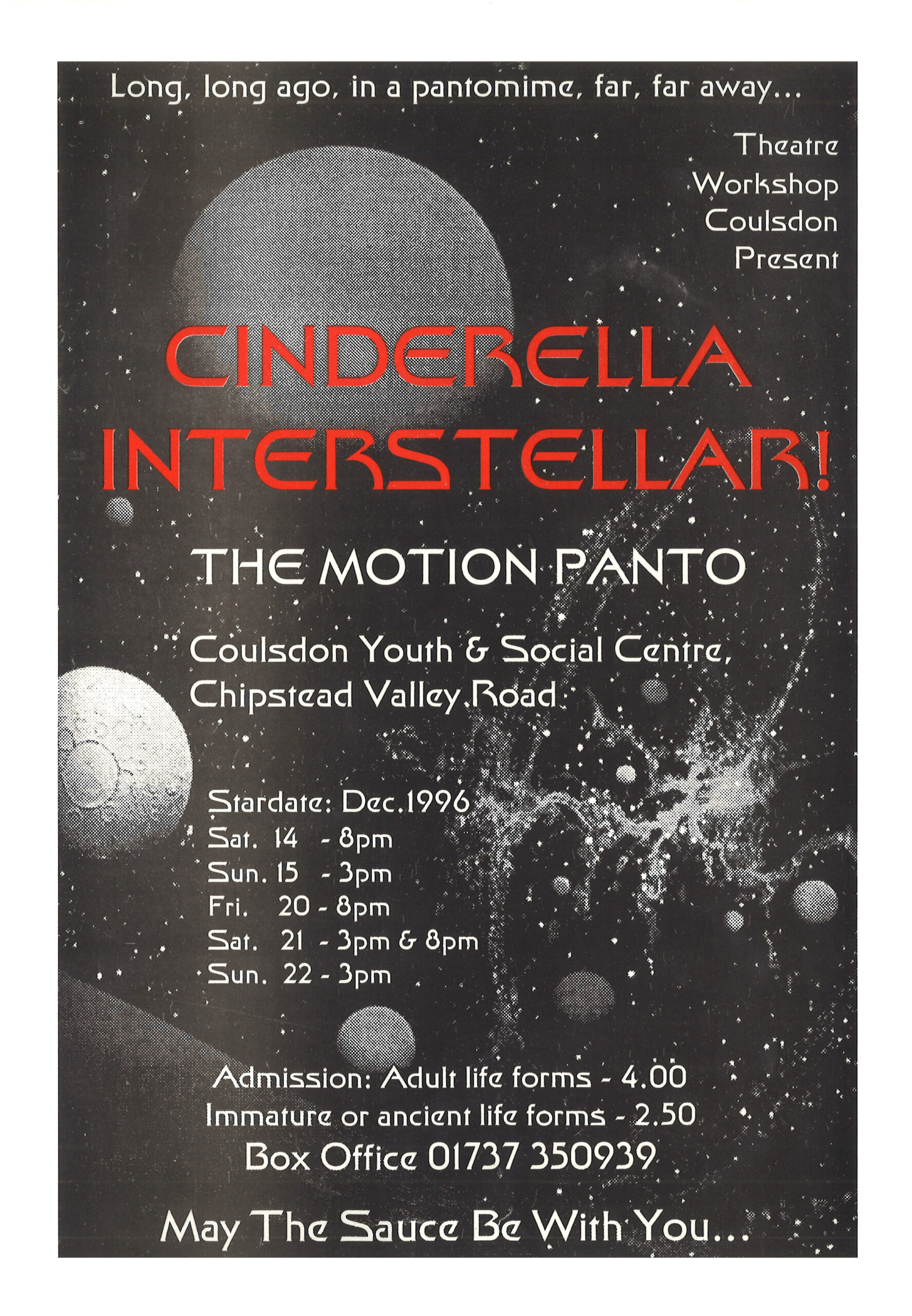
Cinderella Interstellar!

A long time ago, in a galaxy far, far away, there was a pantomime that looked quite a lot like ‘Star Wars’…

Take Cinderella and her ugly sisters and then thrust them into a world of science-fiction adventure, inhabited by characters that are nearly, but not quite, those from the epic blockbuster trilogy of the late 1970’s and early 1980’s.

A cocky, star-faring smuggler and his hairy co-pilot, a kid who’s a whiz behind the controls of space fighter, a monk-like individual wise in the ways of the Source, a black-clad villain in a full-face helmet with breathing difficulties and an army of soldiers who can’t hit a Death Star at close range. They’re all there, just not as you knew them.

Throw in the best Cantina band this side of Tatooine to help belt out some brilliant songs, and you’ve got a powered up panto ready to do the Kessel run in less than 12 parsecs.

This is the panto you were looking for.

The Three Musketeers

France 1625.

A young nobleman called D’Artagnan leaves his family in Gascony, south-west France, and makes his way to Paris to seek his fortune and join the King’s Musketeers. Unfortunately he encounters Rochefort, Captain of the Cardinal’s guard at a rural inn, and after an ill-advised confrontation, loses his letter of introduction to M.de Treville, (the captain of the King’s Musketeers), his money and his sword. So, when he finally arrives at the French capital, his welcome is far from warm. Things take a turn for the even worse when his first meetings with Athos, Porthos and Aramis, the best of the Musketeers, result in him challenging each of them to duels. Finally, taken under the wing of the Three Musketeers rather than being killed by them, the young Gascon finds himself embroiled in the machinations of the cunning Cardinal Richelieu and his deadly agent, Milady de Winter, with plans to dishonour the Queen of France herself. A tale of high adventure, full of fun, swordplay and affairs of the heart…

Originally written by Alexandre Dumas (in collaboration with his regular ghost writer Auguste Maquet) and published in 1844, this swashbuckling historical tale became one of the most enduring adventures in literature, challenged only by, perhaps, ‘Treasure Island’. Numerous adaptations have been made, for stage and screen, including musicals, animation, and even an opera. The script that Chris Argles chose to direct was by Willis Hall, and had been published just the previous year, 1995. Although it keeps to the story, more or less, inevitably some liberties are taken and Hall leans into the humour, no doubt one reason for its selection.

It has passed into Workshop legend that Mike Brown, playing, or rather completely inhabiting the role of Porthos, at one point during the production ran across the stage completely naked, except for a strategically placed broad-brimmed musketeer hat (with a large feather). The part demanded it, obviously.

Treasure Island – The Panto, or ‘Panto Walks The Plank’

‘Treasure Island’, that perennial favourite of British children since its first publication, might seem like an obvious candidate for panto treatment. However, actually arriving at a well-rounded pantomime, incorporating all the essential elements of that genre but also sticking fairly strictly to the plot and characters of Stevenson’s great novel, poses a few problems!

So if ‘Panto Walks The Plank!’ gets under way as a close pastiche of ‘Treasure Island’, you might notice it change tack part way through, in order to accommodate a boarding party of pirate clichés inspired by a wider literature.

After all, as any fan of the Hollywood pirate epics of the 1930s and 1940s will tell you, ‘Treasure Island’ (one of the most famous adventure stories in English literature) is fatally flawed. There’s absolutely no love interest. In fact there are no women at all, with the exception of Mrs Hawkins, and she’s written out of the plot by page 27!

Now, no good pirate movie was truly complete without the love interest, usually represented by Maureen O’Hara. Or the presence of the dastardly Spanish, immaculately attired, elegantly presented and constantly scheming. In fact, the two elements were so quintessential that they were frequently combined through the well-worn dramatic device of ‘Swashbuckling hero falls for the haughty yet gorgeous daughter of the wicked Spanish governor’. So, expect to find both in our version too,

There are other important omissions from ‘Treasure Island’ that undermine its credentials as a bona-fide all-round classic pirate story. For instance, absolutely no-one walks the plank! Now, as it happens, that’s probably because no-one ever really did walk the plank. People who really know their pirates will tell you that this infamous punishment was simply the macabre whimsy of the Victorians and their overheated imaginations. However, if you’re set on telling a good old-fashioned blood and thunder tale of skulduggery on the high seas, you’ve got to include it. It’s part of the tradition.

Being a pantomime also dictates certain changes to the story. For instance, no-one is horribly murdered. Any violence is strictly of the gratuitous slapstick variety. And of course, Long John’s legendary parrot serves splendidly as a pantomime animal. This one even talks! And a ‘Crimson Parakeet’ does have a certain resonance with the 1952 Burt Lancaster comedy adventure movie, ‘The Crimson Pirate’, filmed in glorious Technicolour!

So, shiver your timbers and splice your mainbrace, while Theatre Workshop heaves to and delivers a hefty broadside of fun and adventure. And you may lay to that, arrrrrh!

Wyrd Sisters

Terry Pratchett is rightly regarded as one of the fantasy genre’s most popular and successful authors. He is without doubt one of its most prolific, with a string of best-selling novels set on his imaginary Discworld, a planet-sized disc that sits on the backs of four huge elephants, who in turn stand on the back of an enormous turtle called the Great A’Tuin as it swims through interstellar space.

His books frequently parody the vast body of ‘sword and sorcery’ literature that has been spawned by generations of Tolkien imitators, but he doesn’t stop there. Social comment is often interwoven into his humorous tales, and then there’s Shakespeare, whose plots and themes have been known to appear. ‘Wyrd Sisters’, for instance, seems to resemble at times a certain Scottish play, at others ‘Hamlet’. ‘As You Like It’ and ‘King Lear’ get a look in too.

‘Wyrd Sisters’ was Pratchett’s sixth Discworld novel, written in 1988, and the first to feature the Lancre coven of witches, composed of Magrat Garlick, Gytha ‘Nanny’ Ogg and Esmerelda or Esme ‘Granny’ Weatherwax. Favourites of both the readership and Pratchett himself, they would go on to feature in a number of his other books. In neopagan traditions, there exists the Triple Goddess, the maiden, the mother and the crone, and Pratchett has knowingly taken this as a model.

In the play, adapted from the novel by long-time Pratchett collaborator Stephen Briggs, King Verence I of Lancre is murdered by his scheming cousin, Leonal, Duke Felmet, after his ambitious wife persuades him to do so. However, a fleeing servant manages to rescue Verence’s son and heir, along with the King’s crown, and both are given to the witches, who in turn pass them onto a troupe of travelling actors. The crown is hidden in the props box and the boy will be brought up as the actor/manager Olwyn Vitoller’s son. The witches understand that in the fullness of time, destiny will take its course and the child, Tomjon, will grow up to defeat Duke Felmet and take his rightful place as king. Of course, it doesn’t turn out like quite like that…

We’d like to give our particular thanks to both Stephen Briggs and Terry Pratchett for giving us permission to stage ‘Wyrd Sisters’ now. The authorised adaptation hasn’t actually been published yet, so we’re grateful to get a head start on the rest of the amateur theatre brigade.