The Sweet Science of Bruising

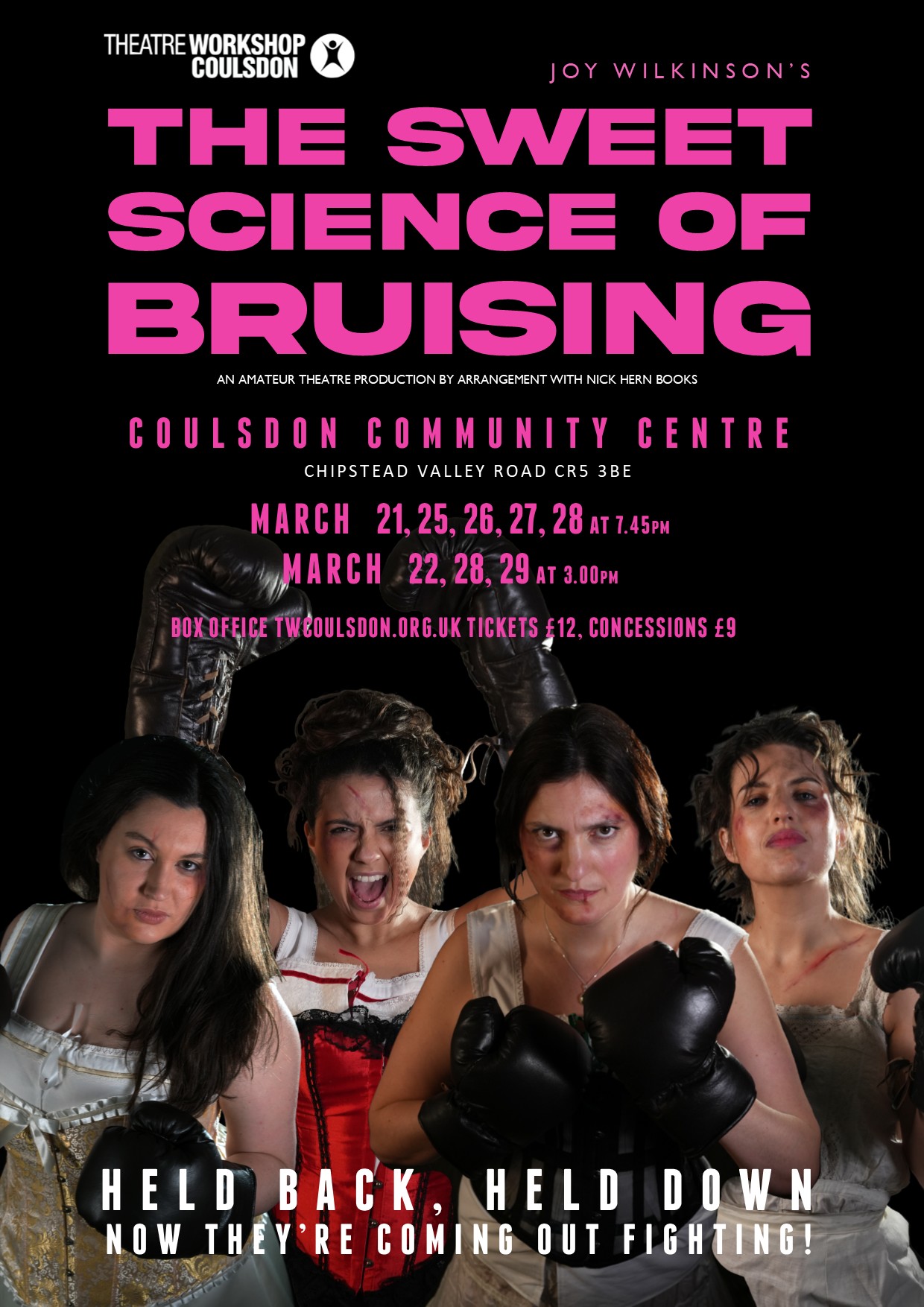
Victorian London, 1869. The shadowy world of female boxing provides the opportunity for four very different women to break away from the lives that have been ordained for them by society.

Polly Stokes is a fighter, has been ever since she was abandoned on a doorstep as a babe. Irish-born Mattie Blackwell lives on the streets, her life a constant battle to survive. Violet Hunter wants to be a doctor but no man will let her, and Anna Lamb seems to have it all, a husband, children, a house, servants… but in truth, she has nothing.

Held in by corsets, held back by men, the violent release they find in the boxing ring brings them a form of freedom they’ve never known, but at the final bell, there can only be one Lady Boxing Champion of the World.

An epic tale of passion, power, politics and pugilism from the pen of Joy Wilkinson and performed with verve by TWC.

Burnley-born Joy Wilkinson is an accomplished and prize-winning author who has written several plays (Now is the Time, Fair and Britain’s Best Recruiting Sergeant among others), plus numerous TV and film scripts covering a range from sci-fi/fantasy such as Doctor Who and Lockwood & Co. through to thrilling dramas Suspect and The Pact, via Holby City, Casualty and Land Girls.
Animal Farm

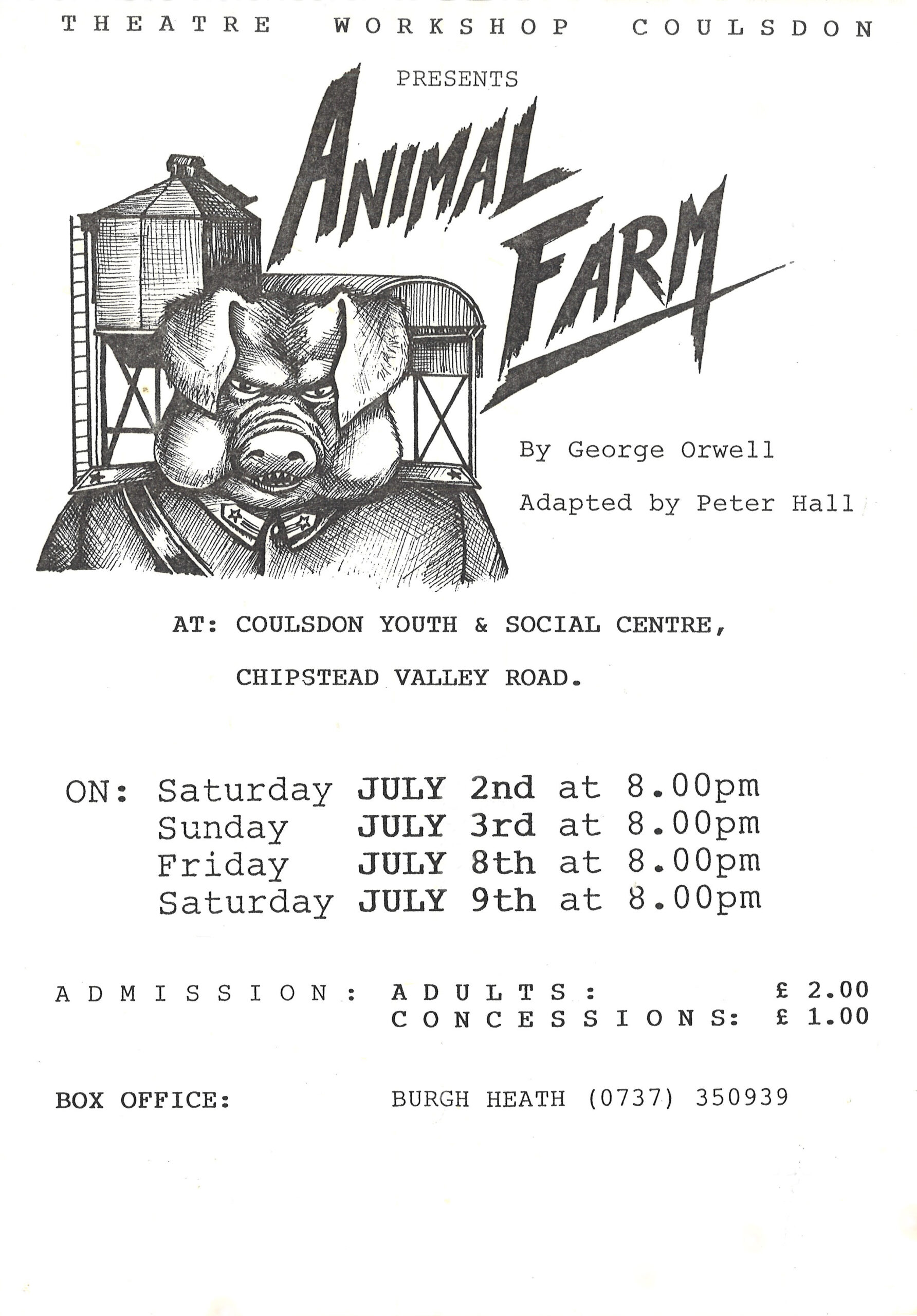
One night, all the animals at Manor Farm gather in the barn to hear ‘Old Major’, a pig, describe a dream he had about a world where all animals live free from the tyranny of their human masters. The elderly pig dies soon after the meeting, but the animals — inspired by his philosophy of Animalism — plot a rebellion against the farmer, Jones. When Jones drunkenly forgets to feed the animals, they rise up, and Jones and his farmhands are chased away. Manor Farm is renamed Animal Farm, and the Seven Commandments of Animalism are painted on the barn wall. But what follows is far from the dream that Old Major promised…

‘All Animals Are Equal – But Some Are More Equal Than Others’

George Orwell’s ‘Animal Farm’ is a powerful and uncompromising allegory of the Russian revolution, with every character and event that takes place in his tale mirroring Russian history from October 1917 through to the Teheran Conference of 1943.

The succession of steps through which, by persuasion, propaganda, lies and force, Napoleon rises to power in ‘Animal Farm’ are a bitter parody of Josef Stalin’s ascent to dictatorship, and what Orwell saw as the ultimate betrayal of the Russian people.

A fable, a satire, a fairy story, ‘Animal Farm’ is one of the great works of English literature, and a revealing study of the effects of power.

The evocative, and by association, now chilling music chosen by the director to open the production was ‘Fantasia on a theme by Thomas Tallis’ written by Ralph Vaughan Williams. The same composer’s ‘Five variants of Dives and Lazarus’ was used to maintain the mood during the interval.

Sinbadaladdin

Sinbad sails into panto peril with Aladdin on board for laughs!

Sinbad the sailor, or Sinbad of the sea, was the hero of a series of stories outlining his seven voyages across and around the Indian Ocean. He came from Baghdad, now capital of Iraq, then the capital of the sprawling Abbasid Empire that stretched from Tunisia in the west to Pakistan in the East. The original tale of Aladdin is also set in the Middle East. And yet, in panto, this tale of a poor boy made good is landed in a Chinese laundry, surrounded by absurd cod-Chinese names and a mother, Widow Twankey, closer to the East End of London than the Far East. This has long been the case, since 1788 in fact, when John O’Keefe staged the first Aladdin pantomime at the Theatre Royal, Drury Lane.

Richard Lloyd has leant into the exotic influence, with his new pantomime mash-up featuring a significant flavour of the Orient (not the Leyton version). Wizards, pirates, genies, beautiful heroines and brave heroes abound, even if these last do look a lot like girls. Widow Twankee gets up to her usual mischief as manageress of the laundry – not so ably assisted by slopper-out Wishee-Washee, while the feisty Princess Jasmine steals Aladdin’s heart and risks the wrath of her father, the Sultan Ming the Mirthless and her ghastly mother, the Sultana No-Lo-Fat. The terrifying magician Abanazar, meanwhile, proves a formidable rival for Jasmine’s hand in marriage.

Songs, sorcery and silliness, with a touch or two of derring-do. Now that’s a pantomime, wherever it comes from.

Dick Barton – Special Agent

The star of the BBC’s first daily radio serial, private investigator and sometime Special Agent, Dick Barton appeared in in 711 episodes between 1946 and 1951 – the brainchild of BBC producer Norman Collins, who had of a visions of a ‘cloak and dagger soap opera’ broadcast every evening.

With his two sidekicks Jock and Snowy, Dick managed to get into some pretty tight scrapes – much to the delight of the listening audience but to the murmurings of stern disapproval from various clergymen of the day. Which seems strange, especially in hindsight, given that Dick’s adventures and last-moment escapes from deadly danger were all written and performed in accordance with a very strict code of conduct. No drinking, no swearing, no violence other than a good clean ‘sock to the jaw’ and even then only if evenly matched or outnumbered. Definitely no girlfriends or romantic associations, and no lying. If Dick needs to give chase to a fleeing villain in a conveniently available car, he must first ask the owner’s permission. No themes of horror should be used either, so no ghosts, vampires, other supernatural creatures or gorillas. (Yes, specifically no gorillas). It’s a wonder Dick managed anything more exciting than a trip to the shops.

Despite all this the show was a huge success, with, at its peak, 15 million listeners tuning in at 6.45pm each evening for 15 minutes of derring-do. The fast-paced, free wheeling adventures were just what post-war Britain was waiting for, and one-time commando Capt. Richard Barton MC was the hero of the hour. Or quarter of an hour, to be precise. However, the BBC were uncomfortable with their sensationalist success story, and when a new programme successfully debuted in a late morning slot in 1951, an everyday tale of life in a rural community, they quickly moved to replace the Special Agent with it. So for all the arch-foes and villains that Barton confronted, he was eventually killed off by ‘The Archers’.

An ill-fated attempt to bring back Barton to television in 1979 seemed to draw a far from discreet veil over any new adventures, but in 1998, Phil Wilmott wrote the musical ‘Dick Barton, Episode One – Special Agent’, part homage, part spoof, and with music from Stefan Bednarczyk, it was a roaring success when it debuted at the Croydon’s Warehouse Theatre, going on to tour Britain over the next couple of years. Since then there have been five sequels, the first two penned by Wilmott and then Duncan Wisbey took the reins

And now, it’s our turn to take on the mac and trilby of upright and uptight British manliness. Warning. The code of conduct will be disobeyed frequently.

During one of the Sunday set-building sessions for ‘Dick Barton’, Julian Cooper, who had been a well-liked part of the group in a backstage capacity for a number of years, suffered a sudden massive heart attack. Despite the efforts of both TWC members and ambulance crew to resuscitate him, Julian was pronounced dead on arrival at Mayday Hospital in Croydon. He was just 43. The play was dedicated to his memory.

Kidnapped At Christmas

Christmas Eve. And banged up again are the gormless Crosby and Gilbert, two life-long criminals who are bemoaning their fate in the nick. Tomorrow will be the regulation prison Christmas dinner, greasy chicken, clammy sprouts and lumpy potatoes. The thought is too much to bear, they must escape! And with the aid of the audience, a spider and some not very bright prison warders, escape they do.

However, that’s just the start of their adventures. When they break into a house to escape the awful weather, they think they’ve lucked in, but actually it’s the home of Detective Constable Grummett, the man who’s been tasked with recapturing them. Worse, Grummett’s son Alexander is there and he’s not frightened of them one bit. Even worser, he’s got a gun. Worstest yet, when the lights go out suddenly, young Alex has been kidnapped, and guess who are the prime suspects?

A fast-paced and silly family entertainment with bucketloads of broken fourth wall and audience participation, follow Crosby and Gilbert’s misadventures as they become Olympic athletes, take on the horror of Frankenstein’s monster and even solve a crime! Yes, really!

And do they get a decent Christmas dinner? That would be telling.

The Hunchback Of Notre Dame – The Panto


‘The Hunchback of Notre Dame’ was originally a novel by celebrated French writer Victor Hugo, first published in 1831. Set in 15th Century Paris, it centres on the unrequited love that Quasimodo, the deformed bell-ringer of the famous cathedral, has for Esmerelda, a beautiful Romani dancer. Sadly, she only has eyes for the handsome captain Phoebus of the King’s archers, but unknown to the young girl, Phoebus is vain, untrustworthy and a womanizer. Esmeralda’s beauty has also attracted two other men, a poet, Gringoire, and the darkly motivated arch-deacon of Notre Dame Cathedral, Claude Frollo, who is also Quasimodo’s guardian. It’s an epic tale of misplaced love, exploring themes on social marginalisation and even the power of architecture, and ends in tragedy. So, absolutely perfect for a TWC panto then!

With the addition of broker’s men Ratatouille and Cassoulet, not to mention the uproarious Frottez LaToilette well and truly putting the Dame into Madame, this is great French literature as you’ve never seen it before! (let’s not even talk about the Disney cartoon, eh?) Oh, and the goat? Jingli Jangli? Not Mr Lloyd’s invention. Victor Hugo gave us Djali the goat (we changed the name to protect the innocent) on whom Gringoire becomes oddly fixated, with tragic results. Ah, the French. Qu’est-ce que c’est?


Peter And The Wolf! – A Pantomime of Old Russia

A pantomime drawing on all sorts of classic old Russian themes? Coming right up, comrade!

The villain of the piece is Grand Duchess Irina Bogovsky, whose personal vanity and quest for immortality has led her down a dark path, as only by sacrificing young peasant girls will she stave off her personal march of time. Against her is set the heroic, young, thigh-slapping principal girl, Pyotyr Pyotrovich, who must rescue her true love from the Duchess’s evil machinations.

Does Pyotyr stand a chance against the devilish Irina and her fiendish Cossack ally Ivan and his men?

Oh no, he doesn’t!

Oh yes, he does!

With Grandmother Masha by his side, and help from various over-sized and over-furry animals, Pyotr will trawl through an entertainingly curated collection of recognisable Russian folklore, from mad monks to Firebirds, rescue Dasha and free the motherland. With songs too!

That’s Theatre Workshop for you, always giving you plenty of bang for your rouble.

The Mummy – The Panto

A brand-new and original pantomime from the fevered imagination of Mark Taylor, who wrote the script, directed the show and the music as well as played piano and keyboards. That’s dedication. Or possibly he’s just a control freak. Either way, this unique tale follows the adventures of a daring expedition into Egypt, in search of the tomb of Imhotep, lost to history thousands of years ago. Professor Pottering and Rose Garden not only have the threat of the evil Ardet Bey to contend with, and the curse that surrounds the long-dead ancient Egyptian ruler, but Mrs Beryl Pie’n’mash, foisted upon them by the needs of a pantomime to contain at least one man dressed as a woman with no dress sense and make-up applied in the dark with a trowel. There is nothing like this Dame.

Brokers men Muk-Itup and Kok-itup are on hand to help carry out Ardet Bey’s malicious wishes, but incompetently, of course, and there’s a four piece band to accompany a dozen songs all hand-picked and adapted to amuse and entertain.

All in all, a trip to the sun-scorched desert by the banks of the Nile with Theatre Workshop Coulsdon is a great way to spend a cold December evening.

The Three Musketeers – Le Panteau

Our pantomime version of ‘Treasure Island’ was not only immense fun for us to do, but proved to be a big hit, not just here in Coulsdon but in the wider world of amateur theatre. In the two years since its publication, there have been over 60 productions of our tongue-in-cheek swashbuckling tale!

So, what better reason to give another classic story of adventure and derring-do the pantomime treatment. Like ‘Treasure Island’, ‘The Three Musketeers’ transcends age and generations, and has slipped across the border from literature into folklore. Written originally in 1844, there have been so many adaptations over the years, across so many media, that people who are perfectly familiar with the characters, the plot and the musketeers’ bold call to arms, have never read so much as a word of Alexandre Dumas’ original tale. Athos, Porthos, Aramis and D’Artagnan are no longer confined to the printed page, they are creatures of myth, with a life all their own.

So, our pantomime is not so much a spoof of the book, as a pastiche of the very idea of ‘The Three Musketeers’, only taking those parts of the plot and the characters that easily lend themselves to being funny. Yes, it does bear some resemblance to the original, but only very loosely (probably about as much as the usual Hollywood treatment). One very significant difference to most versions is that in ours, D’Artagnan and the other gallant comrades in arms are all played by women.

It’s our opinion that the female of the species can swashbuckle as well any male, but rarely are they given the chance. Well, here’s that chance, and alongside Dame D’Artagnan (the would-be musketeer’s aunt) and a pantomime snail (yes, really) they will fight for honour, justice and outright silliness, along with some excellent songs.

‘All for one, and one for all!’*

*For the record, Dumas may have used this as the Musketeers motto and made it famous, but guess who wrote it and used it first? Yep, William Shakespeare, in his narrative poem of 1594, ‘The Rape of Lucrece’. We’ll not be making a panto out of that.