The Sweet Science of Bruising

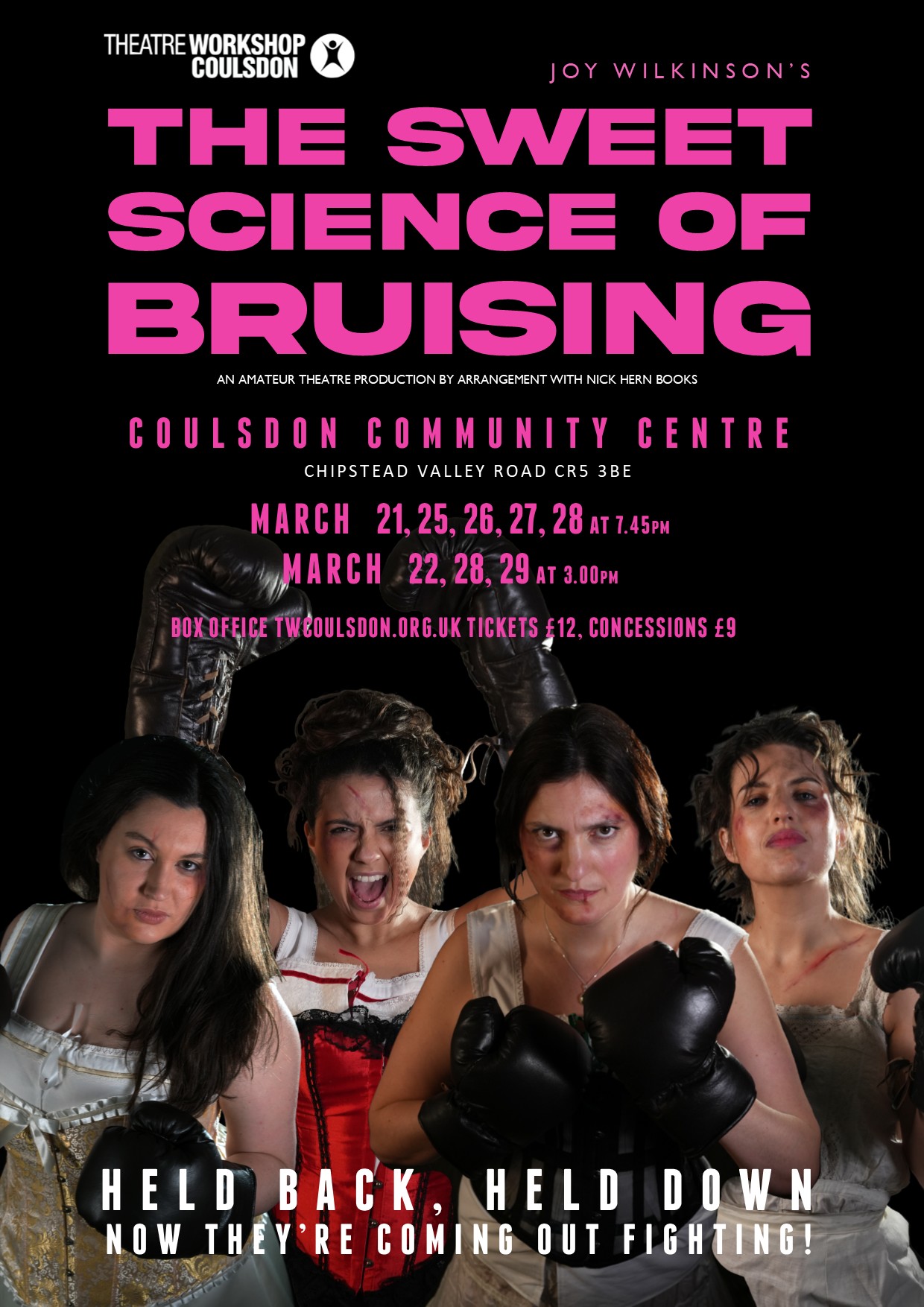
Victorian London, 1869. The shadowy world of female boxing provides the opportunity for four very different women to break away from the lives that have been ordained for them by society.

Polly Stokes is a fighter, has been ever since she was abandoned on a doorstep as a babe. Irish-born Mattie Blackwell lives on the streets, her life a constant battle to survive. Violet Hunter wants to be a doctor but no man will let her, and Anna Lamb seems to have it all, a husband, children, a house, servants… but in truth, she has nothing.

Held in by corsets, held back by men, the violent release they find in the boxing ring brings them a form of freedom they’ve never known, but at the final bell, there can only be one Lady Boxing Champion of the World.

An epic tale of passion, power, politics and pugilism from the pen of Joy Wilkinson and performed with verve by TWC.

Burnley-born Joy Wilkinson is an accomplished and prize-winning author who has written several plays (Now is the Time, Fair and Britain’s Best Recruiting Sergeant among others), plus numerous TV and film scripts covering a range from sci-fi/fantasy such as Doctor Who and Lockwood & Co. through to thrilling dramas Suspect and The Pact, via Holby City, Casualty and Land Girls.
It’s A Wonderful Life

Bedford Falls is a small town in a big country, and for as long as he can remember, George Bailey had wanted to leave it behind and see the world, make a real difference. Somehow though, he never got the chance. Now, on a cold Christmas Eve, he stands on a snow-clad bridge parapet, looking down into the dark, icy river below. He faces ruin, but perhaps one last sacrifice can salvage some small hope for those he loves. But kind eyes are watching, and on the edge of tragedy, George is given a divine opportunity to see how his life has changed so many others.

This new adaptation of ‘It’s A Wonderful Life’ by Mary Elliot Nelson follows George and many of the other inhabitants of Bedford Falls from the end of the Great War, through the Depression of the 1930’s, to the end of the Second World War. From high school prom to happy marriage, the wins and the losses, the smiles and heartbreak, the characters both good and bad that make up life in Bedford Falls.

This play is based on the now classic 1946 movie directed by Frank Capra and starring James Stewart and Donna Reed. It’s an uplifting, moving story of love, redemption and community. It’s also a brilliant, evocative slice of period small town Americana.

Dr Ho

It’s Bond. James Bond. But you’ve never seen him like this.

Britain’s finest, and most well-known, spy has encountered threats over the years that have endangered his life, his country and even the world, but now someone is placing Christmas itself in peril! Plucked from the night skies, Santa Claus has been kidnapped and here’s only one man who can possibly find him in time before the world’s children open their eyes on Christmas morning, and find… nothing! But will a fondness for fast cars, faster women, a particular martini and a licence to kill be enough?

Mark Taylor draws on 007’s significant rogue gallery to populate this panto with vile villains galore and their perfectly hissable henchmen. Dr Ho. Ernst Stavro Blowave. Bob-a-Job. Rosa Widdecombe. Jaws. (‘What’s Jaws?’ ‘Thank you, mine’s a pint.’) However, this time around, Bond isn’t working solo. Enter Ada Bagwash, MI5’s cleaner. Is she really what she appears? Or is she a deep-cover intelligence operative with the tactical nous of a bagful of generals and the combat potential of a Gorilla with a machine gun? Sad to say, she’s just a cleaner, but what she lacks in intelligence… let’s just leave it there. Throw in a casino, an atomic reactor and a couple of women with unlikely and sexually provocative names, not to mention the all-singing Bondettes and their backing band, and you have a pantomime to live and let die for.

Mission briefing over, report to Q Branch to pick up your tickets now.

The Wind in the Willows

For our eleventh summer production, staged in the open air at The Woodman, we’ve picked a classic of children’s literature ‘The Wind in the Willows’, based on the 1908 book by Kenneth Grahame.

There’s not a great deal one can say about ‘The Wind in the Willows’. Almost everybody is familiar with the adventures of Toad, Ratty. Mole, Badger and co., either because they’ve read the book, or at least they think they have. It’s certainly amongst the most widely loved of books – a rural riverbank idyll of friendship and innocence which seems to strike some peculiarly English sentimental chord.

Maybe it’s the little furry animals. Perhaps, viewed through the prism of history, the modest, meandering adventures of Rat and Mole, set as they are in an evocative pastoral England where good manners and tranquillity are only occasionally disturbed by the vainglorious antics of a certain ‘Nouveau Riche’ amphibian, genuinely do call to mind an time of lost innocence and comfortably parochial concerns. An England before the cataclysm of The Great War, and all the horrors of the industrialised, globalised conflicts that have occurred since.

However, ‘The Wind in the Willows’ doesn’t simply hark back to a bygone age. It presages the uncomfortable shape of things to come as Grahame saw them in 1908 – the ‘menace’ of the motor car for instance, and the upheaval of the deferential norms of polite society, where Wild Wooders and other assorted ‘lower orders’ simply don’t seem to know their place any more, and are starting, as Ratty says, ‘to break out’.

Much of the appeal lies in the story’s great comic set pieces, its sympathetic characters and larger than life caricatures such as the irrepressible Toad. Appalling amoral and utterly incorrigible, he’s become a firm favourite on stage for much of the twentieth century, mostly due to A.A. Milne’s ‘Toad of Toad Hall’, the first and most enduring of the many adaptations that the story has undergone.

That said, we’re actually using the more recent (1990) adaptation by Alan Bennett, with a few choice embellishments of our own. Some critics have said that Bennett’s version is somehow truer to the book than Milne’s classic, but if you watch our show closely, it’s clear that Bennett’s voice can be heard intermixed with that of Grahame’s. Regardless, as Mr Toad so succinctly put it, ‘Poop Poop!’.

The Three Musketeers – Le Panteau

Our pantomime version of ‘Treasure Island’ was not only immense fun for us to do, but proved to be a big hit, not just here in Coulsdon but in the wider world of amateur theatre. In the two years since its publication, there have been over 60 productions of our tongue-in-cheek swashbuckling tale!

So, what better reason to give another classic story of adventure and derring-do the pantomime treatment. Like ‘Treasure Island’, ‘The Three Musketeers’ transcends age and generations, and has slipped across the border from literature into folklore. Written originally in 1844, there have been so many adaptations over the years, across so many media, that people who are perfectly familiar with the characters, the plot and the musketeers’ bold call to arms, have never read so much as a word of Alexandre Dumas’ original tale. Athos, Porthos, Aramis and D’Artagnan are no longer confined to the printed page, they are creatures of myth, with a life all their own.

So, our pantomime is not so much a spoof of the book, as a pastiche of the very idea of ‘The Three Musketeers’, only taking those parts of the plot and the characters that easily lend themselves to being funny. Yes, it does bear some resemblance to the original, but only very loosely (probably about as much as the usual Hollywood treatment). One very significant difference to most versions is that in ours, D’Artagnan and the other gallant comrades in arms are all played by women.

It’s our opinion that the female of the species can swashbuckle as well any male, but rarely are they given the chance. Well, here’s that chance, and alongside Dame D’Artagnan (the would-be musketeer’s aunt) and a pantomime snail (yes, really) they will fight for honour, justice and outright silliness, along with some excellent songs.

‘All for one, and one for all!’*

*For the record, Dumas may have used this as the Musketeers motto and made it famous, but guess who wrote it and used it first? Yep, William Shakespeare, in his narrative poem of 1594, ‘The Rape of Lucrece’. We’ll not be making a panto out of that.

Journey’s End

R.C.Sheriff’s play is set in the officer’s dug-out of a British infantry company in the trenches facing Saint Quentin. It is the 18th of March, 1918, and in just a few days, the German army will begin Operation Michael, the opening of Ludendorff’s Spring offensive intended to push the British Expeditionary Force into the sea and capture the Channel ports. For the Germans, it is the last roll of the dice in the Great War, which has been going on since August 1914 and wiped out a generation of young men across the continent. In the trenches, the constant threat of death and the fear that generates, along with the loss of friends and comrades, has deeply affected every man there, and each deals with it in their own way. Captain Stanhope leads the infantry company, with a keen sense of duty but a growing dependence on alcohol to cope with the pressures of command. When the young and naive Raleigh joins the company, his precarious balance is disturbed…

After it was written, Sheriff encountered resistance in getting the play produced in London’s West End. There was a reluctance to put on a play about the war, which having ended just ten years previously, was all too fresh in people’s minds. Others baulked at the idea of a play without a leading lady, which would hinder ticket sales. Eventually, the Independent Stage Society were persuaded, after some words from George Bernard Shaw, to put it on at the Apollo Theatre. They still hedged their bets. It was a ‘semi-staged’ production, meaning no sets and minimal props, and would run for just two nights. The lead, Captain Stanhope, would be played by a 21 year old unknown…called Lawrence Olivier. However, when the curtains finally rose on the evening of Sunday, December 9, 1928, in the audience was Maurice Brown, a West End producer. He was impressed, enough at least to take a gamble on booking it to open at the Savoy Theatre on January 21, 1929. Even then, it received minimal promotion and no advance bookings were taken. However, word of mouth was enough, and ‘Journey’s End’ sold out, and proceeded to run for a further two years to packed houses.

Sheriff himself didn’t see the play as being expressly an anti-war piece, rather it was an account of his own experiences. He’d been only 18 when he’d gone to France as a Captain in the 9th East Surrey Regiment, and fought at Vimy, Loos and Passchendaele, where he was severely wounded. He’d written other plays and would go on to write more, though ‘Journey’s End’ remained his most famous stage work. He’d go on to write screenplays too, receiving an Academy (Oscar) nomination for ‘Goodbye, Mr Chips’ (1939) and a BAFTA nomination for ‘The Dambusters’ (1955).

The Fairy Godfather

In 1972, Francis Ford Coppola gave us the gangster epic ‘The Godfather’. Set in 1940’s New York, it centred on the criminal empire of the Corleone family, led by Marlon Brando’s iconic Don Corleone, and it single-handedly set the tone for American Mafia/Mob/Gangster movies to follow ever since. Nowhere did it say anything about pantomimes.

Richard Lloyd made us an offer we couldn’t refuse. He’d written a pantomime that less than delicately mashed up a bucket of well-used mafia gangster tropes, spread them over a comedy base, added some spicy panto sauce and served them up with side order of rollicking good songs, finishing with a rousing (everybody join in!) rendition of ‘That’s Amore!’. There are good fairies, evil villains, a dame and a gondola-full of Italian cheese gags. You just have to look at the cast list.

So we had to put it on. Really, we had to. And now you gotta to watch it, capisce?

Cut yourself in for a pizza the action tonight.