The Wind in the Willows
About the Production
For our eleventh summer production, staged in the open air at The Woodman, we’ve picked a classic of children’s literature ‘The Wind in the Willows’, based on the 1908 book by Kenneth Grahame.
There’s not a great deal one can say about ‘The Wind in the Willows’. Almost everybody is familiar with the adventures of Toad, Ratty. Mole, Badger and co., either because they’ve read the book, or at least they think they have. It’s certainly amongst the most widely loved of books – a rural riverbank idyll of friendship and innocence which seems to strike some peculiarly English sentimental chord.
Maybe it’s the little furry animals. Perhaps, viewed through the prism of history, the modest, meandering adventures of Rat and Mole, set as they are in an evocative pastoral England where good manners and tranquillity are only occasionally disturbed by the vainglorious antics of a certain ‘Nouveau Riche’ amphibian, genuinely do call to mind an time of lost innocence and comfortably parochial concerns. An England before the cataclysm of The Great War, and all the horrors of the industrialised, globalised conflicts that have occurred since.
However, ‘The Wind in the Willows’ doesn’t simply hark back to a bygone age. It presages the uncomfortable shape of things to come as Grahame saw them in 1908 – the ‘menace’ of the motor car for instance, and the upheaval of the deferential norms of polite society, where Wild Wooders and other assorted ‘lower orders’ simply don’t seem to know their place any more, and are starting, as Ratty says, ‘to break out’.
Much of the appeal lies in the story’s great comic set pieces, its sympathetic characters and larger than life caricatures such as the irrepressible Toad. Appalling amoral and utterly incorrigible, he’s become a firm favourite on stage for much of the twentieth century, mostly due to A.A. Milne’s ‘Toad of Toad Hall’, the first and most enduring of the many adaptations that the story has undergone.
That said, we’re actually using the more recent (1990) adaptation by Alan Bennett, with a few choice embellishments of our own. Some critics have said that Bennett’s version is somehow truer to the book than Milne’s classic, but if you watch our show closely, it’s clear that Bennett’s voice can be heard intermixed with that of Grahame’s. Regardless, as Mr Toad so succinctly put it, ‘Poop Poop!’.

The Cast
Behind the Scenes
Image Gallery




The Reviews
Awarded Four Stars
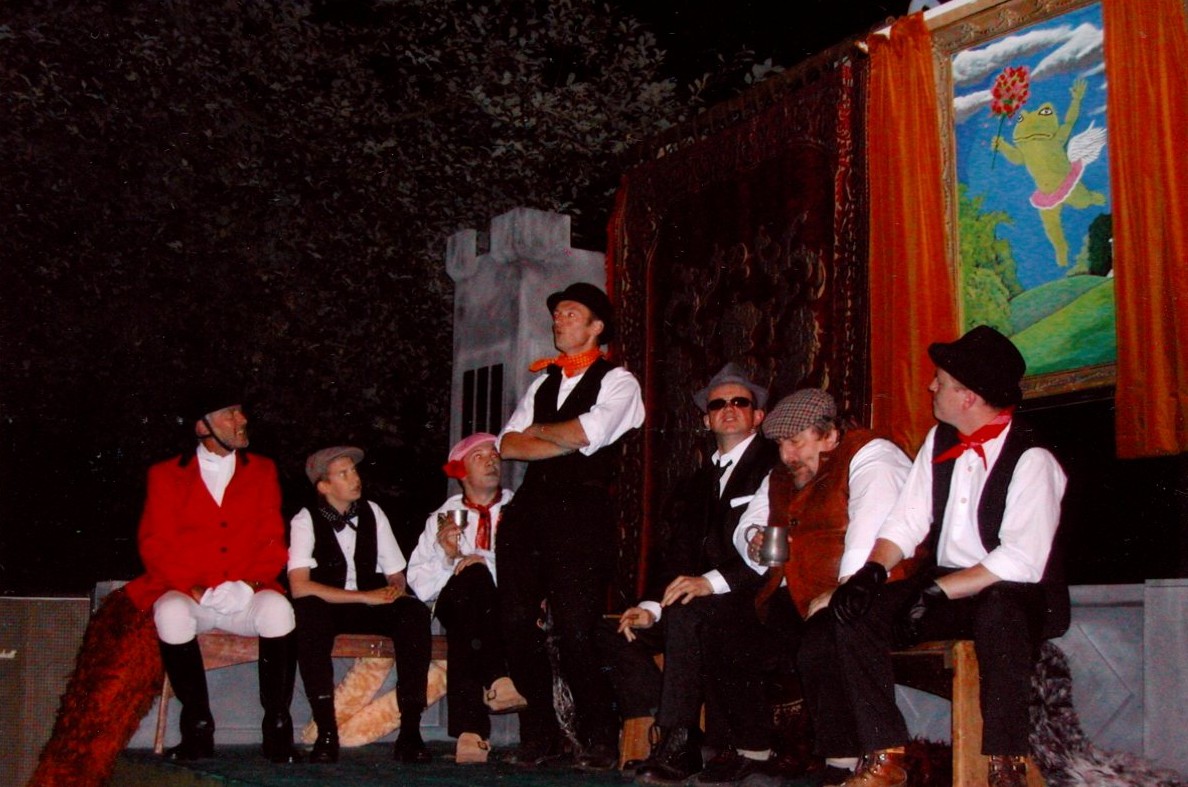
Although the elements threatened to flood the river bank on the first night on Tuesday, Mr Toad, Ratty, Moley and the rest exuberantly overcame the torrent to provide a thoroughly entertaining version of Kenneth Grahame’s classic tale. Alan Bennett’s adaptation features some comically satirical modern anachronisms, highlighting the political leanings and class background of some of the characters, but the show can be enjoyed on different levels, by different ages. Although the lighting is rudimentary, the stage management is well-drilled, the sound effective, and the design amusing and consistent – the wheel-yourself boat, train and car, for example. Costumes are dominated by large tails and complementary ears.
The players give bold, cartoon-like, but not threatening characterisations, which hold youngsters’ attentions very easily, and are enjoyable for all ages. Emma Rose is a twittery, high-pitched, happy, excitable Mole, contrasting well with Richard Lloyd’s macho, good-natured, Northern Badger, for example. Ratty seems to come from a world far removed from our own in a nice but dim sort of way as played by Chris Blakeney. My favourite character is Albert, the flatulent, lugubrious, exploited horse, played by Mike Brown, whose role as everybody’s factotum explains his Marxist tendencies.
Paul Ford is a bouncy, rubber legged braggart of a Toad, appropriately trance-like at the allure of the motor car, and pompous enough to look very silly when escaping from prison disguised as a washer woman.
The evil weasels, stoats and fox are a troupe of pantomime or Gotham City villains, marshalled energetically by their nasty chief Chris Strachan.
Mark Taylor’s substantial original music score adds greatly to the atmosphere of the event, and underlines some of the dramatic highlights, and a large supporting cast of rabbits, hedgehogs and squirrels adds to the feel of a crowded but quaintly attractive river bank.
Keith Lancing for The Croydon Advertiser, Friday August 1 2003
Letter from Jean Madgwick
To Theatre Workshop Coulsdon,
I don’t have to remind you how important the local theatre groups were to Don. I have now discovered how important he was to you, and how appreciated he was. Thank you for you memories of him and your beautiful floral tribute.
I have to add that I was slightly overwhelmed by your kindness when we attended your delightful performance of ‘The Wind in the Willows’. We probably would not have attended so soon after Don’s death if we hadn’t had my grand-daughter from Spain staying with us. Might I add that she began as a pre-teen moaning that she felt out of place with so many younger children (how beautifully well-behaved they were, too). However, by the second half she was thoroughly won over by the production and began to understand that plays can be appreciated at many levels by old and young alike. Something her grandad believed in sincerely. Maria was very touched by your tribute to her beloved grandad, as was I, and my son.
Yours most sincerely,
Jean Madgwick
Donald Madgwick, Chief Drama Critic for The Croydon Advertiser and regular reviewer of TWC productions, died in early August 2003.
From Jean Madgwick, widow of the late Donald Madgwick, 30 August 2003
Other Productions