Journey’s End
About the Production
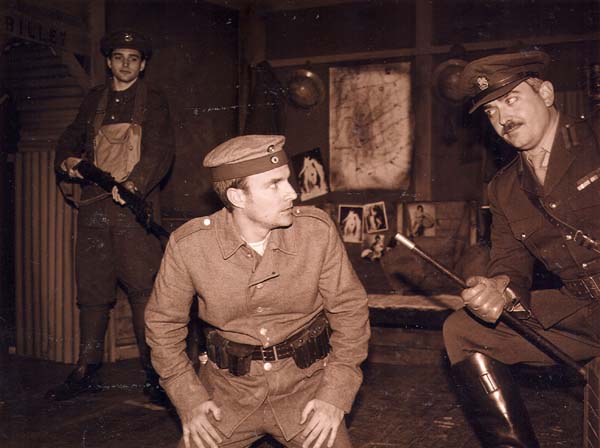
R.C.Sheriff’s play is set in the officer’s dug-out of a British infantry company in the trenches facing Saint Quentin. It is the 18th of March, 1918, and in just a few days, the German army will begin Operation Michael, the opening of Ludendorff’s Spring offensive intended to push the British Expeditionary Force into the sea and capture the Channel ports. For the Germans, it is the last roll of the dice in the Great War, which has been going on since August 1914 and wiped out a generation of young men across the continent. In the trenches, the constant threat of death and the fear that generates, along with the loss of friends and comrades, has deeply affected every man there, and each deals with it in their own way. Captain Stanhope leads the infantry company, with a keen sense of duty but a growing dependence on alcohol to cope with the pressures of command. When the young and naive Raleigh joins the company, his precarious balance is disturbed…
After it was written, Sheriff encountered resistance in getting the play produced in London’s West End. There was a reluctance to put on a play about the war, which having ended just ten years previously, was all too fresh in people’s minds. Others baulked at the idea of a play without a leading lady, which would hinder ticket sales. Eventually, the Independent Stage Society were persuaded, after some words from George Bernard Shaw, to put it on at the Apollo Theatre. They still hedged their bets. It was a ‘semi-staged’ production, meaning no sets and minimal props, and would run for just two nights. The lead, Captain Stanhope, would be played by a 21 year old unknown…called Lawrence Olivier. However, when the curtains finally rose on the evening of Sunday, December 9, 1928, in the audience was Maurice Brown, a West End producer. He was impressed, enough at least to take a gamble on booking it to open at the Savoy Theatre on January 21, 1929. Even then, it received minimal promotion and no advance bookings were taken. However, word of mouth was enough, and ‘Journey’s End’ sold out, and proceeded to run for a further two years to packed houses.
Sheriff himself didn’t see the play as being expressly an anti-war piece, rather it was an account of his own experiences. He’d been only 18 when he’d gone to France as a Captain in the 9th East Surrey Regiment, and fought at Vimy, Loos and Passchendaele, where he was severely wounded. He’d written other plays and would go on to write more, though ‘Journey’s End’ remained his most famous stage work. He’d go on to write screenplays too, receiving an Academy (Oscar) nomination for ‘Goodbye, Mr Chips’ (1939) and a BAFTA nomination for ‘The Dambusters’ (1955).

The Cast
Behind the Scenes
Image Gallery




The Reviews
Commanding Look At Life In The Trenches’
Although coming in 1928, ten years after the event, R.C.Sheriff’s gritty drama of life in the trenches was one of the most notable plays to come out of the First World War. It is seldom performed nowadays, and when it is we have to make allowances for its dated attitudes and language. (One of the curtain lines is “I say!”) For all this, it still has power to stir us and reach our hearts.
Director Mike Brown also designed the set which, if rather too spick and span, admirably reflects the hand-to-mouth improvisation of trench warfare. The production is introduced by some stirring music by Peter Bird reflecting the pomp of imperial power.
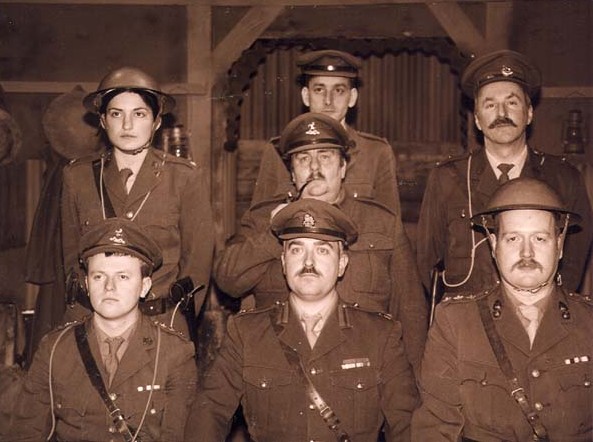
The core of the drama is between the young officer Raleigh and Captain Stanhope, the hard-drinking commander who returns his hero-worship with undeserved scorn. I must say that I think that it was a huge mistake to cast a female in the former role, even though Vanessa Hammick makes a brave stab at pretending to be an eager young subaltern. As Stanhope, Luke Argles is too even of mood in the early stages, but shows his mettle following the death of his friend… The last act brings out the best in him, when he really begins to crack under the stress and strain.
Chris Argles is well cast as Osborne, known as Uncle, the pipe-smoking older man to whom everyone turns, the still point in a turning circle, British phlegm with a stiff upper lip. Tim Young gives a comfortable, down-to-earth performance as Trotter, the officer drawn from the ranks, the joker in the pack. And Mark Taylor provides a leavening of humour as the officers’ cook Mason, somewhat stiff of manner but with the common touch. Martin Smith plays the company coward Hibbert, a somewhat ambiguous role in that our attitude towards such types has undergone quite a change since the play was written. Are we supposed to sympathise with him or despise him? Take your pick. Richard Lloyd is every inch the crisp, blimpish Colonel, a man who barks out his orders in the tones of one born and groomed to command, while John Mills as the Sergeant-Major shows us the other side of the coin.
The actors complement each other in defining the distinction between command in the officer class and in the non-coms.
Donald Madgwick for The Croydon Advertiser
Other Productions