Grimm Tales (2001)

A collection of traditional European folk tales are here given a new lease of life, stripping away much of the saccharine coating so many have accumulated through adaptation for children’s books, TV and film. Yes, we’re looking at you, Disney.

We’ve chosen nine tales all told, each with it’s own director and unique music composition, from one of three talented musicians, Pete Bird, Dominic Russell and Mark Taylor. See the programme for full details. The nine stories are;

Ashputtel

The Golden Goose

The Lady and the Lion

A Riddling Tale

The Hare and the Hedgehogs

Hansel and Gretel

Little Red Cap

Rumplestiltskin

The Magic Table

We like to finish our open air shows with a song, where we can. For this production, we’ve chosen ‘Who’s The Fool Now?’, an old song, first published in 1580 but most certainly far older than that. It doesn’t come from a Grimm tale, but it is a song about tall tales, and it’s also a drinking song, which given we’re sitting in a pub beer garden seems very appropriate. Join in the chorus if you fancy.

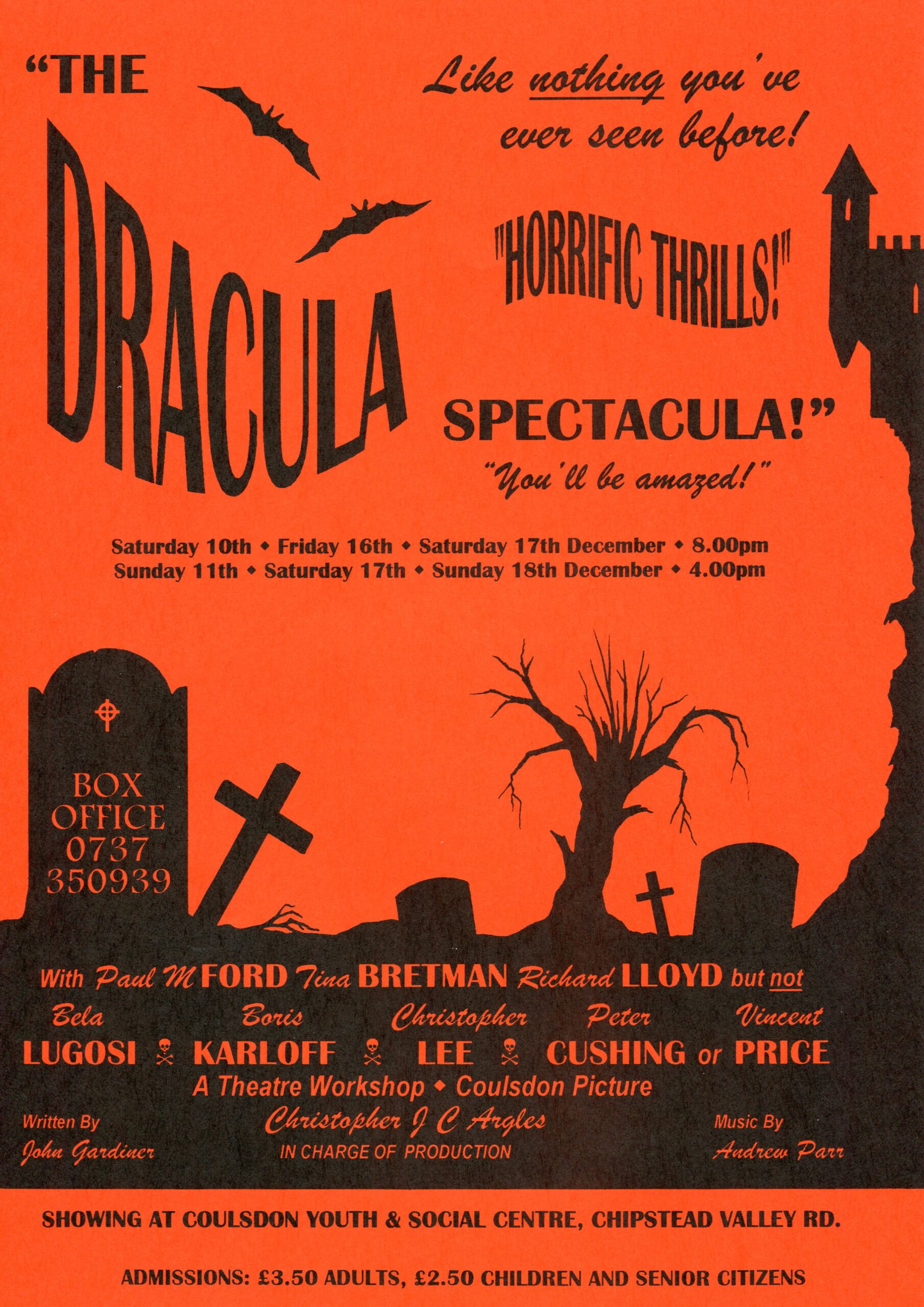
The Dracula Spectacula

It’s been seventeen years since Theatre Workshop Coulsdon first staged ‘The Dracula Spectacula’. At the time it was regarded by the group as probably the biggest and best production that had been performed by them up to that point (we’d only been in existence seven years by that time), involving over 50 people and having a full band.

1995 will be our 25th anniversary year, and we decided that we’d start the celebrations early, by revisiting what was a landmark production for the group.

Amazingly only two of those fifty members who were involved in the 1977 production are actively talking part this time – those being Chris Argles, the director who played Dracula in the original production, and Tim Young, who will recreate his role as Hans, the Innkeeper.

So, how well has ‘The Dracula Spectacula’ stood the test of time? Was it really the terrific show that we fondly remembered, or have the rose-tinted glasses of nostalgia left us with a false impression? Well, let’s be honest, we had to make some changes to the script. Seventeen years doesn’t seem like a long time, but its enough to make some of the dialogue, and the characterisations, sound dated. A number of the songs too, which may have knocked them un-dead back in the day, really don’t cut it now, and so we’ve replaced them with exuberant pastiches of songs that you might just have heard before.

What you see tonight then is very much a brand-new incarnation – albeit of an old favourite, resurrected and rising from its dusty resting place with a whole new lease of life.

Whether this is the first or second time you’ve seen Theatre Workshop Coulsdon perform ‘The Dracula Spectacula’ we hope you enjoy the experience, and live to tell the tale!

The Merry Wives of Windsor

‘The Merry Wives of Windsor’ is one of Shakespeare’s more unusual comedies. No strange land for this one for a start. No far-flung Illyria, exotic Messina or Syracuse, but instead the action centres round The Garter Inn in Windsor. A real place no less, and one that stands to this day. Similarly, the Princes, Dukes and sundry other nobles that inhabit so many of his tales are notable by their complete absence, replaced by the title-less and newly prosperous middle classes. The only knight of the realm that features is the rascally, roguish Sir John Falstaff, a knave who sets out with poor intentions to fool the good wives of Windsor out of money, but fails spectacularly at every turn.

It is said that the character of Falstaff was one that Queen Elizabeth herself was most fond of. He appeared first in Henry IV Part One, and again in Henry IV Part Two, a portly, aging disreputable sot, too fond of his drink and of cheap women, forever lacking in funds. Quick to borrow, never to repay, and cowardly to boot, Falstaff does retain a certain charm and zest for life, and it’s this, for a time, that endears him to Prince Hal. However, when the prince becomes the King, all his former life is left behind, including Falstaff. In Henry V, Mistress Quickly delivers a eulogy outlining the circumstances of his death, and there, one might suppose, was the end of him. If a queen commands though, a humble playwright must write, and so, two years after his death, Sir John Falstaff lived again.

So ‘The Merry Wives…’ is what we would call today a ‘prequel’. Reunited with his low-life comrades, Pistol, Nym and Bardolph (the latter two also dying in Henry V, executed for looting), Falstaff unknowingly engages in a battle of wits with Mistress Page and Mistress Ford and finds himself distinctly unarmed, or at least badly under-gunned. Unlike the bittersweet nature of his antics in the histories though, these adventures are purely comedy, descending almost into farce. It dispenses with the oft-used conventions of romantic comedy, such as the mistaken identity, the flirtatious wordplay, the lovesick entanglements, and replaces them with Falstaff, the aging would-be suitor and lothario (supremely lacking in self-awareness) falling for the tricks being being played on him. In parallel, middle-aged, middle-class Francis Ford, consumed with ill-founded jealousy, repeatedly makes a fool of himself while attempting to prove, vainly, his wife an adulterer.

It’s funny, but this, undoubtedly the most original of Shakespeare’s works, drawing on no ancient text or foreign translation, is looked down upon by numerous scholars of the Bard. They seem to forget that the texts weren’t designed to be pored over, dissected and examined by fusty literary experts. It was created to have life on the stage, uproarious, physical life as popular entertainment.

And that is what you have before you. Enjoy.

Twelfth Night (1999)

What is Twelfth night? Well, it is, traditionally, the last night of the twelve days of Christmas, and falls on either the 5th or 6th of January, depending on whether you start counting on Christmas Day or Boxing Day. A Christian festival, superstition has it that leaving your decorations up after the twelfth night is unlucky, and other customs surrounding the date include singing carols, eating cake and having your house blessed. None of which are remotely connected to Shakespeare’s play of the same name. The source of its naming remains a mystery, though some make tenuous links to the awarding of the title ‘Lord of Misrule’ and the wild abandon or ‘a world turned upside down’ which may possibly have formed part of the festivities on the day during Elizabethan times. However, that’s somewhat overselling the action contained within the play.

What we have is a resourceful heroine, Viola, who having been shipwrecked and washed up on the shores of an unknown land, adopts the masculine persona ‘Cesario’, to enhance her chances of survival. She falls into the employ of Orsino, the Duke of Illyria, who is hopelessly smitten with the Countess Olivia, a woman in mourning for her recently departed brother. Orsino uses Cesario as a go-between to advance his romantic case, but unfortunately Olivia falls for Cesario instead. Worse still, Viola has become infatuated with Orsino, but can’t do anything because she’s pretending to be a man.

Olivia’s household is a place overrun with guests and servants. The steward, Malvolio, is a pompous ass disliked by all. Sir Toby Belch, Olivia’s uncle seems to be a permanent resident, drinking and carousing with his frankly gormless associate Sir Andrew Aguecheek, and flirting with Maria, one of the sharper of Olivia’s housemaids. It is she who formulates a plan, with the two dissolute knights, to take Malvolio down a peg or two by persuading the steward that Olivia secretly loves him.

And into all this walks Sebastian, Viola’s identical twin brother. Thought drowned by his sister, he did in fact survive the shipwreck and is now endlessly confused by people referring to him, and more, as Cesario…

TWC have, somewhat inevitably, been forced to cut back some of the script. Feste, Olivia’s fool or jester, is mainly there to add even more of a comic touch to this already amusing situation. Sadly, what was undoubtedly hilarious to the groundlings in 1602 falls these days on ears that have no understanding of the references being used, and so much of his ‘stand-up routine’ has been excluded. We present ‘Twelfth Night’ as we guess it was intended to be played – an exhilarating and romantic romp, shot through with a vein of wistful lyricism, delivered with exuberance and delight. The alternative title for the play is ‘What you will’, seemingly indicating that Shakespeare was happy to leave the title to the preference of the audience. Whatever you call it, it remains one of his funniest romantic comedies. Enjoy.

The Little Shop Of Horrors

Back in 1960, director Roger Corman, ‘king’ of the low-budget movie, made a horror comedy film called ‘The Passionate People Eater’ on practically no budget, in very little time, using sets left over from a previous movie. Released in that same October under the new title of ‘The Little Shop of Horrors’, it slowly gained a cult following, and over twenty years later, in 1982, a musical version (with some significant changes to the story) opened off-off-Broadway, written by Howard Ashman and Alan Menken. It was successful enough to merit a transfer to the off-Broadway Orpheum Theatre in Manhattan’s East Village, and there it ran for five years, winning numerous awards and becoming the highest-grossing production in off-Broadway history. A transfer to Broadway was proposed, but writer Ashman declined, saying it belonged where it was. In much the same way that Mel Brooks’ ‘The Producers’ was first a film, then a stage musical, followed by film of the stage musical, so to did a film version of ‘The Little Shop of Horrors’ emerge, in 1986. Starring Rick Moranis as Seymour, this was anything but low-budget, costing US$25 million, with cameos from Steve Martin, Jim Belushi, Bill Murray and John Candy, and the voice of Audrey II being provided by Levi Stubbs, lead singer with 1960s and 70s Motown group, The Four Tops.

Theatre Workshop Coulsdon don’t have US$25 million to throw around, but we do have people with creative skills, buckets of talent, and lots of enthusiasm. We’ll not disappoint.

So, what’s it all about?

Well, down on Skid Row, in the crummy part of town, grumpy store-owner Mushnik runs a seedy, run-down florist’s, with two assistants, Seymour and Audrey. Seymour, orphaned and poor, with only the little money he gets from Mushnik, is secretly in love with pretty, blonde Audrey. However, not only does he lack the confidence to share his feelings, but she’s already got a boyfriend, the arrogant and sadistic Orin Scrivello, a leather-clad, motorcycle-riding dentist. One day, after a sudden eclipse, Seymour discovers a mysterious plant, looking a bit like a Venus Fly-Trap, which he names Audrey II. He tends it carefully, but despite his best ministrations, the plant is clearly ailing. Then, while working with some roses, Seymour pricks his finger on a thorn, and Audrey II eagerly laps up the drops of blood. This is what the mysterious plant thrives on…

Complete with four piece band, TWC’s ‘The Little Shop of Horrors’ gives you eighteen singalong numbers as the story charts the misadventures of Seymour, Audrey, and Mushnik and the murderous growth of Audrey II. It’s blooming marvellous!

The Christmas Curse Of Fu Manchu

Created by English author Sax Rohmer back in 1910, Doctor Fu Manchu can rightly lay claim to being one of earliest ‘Super-villains’, a man whose insidious plotting and scheming would, if not stopped by his heroic rival Denis Nayland Smith and his like, have brought down Western civilisation, and ensured the final victory of ‘The Yellow Peril’. Rohmer, whose real name was the somewhat more ordinary Arthur Ward, lived for a while just down the road, in a house called Little Gatton, on Gatton Road, Reigate.

However, he could not have guessed that one day his evil creation would sink to the level that Mark Taylor has devised in his latest pantomime adventure, with the eradication of every Santa Claus on the planet!

Fu Manchu will surely not have it all his own way. Not when faced with the might of Scotland Yard’s finest, Inspector Burke, with assistance from the uniformed (or is that uninformed?) branch in the shape of WPC Shapely, along with PC Manly and Sergeant Duffem. And then there’s Lavinia. Lavinia Smythe-Bottonne to those who know, Dame to you. If you take-away just the one thing about her, it’s that she’ll not stand for any oriental skulduggery. She might sit of course, if the seat is comfortable enough, but obviously not the ones in the hall that you’re sitting on.

(The Director would like to point out that no real Santa Clauses were harmed in the course of making of this pantomime, and that all Santas appear by kind permission of the REAL Father Christmas, who is, as we all know, busily preparing for Christmas in Lapland at this very moment.)

The Recruiting Officer (1998)

Written in 1706 by Irish writer George Farquhar, ‘The Recruiting Officer’ is a comedy set in and around the town of Shrewsbury in Shropshire. As the War of the Spanish Succession rumbles on in Europe, two recruiting officers, the womanising Captain Plume and the effete and cowardly Captain Brazen, attempt to entice the men of the town into the army and the women into their beds. Plume has an advantage here, for on his side is the redoubtable Sergeant Kite, who will use any means, fair or foul, to get men to join up.

Life is complicated by the women in their lives, who are far more independently minded, and smarter, than they can honestly cope with. Plume is promised to Sylvia, the daughter of a local Justice, Balance, but he’s also the father to a bastard born of a local girl, who Sylvia knows about and is caring for. Melinda, Sylvia’s cousin, was the amour of Plume’s friend Worthy, but he refused to marry her and instead proposed that she become his mistress, because she was too poor. Now she’s inherited a fortune, he’s back, but Melinda’s going to have a little fun with Worthy, by playing up to Captain Brazen. And then there’s Lucy, Melinda’s maid, who by subterfuge intends to wed Brazen too.

Hidden motives, trickery, miscommunication and disguise, all go towards making this boisterous romantic comedy laugh out loud funny, and it’s been doing it for over 300 years. It was the first play ever performed in New York City, at the Theatre on Nassau Street, on 11 December, 1732 (by amateurs too!). However, Farquhar didn’t benefit from its success. Heavily in debt and made ill with worry, he died in April 1707, not two months after the debut of his last play, ‘The Beaux Stratagem’.

Raiders Of The Lost Shark

An unashamed tribute / spoof / homage of the Indiana Jones’ movies that made the 1980s such fun, Richard Lloyd’s comedy adventure draws most heavily on the second of the series, ‘Indiana Jones and Temple of Doom’ (1984). (the first chronologically, being a prequel, set a year before ‘Raiders of the Lost Ark’). Although the inevitable Nazi villains are still in the mix (they are so irredeemably bad and easy to dislike), the far Eastern settings, ranging from India to the South China Sea, plus the inclusion of a young Chinese sidekick and a plucky cabaret singer, have clear parallels with the follow-up film.

But if Harrison Ford was only the second choice to play our favourite adventuring archaeologist, behind Tom Selleck, there was only one choice for us. Neil Grew, who had at that time cornered the market (at TWC) in somewhat knowing heroic leading-man characters (He played Robin Hood in 1993, and would go on to play James Bond in 2004). His donning of the trademark (Lucasfilm, that is) battered fedora, leather jacket and bullwhip was pretty obvious casting.

So, beware of the deadly traps, look out for the evil villains and the deliciously duplicitous femme fatales, jump in the seaplane and head due east for excitement and laughter, as Alabama, Frenchy and Hoi-Sin go in search for the fabled Jewel of Munkipore!

A Midsummer Night’s Dream

This is the second time that Theatre Workshop have visited the strangely English forest that exists just outside Shakespeare’s Athens. Peter Quince and his band of tradesmen cum would-be actors have wandered out from the city to ensure they’re not overlooked as they go about their amateur thespian labours, but either they’ve wandered much further than they intended from the busy streets of London, or there’s a thriving English enclave of ex-pat artisans tucked away in the shadow of the Parthenon. 

There are changes. Not least in the location of our endeavours. Having seized the opportunity to take the group from its home and perform in the open-air just three years previously, we’ve gone further, and at the invitation of Southern Water, will take the production to the shores of the Bewl Water reservoir, near Lamberhurst in Kent. Though the setting is idyllic, this represents no small undertaking, especially for an amateur group whose members are mostly in full-time employment. So we can feel for Messrs Starveling, Bottom, Snug, Snout and co., as we do a full day’s work and then barrel down the A21.

But we’ve not given up on our first open-air home, and will perform first at The Woodman before packing up and heading for Bewl. We could hardly do otherwise, given that it’s our regular watering-hole.

Let’s talk about the music for a moment. Most of the music you’ll hear will be played live by Mark Taylor, though there are a couple of passages that are pre-recorded. He’s composed most of it himself too, because he’s a talented gentleman. Exceptions include the fairy and bergomask dances in Act IV and V which are set to traditional tunes. He’s also composed the music for ‘Philomel with Melody’, whose lyrics are by Shakespeare, and given that Shakespeare’s own lyrics to the fairy benediction at the end of the play are lost to us, we’ve used a 5th Century Celtic blessing as the basis for a song, which again will be accompanied by Mark Taylor’s music.

One last thing. The production is dedicated to the memory of Lesley Argles, a member of Theatre Workshop almost since the beginning. She died aged just 44, as the result of a tragic accident on the 13th July, only two weeks before curtain up. Her husband, Chris, who she met through the group, as well as her son, Luke, and daughter Kimberley, are all on stage here tonight. They were united in their decision that the production should go ahead with their full participation, despite grievous personal loss. They are certain it was what she would have wanted.

The Three Musketeers

France 1625.

A young nobleman called D’Artagnan leaves his family in Gascony, south-west France, and makes his way to Paris to seek his fortune and join the King’s Musketeers. Unfortunately he encounters Rochefort, Captain of the Cardinal’s guard at a rural inn, and after an ill-advised confrontation, loses his letter of introduction to M.de Treville, (the captain of the King’s Musketeers), his money and his sword. So, when he finally arrives at the French capital, his welcome is far from warm. Things take a turn for the even worse when his first meetings with Athos, Porthos and Aramis, the best of the Musketeers, result in him challenging each of them to duels. Finally, taken under the wing of the Three Musketeers rather than being killed by them, the young Gascon finds himself embroiled in the machinations of the cunning Cardinal Richelieu and his deadly agent, Milady de Winter, with plans to dishonour the Queen of France herself. A tale of high adventure, full of fun, swordplay and affairs of the heart…

Originally written by Alexandre Dumas (in collaboration with his regular ghost writer Auguste Maquet) and published in 1844, this swashbuckling historical tale became one of the most enduring adventures in literature, challenged only by, perhaps, ‘Treasure Island’. Numerous adaptations have been made, for stage and screen, including musicals, animation, and even an opera. The script that Chris Argles chose to direct was by Willis Hall, and had been published just the previous year, 1995. Although it keeps to the story, more or less, inevitably some liberties are taken and Hall leans into the humour, no doubt one reason for its selection.

It has passed into Workshop legend that Mike Brown, playing, or rather completely inhabiting the role of Porthos, at one point during the production ran across the stage completely naked, except for a strategically placed broad-brimmed musketeer hat (with a large feather). The part demanded it, obviously.