Twelfth Night (1999)
About the Production
What is Twelfth night? Well, it is, traditionally, the last night of the twelve days of Christmas, and falls on either the 5th or 6th of January, depending on whether you start counting on Christmas Day or Boxing Day. A Christian festival, superstition has it that leaving your decorations up after the twelfth night is unlucky, and other customs surrounding the date include singing carols, eating cake and having your house blessed. None of which are remotely connected to Shakespeare’s play of the same name. The source of its naming remains a mystery, though some make tenuous links to the awarding of the title ‘Lord of Misrule’ and the wild abandon or ‘a world turned upside down’ which may possibly have formed part of the festivities on the day during Elizabethan times. However, that’s somewhat overselling the action contained within the play.
What we have is a resourceful heroine, Viola, who having been shipwrecked and washed up on the shores of an unknown land, adopts the masculine persona ‘Cesario’, to enhance her chances of survival. She falls into the employ of Orsino, the Duke of Illyria, who is hopelessly smitten with the Countess Olivia, a woman in mourning for her recently departed brother. Orsino uses Cesario as a go-between to advance his romantic case, but unfortunately Olivia falls for Cesario instead. Worse still, Viola has become infatuated with Orsino, but can’t do anything because she’s pretending to be a man.
Olivia’s household is a place overrun with guests and servants. The steward, Malvolio, is a pompous ass disliked by all. Sir Toby Belch, Olivia’s uncle seems to be a permanent resident, drinking and carousing with his frankly gormless associate Sir Andrew Aguecheek, and flirting with Maria, one of the sharper of Olivia’s housemaids. It is she who formulates a plan, with the two dissolute knights, to take Malvolio down a peg or two by persuading the steward that Olivia secretly loves him.
And into all this walks Sebastian, Viola’s identical twin brother. Thought drowned by his sister, he did in fact survive the shipwreck and is now endlessly confused by people referring to him, and more, as Cesario…
TWC have, somewhat inevitably, been forced to cut back some of the script. Feste, Olivia’s fool or jester, is mainly there to add even more of a comic touch to this already amusing situation. Sadly, what was undoubtedly hilarious to the groundlings in 1602 falls these days on ears that have no understanding of the references being used, and so much of his ‘stand-up routine’ has been excluded. We present ‘Twelfth Night’ as we guess it was intended to be played – an exhilarating and romantic romp, shot through with a vein of wistful lyricism, delivered with exuberance and delight. The alternative title for the play is ‘What you will’, seemingly indicating that Shakespeare was happy to leave the title to the preference of the audience. Whatever you call it, it remains one of his funniest romantic comedies. Enjoy.

The Cast
Behind the Scenes
Image Gallery






The Reviews
Bard-in-the-open is a great night out for the whole family
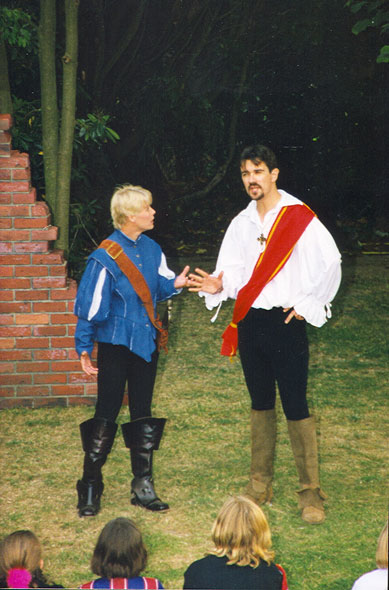
The second title of Twelfth Night, “Or what you will”, always appears more apt, and Theatre Workshop Coulsdon, whatever their shortcomings may have been with the iambic pentameters, simply exuded the spirit of Shakespeare. Our Will still packs them in and he was ably assisted by the cunning direction of Richard Lloyd and Luke Argles. Playing in the open air also helped and the setting in the pub was idyllic.
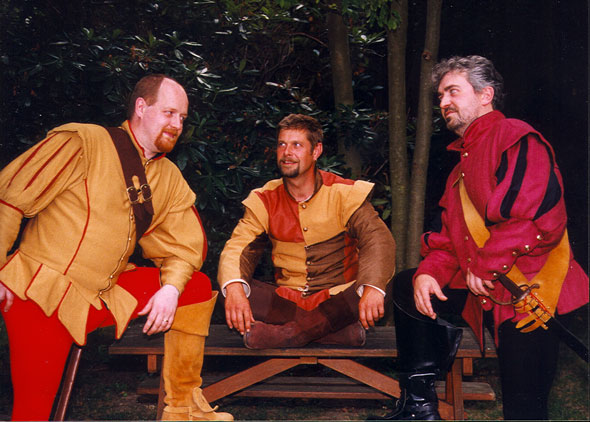
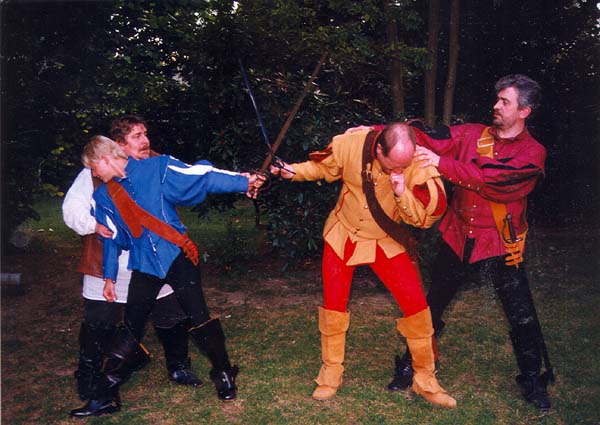
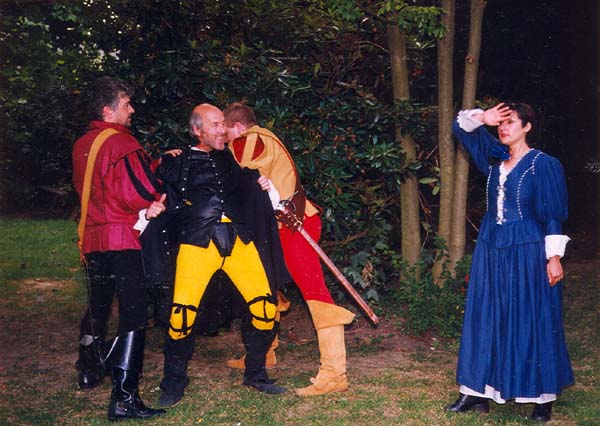
There are two plots, and the subsidiary and farcical one appears to have been stitched on by the Bard. Sir Toby Belch, bon viveur and lecher, was played by Richard Lloyd with an actor’s voice and prehensile eyebrows. Mike Brown was his sidekick Sir Andrew Aguecheek, of the comically and cowardly disposition, ably assisted by Tim Young as Fabian, whose accent came from the west country part of Illyria. These, together with Tina Poole as Maria, whose rear should be black and blue by the end of the run, made life miserable for Chris Argles as the dessicated Malvolio. They have one of the great comic scenes, and they did it justice.
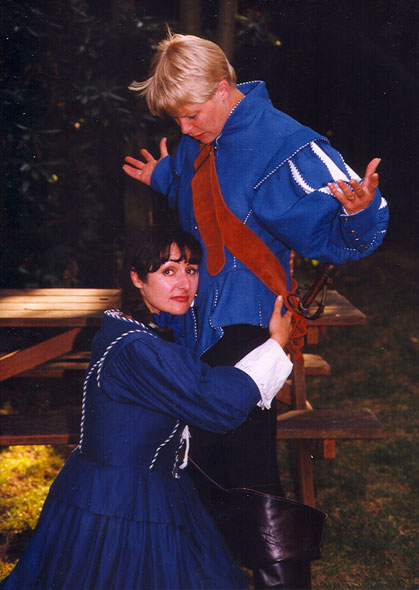
The main plot is of mistaken identity caused by look-a-like twins who are brother and sister: Lisa Lloyd as Viola with feminine charm, then made a plausible Cesario in doublet and tights. Playing the part of her twin was Paul Breden, replete with blonde wig. Their clothes were identical and we could accept that “They were two forms with but one face”.
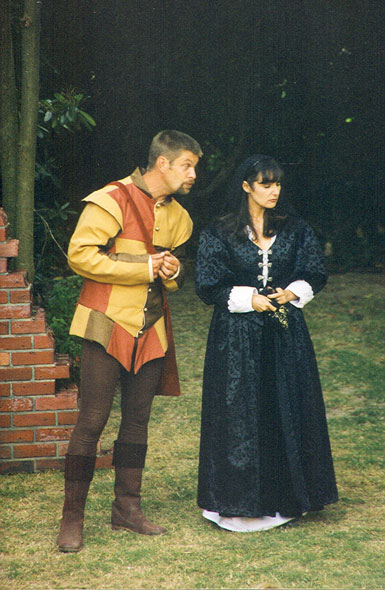
Tanya Allison was Olivia in love with Cesario, and revealed a superb comic touch when the grimacing Malvolio declared his love for her. Neil Grew was a young and handsome Duke of Orsino in love with Olivia but ends up with Cesario. All is okay because she is really Viola. The only piece of sanity was Feste the fool (Nigel Sorensen), who had a delightful singing voice and added hugely to the evening’s merriment.
Mark Taylor composed and played the music in the manner of the cinema. I wondered if it might be distracting but soon found that it complemented the acting.
This is a great night out for all the family.
Peter Steptoe for The Croydon Advertiser
Other Productions