The Merry Wives of Windsor
About the Production
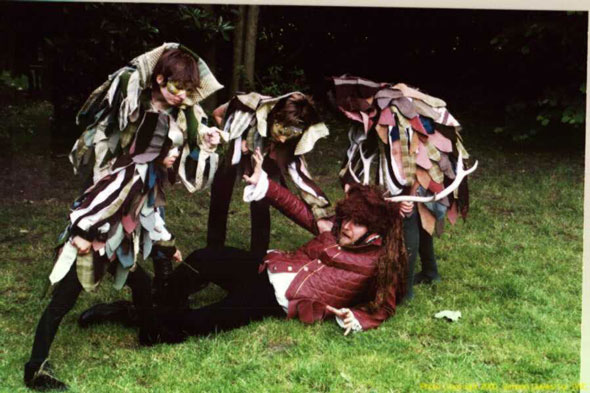
‘The Merry Wives of Windsor’ is one of Shakespeare’s more unusual comedies. No strange land for this one for a start. No far-flung Illyria, exotic Messina or Syracuse, but instead the action centres round The Garter Inn in Windsor. A real place no less, and one that stands to this day. Similarly, the Princes, Dukes and sundry other nobles that inhabit so many of his tales are notable by their complete absence, replaced by the title-less and newly prosperous middle classes. The only knight of the realm that features is the rascally, roguish Sir John Falstaff, a knave who sets out with poor intentions to fool the good wives of Windsor out of money, but fails spectacularly at every turn.
It is said that the character of Falstaff was one that Queen Elizabeth herself was most fond of. He appeared first in Henry IV Part One, and again in Henry IV Part Two, a portly, aging disreputable sot, too fond of his drink and of cheap women, forever lacking in funds. Quick to borrow, never to repay, and cowardly to boot, Falstaff does retain a certain charm and zest for life, and it’s this, for a time, that endears him to Prince Hal. However, when the prince becomes the King, all his former life is left behind, including Falstaff. In Henry V, Mistress Quickly delivers a eulogy outlining the circumstances of his death, and there, one might suppose, was the end of him. If a queen commands though, a humble playwright must write, and so, two years after his death, Sir John Falstaff lived again.
So ‘The Merry Wives…’ is what we would call today a ‘prequel’. Reunited with his low-life comrades, Pistol, Nym and Bardolph (the latter two also dying in Henry V, executed for looting), Falstaff unknowingly engages in a battle of wits with Mistress Page and Mistress Ford and finds himself distinctly unarmed, or at least badly under-gunned. Unlike the bittersweet nature of his antics in the histories though, these adventures are purely comedy, descending almost into farce. It dispenses with the oft-used conventions of romantic comedy, such as the mistaken identity, the flirtatious wordplay, the lovesick entanglements, and replaces them with Falstaff, the aging would-be suitor and lothario (supremely lacking in self-awareness) falling for the tricks being being played on him. In parallel, middle-aged, middle-class Francis Ford, consumed with ill-founded jealousy, repeatedly makes a fool of himself while attempting to prove, vainly, his wife an adulterer.
It’s funny, but this, undoubtedly the most original of Shakespeare’s works, drawing on no ancient text or foreign translation, is looked down upon by numerous scholars of the Bard. They seem to forget that the texts weren’t designed to be pored over, dissected and examined by fusty literary experts. It was created to have life on the stage, uproarious, physical life as popular entertainment.
And that is what you have before you. Enjoy.

The Cast
Behind the Scenes
Image Gallery

The Reviews
Wives are a real hoot as Workshop excel in this garden frolic
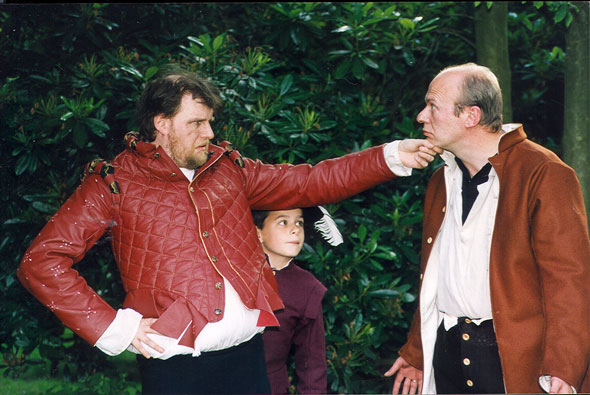
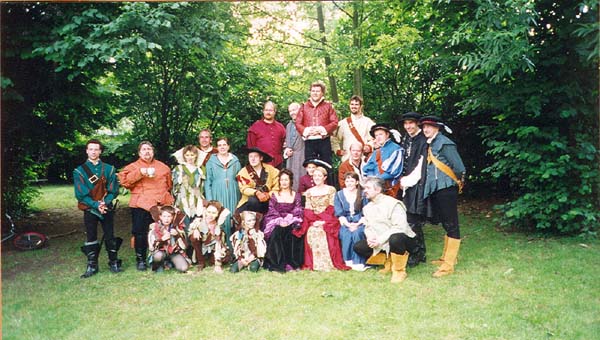
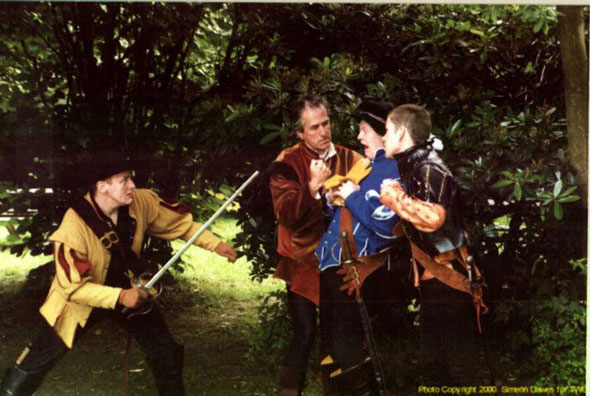
The garden of The Woodman pub at Woodmansterne provides a great natural open air setting, and this year Theatre Workshop Coulsdon have excelled themselves in a peach of a production by Richard Lloyd of Shakespeare’s only English comedy (Forget the Forest of Arden in As You Like It: that’s Ardennes, stupid). The hand of the director can be detected in many a shrewd detail, making it easier to take a bit of the rough, such as Shallow’s marathon handshakes, with a large helping of the smooth.
The play, almost a “humours” comedy in the Jonsonian sense, produces a whole series of inspired portrayals, and oddly enough it is Falstaff himself, in the person of Mark Taylor, who in a measure disappoints. No one need doubt his credentials as an actor, but any portrayal of the fat knight should begin from the inner core of that immense belly. The lightly padded Mr Taylor neither looks nor acts fat, nor is he anywhere near decrepit enough for the old lecher he has become.
The quality of diction and delivery is exemplary, beginning with Richard Lloyd, in every way an outstanding Ford, the emblem of jealous husband-hood, wonderfully funny in disguise as Brook, and admirably contrasted with Mike Brown’s bluffly countrified Page.
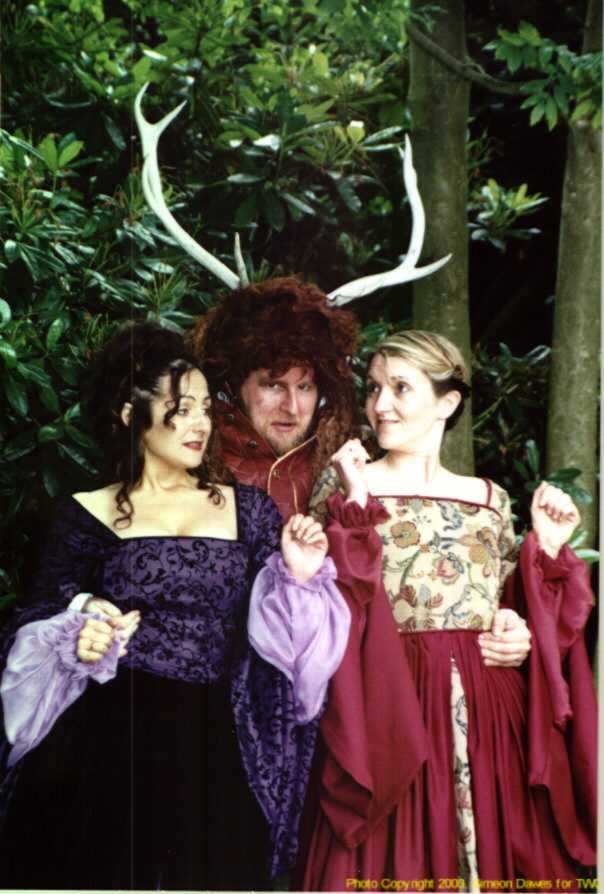
Tanya Allison and Tina Poole are a great double act as Mistresses Page and Ford, laying the perfect traps for Falstaff’s tottering testosterone. Simeon Dawes, too, is on tip top form as the Welsh parson Hugh Evans, and Neil Grew’s choleric French Doctor Caius made even me, a notoriously silent laugher, hoot out loud, by Gar!
Steve North’s Fenton needs to be bolder and more romantic, for after all he and Amy Coates, as Anne Page, have to carry the only scenes of true love this cynical comedy has to offer. Chris Argles is a picture of pernickety senescence as Justice Shallow, while Luke Argles as his foolish nephew Slender, surely a first cousin to Sir Andrew Aguecheek, adopts a voice like Mrs Jean-Paul Sartre of blessed Monty Python memory. Rosie Martin’s Mistress Quickly is a wonder to behold, driving little Matthew Proctor, a sly page boy, to steal away on all fours to escape her garrulity: another fine touch of direction.
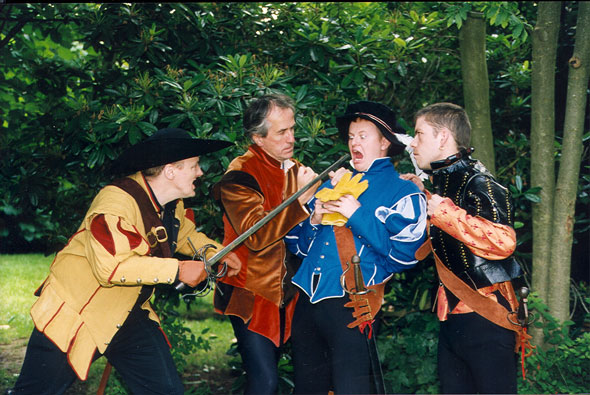
Valuable contributions also from Tim Young’s sly Host and Bruce Montgomery’s sublimely dim Peter Simple; Paul M Ford, Jonathan Wales and Hugh Proctor as Falstaff’s followers; and Richard Hull’s long-suffering servant to Dr Caius.
A great evening.
Donald Madgwick for The Croydon Advertiser
Other Productions