Grimm Tales (2001)

A collection of traditional European folk tales are here given a new lease of life, stripping away much of the saccharine coating so many have accumulated through adaptation for children’s books, TV and film. Yes, we’re looking at you, Disney.

We’ve chosen nine tales all told, each with it’s own director and unique music composition, from one of three talented musicians, Pete Bird, Dominic Russell and Mark Taylor. See the programme for full details. The nine stories are;

Ashputtel

The Golden Goose

The Lady and the Lion

A Riddling Tale

The Hare and the Hedgehogs

Hansel and Gretel

Little Red Cap

Rumplestiltskin

The Magic Table

We like to finish our open air shows with a song, where we can. For this production, we’ve chosen ‘Who’s The Fool Now?’, an old song, first published in 1580 but most certainly far older than that. It doesn’t come from a Grimm tale, but it is a song about tall tales, and it’s also a drinking song, which given we’re sitting in a pub beer garden seems very appropriate. Join in the chorus if you fancy.

The Canterbury Tales (2011)

It is the 14th Century, and in the bustling courtyard of The Tabard Inn, Southwark, men and women from all walks of life gather for a pilgrimage to the cathedral at Canterbury. Friars and priests, pardoners and summoners, millers and good wives. In order to entertain these good folk, the host of the inn asks that each traveller tells a story as they make their way across Kent. And so they, and we, begin our journey.

In this joyous adaptation of Geoffrey Chaucer’s classic work by Richard Lloyd, Theatre Workshop Coulsdon present six of the best and most colourful tales, creating an exuberant and and often hilarious portrait of ordinary folk preoccupied with petty jealousies, mundane squabbles and simple pleasures. Bold and often bawdy, these tales bring home vividly just how little the English people have really changed over the last six hundred years!

The stories presented are The Nun’s Priest’s Tale, The Wife of Bath’s Tale, The Friar’s Tale, The Pardoner’s Tale, The Miller’s Tale and The Reeves Tale, neatly wrapped in an engaging background as host and landlord Harry Bailey attempts to maintain order amongst his boisterous and often wayward charges.

Chaucer (1343 – 1400) is widely considered to be the greatest English poet of the Middle Ages, and was the first poet to be buried in Poet’s Corner at Westminster Abbey. While he achieved fame during his lifetime as an author, philosopher, alchemist and astronomer, Chaucer also maintained an active career in the civil service as a bureaucrat, diplomat and courtier. His many works include ‘The Book of the Duchess’, ‘The House of Fame’, ‘The Legend of Good Women’ and ‘Troilus and Criseyde’, but it is ‘The Canterbury Tales’, in which he uses the tales to paint an ironic and critical picture of English society, for which he will always be remembered.

Much Ado About Nothing (2015)

The path of true love proves to be anything but smooth for not one but two sets of star-crossed lovers in ‘Much Ado About Nothing’, one of Shakespeare’s most romantic, yet comedic tales. For young Claudio and his lady Hero, their happiness is threatened by the Machiavellian scheming of the plain-dealing villain, Don John. For self-professed lifelong batchelor Benedict and the independently minded and sharp-tongued Beatrice, the biggest obstacles are…themselves!

By turns funny, touching, heart-breaking and hilarious, ‘Much Ado About Nothing’ is the perfect way to spend an English Summer evening.

Leonato, a kindly, respectable nobleman, lives in the Italian town of Messina. He shares his villa with his lovely young daughter, Hero, his clever but cynical niece, Beatrice, and his elderly brother, Antonio. As the play begins, Leonato prepares to welcome his good friend, Don Pedro, home from war. Don Pedro, a prince, is accompanied by two friends and fellow soldiers: Claudio, a well-respected young nobleman, and Benedick, a joker who delights in teasing his colleagues. With them too comes Don John, Don Pedro’s illegitimate brother, a sullen, spiteful individual who resents others’ happiness.

After the soldiers arrive, Claudio swiftly falls in love with Hero, while Benedick and Beatrice resume the war of words that they have carried on with each other for years. Claudio and Hero pledge their love to one another and decide to be married. But to pass the days before the wedding, the lovers and their friends decide to trick Beatrice and Benedick, who are obviously meant for each other, into falling in love.

However,  Don John intends to spoil everything. He plots with his followers Borachio and Conrade to ruin Hero’s reputation. And taken in by the treacherous scheme, an enraged Claudio humiliates Hero at the wedding by accusing her of lechery and abandoning her at the altar. Horrified, Hero’s family pretend that she has died of shock and grief and hide her away. Fortunately, a passing watch patrol overhear Borachio drunkenly bragging about his misdeeds to Conrade. Dogberry and Verges, the bumbling heads of the local watch, eventually arrest them and drag them in front of the local magistrate, Leonato. The truth of Don John’s plot is thus revealed, and Claudio and Don Pedro, who believe Hero is dead, are grief stricken.

Leonato tells Claudio that, as a penance for his misjudgement, he must marry his brother  Antonio’s daughter — a girl who, he says, looks much like the dead Hero. Claudio goes to church with the others, solemnly prepared to do his duty and marry the mysterious, masked woman he finds there. But when the masked woman reveals herself to be Hero, Claudio is overwhelmed with joy and all is forgiven.

Benedick then asks Beatrice if she will marry him, and after some verbal sparring,  she agrees. The joyful lovers then celebrate with a double wedding as Don John, who had attempted to escape, is dragged back to face his half-brother’s justice.

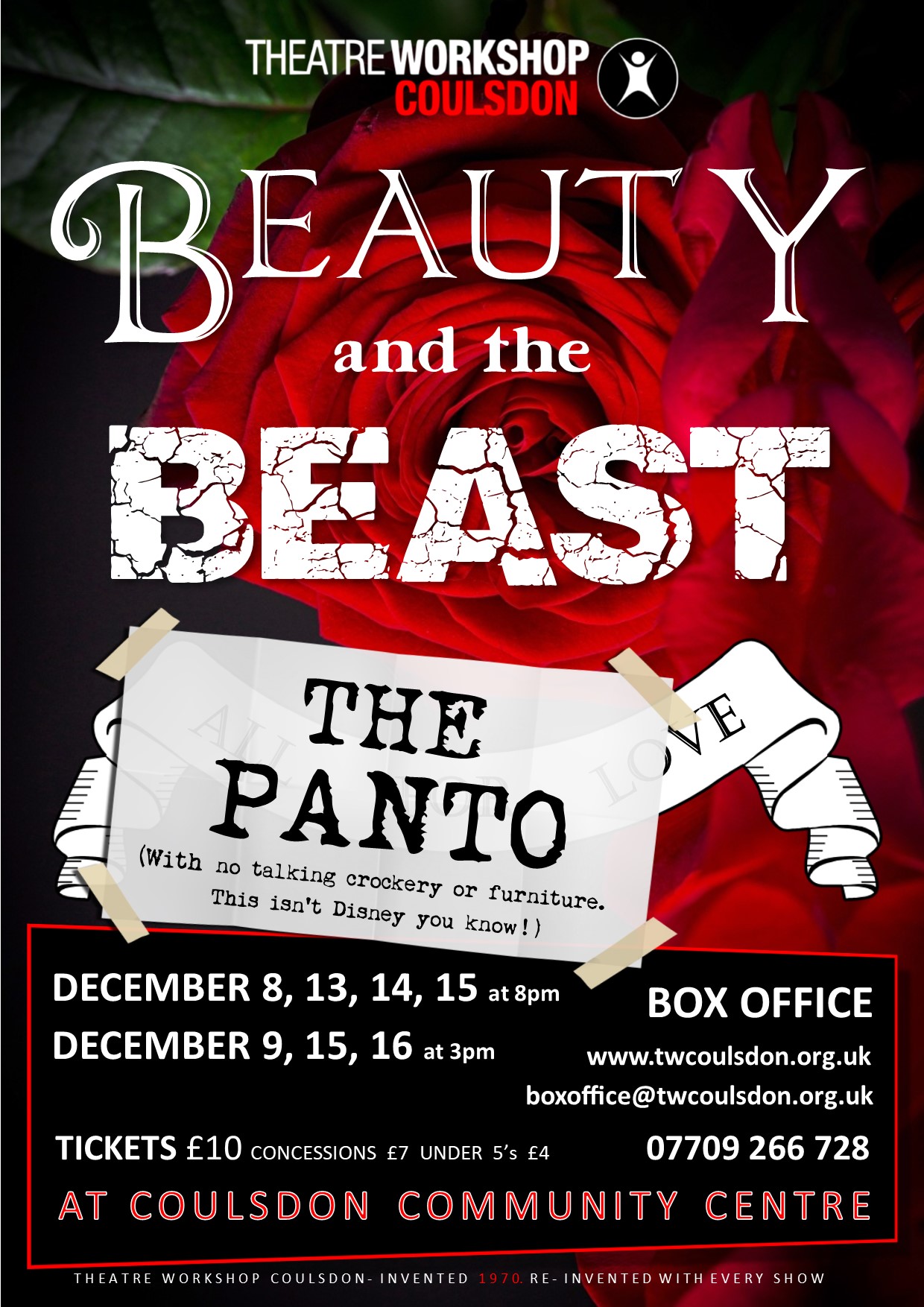
Beauty and The Beast – The Panto

Theatre Workshop Coulsdon’s Christmas 2018 production is an all-new, original pantomime based on the much-loved fairy tale, ‘Beauty and the Beast’. This classic tale, and its underlying message that you shouldn’t judge a book by its cover, has been transformed into a full-fat panto, rocket fuel for the winter season, chock-full of larger than life characters, sing-along songs and audience participation, as the lovely Beauty finds that the monstrous Beast is not what she was expecting. A full band and a large ensemble cast (Bumbling guards, saucy maids, talking vegetation and puppet creatures) support a tale of good versus the evil that is Deadly McNightshade, the woman who puts the wicked into witch and gives it a Scottish accent. Can true love break the dread spell that has locked a handsome prince in a prison he can never escape from? Oh yes it can!

But where did the original story come from? Well, once upon a time there was a woman called Gabrielle-Suzanne Barbot de Villeneuve (They had some cracking names back then) Born in Paris in 1685, she was married at 21 and widowed at 26, her aristocratic but spendthrift husband losing his life almost as swiftly as he lost their money. With her family fortune gone, she needed a way to support herself and eventually moved in with the celebrated playwright and poet Prosper Jolyot de Crebillon (See, another one!) where she began to write. From 1734 through to her death in 1755 she wrote novels and collections of fairy tales but most notably, in 1740, she wrote ‘La Belle et La Bête’, or as we know it, ‘Beauty and the Beast’. It formed part of a much larger story, and was much more complicated than we’re used to now. The simpler version is down to another Frenchwoman, Jeanne-Marie Leprince de Beaumont (and another!) who re-wrote the tale as a much shorter story and published it the year after Villeneuve’s death without acknowledging its origins. Which was a bit sneaky. Boo! Hiss!

Since then it’s become a children’s fairytale classic. Of course, that meant it got the full Disney treatment, twice now, both as a cartoon (1991) and a live-action movie (2017). But there have also been numerous other movie and TV adaptations, a stage musical, an opera, a ballet, and even songs, a disco tune and video games. Its themes of love conquering all and never judging by appearances are simple and easily relatable. And so Sheila May Bird, published children’s author (‘Pete’s Peculiar Petshop’, ‘Pirate Percy’s Parrot’ and others that don’t begin with the letter ‘P’) and long-time member of Theatre Workshop Coulsdon, decided that what had been missing all these years was a pantomime version, full of silliness, slapstick, songs, an audience participation number and the kind of ‘behind you!’ nonsense that makes going to the theatre at this time of year so much fun.

The Adventures of Jason and the Argonauts

The legends of Ancient Greece have continued to weave their magic through our imaginations for over two thousand years. The capricious Gods and Goddesses of Mount Olympus playing with the fates of ordinary mortals for both good and ill. But from the ranks of those mortals came the fabled heroes, those who rose to the challenges and won out despite all. Odysseus taking on the mighty one-eyed giant Cyclops. Theseus defeating the monstrous Minotaur in the labyrinth of Crete. Jason and his Argonauts travelling far and risking everything in search of the Golden Fleece.

This last provides the basis for our winter production. But don’t worry, you won’t need a degree in the classics to work out what’s going on. This is a very loose interpretation of the myths handed down over the centuries. Jason and Medea are two mixed-up kids, an orphan and a runaway, who suddenly find themselves tasked with overthrowing the evil tyrant King Pelias. With a certain amount of divine intervention, Jason becomes the captain of the mighty ‘Argo’, a ship capable of crossing the uncharted seas, with a crew of oddball heroes including the world’s strongest (and possibly clumsiest) man, a wonderful woman warrior, a resting rock star, the least identical twins ever and a seriously streetwise cat. Now he must set off and find the Golden Fleece. If only he knew what it was. And then there are the challenges. The man-eating Harpies of Lemnos, the terrible Clashing Rocks, the fire-breathing Great Bull of Colchis, the evil Dragon Snake and Talos, the bronze giant. (Who might just be a really cool sock puppet.) Not to mention The Sirens…

Medea, Jason and his misfit Argonauts are here this December to have fun. This will be no ordinary adventure tale, but one with songs and laughter, and we’ll be encouraging you to join in, whether you’re five or sixty five. Ever fancied rowing the Argo? You’ll get your chance. Become part of the undead army of skeleton warriors? Oh yes.

The award-winning author of ‘Jason and the Argonauts’, Phil Willmott, is mainly famous around these parts for his creation of the hilariously stiff upper-lipped ‘Dick Barton – Special Agent’ spoofs that were so much a part of the sadly demised Warehouse Theatre in Croydon. But he’s written, adapted and directed numerous productions, many derived from classical sources, and we’re more than pleased to link up with him again.

The Tempest

Torn from the sky!

Returning to its homeland from a royal wedding in distant Tunis, the ‘Napoli Rex’, flagship of the King of Naples’ airfleet, is pulled from the sky by a violent and unnatural storm.

The survivors find themselves scattered across a barren island populated with magical creatures and spirits, fearing for their very lives.  And behind this seeming disaster is Prospero, an exiled sorcerer seeking vengeance…

Shakespeare’s final play is his crowning glory, a tale of magic, love, humour and redemption.

Theatre Workshop Coulsdon have placed ‘The Tempest’ in a steampunk-flavoured Victorian age, where the might of an industrial revolution with its airships, guns and steam-power is confronted with forces beyond its wildest imagining…

Years ago, Prospero forsook his duties as the Duke of Milan to study the arcane arts. With his attention elsewhere, he was unprepared for the coup that saw him dragged from his position and sent out to die alongside his baby daughter, Miranda. By merest chance they survived, crash-landing on a remote and barren island in the Mediterranean, and with the help of two servants, the sprite Ariel and the twisted creature that is Caliban, Prospero lived on and plotted revenge. Now chance again plays into his hands, as those he would mete out vengeance to have been driven to the island by a tempest, their airship torn from the skies and the passengers and crew thrown down. However, he has reckoned without Miranda (now grown to womanhood) and her response to these strange new visitors, one of whom she falls in love with…

Shakespeare’s last play is here transported to a neo-Victorian setting, played out in the traverse among the broken spars and debris of his downed airship, the ‘Milano’. Prospero’s sorcery here vies with magic lanterns and steam-powered pistols in a unique take on the bard’s farewell to the stage.

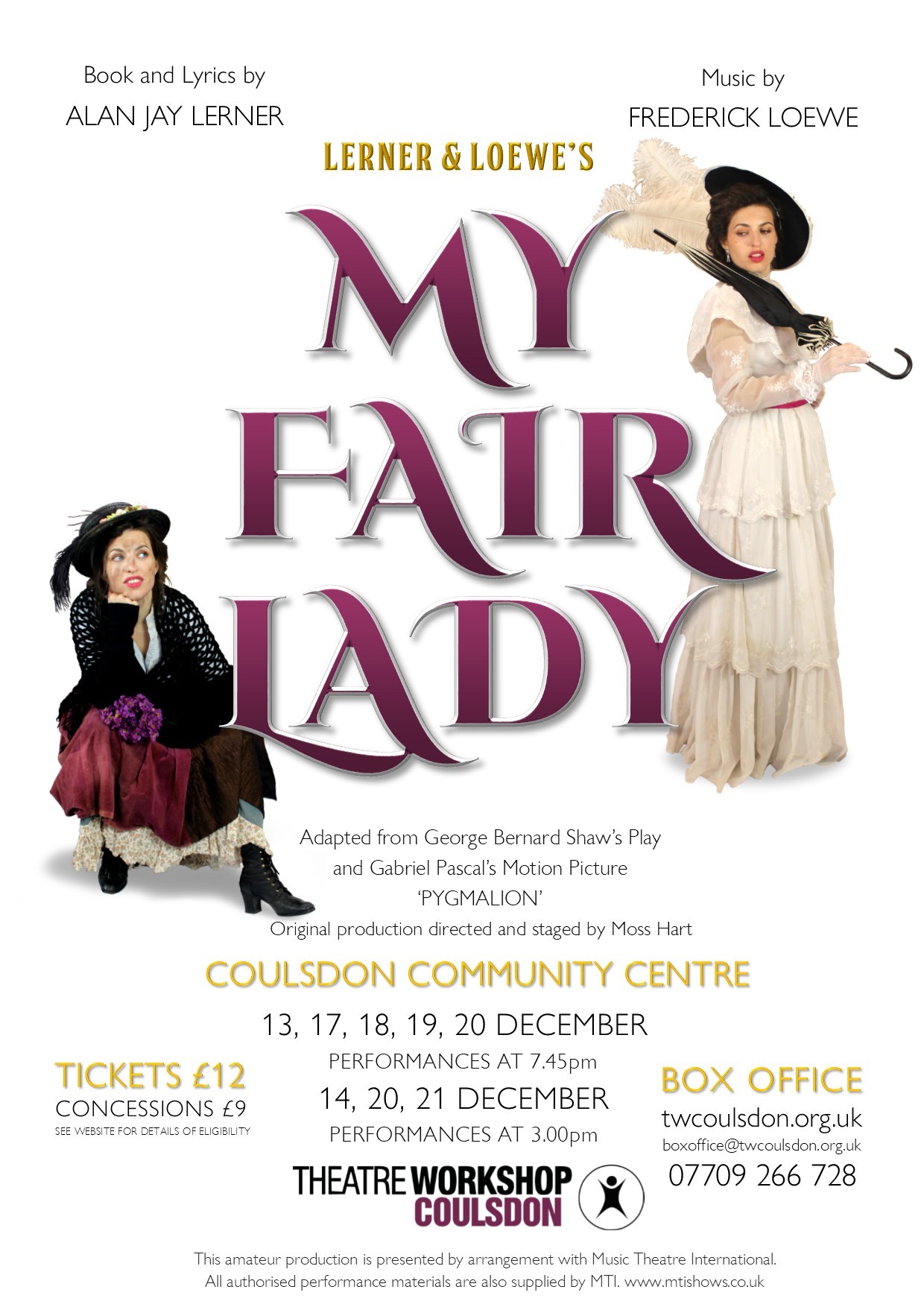
My Fair Lady

Lerner and Loewe’s celebrated stage musical adaptation of George Bernard Shaw’s ‘Pygmalion’ includes some of the best known and best loved show tunes ever written. From ‘Wouldn’t It Be Loverley’ to ‘I’m Getting Married in the Morning’, ‘I Could Have Danced All Night’ and ‘With A Little Bit Of Luck’.

It’s the story of a cockney flower girl’s transformation into the pride of London society – and its unforeseen consequences. In many places it’s very funny; in others, very poignant. When overbearing Professor Higgins stumbles on Eliza Doolittle outside Covent Garden Opera House, he recognises that her hideous vowels and lost consonants are all that separates her from the upper classes. Higgins casually makes a wager that within weeks he can pass Eliza off in polite society as a Duchess. But little does he know that beneath the dirty face and shabby clothes, young Eliza is stuffed full of human feeling. Too eloquent for a flower girl, yet lacking the breeding of the ruling classes, what on earth is to become of Eliza when the bet is over and the game has reached an end?

‘My Fair Lady’ was Lerner and Loewe’s musical adaptation of George Bernard Shaw’s ‘Pygmalion’, a much darker tale than the highly successful Broadway, West End and Hollywood show tells.

The character of ‘Pygmalion’ comes from Greek mythology, where he was sculptor who fell in love with a statue he had created, a statue that then comes to life. Bernard Shaw took that tale and twisted it, the sculptor becoming Henry Higgins, and the thing he creates, Eliza Doolittle. His play debuted in 1913 in Vienna, before going on to London and New York. Critics were generally favourable, though the ending created a certain level of controversy. A standard love story this wasn’t, and the ending was no more conventional. A film version was made in 1938, starring Leslie Howard as Higgins and Wendy Hiller as Eliza, and Shaw, initially distrustful, agreed to it being made only if he had a certain amount of creative control. This resulted in Shaw writing a whole new ballroom scene, the creation of a new character ‘Zoltan Karpathy’, and a new ending. He and his fellow screenwriters were awarded an Oscar for the screenplay, for which Shaw was characteristically dismissive, but it would be this screenplay that would be used as the basis for the musical.

The director of the movie, Gabriel Pascal, had spoken with Shaw about making it into a musical, but the author had refused. However, when Shaw died in 1950, that barrier was no longer an issue. Pascal approached lyricist Alan Jay Lerner to write the musical, with his partner, composer Frederick Loewe. At first, they couldn’t make it work but eventually they found a way, though not before Pascal had died. They called it ‘My Fair Lady’ after a provisional title to Shaw’s play ‘Pygmalion’, and it referred to the Cockney pronunciation of ‘Mayfair Lady’, helping to show Eliza’s transformation from working-class girl to upper-class woman. The part of ‘Higgins’ was initially offered to Noel Coward, who turned it down but suggested they approach Rex Harrison. ‘Eliza’ was offered to Broadway veteran Mary Martin who also turned it down, and they went instead for newcomer Julie Andrews. It opened on Broadway in March 1956 and was a massive success, going on to become, at the time, the biggest grossing Broadway show ever.

The 1964 movie was a similar success, winning eight Oscars including those for Best Picture and Best Actor (Rex Harrison). Interestingly, the Best Actress Oscar that year went to Julie Andrews for her portrayal of Mary Poppins, having been rejected for reprising the part of Eliza as not being famous enough by the studio. It went, famously, to Audrey Hepburn, whose singing voice was overdubbed by Marni Wood.

Theatre Workshop Coulsdon’s presentation of this fabulous show was directed by veteran actor/director Richard Lloyd with musical director and pianist Mark Taylor, and features Dan Carr as Professor Henry Higgins, Indianna Scorziello as flower-seller Eliza Doolittle, Paul Ford as her ne’er-do-well father Alfred, and Mike Brown as the bluff and amiable Col. Pickering.

A Christmas Carol

‘A Christmas Carol’ is a Victorian morality tale of an old and bitter miser, Ebenezer Scrooge, who undergoes a profound journey of redemption over the course of just one night. A financier and money-changer who has devoted his life to the accumulation of wealth, he holds anything other than money in contempt, including friendship, love and particularly the Christmas season. But when on Christmas Eve he is visited by the dread ghost of his former partner, Jacob Marley, and subsequently by other spirits who show him what his life has been before and what a bitter fate lies ahead of him, he is forced to make a decision that will change his life, and all those around him…

Henry V

 Cry God For Harry, England and St George!

This tale of a young man finding his way to be King through a baptism of bloody war against the French is surely the most bold and stirring of Shakespeare’s histories. From his first forays at diplomacy to his nervous attempts to win the heart of a princess, Henry, a one-time rogue more used to the company of thieves than the ways of court, finds that his responsibilities outweigh the power he now wields. And that victory, even a glorious victory on the fields of Agincourt, comes at no small price…
‘Henry V’ sees Theatre Workshop Coulsdon return to grounds of Coulsdon Manor Hotel for their tenth season, following on from previous successes with ‘Wind in the Willows’, ‘Dick Barton and the Slaves of the Sultan’, ‘Much Ado about Nothing’, ‘The Canterbury Tales’ and ‘A Midsummer’s Night Dream’. This show will be no less colourful and entertaining.
With a BBQ and bar set under the gently setting sun and summer stars, this is open-air theatre at its finest.

The Wind In The Willows

Since 1908, this classic tale of inquisitive Mole, stolid Ratty, gruff Badger and ‘ever in trouble’ Toad has delighted children of all ages, and most adults too! This stage adaptation by Theatre Workshop Coulsdon follows their adventures from the river bank to the Wild Wood, via the open road to the deepest dungeon, with a thrilling climax at stately Toad Hall. It’s a path strewn with boats, trains, caravans and stolen cars, as our animal heroes overcome adversity and their own natures to emerge victorious. By turns charming and funny, this is a splendid way to while away a English summer’s evening.