Grimm Tales (2001)

A collection of traditional European folk tales are here given a new lease of life, stripping away much of the saccharine coating so many have accumulated through adaptation for children’s books, TV and film. Yes, we’re looking at you, Disney.

We’ve chosen nine tales all told, each with it’s own director and unique music composition, from one of three talented musicians, Pete Bird, Dominic Russell and Mark Taylor. See the programme for full details. The nine stories are;

Ashputtel

The Golden Goose

The Lady and the Lion

A Riddling Tale

The Hare and the Hedgehogs

Hansel and Gretel

Little Red Cap

Rumplestiltskin

The Magic Table

We like to finish our open air shows with a song, where we can. For this production, we’ve chosen ‘Who’s The Fool Now?’, an old song, first published in 1580 but most certainly far older than that. It doesn’t come from a Grimm tale, but it is a song about tall tales, and it’s also a drinking song, which given we’re sitting in a pub beer garden seems very appropriate. Join in the chorus if you fancy.

The Canterbury Tales (2011)

It is the 14th Century, and in the bustling courtyard of The Tabard Inn, Southwark, men and women from all walks of life gather for a pilgrimage to the cathedral at Canterbury. Friars and priests, pardoners and summoners, millers and good wives. In order to entertain these good folk, the host of the inn asks that each traveller tells a story as they make their way across Kent. And so they, and we, begin our journey.

In this joyous adaptation of Geoffrey Chaucer’s classic work by Richard Lloyd, Theatre Workshop Coulsdon present six of the best and most colourful tales, creating an exuberant and and often hilarious portrait of ordinary folk preoccupied with petty jealousies, mundane squabbles and simple pleasures. Bold and often bawdy, these tales bring home vividly just how little the English people have really changed over the last six hundred years!

The stories presented are The Nun’s Priest’s Tale, The Wife of Bath’s Tale, The Friar’s Tale, The Pardoner’s Tale, The Miller’s Tale and The Reeves Tale, neatly wrapped in an engaging background as host and landlord Harry Bailey attempts to maintain order amongst his boisterous and often wayward charges.

Chaucer (1343 – 1400) is widely considered to be the greatest English poet of the Middle Ages, and was the first poet to be buried in Poet’s Corner at Westminster Abbey. While he achieved fame during his lifetime as an author, philosopher, alchemist and astronomer, Chaucer also maintained an active career in the civil service as a bureaucrat, diplomat and courtier. His many works include ‘The Book of the Duchess’, ‘The House of Fame’, ‘The Legend of Good Women’ and ‘Troilus and Criseyde’, but it is ‘The Canterbury Tales’, in which he uses the tales to paint an ironic and critical picture of English society, for which he will always be remembered.

Much Ado About Nothing (2015)

The path of true love proves to be anything but smooth for not one but two sets of star-crossed lovers in ‘Much Ado About Nothing’, one of Shakespeare’s most romantic, yet comedic tales. For young Claudio and his lady Hero, their happiness is threatened by the Machiavellian scheming of the plain-dealing villain, Don John. For self-professed lifelong batchelor Benedict and the independently minded and sharp-tongued Beatrice, the biggest obstacles are…themselves!

By turns funny, touching, heart-breaking and hilarious, ‘Much Ado About Nothing’ is the perfect way to spend an English Summer evening.

Leonato, a kindly, respectable nobleman, lives in the Italian town of Messina. He shares his villa with his lovely young daughter, Hero, his clever but cynical niece, Beatrice, and his elderly brother, Antonio. As the play begins, Leonato prepares to welcome his good friend, Don Pedro, home from war. Don Pedro, a prince, is accompanied by two friends and fellow soldiers: Claudio, a well-respected young nobleman, and Benedick, a joker who delights in teasing his colleagues. With them too comes Don John, Don Pedro’s illegitimate brother, a sullen, spiteful individual who resents others’ happiness.

After the soldiers arrive, Claudio swiftly falls in love with Hero, while Benedick and Beatrice resume the war of words that they have carried on with each other for years. Claudio and Hero pledge their love to one another and decide to be married. But to pass the days before the wedding, the lovers and their friends decide to trick Beatrice and Benedick, who are obviously meant for each other, into falling in love.

However,  Don John intends to spoil everything. He plots with his followers Borachio and Conrade to ruin Hero’s reputation. And taken in by the treacherous scheme, an enraged Claudio humiliates Hero at the wedding by accusing her of lechery and abandoning her at the altar. Horrified, Hero’s family pretend that she has died of shock and grief and hide her away. Fortunately, a passing watch patrol overhear Borachio drunkenly bragging about his misdeeds to Conrade. Dogberry and Verges, the bumbling heads of the local watch, eventually arrest them and drag them in front of the local magistrate, Leonato. The truth of Don John’s plot is thus revealed, and Claudio and Don Pedro, who believe Hero is dead, are grief stricken.

Leonato tells Claudio that, as a penance for his misjudgement, he must marry his brother  Antonio’s daughter — a girl who, he says, looks much like the dead Hero. Claudio goes to church with the others, solemnly prepared to do his duty and marry the mysterious, masked woman he finds there. But when the masked woman reveals herself to be Hero, Claudio is overwhelmed with joy and all is forgiven.

Benedick then asks Beatrice if she will marry him, and after some verbal sparring,  she agrees. The joyful lovers then celebrate with a double wedding as Don John, who had attempted to escape, is dragged back to face his half-brother’s justice.

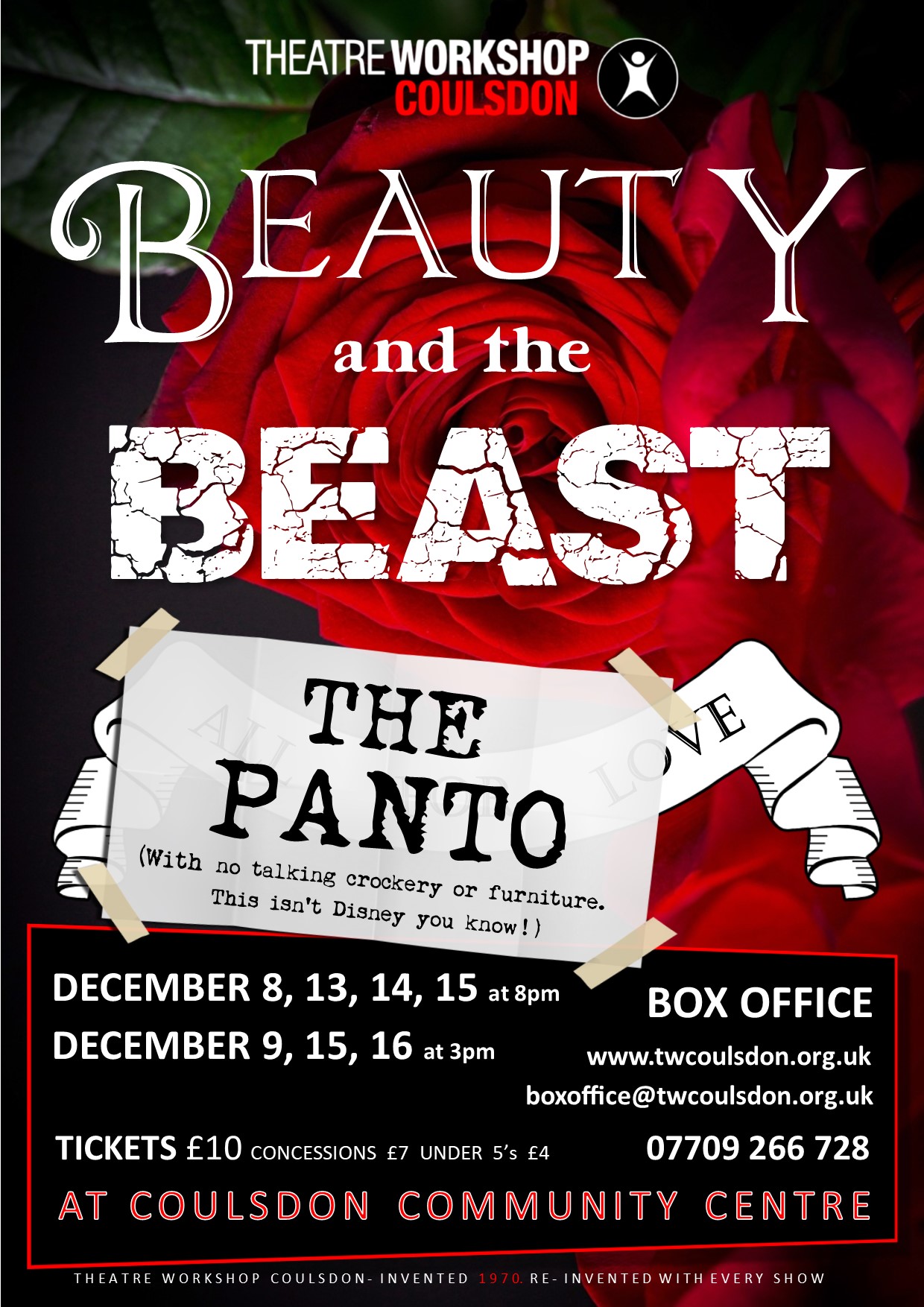
Beauty and The Beast – The Panto

Theatre Workshop Coulsdon’s Christmas 2018 production is an all-new, original pantomime based on the much-loved fairy tale, ‘Beauty and the Beast’. This classic tale, and its underlying message that you shouldn’t judge a book by its cover, has been transformed into a full-fat panto, rocket fuel for the winter season, chock-full of larger than life characters, sing-along songs and audience participation, as the lovely Beauty finds that the monstrous Beast is not what she was expecting. A full band and a large ensemble cast (Bumbling guards, saucy maids, talking vegetation and puppet creatures) support a tale of good versus the evil that is Deadly McNightshade, the woman who puts the wicked into witch and gives it a Scottish accent. Can true love break the dread spell that has locked a handsome prince in a prison he can never escape from? Oh yes it can!

But where did the original story come from? Well, once upon a time there was a woman called Gabrielle-Suzanne Barbot de Villeneuve (They had some cracking names back then) Born in Paris in 1685, she was married at 21 and widowed at 26, her aristocratic but spendthrift husband losing his life almost as swiftly as he lost their money. With her family fortune gone, she needed a way to support herself and eventually moved in with the celebrated playwright and poet Prosper Jolyot de Crebillon (See, another one!) where she began to write. From 1734 through to her death in 1755 she wrote novels and collections of fairy tales but most notably, in 1740, she wrote ‘La Belle et La Bête’, or as we know it, ‘Beauty and the Beast’. It formed part of a much larger story, and was much more complicated than we’re used to now. The simpler version is down to another Frenchwoman, Jeanne-Marie Leprince de Beaumont (and another!) who re-wrote the tale as a much shorter story and published it the year after Villeneuve’s death without acknowledging its origins. Which was a bit sneaky. Boo! Hiss!

Since then it’s become a children’s fairytale classic. Of course, that meant it got the full Disney treatment, twice now, both as a cartoon (1991) and a live-action movie (2017). But there have also been numerous other movie and TV adaptations, a stage musical, an opera, a ballet, and even songs, a disco tune and video games. Its themes of love conquering all and never judging by appearances are simple and easily relatable. And so Sheila May Bird, published children’s author (‘Pete’s Peculiar Petshop’, ‘Pirate Percy’s Parrot’ and others that don’t begin with the letter ‘P’) and long-time member of Theatre Workshop Coulsdon, decided that what had been missing all these years was a pantomime version, full of silliness, slapstick, songs, an audience participation number and the kind of ‘behind you!’ nonsense that makes going to the theatre at this time of year so much fun.

And Then There Were None

August 1939. Dark clouds are gathering over Europe, and off the coast of South Devon, a remote island becomes the setting for a series of sinister killings.

‘And Then There Were None’ has provided the model for innumerable ‘locked room’ mysteries. It’s also one of Christie’s very few works where there is no ingenious detective – no Poirot or Miss Marple – to solve the case. Just a group of extraordinary characters marooned together on an island, where one of them is deranged killer. But which one?

In some ways, it’s the purest mystery Christie ever wrote. Ten strangers are invited to Soldier Island, but on arrival, their hosts, Mr and Mrs U.N. Owen, are strangely absent.

As the evening unfolds, the fragile atmosphere of forced good humour is broken by the sudden accusation that they are all guilty of murder. Then one by one, members of the party begin to die, with the manner of their killing linked to a seemingly innocent nursery rhyme. Fear, suspicion and paranoia take hold of the remaining survivors as they realise the killer must be one of them.

Christie, who wrote the stage adaptation herself, provided a more upbeat ending than her novel. But a 2015 adaptation followed the novel more closely. Which have we used? You’ll have to find out…

The Adventures of Jason and the Argonauts

The legends of Ancient Greece have continued to weave their magic through our imaginations for over two thousand years. The capricious Gods and Goddesses of Mount Olympus playing with the fates of ordinary mortals for both good and ill. But from the ranks of those mortals came the fabled heroes, those who rose to the challenges and won out despite all. Odysseus taking on the mighty one-eyed giant Cyclops. Theseus defeating the monstrous Minotaur in the labyrinth of Crete. Jason and his Argonauts travelling far and risking everything in search of the Golden Fleece.

This last provides the basis for our winter production. But don’t worry, you won’t need a degree in the classics to work out what’s going on. This is a very loose interpretation of the myths handed down over the centuries. Jason and Medea are two mixed-up kids, an orphan and a runaway, who suddenly find themselves tasked with overthrowing the evil tyrant King Pelias. With a certain amount of divine intervention, Jason becomes the captain of the mighty ‘Argo’, a ship capable of crossing the uncharted seas, with a crew of oddball heroes including the world’s strongest (and possibly clumsiest) man, a wonderful woman warrior, a resting rock star, the least identical twins ever and a seriously streetwise cat. Now he must set off and find the Golden Fleece. If only he knew what it was. And then there are the challenges. The man-eating Harpies of Lemnos, the terrible Clashing Rocks, the fire-breathing Great Bull of Colchis, the evil Dragon Snake and Talos, the bronze giant. (Who might just be a really cool sock puppet.) Not to mention The Sirens…

Medea, Jason and his misfit Argonauts are here this December to have fun. This will be no ordinary adventure tale, but one with songs and laughter, and we’ll be encouraging you to join in, whether you’re five or sixty five. Ever fancied rowing the Argo? You’ll get your chance. Become part of the undead army of skeleton warriors? Oh yes.

The award-winning author of ‘Jason and the Argonauts’, Phil Willmott, is mainly famous around these parts for his creation of the hilariously stiff upper-lipped ‘Dick Barton – Special Agent’ spoofs that were so much a part of the sadly demised Warehouse Theatre in Croydon. But he’s written, adapted and directed numerous productions, many derived from classical sources, and we’re more than pleased to link up with him again.

Sherlock Holmes and the Sons of Anubis

From the depths of ancient Egypt an ancient evil is rising, claiming the lives of those who have ransacked its history.

Is this a curse? An occult threat from which there is no defence? Or is there another side to this mystery, something more earthly yet just as deadly? What did Lord Caerphilly’s expedition to the Valley of the Kings disturb, and most importantly, how can it be stopped?

Richard Lloyd’s second exploration into the world of Arthur Conan Doyle’s most famous creation follows on from the success of ‘Sherlock Holmes and the Vampyres of London’, in which the legendary detective faced the iconic prince of darkness, Dracula. This time, as before, real and fictional characters of the period are combined in one fiendish mystery.

Holmes and his trusted companion Dr John Watson travel the streets of Victorian London, from the hallowed British Museum to the seedy brothels of London’s West End in search of the answer to a mystery that if unsolved, may see an empire fall. Which of its denizens may hold the vital clues? Lady Mountjoy, a woman whose most fervent desire is to see the treasures of the tombs returned? Agrippina Bligh, an unscrupulous Madam in a dark trade with darker secrets? The mysterious Egyptian Afzad Azul, who may as easily be allied with demons as angels?

Time is running out…

Machinal

Regularly appearing on ‘The Best Plays of All Time’ lists, ‘Machinal’ is a vivid, unflinching portrayal of the life of a young, working-class woman in 1920’s America. Across nine tense episodes, we play witness to the key moments of her life – from marriage and motherhood, to adultery, murder, and its consequences. We see how women had to navigate a world run by men for men, in an increasingly mechanistic society demanding conformity.
Placing its young heroine at its centre, ‘Machinal’ traces her fight against the trap of a life predestined, as she hurtles toward her desperate and destructive attempt to break free.
It’s a brave, absorbing play that will stay with you long afterwards; unafraid to challenge its audience and to advance ideas that would have been seen as deeply controversial at the time, yet remain all too relevant today.

Journalist and playwright, Sophie Treadwell (1885 – 1970), placed women and marginalised voices front and centre of her stories. Today ‘Machinal’ (1928) is regarded as a masterpiece – an outstanding example of American Expressionist theatre. But in her day, Treadwell never achieved commercial success, and for much of the Twentieth Century her plays were rarely produced. Even today, her name is little known outside drama schools and histories of theatre. Slowly and rightly though, her ground-breaking early modern plays are now being rediscovered, performed and celebrated anew.

With a specially composed industrial soundscape and an accent on physical theatre this production has taken Theatre Workshop Coulsdon to places it’s not been before. Abrasive, uncomfortable, in places shocking, this is not a quiet night’s entertainment.

Dick Barton and the Carnival of Chaos

“Good evening. This is the BBC Light Programme broadcasting from London. It’s 6.45 and time for the next thrilling episode of ‘Dick Barton and the Carnival of Chaos’!”

Yes, Barton is back, and in his toughest assignment yet!

London. 1949. Wartime rationing remains in force, and only marmalade – that nutritious, morale-boosting foodstuff – continues to fortify our island nation’s grit, spunk, vim and pluck after six long years facing down the Nazi peril.
But now there’s a fiendish foreign conspiracy afoot to kidnap Tiggy Zesty-Peel, heiress to the Zesty-Peel preserves empire, and only Dick Barton can stop it. But who has evil designs on the Marmalade Millionairess? And just what is their nefarious purpose?

Meanwhile, Snowy White and Jock Anderson, Barton’s salt-of-the-earth working class assistants, are each in a jam of their own. Snowy’s been injected with bonobo serum during a brush with a batty Bulgarian ballerina, and has gone more than a little ape. And Jock has fallen for the charms of ex-Nazi filmmaker and flaxen femme fatale, Leni Fuchs.
Throw in the homegrown villainy of the Crayfish Twins (the East End’s favourite lovable cockney mass murderers) and mysterious Italian yoga swami, Contessa Bianca Di Scalzo, and the plot is thicker than a jar of rough-cut.
Can Barton unravel the mystery and save Britain’s marmalade? Or will our favourite spread succumb to the spread of evil? To find out, tune in to the next thrilling instalment of ‘Dick Barton and the Carnival of Chaos’!

Theatre Workshop Coulsdon’s third outing for Dick Barton, Boy’s Own adventurer, all-English hero and teatime wireless star, is another ripping comedy adventure, full of improbable characters, glorious gags, and a cheeky sprinkling of spiffing song and dance numbers. Pip pip!

Reginald Rare – Rocketeer Extraordinaire

‘Reginald Rare – Rocketeer Extraordinaire’, is an affectionate spoof on the classic sci-fi comic strip, ‘Dan Dare – Pilot of the Future’, as created by illustrator Frank Hampson and appeared in the ‘Eagle’ from 1950 through to 1967.

In 1945, WW2 Spitfire ace Squadron Leader Reginald Rare is shot down while on a top secret mission over Germany by a experimental Nazi freeze ray. Awakening after decades of cryogenic suspension, Reg finds himself in the far-flung year 2015, and a world quite unlike his own. Countries and borders are gone, merged into one united World Government. Women and men are equals. Poverty has been eradicated. But the Earth is under threat from the Venereans – fiendish alien overlords of Venus. They’re using a powerful heat ray to cause global warming, and once they’ve destroyed life on Earth, the dastardly Venereans will occupy it as their new home! The trouble is, that Earth gave up war decades ago, and no longer knows how to fight. The newly-promoted head of the armed forces can’t even tell the difference between a set of bagpipes and an instrument of torture! (Hmmm.)

As the only man in the world with combat experience, bravery and a natural air of command unsullied by knowledge or common sense, Reg – a man out of his time in so many ways – is immediately recruited by the Earth’s government to lead a mission to Venus to carry the fight to the enemy. Accompanied by a hand-picked crew of assorted misfits and weirdos (‘Oily’ Wragg, the chief engineer, Bruce McKenzie the Xenobiologist and Giuseppe Bernatelli, the weapons specialist – sorry, chef, as well as the entirely delectable but decidedly feisty physicist and astrogator Dr Mary Honeydew) – Reg heads for Venus in his brand-new untried rocket ship, with a brand-new untried weapon, to give those alien fiends what for! And save the world, obviously. What could possibly go wrong?

Spiffing adventures ensue, by turns comical and thrilling, in a fast moving yet knowing homage to the lantern-jawed sci-fi hero of yesteryear, written by Sean Young and now brought joyously to life on stage.

Special mention to director Pete Bird who with only a couple of weeks to go, had to step in and play Bruce McKenzie after Joe Wilson had fallen ill with appendicitis!