Grimm Tales (2001)

A collection of traditional European folk tales are here given a new lease of life, stripping away much of the saccharine coating so many have accumulated through adaptation for children’s books, TV and film. Yes, we’re looking at you, Disney.

We’ve chosen nine tales all told, each with it’s own director and unique music composition, from one of three talented musicians, Pete Bird, Dominic Russell and Mark Taylor. See the programme for full details. The nine stories are;

Ashputtel

The Golden Goose

The Lady and the Lion

A Riddling Tale

The Hare and the Hedgehogs

Hansel and Gretel

Little Red Cap

Rumplestiltskin

The Magic Table

We like to finish our open air shows with a song, where we can. For this production, we’ve chosen ‘Who’s The Fool Now?’, an old song, first published in 1580 but most certainly far older than that. It doesn’t come from a Grimm tale, but it is a song about tall tales, and it’s also a drinking song, which given we’re sitting in a pub beer garden seems very appropriate. Join in the chorus if you fancy.

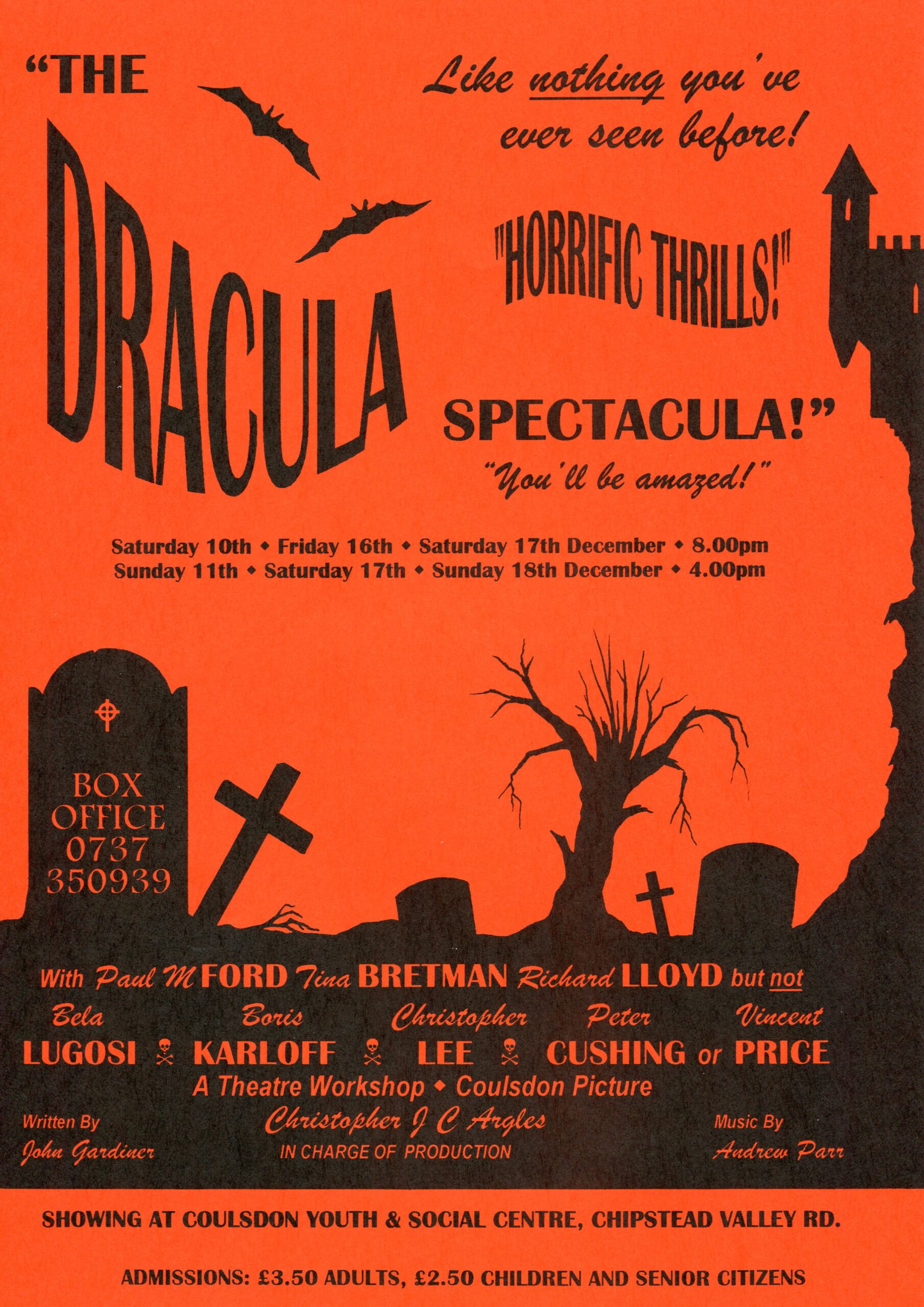
The Dracula Spectacula

It’s been seventeen years since Theatre Workshop Coulsdon first staged ‘The Dracula Spectacula’. At the time it was regarded by the group as probably the biggest and best production that had been performed by them up to that point (we’d only been in existence seven years by that time), involving over 50 people and having a full band.

1995 will be our 25th anniversary year, and we decided that we’d start the celebrations early, by revisiting what was a landmark production for the group.

Amazingly only two of those fifty members who were involved in the 1977 production are actively talking part this time – those being Chris Argles, the director who played Dracula in the original production, and Tim Young, who will recreate his role as Hans, the Innkeeper.

So, how well has ‘The Dracula Spectacula’ stood the test of time? Was it really the terrific show that we fondly remembered, or have the rose-tinted glasses of nostalgia left us with a false impression? Well, let’s be honest, we had to make some changes to the script. Seventeen years doesn’t seem like a long time, but its enough to make some of the dialogue, and the characterisations, sound dated. A number of the songs too, which may have knocked them un-dead back in the day, really don’t cut it now, and so we’ve replaced them with exuberant pastiches of songs that you might just have heard before.

What you see tonight then is very much a brand-new incarnation – albeit of an old favourite, resurrected and rising from its dusty resting place with a whole new lease of life.

Whether this is the first or second time you’ve seen Theatre Workshop Coulsdon perform ‘The Dracula Spectacula’ we hope you enjoy the experience, and live to tell the tale!

The Canterbury Tales (2011)

It is the 14th Century, and in the bustling courtyard of The Tabard Inn, Southwark, men and women from all walks of life gather for a pilgrimage to the cathedral at Canterbury. Friars and priests, pardoners and summoners, millers and good wives. In order to entertain these good folk, the host of the inn asks that each traveller tells a story as they make their way across Kent. And so they, and we, begin our journey.

In this joyous adaptation of Geoffrey Chaucer’s classic work by Richard Lloyd, Theatre Workshop Coulsdon present six of the best and most colourful tales, creating an exuberant and and often hilarious portrait of ordinary folk preoccupied with petty jealousies, mundane squabbles and simple pleasures. Bold and often bawdy, these tales bring home vividly just how little the English people have really changed over the last six hundred years!

The stories presented are The Nun’s Priest’s Tale, The Wife of Bath’s Tale, The Friar’s Tale, The Pardoner’s Tale, The Miller’s Tale and The Reeves Tale, neatly wrapped in an engaging background as host and landlord Harry Bailey attempts to maintain order amongst his boisterous and often wayward charges.

Chaucer (1343 – 1400) is widely considered to be the greatest English poet of the Middle Ages, and was the first poet to be buried in Poet’s Corner at Westminster Abbey. While he achieved fame during his lifetime as an author, philosopher, alchemist and astronomer, Chaucer also maintained an active career in the civil service as a bureaucrat, diplomat and courtier. His many works include ‘The Book of the Duchess’, ‘The House of Fame’, ‘The Legend of Good Women’ and ‘Troilus and Criseyde’, but it is ‘The Canterbury Tales’, in which he uses the tales to paint an ironic and critical picture of English society, for which he will always be remembered.

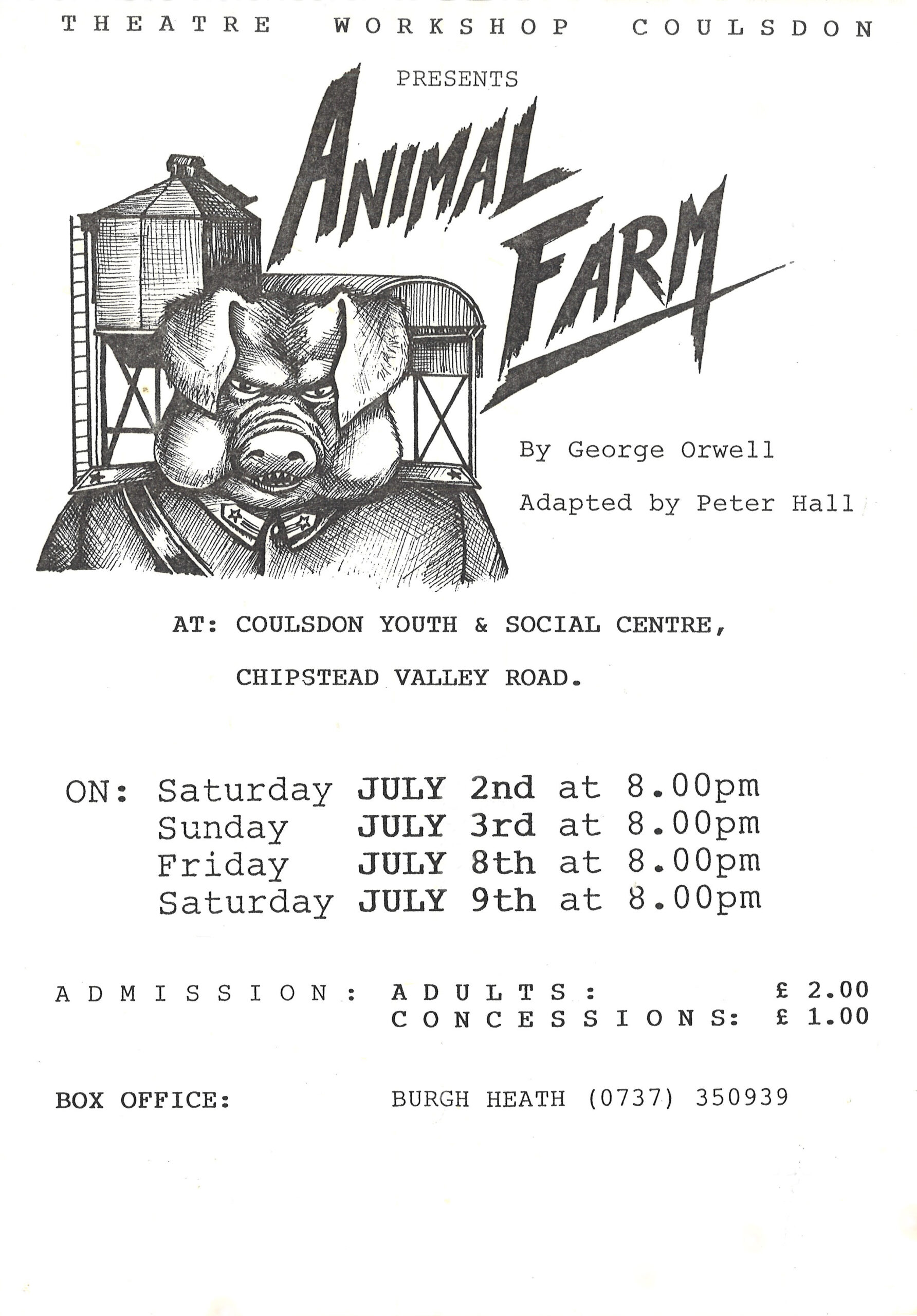
Animal Farm

One night, all the animals at Manor Farm gather in the barn to hear ‘Old Major’, a pig, describe a dream he had about a world where all animals live free from the tyranny of their human masters. The elderly pig dies soon after the meeting, but the animals — inspired by his philosophy of Animalism — plot a rebellion against the farmer, Jones. When Jones drunkenly forgets to feed the animals, they rise up, and Jones and his farmhands are chased away. Manor Farm is renamed Animal Farm, and the Seven Commandments of Animalism are painted on the barn wall. But what follows is far from the dream that Old Major promised…

‘All Animals Are Equal – But Some Are More Equal Than Others’

George Orwell’s ‘Animal Farm’ is a powerful and uncompromising allegory of the Russian revolution, with every character and event that takes place in his tale mirroring Russian history from October 1917 through to the Teheran Conference of 1943.

The succession of steps through which, by persuasion, propaganda, lies and force, Napoleon rises to power in ‘Animal Farm’ are a bitter parody of Josef Stalin’s ascent to dictatorship, and what Orwell saw as the ultimate betrayal of the Russian people.

A fable, a satire, a fairy story, ‘Animal Farm’ is one of the great works of English literature, and a revealing study of the effects of power.

The evocative, and by association, now chilling music chosen by the director to open the production was ‘Fantasia on a theme by Thomas Tallis’ written by Ralph Vaughan Williams. The same composer’s ‘Five variants of Dives and Lazarus’ was used to maintain the mood during the interval.

A Christmas Carol

‘A Christmas Carol’ is a Victorian morality tale of an old and bitter miser, Ebenezer Scrooge, who undergoes a profound journey of redemption over the course of just one night. A financier and money-changer who has devoted his life to the accumulation of wealth, he holds anything other than money in contempt, including friendship, love and particularly the Christmas season. But when on Christmas Eve he is visited by the dread ghost of his former partner, Jacob Marley, and subsequently by other spirits who show him what his life has been before and what a bitter fate lies ahead of him, he is forced to make a decision that will change his life, and all those around him…

Deaf on the Nile

Look out! He’s… Behind You! (Oh no he isn’t!)

Take a priceless diamond necklace, a luxury Christmas cruise down the Nile, a collection of very suspicious characters and add… a pantomime dame?

Theatre Workshop Coulsdon present a pantomime with a difference!

Comedy is guaranteed as the mystery unfolds. Can you unmask the villain before the familiar-looking Belgian detective, Hercules Toilet, does? Or will you be too busy laughing?

Is it Shelby and Lara Smythe-Rotter, the elegant Riviera thieves?

Lady Pokingham-Proditt, whose last five husbands have all met untimely ends?

Hesketh and Petunia, the runaway lovers with a dark secret?

The seedy Reverend Pinchme and his secretary Miss Chaste, on the run from blackmailers?

All will be revealed!                                                                                         

A festive show of songs, slapstick and skull-duggery! Not to mention a show-stopping turn from Mrs Eliza Wallop, our dame with a difference, as ‘she’ powers out a truly operatic rendition of ‘Nessun Dorma’!

Treasure Island (2010)

Long before Jack Sparrow was ever dreamt of, an even more irredeemable rogue bestrode the rolling quarter-deck of pirate fiction. A one-legged villain by the name of Silver…

When Robert Louis Stevenson wrote ‘Treasure Island’ in 1883, he created not only the most famous adventure story in the English language, but an entire genre. Maps marked with crosses, buried treasure chests, one-legged seafarers with parrots, tropical islands full of mystery and danger, black spots and ‘Yo-ho-ho’s – all these commonplaces of pirate fiction were entirely Stevenson’s invention. He was writing about a world 150 years before his own time, about which he knew very little. That didn’t stop him writing a thrilling story that also held a wry commentary on coming of age and the ambiguity of morality – in the maimed shape of Long John Silver – unusual for children’s literature both then and now.

In our 40th year, choosing Treasure Island for our summer, open-air production seemed both obvious and fitting. It marks the fourth time we’ve set sail with this tale of derring-do, having done so previously in 1974 and 1989, as well as spoofing it with a panto version in 1995. One tradition has remained throughout, the trademark of TWC. In the absence of female characters (with the exception of Mrs Hawkins) we have the heroes played by women and the villainous pirates played by men. Now that might sound a little strange perhaps, but believe me, it works well.

The songs in this production are traditional sea songs and shanties, a rousing accompaniment for life and adventure aboard the Hispaniola. Several hundred of these traditional songs are known, with literally thousands of versions, many blurred into hybrids of several different songs They formed a constantly evolving oral tradition passed on by seamen around the world during the great age of sail. The songs took their influences from different languages and cultures: from Gaelic and Scandinavian dialect song to Wild West ballads; from the rhythms of the South Sea Islands to Negro Spirituals. They were only ever sung on merchant ships though, not the Royal Navy, who frowned on the practice.

Traditional sea songs divide into two main types: the shanty, a chanted work song with a repetitive chorus designed to help gangs of men synchronise the heavy tasks hauling, heaving or pumping aboard ship, and the foc’sle ballad – songs composed and sung just for entertainment. The divide is far from hard and fast however, and many shanties have, over time, developed a more lyrical form.

Our band for the production, pressganged into service of course, are called ‘Ninepence Three Farthings’. Enjoy.

Dracula

A bloody, poetic and sexually-charged interpretation of the world’s most infamous horror story!

Bram Stoker’s ‘Dracula’ wasn’t the first Gothic Horror tale (that honour falls to Horace Walpole’s ‘The Castle of Otranto’ published over a century before) but it is, arguably, the most famous exponent of the genre, though it has stiff competition in Mary Shelley’s ‘Frankenstein’, R L Stevenson’s ‘Strange Case of Dr Jekyll and Mister Hyde’ and Oscar Wilde’s ‘The Picture of Dorian Gray’. However, none have quite the strange sexual allure that the Transylvanian aristocrat has, even to this day. This creature, for human he most certainly isn’t, should be repulsive, but yet the opposite is true. The vampire has taken on an eerie glamour, coupled with a sense of tragedy. Hence the success of Anne Rice’s ‘Vampire Lestat’ books and the ‘Twilight’ series by Stephanie Meyer.

Of course, folkloric vampires predate Dracula by centuries, with demons showing what we would consider to be vampiric ways and practices noted by the Romans, Mesopotamians and the Ancient Greeks. But these creatures were ruddy, or purplish in colour, and bloated from the drinking of blood, a far cry from the slim, pale skinned figures we associate with the term now. And frankly a lot less sexy.

Liz Lochead is a Scottish playwright and poet who adapted ‘Dracula’ for the stage in 1985. She made a number of changes to the tale, but then reducing a novel of several hundred pages down to a workable two act play was always going to require that. Lucy Westernra and Mina Murray became sisters sharing the surname Westerman. Arthur Holmwood, also known as Lord Godalming, and American Quincey Morris, two of Lucy Westernra’s suitors, are excised from the script while Renfield’s part is expanded on. In come new characters, such as Nurses Grice and Nisbett, as well as Orderly Drinkwater, at Dr Seward’s asylum, and to add a working class voice to the narrative, Florrie Hathersage, the Westerman’s maid. Across the whole script, the language has been updated to provide a level of humour and innuendo, while focusing on female sexuality and madness.

Do the changes work? Certainly Renfield’s character, and the story, benefits from the extra time spent with him. He’s more articulate, even sympathetic. A victim who can see his own doom coming. Mina though is something less in this version. Pared back, she’s no longer the architect of Dracula’s downfall, nor is Lucy any the stronger for having been reshaped for the late 20th Century. Dracula remains however, untouched, his presence throughout underlined by over a century of cultural familiarity.

Dark Deeds at St. Mildred’s

Welcome to ‘Dark Deeds at St Trynian’s’ – a homage to the St Trinian’s books created by the cartoonist Ronald Searle (1920 – 2011) between 1941 and 1954. Searle’s cartoons were hugely popular – the antithesis on the Enid Blyton-type posh girl’s boarding school; its pupils are wicked and well-armed, and mayhem is rife. The Gothic cartoons often showed the dead bodies of girls who had been skewered with pitchforks, tortured by their classmates, or succumbed to violent team sports. Searle started to draw these cartoons whilst a prisoner of war of the Japanese. Perhaps it was his way of dealing with the unimaginable horror.

Four movies, based on Searle’s cartoons, were made between 1954 and 1966. There was a remake in 1980 and another in 2007. St Trinian’s is portrayed as an unorthodox girls school where sex, smoking, drinking and gambling aren’t on the curriculum – but they’re not exactly frowned upon either. The girls come in two categories: the Fourth Form, most closely resembling Searle’s original drawings of ink-stained, ungovernable pranksters, and the much older Sixth Form, sexually precocious to a degree that must have seemed alarming in 1954 (one of the girls is even married). The Fourth Form includes a number of much younger girls who are the most ferocious of all. The rule of thumb is that the smaller a St Trinian’s girl, the more dangerous she is – especially with a lacrosse or hockey stick in her hands.

Sadistic, cunning, dissolute, crooked, sordid and capable of any excess, the films implied that the girls were mainly the daughters of well-off gangsters, crooks, shady bookmakers and other low-lifes.

Our production is loosely based on some of the characters from the St Trinian’s books and movies, but with a wholly home-grown script and story. Firmly set in a comfy, non-specific era of post-war nostalgia sometime around the middle of the last century, it bears no resemblance to the recent ‘updated’ movies of St Trinian’s. (Sorry about that, if you were expecting Girls Aloud…)

Lords and Ladies

It’s a hot midsummer’s night in the tiny kingdom of Lancre, up in the far northern hill country of Discworld. Crop circles are turning up everywhere, bursting like raindrops, a portent of wayward magic leaking into the land from between the standing stones known as ‘The Dancers’.

Magrat Garlick, witch, is getting married in the morning – to King Verence of Lancre no less. The wizards of the Unseen University are journeying north from the great city of Ankh-Morpork to bless the union, and the Lancre All-Comers Morris Team have been lined up to stage a rustic entertainment for the happy couple. In short, everything should be going like a dream.

But all is not well in Lancre. Elves, long banished from the human realm are pushing at the iron boundaries of their barren winter land, bringing with them all those things traditionally associated with the magical, glittering realm of faerie: cruelty, kidnapping, malice and murder.

‘The Dancers’ form the gateway between the two worlds, and for many years, Granny Weatherwax and her tiny argumentative coven have worked to keep that portal tightly closed. But now a new coven, led by the young, ambitious and wilful Diamanda (real name Lucy Tockley, but Diamanda sounds so much better) are determined to overturn the old order…

And when the Lancre morris team gets seriously drunk on a fairy mound, all Hell is ready to break loose. In short, it’s a festival of dwarves, wizards, trolls, morris dancers – plus an orang-utan, with a fair helping of hey-nonny-nonny and blood all over the place… We hope you enjoy tonight’s performance!

A big thank you to Debbie Bradshaw and Katy Tupholme at Bluetree Design and Print of Rotherham for designing our posters for the production, and to Mark Lewis and Nick Hewson at Mastercolour of Tunbridge Wells for printing them.

‘Lords and Ladies’ (1992) is adapted from the comic fantasy novel by prolific author Terry Pratchett, his fourteenth set on Discworld, and the fourth to feature the Lancre coven of witches led by the redoubtable Esmerelda ‘Esme’ Weatherwax, a character who Pratchett clearly enjoyed revisiting. Astonishingly successful, he sold over 100 million copies of his books, forty-one of which were Discworld novels, and he was awarded first the OBE in 1998 and then a knighthood in 2009. He died at the age 66, from complications relating to Alzheimer’s Disease, which he had been diagnosed with in 2007.
 
Following on from ‘Wyrd Sisters’ in 1995 and ‘Mort’ in 1997, ‘Lords and Ladies’ is the third stage adaptation of a Discworld novel that Theatre Workshop Coulsdon have undertaken, and any similarities to Shakespeare’s ‘A Midsummer Night’s Dream’ are purely intentional. Nor is it a coincidence that all three have been directed by Mike Brown.