Twelfth Night

‘Some are born great, some achieve greatness, and some have greatness thrust upon ’em.’ And ‘Twelfth Night’ is surely Shakespeare’s greatest rom-com.

In Illyria, disguised Viola becomes a reluctant go-between in the unrequited courtship of disdainful Lady Olivia by Illyria’s Duke, the lovesick Orsino. This gives rise to perhaps the most famous love triangle in English literature: Uptight Olivia falls madly for the impudent ‘Cesario’; who is desperately in love with wistful romantic Orsino; who is besotted with haughty Olivia. The secondary plot concerns the antics of Olivia’s disreputable uncle, Sir Toby Belch, and his band of ne’er-do-well accomplices from Olivia’s peculiar household. These deplorables embark on a spiteful ruse to humiliate Olivia’s insufferably overstuffed steward, Malvolio, but get their comeuppance when drawn into the Viola / Sebastian mix-ups.

Historical Illyria roughly corresponds to present-day Croatia, but this ostensibly foreign setting (as in most of Shakespeare’s comedies), is not remotely real nor realised. It’s merely a conveniently far-flung land where strange things can happen, yet firmly rooted in a familiar Tudor world of great houses and box hedges, butts of ale and casks of sweet Spanish wine. Shakespeare’s Illyria is clearly within hailing distance of the Thames Watermen, with visitors from Messaline putting up ‘in the south suburbs, at The Elephant’ – as did many visitors to London (hence the Elephant & Castle).

So while Sir Toby Belch and Sir Andrew Aguecheek, a brace of obviously Anglo-Saxon buffoons, rub shoulders with exotically named characters like Orsino, Antonio, and Malvolio, these would all have been instantly recognisable types to the groundlings packed into the playhouse yard of The Rose or The Globe… Orsino, the effete, capricious aristocrat; Antonio, the seaman-adventurer struck from the mould of Hawkins, Drake and Raleigh; and Malvolio, the killjoy puritan stuffed-shirt.

In the interests of duration (about an hour in each half) and clarity, we’ve made some cuts to the text here and there, notably to many of Feste’s extended quips. These were no doubt hugely funny to an Elizabethan audience, but 400 years later many of these jokes, topical references, and allusions to classical mythology have lost all meaning and will simply puzzle a modern-day audience.

Our aim is to present Twelfth Night in the spirit in which we guess it was intended to be played – an exhilarating romantic romp, shot through with a vein of wistful lyricism, full of music and song, and rounded off with a quicksilver exuberance and delight in life.

With more songs than any other Shakespeare play, as Orsino says, ‘If music be the food of love, play on’

Machinal

Regularly appearing on ‘The Best Plays of All Time’ lists, ‘Machinal’ is a vivid, unflinching portrayal of the life of a young, working-class woman in 1920’s America. Across nine tense episodes, we play witness to the key moments of her life – from marriage and motherhood, to adultery, murder, and its consequences. We see how women had to navigate a world run by men for men, in an increasingly mechanistic society demanding conformity.
Placing its young heroine at its centre, ‘Machinal’ traces her fight against the trap of a life predestined, as she hurtles toward her desperate and destructive attempt to break free.
It’s a brave, absorbing play that will stay with you long afterwards; unafraid to challenge its audience and to advance ideas that would have been seen as deeply controversial at the time, yet remain all too relevant today.

Journalist and playwright, Sophie Treadwell (1885 – 1970), placed women and marginalised voices front and centre of her stories. Today ‘Machinal’ (1928) is regarded as a masterpiece – an outstanding example of American Expressionist theatre. But in her day, Treadwell never achieved commercial success, and for much of the Twentieth Century her plays were rarely produced. Even today, her name is little known outside drama schools and histories of theatre. Slowly and rightly though, her ground-breaking early modern plays are now being rediscovered, performed and celebrated anew.

With a specially composed industrial soundscape and an accent on physical theatre this production has taken Theatre Workshop Coulsdon to places it’s not been before. Abrasive, uncomfortable, in places shocking, this is not a quiet night’s entertainment.

Dick Barton and the Carnival of Chaos

“Good evening. This is the BBC Light Programme broadcasting from London. It’s 6.45 and time for the next thrilling episode of ‘Dick Barton and the Carnival of Chaos’!”

Yes, Barton is back, and in his toughest assignment yet!

London. 1949. Wartime rationing remains in force, and only marmalade – that nutritious, morale-boosting foodstuff – continues to fortify our island nation’s grit, spunk, vim and pluck after six long years facing down the Nazi peril.
But now there’s a fiendish foreign conspiracy afoot to kidnap Tiggy Zesty-Peel, heiress to the Zesty-Peel preserves empire, and only Dick Barton can stop it. But who has evil designs on the Marmalade Millionairess? And just what is their nefarious purpose?

Meanwhile, Snowy White and Jock Anderson, Barton’s salt-of-the-earth working class assistants, are each in a jam of their own. Snowy’s been injected with bonobo serum during a brush with a batty Bulgarian ballerina, and has gone more than a little ape. And Jock has fallen for the charms of ex-Nazi filmmaker and flaxen femme fatale, Leni Fuchs.
Throw in the homegrown villainy of the Crayfish Twins (the East End’s favourite lovable cockney mass murderers) and mysterious Italian yoga swami, Contessa Bianca Di Scalzo, and the plot is thicker than a jar of rough-cut.
Can Barton unravel the mystery and save Britain’s marmalade? Or will our favourite spread succumb to the spread of evil? To find out, tune in to the next thrilling instalment of ‘Dick Barton and the Carnival of Chaos’!

Theatre Workshop Coulsdon’s third outing for Dick Barton, Boy’s Own adventurer, all-English hero and teatime wireless star, is another ripping comedy adventure, full of improbable characters, glorious gags, and a cheeky sprinkling of spiffing song and dance numbers. Pip pip!

A Christmas Carol (2023)

The Past Is Forfeit. The Future In Peril. The Present In The Balance. All That Matters Is Now.

It’s Christmas Eve! A time for joyful anticipation, celebration and goodwill to all!

Perhaps not all. To the poor and the hungry in Victorian London, Christmas Day is just another day to struggle through. And for Ebenezer Scrooge it’s a day lost, with business left undone and money misspent. Happy Christmas? Bah, Humbug! But tonight, at midnight, Scrooge will be forced to confront the choices he has made, the opportunities he’s missed and the bleak future that lies ahead, unless he can change…

Although Charles Dickens wrote many classic stories, from Oliver Twist to Great Expectations, there is surely no tale of his more famous, or heart-warming, than ‘A Christmas Carol’. Written in 1843, Dickens paints his protagonist in dreary colours. Ebeneezer Scrooge is a mean-spirited, grasping and bitter individual, shorn of all the things that make a life worth living by choice. Though wealthy, his existence is impoverished, begrudging spending his hard earned coin on anything that might provide a crumb of comfort, either to himself or those around him. He treats his employee with disdain, his nephew as a fool. But on one Christmas Eve, he is forced to look hard at what he has done with his life, and what his actions have meant for others. Three spirits, the ghosts of Christmas Past, Present and Future, show Ebeneezer where he has come from, where he is now, and the cold, unloved end of his days on the path he is destined to take. Will he change his ways? Can he change?

A time-honoured story of redemption, with love, laughter, song and a warmth to melt even the meanest misers’ heart, Theatre Workshop Coulsdon is proud to present ‘A Christmas Carol’.

Theatre Workshop Coulsdon is also pleased to be able to partner with the Purley Food Hub for this production. Dickens was very much a social reformer and the plight of families and children with little food, especially at Christmas, was a source of concern reflected in his writings and emphasised in this version of his story. A Purley Food Hub collection point for voluntary food donations will be set up at the Coulson Community Centre for the duration of the run of the show, from December 9 through to December 17.

Come along, enjoy the show and perhaps make Christmas a little better for someone else too.

The Tempest

Torn from the sky!

Returning to its homeland from a royal wedding in distant Tunis, the ‘Napoli Rex’, flagship of the King of Naples’ airfleet, is pulled from the sky by a violent and unnatural storm.

The survivors find themselves scattered across a barren island populated with magical creatures and spirits, fearing for their very lives.  And behind this seeming disaster is Prospero, an exiled sorcerer seeking vengeance…

Shakespeare’s final play is his crowning glory, a tale of magic, love, humour and redemption.

Theatre Workshop Coulsdon have placed ‘The Tempest’ in a steampunk-flavoured Victorian age, where the might of an industrial revolution with its airships, guns and steam-power is confronted with forces beyond its wildest imagining…

Years ago, Prospero forsook his duties as the Duke of Milan to study the arcane arts. With his attention elsewhere, he was unprepared for the coup that saw him dragged from his position and sent out to die alongside his baby daughter, Miranda. By merest chance they survived, crash-landing on a remote and barren island in the Mediterranean, and with the help of two servants, the sprite Ariel and the twisted creature that is Caliban, Prospero lived on and plotted revenge. Now chance again plays into his hands, as those he would mete out vengeance to have been driven to the island by a tempest, their airship torn from the skies and the passengers and crew thrown down. However, he has reckoned without Miranda (now grown to womanhood) and her response to these strange new visitors, one of whom she falls in love with…

Shakespeare’s last play is here transported to a neo-Victorian setting, played out in the traverse among the broken spars and debris of his downed airship, the ‘Milano’. Prospero’s sorcery here vies with magic lanterns and steam-powered pistols in a unique take on the bard’s farewell to the stage.

Reginald Rare – Rocketeer Extraordinaire

‘Reginald Rare – Rocketeer Extraordinaire’, is an affectionate spoof on the classic sci-fi comic strip, ‘Dan Dare – Pilot of the Future’, as created by illustrator Frank Hampson and appeared in the ‘Eagle’ from 1950 through to 1967.

In 1945, WW2 Spitfire ace Squadron Leader Reginald Rare is shot down while on a top secret mission over Germany by a experimental Nazi freeze ray. Awakening after decades of cryogenic suspension, Reg finds himself in the far-flung year 2015, and a world quite unlike his own. Countries and borders are gone, merged into one united World Government. Women and men are equals. Poverty has been eradicated. But the Earth is under threat from the Venereans – fiendish alien overlords of Venus. They’re using a powerful heat ray to cause global warming, and once they’ve destroyed life on Earth, the dastardly Venereans will occupy it as their new home! The trouble is, that Earth gave up war decades ago, and no longer knows how to fight. The newly-promoted head of the armed forces can’t even tell the difference between a set of bagpipes and an instrument of torture! (Hmmm.)

As the only man in the world with combat experience, bravery and a natural air of command unsullied by knowledge or common sense, Reg – a man out of his time in so many ways – is immediately recruited by the Earth’s government to lead a mission to Venus to carry the fight to the enemy. Accompanied by a hand-picked crew of assorted misfits and weirdos (‘Oily’ Wragg, the chief engineer, Bruce McKenzie the Xenobiologist and Giuseppe Bernatelli, the weapons specialist – sorry, chef, as well as the entirely delectable but decidedly feisty physicist and astrogator Dr Mary Honeydew) – Reg heads for Venus in his brand-new untried rocket ship, with a brand-new untried weapon, to give those alien fiends what for! And save the world, obviously. What could possibly go wrong?

Spiffing adventures ensue, by turns comical and thrilling, in a fast moving yet knowing homage to the lantern-jawed sci-fi hero of yesteryear, written by Sean Young and now brought joyously to life on stage.

Special mention to director Pete Bird who with only a couple of weeks to go, had to step in and play Bruce McKenzie after Joe Wilson had fallen ill with appendicitis!

Orca

Midsummer. On an isolated Atlantic island, the community prepares to enact their hallowed annual ritual. The village must choose a new ‘Daughter’ to sail with the boats and bless the fishing grounds. Keeping them safe from the roaming pods orcas for another year. Fan hopes with all her heart to be chosen. But her older sister Maggie says she must never, never go with the boats. Because Maggie swears that something happened to her out there, but no-one will admit it. No-one will even talk about it. And no-one, not even Fan, believes her.

What the papers have said about ‘Orca’:

‘A world as soaked in myth and ritual as it is with salt water’.

‘Jaws meets The Wicker Man’.

‘An unnerving play about mythical ritual sacrifice that acts as a metaphor for the present’.

‘A gut-chilling reminder that the smallest communities have room for danger, and that often the biggest risks come not from nature, but from the people who claim to want to keep you safe’.

Winner of the 2016 Papatango New Writing Prize, ‘Orca’ is a dark, intense and thrilling piece of theatre – an unflinching insight into what makes a community tolerate the unthinkable.

If you enjoyed our 2023 production of ‘Machinal’ – another pitch dark and compelling play – we think you’ll love ‘Orca’.

Please note this play contains adult themes, strong language and portrayal of violence. We’d suggest it’s not suitable for children under the age of 16 – subject to parental guidance.

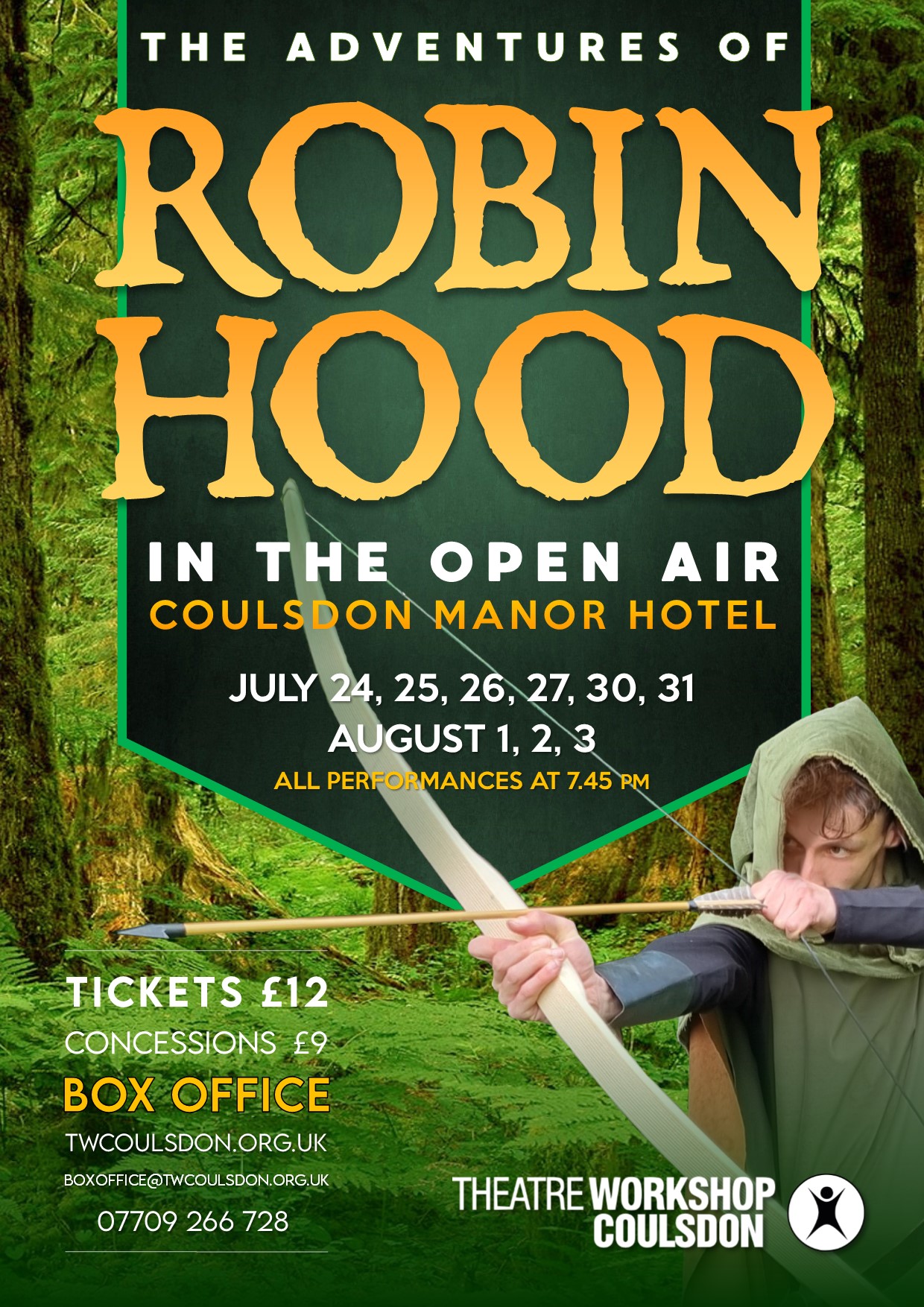
The Adventures of Robin Hood

Good King Richard is dead, and the throne is now held by his brother John, a man determined to make his mark no matter what the cost to the people he rules. In Nottingham, the evil Sheriff brutally extorts higher and higher taxes for his royal master, putting dissenters to the sword. The land has never been in greater need of a hero.

This Summer, we’re back in our idyllic woodland glade at the Coulsdon Manor Hotel with that most celebrated icon of English folklore, Robin Hood. Alongside his outlaw allies, Little John, Will Scarlet, Alan A’Dale and Friar Tuck, aided by the fearless Marian Fitzwalter, they’re going to challenge the tyranny and injustice that the Sheriff and his royal patron are imposing on the good people of England, and tear the whole rotten edifice down. Or die trying.

High adventure and fun on a Summer’s  evening – among the trees in the good company of the free men of Sherwood, witnessing thrilling and entertaining encounters as the fight for freedom begins, with sword, with bow, with quarterstaff and with laughter.

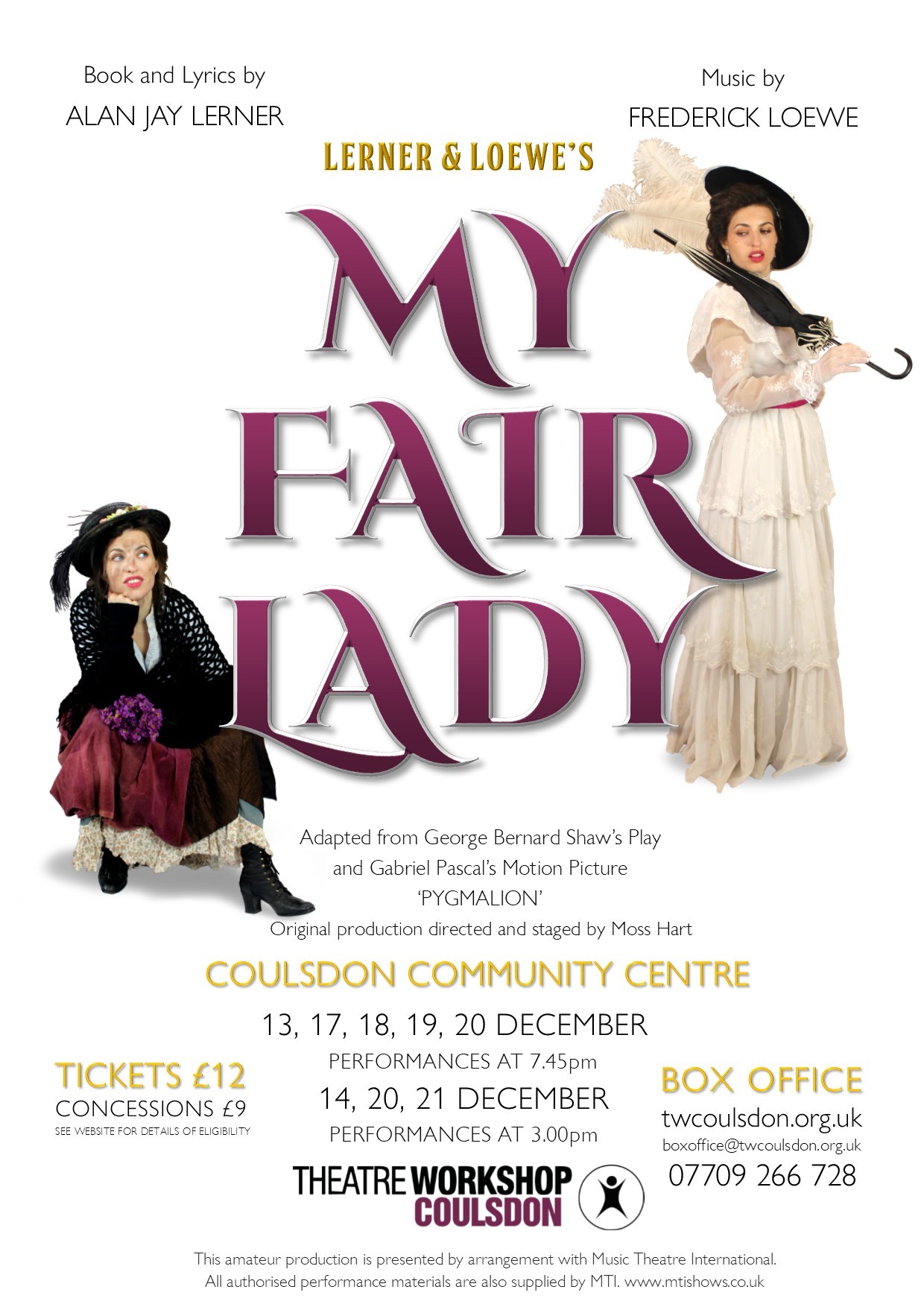
My Fair Lady

Lerner and Loewe’s celebrated stage musical adaptation of George Bernard Shaw’s ‘Pygmalion’ includes some of the best known and best loved show tunes ever written. From ‘Wouldn’t It Be Loverley’ to ‘I’m Getting Married in the Morning’, ‘I Could Have Danced All Night’ and ‘With A Little Bit Of Luck’.

It’s the story of a cockney flower girl’s transformation into the pride of London society – and its unforeseen consequences. In many places it’s very funny; in others, very poignant. When overbearing Professor Higgins stumbles on Eliza Doolittle outside Covent Garden Opera House, he recognises that her hideous vowels and lost consonants are all that separates her from the upper classes. Higgins casually makes a wager that within weeks he can pass Eliza off in polite society as a Duchess. But little does he know that beneath the dirty face and shabby clothes, young Eliza is stuffed full of human feeling. Too eloquent for a flower girl, yet lacking the breeding of the ruling classes, what on earth is to become of Eliza when the bet is over and the game has reached an end?

‘My Fair Lady’ was Lerner and Loewe’s musical adaptation of George Bernard Shaw’s ‘Pygmalion’, a much darker tale than the highly successful Broadway, West End and Hollywood show tells.

The character of ‘Pygmalion’ comes from Greek mythology, where he was sculptor who fell in love with a statue he had created, a statue that then comes to life. Bernard Shaw took that tale and twisted it, the sculptor becoming Henry Higgins, and the thing he creates, Eliza Doolittle. His play debuted in 1913 in Vienna, before going on to London and New York. Critics were generally favourable, though the ending created a certain level of controversy. A standard love story this wasn’t, and the ending was no more conventional. A film version was made in 1938, starring Leslie Howard as Higgins and Wendy Hiller as Eliza, and Shaw, initially distrustful, agreed to it being made only if he had a certain amount of creative control. This resulted in Shaw writing a whole new ballroom scene, the creation of a new character ‘Zoltan Karpathy’, and a new ending. He and his fellow screenwriters were awarded an Oscar for the screenplay, for which Shaw was characteristically dismissive, but it would be this screenplay that would be used as the basis for the musical.

The director of the movie, Gabriel Pascal, had spoken with Shaw about making it into a musical, but the author had refused. However, when Shaw died in 1950, that barrier was no longer an issue. Pascal approached lyricist Alan Jay Lerner to write the musical, with his partner, composer Frederick Loewe. At first, they couldn’t make it work but eventually they found a way, though not before Pascal had died. They called it ‘My Fair Lady’ after a provisional title to Shaw’s play ‘Pygmalion’, and it referred to the Cockney pronunciation of ‘Mayfair Lady’, helping to show Eliza’s transformation from working-class girl to upper-class woman. The part of ‘Higgins’ was initially offered to Noel Coward, who turned it down but suggested they approach Rex Harrison. ‘Eliza’ was offered to Broadway veteran Mary Martin who also turned it down, and they went instead for newcomer Julie Andrews. It opened on Broadway in March 1956 and was a massive success, going on to become, at the time, the biggest grossing Broadway show ever.

The 1964 movie was a similar success, winning eight Oscars including those for Best Picture and Best Actor (Rex Harrison). Interestingly, the Best Actress Oscar that year went to Julie Andrews for her portrayal of Mary Poppins, having been rejected for reprising the part of Eliza as not being famous enough by the studio. It went, famously, to Audrey Hepburn, whose singing voice was overdubbed by Marni Wood.

Theatre Workshop Coulsdon’s presentation of this fabulous show was directed by veteran actor/director Richard Lloyd with musical director and pianist Mark Taylor, and features Dan Carr as Professor Henry Higgins, Indianna Scorziello as flower-seller Eliza Doolittle, Paul Ford as her ne’er-do-well father Alfred, and Mike Brown as the bluff and amiable Col. Pickering.

Animal Farm (2025)

All is not well on Manor Farm. The animals are neglected and abused by their drunken owner, and anger and a sense of injustice are growing. They dare to dream of taking their destinies into their own hooves, paws and claws. When man is gone, fairness and equality for all animals shall be the rule! Won’t it?

TWC’s Summer 2025 open air production is a new, fast-paced, occasionally frightening and sometimes bleakly comic adaptation of one of the most celebrated novels of the Twentieth Century – George Orwell’s ‘Animal Farm’.

An army of downtrodden farm animals rises up to overthrow their human oppressors. But their dream of a society where all animals are equal soon collides with the seductive allure of privilege and the corrupting nature of political power. Orwell’s famous fable – a brilliant satire on the Russian revolution and the rise of Stalin – is a gripping tale of rebellion, heroism and ultimate betrayal. The writing is on the wall – literally:

ALL ANIMALS ARE EQUAL, BUT SOME ANIMALS ARE MORE EQUAL THAN OTHERS