The Dracula Spectacula

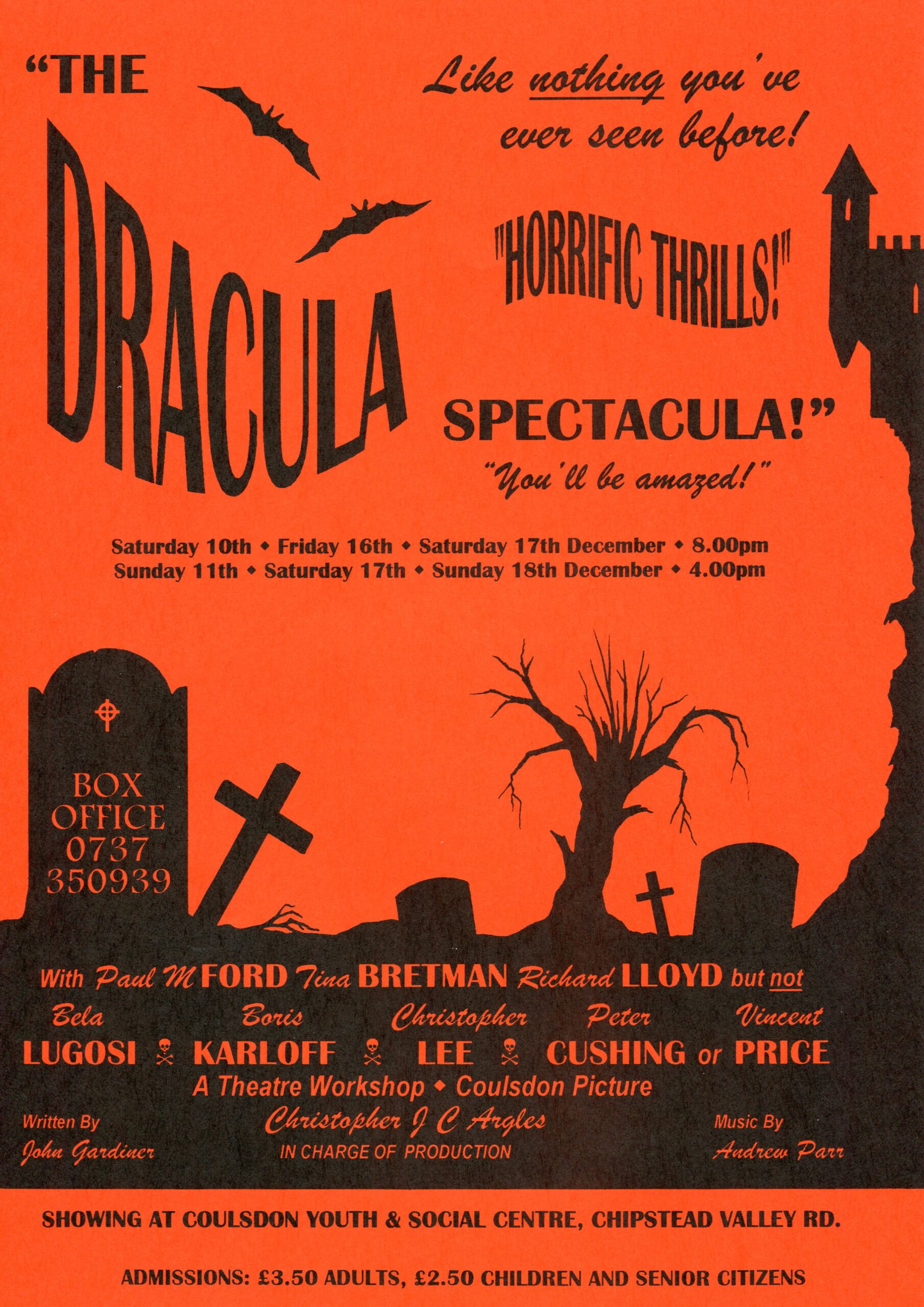
It’s been seventeen years since Theatre Workshop Coulsdon first staged ‘The Dracula Spectacula’. At the time it was regarded by the group as probably the biggest and best production that had been performed by them up to that point (we’d only been in existence seven years by that time), involving over 50 people and having a full band.

1995 will be our 25th anniversary year, and we decided that we’d start the celebrations early, by revisiting what was a landmark production for the group.

Amazingly only two of those fifty members who were involved in the 1977 production are actively talking part this time – those being Chris Argles, the director who played Dracula in the original production, and Tim Young, who will recreate his role as Hans, the Innkeeper.

So, how well has ‘The Dracula Spectacula’ stood the test of time? Was it really the terrific show that we fondly remembered, or have the rose-tinted glasses of nostalgia left us with a false impression? Well, let’s be honest, we had to make some changes to the script. Seventeen years doesn’t seem like a long time, but its enough to make some of the dialogue, and the characterisations, sound dated. A number of the songs too, which may have knocked them un-dead back in the day, really don’t cut it now, and so we’ve replaced them with exuberant pastiches of songs that you might just have heard before.

What you see tonight then is very much a brand-new incarnation – albeit of an old favourite, resurrected and rising from its dusty resting place with a whole new lease of life.

Whether this is the first or second time you’ve seen Theatre Workshop Coulsdon perform ‘The Dracula Spectacula’ we hope you enjoy the experience, and live to tell the tale!
The Recruiting Officer (1998)

Written in 1706 by Irish writer George Farquhar, ‘The Recruiting Officer’ is a comedy set in and around the town of Shrewsbury in Shropshire. As the War of the Spanish Succession rumbles on in Europe, two recruiting officers, the womanising Captain Plume and the effete and cowardly Captain Brazen, attempt to entice the men of the town into the army and the women into their beds. Plume has an advantage here, for on his side is the redoubtable Sergeant Kite, who will use any means, fair or foul, to get men to join up.

Life is complicated by the women in their lives, who are far more independently minded, and smarter, than they can honestly cope with. Plume is promised to Sylvia, the daughter of a local Justice, Balance, but he’s also the father to a bastard born of a local girl, who Sylvia knows about and is caring for. Melinda, Sylvia’s cousin, was the amour of Plume’s friend Worthy, but he refused to marry her and instead proposed that she become his mistress, because she was too poor. Now she’s inherited a fortune, he’s back, but Melinda’s going to have a little fun with Worthy, by playing up to Captain Brazen. And then there’s Lucy, Melinda’s maid, who by subterfuge intends to wed Brazen too.

Hidden motives, trickery, miscommunication and disguise, all go towards making this boisterous romantic comedy laugh out loud funny, and it’s been doing it for over 300 years. It was the first play ever performed in New York City, at the Theatre on Nassau Street, on 11 December, 1732 (by amateurs too!). However, Farquhar didn’t benefit from its success. Heavily in debt and made ill with worry, he died in April 1707, not two months after the debut of his last play, ‘The Beaux Stratagem’.

Much Ado About Nothing

‘Much Ado About Nothing’ is a comedy of love nearly thwarted by villainy, and tragedy narrowly averted. It is held by many to be one of the most verbally dextrous of Shakespeare’s works, and the dialogue fairly sparkles with witty repartee, chiefly from Benedick and Beatrice, two of his most compelling and human creations.

The setting is a Sicily at war. Don Pedro, the Prince of Aragon, returns from the fighting, with his entourage, to stay with his old friend Leonato, the Governor of Messina.

While there, Claudio, a member of Don Pedro’s retinue, quickly falls in love with Leonato’s daughter, Hero. It’s a cause for much celebration, in most parts. However, Don John, Don Pedro’s bastard brother, sees only a chance to sew discord, and with the help of his two henchmen, Conrade and Borachio, they plot to break up the loving pair and ruin Hero’s reputation..

Elsewhere, another scheme is put into place, but his time it’s with chiefly good intentions. Benedick, a good comrade to Don Pedro, and Beatrice, Leonato’s niece, have known each other for some time. They trade insults, they verbally spar whenever they are together. All but they can see the spark of something special between them. And so the plan is hatched by Don Pedro to push the warring duo away from conflict and into loving reconciliation, getting the two to see each other as others see them. 

When all is said and done both couples find themselves together, but not before they run a gauntlet of lies and confusion, flirting with each other and disaster.

‘Much Ado About Nothing’ is undoubtedly one of Shakespeare’s finer plays, possibly his best comedy, edged only by ‘A Midsummer Night’s Dream’. Much of it though, if you look hard enough, makes no sense. Don Pedro is a Spanish warlord, with two of his closest companions coming from rival Italian city states, Padua and Florence. For no explained reason, they’re fighting in Sicily. Leonato at least sounds Italian, but Beatrice and Hero, not to mention servants Margaret and Ursula, don’t. And the whole of the watch, Dogberry, Verges, Hugh Oatcake etc. have clearly been parachuted in from England. Best not to dwell on it.

Talking of which, TWC has edited the Bard’s script. I know, how dare we! Well, if it was good enough for Kenneth Branagh in his 1992 film adaptation, it’s good enough for us. Really, it had to be done. A lot, and we mean a lot, of references to cuckolds and horns needed to go, and there are only so many allusions to obscure classical mythology any audience can take. And cast for that matter.

So, sit back and relax. Be taken to an island in the Mediterranean, and treated to some of Shakespeare’s finest prose. And maybe a pint or two…

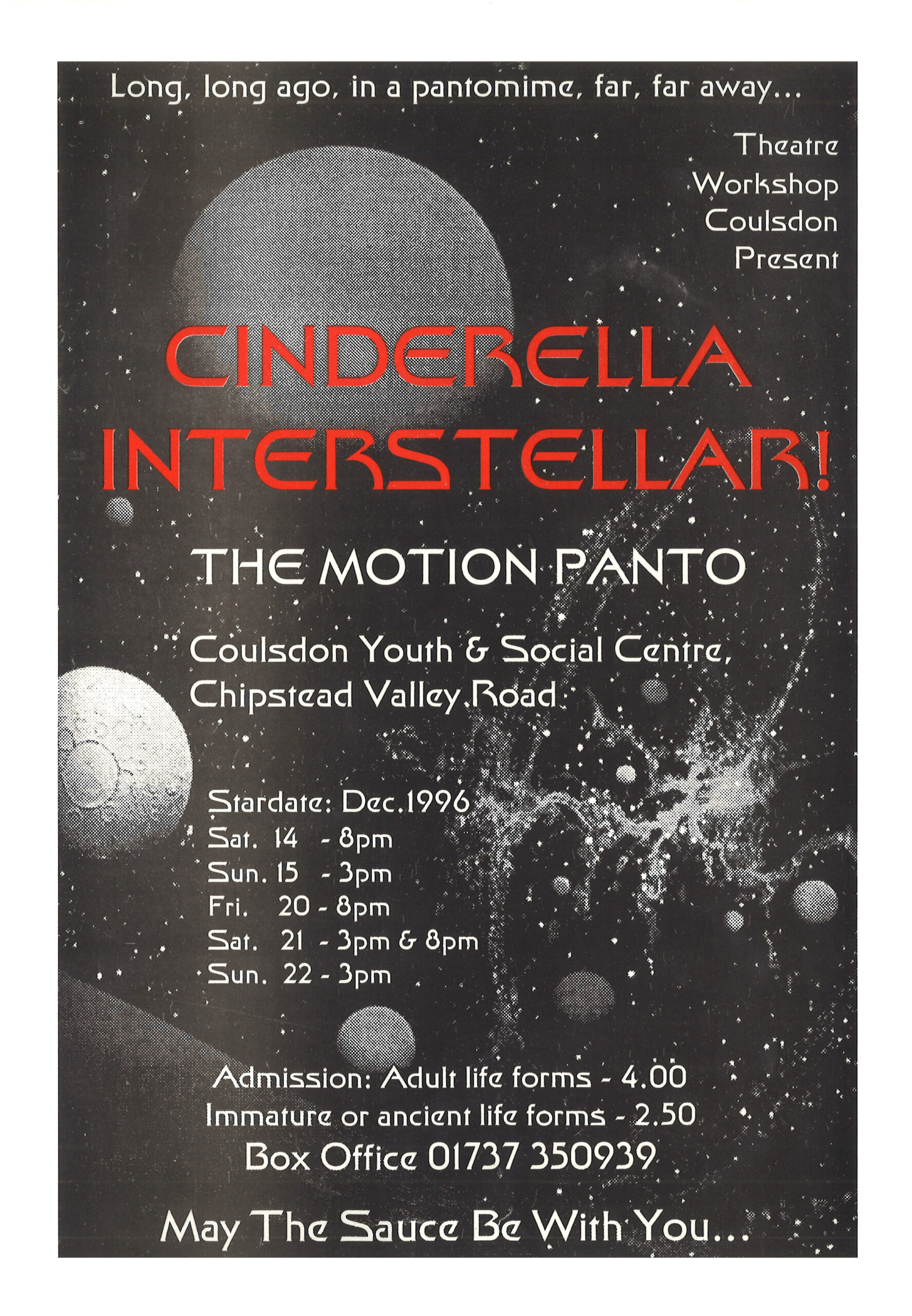
Cinderella Interstellar!

A long time ago, in a galaxy far, far away, there was a pantomime that looked quite a lot like ‘Star Wars’…

Take Cinderella and her ugly sisters and then thrust them into a world of science-fiction adventure, inhabited by characters that are nearly, but not quite, those from the epic blockbuster trilogy of the late 1970’s and early 1980’s.

A cocky, star-faring smuggler and his hairy co-pilot, a kid who’s a whiz behind the controls of space fighter, a monk-like individual wise in the ways of the Source, a black-clad villain in a full-face helmet with breathing difficulties and an army of soldiers who can’t hit a Death Star at close range. They’re all there, just not as you knew them.

Throw in the best Cantina band this side of Tatooine to help belt out some brilliant songs, and you’ve got a powered up panto ready to do the Kessel run in less than 12 parsecs.

This is the panto you were looking for.

A Midsummer Night’s Dream

This is the second time that Theatre Workshop have visited the strangely English forest that exists just outside Shakespeare’s Athens. Peter Quince and his band of tradesmen cum would-be actors have wandered out from the city to ensure they’re not overlooked as they go about their amateur thespian labours, but either they’ve wandered much further than they intended from the busy streets of London, or there’s a thriving English enclave of ex-pat artisans tucked away in the shadow of the Parthenon. 

There are changes. Not least in the location of our endeavours. Having seized the opportunity to take the group from its home and perform in the open-air just three years previously, we’ve gone further, and at the invitation of Southern Water, will take the production to the shores of the Bewl Water reservoir, near Lamberhurst in Kent. Though the setting is idyllic, this represents no small undertaking, especially for an amateur group whose members are mostly in full-time employment. So we can feel for Messrs Starveling, Bottom, Snug, Snout and co., as we do a full day’s work and then barrel down the A21.

But we’ve not given up on our first open-air home, and will perform first at The Woodman before packing up and heading for Bewl. We could hardly do otherwise, given that it’s our regular watering-hole.

Let’s talk about the music for a moment. Most of the music you’ll hear will be played live by Mark Taylor, though there are a couple of passages that are pre-recorded. He’s composed most of it himself too, because he’s a talented gentleman. Exceptions include the fairy and bergomask dances in Act IV and V which are set to traditional tunes. He’s also composed the music for ‘Philomel with Melody’, whose lyrics are by Shakespeare, and given that Shakespeare’s own lyrics to the fairy benediction at the end of the play are lost to us, we’ve used a 5th Century Celtic blessing as the basis for a song, which again will be accompanied by Mark Taylor’s music.

One last thing. The production is dedicated to the memory of Lesley Argles, a member of Theatre Workshop almost since the beginning. She died aged just 44, as the result of a tragic accident on the 13th July, only two weeks before curtain up. Her husband, Chris, who she met through the group, as well as her son, Luke, and daughter Kimberley, are all on stage here tonight. They were united in their decision that the production should go ahead with their full participation, despite grievous personal loss. They are certain it was what she would have wanted.

The Three Musketeers

France 1625.

A young nobleman called D’Artagnan leaves his family in Gascony, south-west France, and makes his way to Paris to seek his fortune and join the King’s Musketeers. Unfortunately he encounters Rochefort, Captain of the Cardinal’s guard at a rural inn, and after an ill-advised confrontation, loses his letter of introduction to M.de Treville, (the captain of the King’s Musketeers), his money and his sword. So, when he finally arrives at the French capital, his welcome is far from warm. Things take a turn for the even worse when his first meetings with Athos, Porthos and Aramis, the best of the Musketeers, result in him challenging each of them to duels. Finally, taken under the wing of the Three Musketeers rather than being killed by them, the young Gascon finds himself embroiled in the machinations of the cunning Cardinal Richelieu and his deadly agent, Milady de Winter, with plans to dishonour the Queen of France herself. A tale of high adventure, full of fun, swordplay and affairs of the heart…

Originally written by Alexandre Dumas (in collaboration with his regular ghost writer Auguste Maquet) and published in 1844, this swashbuckling historical tale became one of the most enduring adventures in literature, challenged only by, perhaps, ‘Treasure Island’. Numerous adaptations have been made, for stage and screen, including musicals, animation, and even an opera. The script that Chris Argles chose to direct was by Willis Hall, and had been published just the previous year, 1995. Although it keeps to the story, more or less, inevitably some liberties are taken and Hall leans into the humour, no doubt one reason for its selection.

It has passed into Workshop legend that Mike Brown, playing, or rather completely inhabiting the role of Porthos, at one point during the production ran across the stage completely naked, except for a strategically placed broad-brimmed musketeer hat (with a large feather). The part demanded it, obviously.

The Canterbury Tales

Geoffrey Chaucer (c. 1340 – 1400) has been called the father of English Literature. Certainly there is nothing quite like his epic ‘The Canterbury Tales’ to put the present-day observer in touch with the ordinary life of our medieval forebears. Nothing to match the unflinching realism of Chaucer’s portraits of his fellow men. And nothing quite so effectively holds up a mirror, not only to the England of his times – but to the unchanging nature of human experience.

We considered four different published playscripts before creating our own adaptation of ‘The Canterbury Tales’. In the end we decided against paying royalty fees to use someone else’s script. After all, Chaucer is part of our shared heritage – his words should belong to all of us.

Across the different playscripts there had been a range of selections made regarding which tales were best to tell. Clearly, given that there are 28 tales in all, you can’t use all of them in one two hour show (and note that Chaucer had intended for there to be 120!), so a choice has to be made. However, most seemed to go for the stories with classical settings, such as The Knight’s Tale, The Franklin’s Tale and The Merchant’s tale.

Focused on the nobility, and concentrating on stories of courtly love and mortal combat as they are, we decided that these rarified tales were not the ones we wanted to tell. We wanted to hear from the ordinary people, engaged in the medieval day-to-day of simple pleasures, petty jealousies and mundane squabbles. Exuberant and resilient folk, yet dominated by an overbearing Church. So, these are the stories we chose:

The Nun’s Priest’s Tale

The Wife of Bath’s Tale

The Friar’s Tale

The Pardoner’s Tale

The Miller’s Tale

The Reeve’s Tale

Our adaptation is actually based on the 1985 Oxford University Press translation by David Wright, though we’ve edited out much of the narrative in favour of dialogue. This is a drama after all, not a story telling, and that has meant some minor amendments in order to make sense of the editing. Regardless, we’ve actually added or rewritten very little. So the words you’ll hear spoken are Chaucer’s own, translated with fidelity into modern English by one of the foremost scholars in this field. If you take any pleasure from the tales we unfold for you today, reflect for a moment on the fact that these are the same stories that entertained your ancestors, some 600 years ago.

Lark Rise

Welcome to the tiny hamlet of Lark Rise. It is the first day of the harvest, one summer early in the 1880’s…

Flora Thompson’s autobiographical trilogy ‘Lark Rise’, ‘Over To Candleford’ and ‘Candleford Green’, describing her childhood in a remote Oxfordshire farming community has been termed English Literature’s classic masterpiece of a lost way of village life – a vivid and moving account, rich in fascinating detail.

In 1978, Keith Dewhurst’s acclaimed adaptation for The National Theatre took characters and episodes, songs and scenes directly from the books, to create two composite plays – ‘Lark Rise’ and ‘Candleford’. Each of the plays also featured a wealth of traditional music contributed by the influential British folk-rock group, The Albion Band. (John Tams and Ashley Hutchings, both members of the band, acted as musical directors for the play.)

The result is an enchanting play which, while lacking a strong narrative, does offer an evocative and entertaining glimpse into how our ancestors lived and worked in the years before The Great War, and the machine age that finally succeeded in sweeping England’s rural innocence away forever. In place of The Albion Band we have The Royal Borough Band, led by Dave Hankey, with a few of our own members helping to provide vocals.

We hope you will accept our production of ‘Lark Rise’ as a pleasant diversion fit for a summer’s evening – especially in the garden of what is still, very much, a village pub.

Panto Goes West

Saddle up your horses and load your six-guns! This rootin’ tootin’ script (also known as ‘The Ballad of Hamster Gulch’) is headin’ back to the Old West for a rip-roaring pantomime adventure. All the very best of traditional pantomime, including custard pies, explosions, amazing costumes, and masses of audience participation, but with the added attraction of a brand new story and setting, way out on the prairie! From quick draws to man-eating saloon doors, and from bandidos to baked beans, not a Wild West cliché is omitted, and no opportunity missed to lasso the audience into the action!

Our tall tale relates the fiendish efforts of Badman Jake McCabe and his redskin sidekick, Speaks Like A Rattlesnake, to set Big Chief Running Buffet on the warpath – all in order to spark off a range war and get the Indians driven onto a reservation. With Running Buffet and his people out of the way, McCabe and his mad, bad hombrés, Dopey Hobart and The Cactus Kid, can get their sticky hands on the gold buried beneath them thar ancient burial grounds of the Magwumpa Sioux.

Fortunately, McCabe’s wicked plot is thwarted by an unlikely alliance of Clint Cougar of the Texas Rangers, Red Indian maiden Sings Like Mountain Stream, ornery ol’ timer Gus Varmint, and Clint’s outrageous auntie over from England – Calamity Dame!

Robin Hood

The Woodman has been Theatre Workshop Coulsdon’s ‘local’ for the last fifteen years now – the nearest decent pub to our home base, the Coulsdon Youth and Social Centre in Chipstead Valley Road. Every Monday and Wednesday evening, TWC members can be found quenching their thirst in The Woodman after a hard evening’s rehearsing!

So when we set ourselves a challenge – staging a play in the open air, the gardens of our favourite hostelry seeming like an obvious choice. Fortunately our obliging hosts, Chris and Linda Matthews, (although probably not quite realising what they were letting them selves in for) fully embraced the idea, and you could hardly choose a more appropriate play to be presented in the open air than ‘Robin Hood’.

A ‘Robin Hood’ staged in the open air among real trees and under real stars is quite a different, and very special, proposition to one staged in a theatre or hall.

Although the popular mythology of a medieval Robin had evolved over many centuries, his origins as a powerful manifestation of the Wildwood can be traced back in time, beyond any supposed historical roots, to pre-Christian folklore. Folk plays on the theme of Robin Hood have an ancient pedigree stretching back to at least the thirteenth century. Such plays would have been a familiar entertainment to the common people of the time – and were of course customarily presented in the open air.

Our current production is a free adaptation of a quite recent American script – which in turn was a fairly straight retelling of what we consider to be the most common elements in any recounting of the legend of Robin Hood.

And so began what became our traditional open-air summer production. We would perform in the beer garden at The Woodman every summer until 2010, our last production in 2009 being an adaptation of Terry Pratchett’s ‘Lord and Ladies’. A number of unsympathetic landlords who simply failed to understand the numbers of additional people we were bringing to the pub to eat and drink each year, a remodelling of the beer garden that didn’t seem to help the pub and certainly worked against us, and then the building of a new cricket pavilion next door with floodlighting that overspilled into the area we were using – all contributed to us taking the decision to move elsewhere. But in 1993, it was a marvellous new experience and one we enjoyed, and would continue to enjoy, for many years.