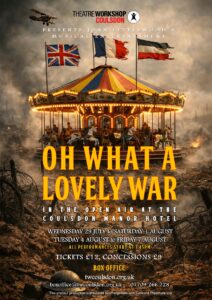
Oh What a Lovely War!
About the Production
As 1914 began, Europe was a tinderbox waiting for a spark. On the 28 June, That spark was provided by a young Bosnian Serb, Gavrilo Pricip, who assassinated Archduke Ferdinand, heir to the throne of the Austro-Hungarian Empire, on the streets of Sarajevo. Not just Europe, but the world caught fire. By the time the armistice was declared on the 11 November 1918, millions had died.
It was a hideous conflict. Germany had hoped for a repeat of the Franco-Prussian war of 1870, fast moving and decisive, over with complete and resounding success inside six months. It was not to be. The stalemate of the Western Front, with miles of trenches, mud and barbed wire, is the overarching image of this period.
On Armistice Day 1962, Gerry Raffles was listening to the BBC Home Service, and a programme called ‘The Long Long Trail’, written by Charles Chilton. It was a documentary about the First World War, interspersing facts and statistics with reminiscences and popular songs of the day. He thought it would provide a good basis for a new production, and broached the subject with his partner, Joan Littlewood, the prime mover in Theatre Workshop, a group she’d set up in 1945 with Ewan McColl. She hated the idea, but Raffles had brought Chilton along, and the two played and sung a number of the songs. Eventually she was persuaded that perhaps the idea had merit after all.
The show was developed through improvisation, and Littlewood had very definite ideas about what would and would not be admissible on the stage. No khaki or uniforms for instance. Instead the cast would wear pierrot costumes, taken from the Comedia dell’Arte, in order to provide some form of ironic contrast.
The production debuted at the Theatre Royal Stratford East on the 19 March 1963 to rave reviews. However, a transfer to the West End seemed unlikely, as the official censor was unprepared to authorise it. The intervention of Princess Margaret, who having watched a performance, discreetly bent the ear of the Lord Chamberlain, changed that, and it opened at Wyndham’s Theatre on the 20 June.
A film version followed in 1969, directed by Richard Attenborough, and with a screenplay written by thriller writer Len Deighton. Filmed in and around Brighton, notably on the now derelict West Pier, it dispensed with the pierrot costumes and thoroughly embraced the military uniforms. Littlewood loathed it.

The Cast
Behind the Scenes
Image Gallery


The Reviews
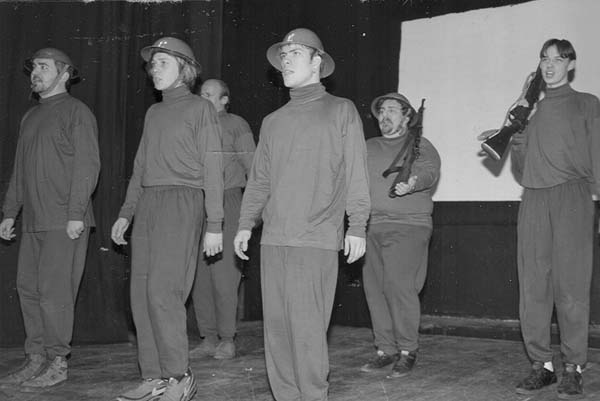
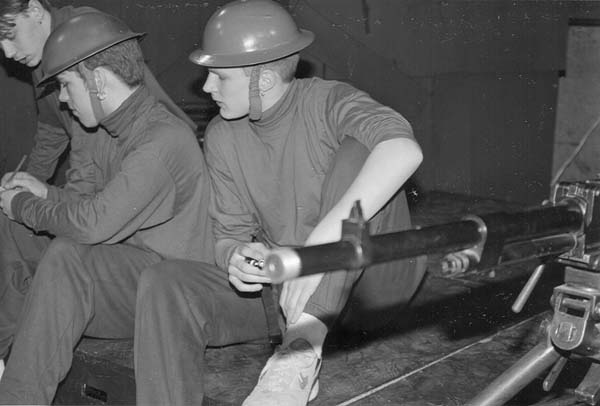
This famous show, devised for Stratford East by Joan Littlewood and her team, is supposed to use the convention of the Pierrot troupe to enact the unimaginable horrors of the First World War. But it is first and foremost a director’s piece, and each one must find his or her own balance between the serious and the blackly farcical. Under Coulsdon’s Mike Brown, there is not a Pierrot costume in sight, though Tim Young genially acts as MC to what might be a travelling company.
Chris Argles, as Field-Marshal Hague, crisp, disciplined, stubborn, an angel of death, is in uniform, which marks him out from the standard male attire of plain green.
This is a tidy production, with some good individual cameos, but it seems to me to lack a sharp focus. No powerful commitment fuels it. One feels neither rage at the human follies it depicts nor the ironical detachment distance brings. It must be said, however, that its impact is largely dictated by modesty of means. Those mad messages of casual slaughter need to be hammered into the brain in an endless parade of light, not dimly projected on a fuzzy screen not always even easy to read.
Nevertheless, there are some effective scenes by the alphabetically listed cast of a dozen gents and four ladies. Pride of place goes to the bayonet drill scene, which indeed generally seems to bring out the best in amateur productions. Could it be that we British specialise in sadistic NCOs? High spots include the Christmas fraternisation, the conference between mutually uncomprehending Allies, and the condescending lecture by a bone-headed officer to the front line troops.
The flavour of the songs is nicely captured, with some fine contributions by the ladies, and Mark Taylor helps things along on piano; but I do mourn the omission of Roses of Picardy, to my mind the most poignant of all those haunting melodies that memorialise a savage and bitter conflict
Donald Madgwick for The Croydon Advertiser
Other Productions