Grimm Tales (2001)

A collection of traditional European folk tales are here given a new lease of life, stripping away much of the saccharine coating so many have accumulated through adaptation for children’s books, TV and film. Yes, we’re looking at you, Disney.

We’ve chosen nine tales all told, each with it’s own director and unique music composition, from one of three talented musicians, Pete Bird, Dominic Russell and Mark Taylor. See the programme for full details. The nine stories are;

Ashputtel

The Golden Goose

The Lady and the Lion

A Riddling Tale

The Hare and the Hedgehogs

Hansel and Gretel

Little Red Cap

Rumplestiltskin

The Magic Table

We like to finish our open air shows with a song, where we can. For this production, we’ve chosen ‘Who’s The Fool Now?’, an old song, first published in 1580 but most certainly far older than that. It doesn’t come from a Grimm tale, but it is a song about tall tales, and it’s also a drinking song, which given we’re sitting in a pub beer garden seems very appropriate. Join in the chorus if you fancy.

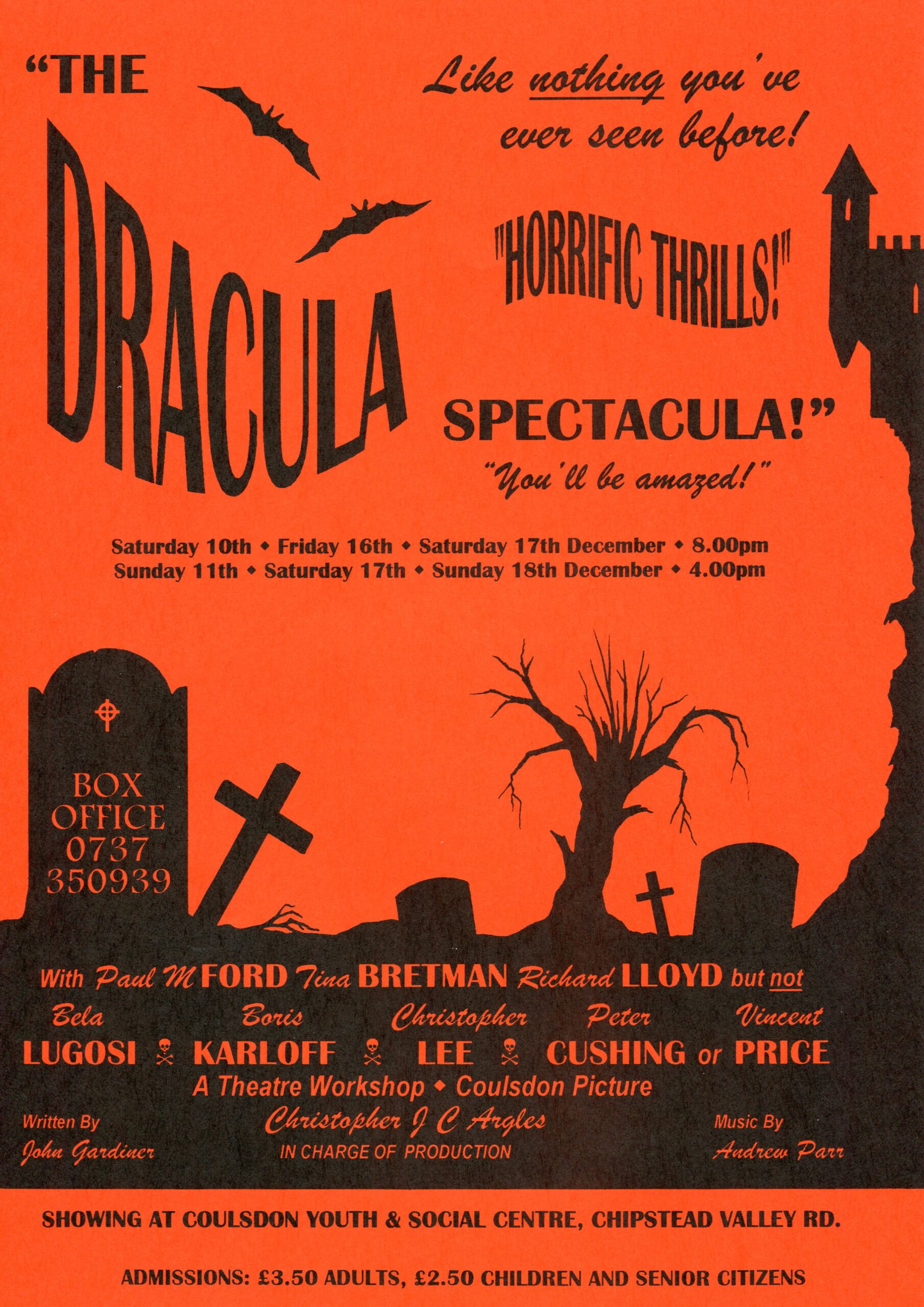
The Dracula Spectacula

It’s been seventeen years since Theatre Workshop Coulsdon first staged ‘The Dracula Spectacula’. At the time it was regarded by the group as probably the biggest and best production that had been performed by them up to that point (we’d only been in existence seven years by that time), involving over 50 people and having a full band.

1995 will be our 25th anniversary year, and we decided that we’d start the celebrations early, by revisiting what was a landmark production for the group.

Amazingly only two of those fifty members who were involved in the 1977 production are actively talking part this time – those being Chris Argles, the director who played Dracula in the original production, and Tim Young, who will recreate his role as Hans, the Innkeeper.

So, how well has ‘The Dracula Spectacula’ stood the test of time? Was it really the terrific show that we fondly remembered, or have the rose-tinted glasses of nostalgia left us with a false impression? Well, let’s be honest, we had to make some changes to the script. Seventeen years doesn’t seem like a long time, but its enough to make some of the dialogue, and the characterisations, sound dated. A number of the songs too, which may have knocked them un-dead back in the day, really don’t cut it now, and so we’ve replaced them with exuberant pastiches of songs that you might just have heard before.

What you see tonight then is very much a brand-new incarnation – albeit of an old favourite, resurrected and rising from its dusty resting place with a whole new lease of life.

Whether this is the first or second time you’ve seen Theatre Workshop Coulsdon perform ‘The Dracula Spectacula’ we hope you enjoy the experience, and live to tell the tale!

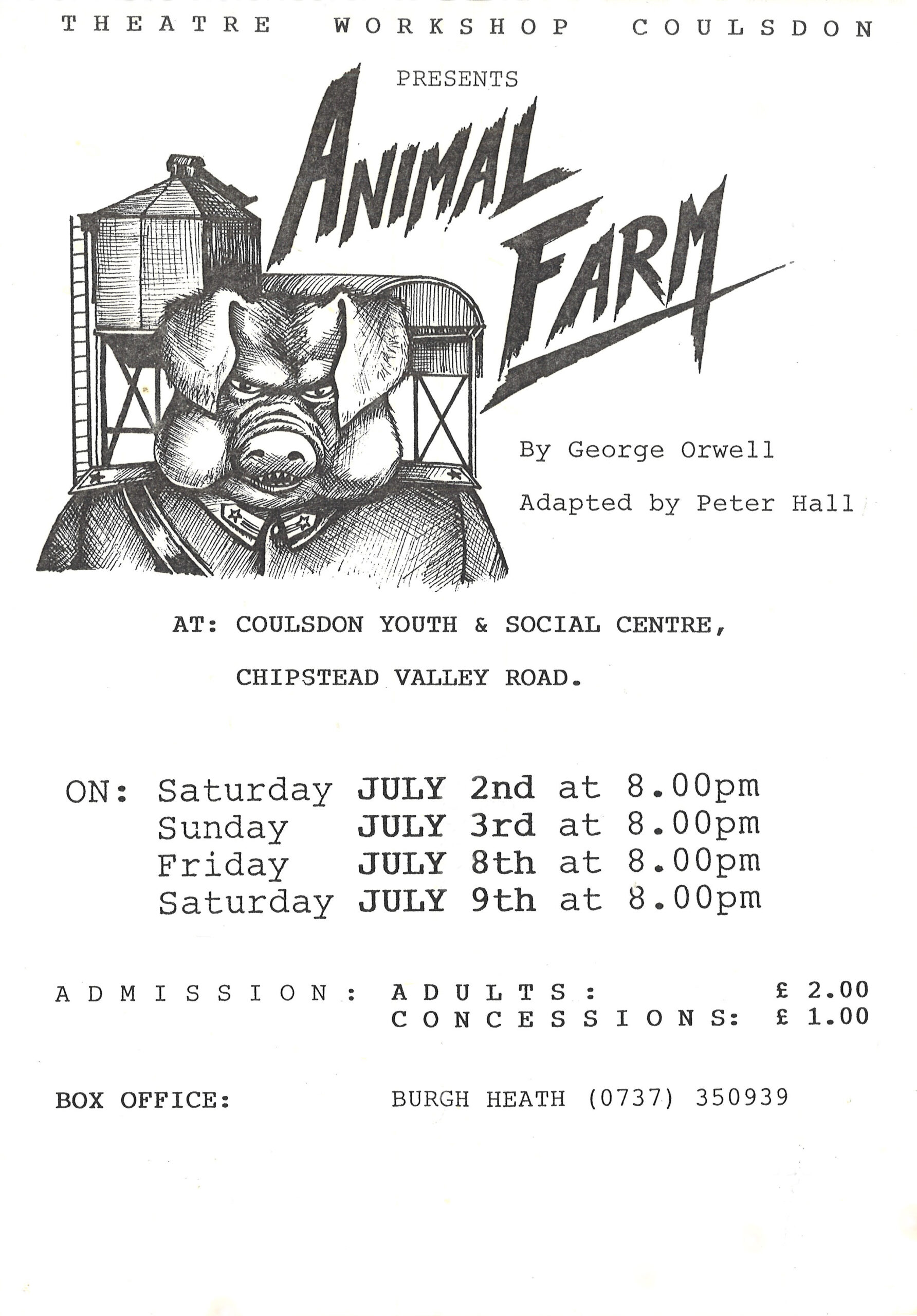
Animal Farm

One night, all the animals at Manor Farm gather in the barn to hear ‘Old Major’, a pig, describe a dream he had about a world where all animals live free from the tyranny of their human masters. The elderly pig dies soon after the meeting, but the animals — inspired by his philosophy of Animalism — plot a rebellion against the farmer, Jones. When Jones drunkenly forgets to feed the animals, they rise up, and Jones and his farmhands are chased away. Manor Farm is renamed Animal Farm, and the Seven Commandments of Animalism are painted on the barn wall. But what follows is far from the dream that Old Major promised…

‘All Animals Are Equal – But Some Are More Equal Than Others’

George Orwell’s ‘Animal Farm’ is a powerful and uncompromising allegory of the Russian revolution, with every character and event that takes place in his tale mirroring Russian history from October 1917 through to the Teheran Conference of 1943.

The succession of steps through which, by persuasion, propaganda, lies and force, Napoleon rises to power in ‘Animal Farm’ are a bitter parody of Josef Stalin’s ascent to dictatorship, and what Orwell saw as the ultimate betrayal of the Russian people.

A fable, a satire, a fairy story, ‘Animal Farm’ is one of the great works of English literature, and a revealing study of the effects of power.

The evocative, and by association, now chilling music chosen by the director to open the production was ‘Fantasia on a theme by Thomas Tallis’ written by Ralph Vaughan Williams. The same composer’s ‘Five variants of Dives and Lazarus’ was used to maintain the mood during the interval.

The Mummy – The Panto

A brand-new and original pantomime from the fevered imagination of Mark Taylor, who wrote the script, directed the show and the music as well as played piano and keyboards. That’s dedication. Or possibly he’s just a control freak. Either way, this unique tale follows the adventures of a daring expedition into Egypt, in search of the tomb of Imhotep, lost to history thousands of years ago. Professor Pottering and Rose Garden not only have the threat of the evil Ardet Bey to contend with, and the curse that surrounds the long-dead ancient Egyptian ruler, but Mrs Beryl Pie’n’mash, foisted upon them by the needs of a pantomime to contain at least one man dressed as a woman with no dress sense and make-up applied in the dark with a trowel. There is nothing like this Dame.

Brokers men Muk-Itup and Kok-itup are on hand to help carry out Ardet Bey’s malicious wishes, but incompetently, of course, and there’s a four piece band to accompany a dozen songs all hand-picked and adapted to amuse and entertain.

All in all, a trip to the sun-scorched desert by the banks of the Nile with Theatre Workshop Coulsdon is a great way to spend a cold December evening.

Hamlet

Once upon a time there lived a Prince Amleth, whose father, the King of Jutland, was killed by his own brother, the prince’s uncle… 

This was a story told by the wonderfully named Saxo Grammaticus, a thirteenth century Danish historian. The tale was picked up in the mid-1500s by Matteo Bandello, an Italian writer of short stories, and adapted to his needs, and then the French writer and translator, Francois de Belleforest, took Bandello’s version and did much the same in 1570. He expanded the original story in his version and introduced the main character’s famous melancholia, and it’s almost certain that Shakespeare took his inspiration for Hamlet from this version, translated into English. (‘Cymbeline’, ‘Much Ado About Nothing’ and ‘Romeo and Juliet’ almost certainly trace their roots in much the same way, as does John Webster’s ‘The Duchess of Malfi’.). 

Shakespeare’s play was published in 1601, though it had been in existence, and performed, before then. It’s even thought that a early version of it existed as far back as 1589, written by either playwright Thomas Kyd or Shakespeare himself, but the script has been lost. It’s thought that the ‘Ghost’ made its debut in this version, but to date, that remains unproven.

Our script is not as Shakespeare wrote it. It’s simply far too long for our needs. Branagh’s film adaptation (1996) retained every word and ran for over four hours and a standard stage version will easily run to three and a half. In our version we’ve edited the text significantly, taking out fully a third of what was there. However, we’ve not been so foolish as to endanger the story proper. The key plot components, important speeches and oh, so quotable lines are all there. Gone are many of the political aspects, and (purists look away now) some of the flights of poetic fancy. We believe we’ve struck the proper balance here between art and comfort. We’ll leave the decision as to whether we called it right down to you.

‘Hamlet’ is part of the English revenge play tradition. A crime or wrong-doing has taken place and the drama proceeds from the protagonist/s attempting to seek some form of justice, either by simply disclosing the offence or exacting revenge upon the perpetrator. The history of revenge plays goes back at least as far as Aeschylus and his Oresteian trilogy in 500BC, which were translated into Latin by Seneca half a millennia later and from Latin into English over a thousand years after that. These then provided the model from which English playwrights would craft their own stories. Thomas Kyd’s ‘The Spanish Tragedie’ (1588), John Marston’s ‘Antonio’s Revenge’ (1599), Cyril Tourneur’s ‘The Revenger’s Tragedy (1607) are classics of their kind. Of all of them, however, ‘Hamlet’ remains the exemplar, for its depth, its questioning of the human condition, its ability, centuries on, to make itself so clearly understood. 

A final note. In Old Norse, in which the original tale was told, the name ‘Amleth’ meant ‘Not sane’. Which of course throws into question any and all of the protagonist’s considerations and actions. Perhaps think on that.


The Three Musketeers – Le Panteau

Our pantomime version of ‘Treasure Island’ was not only immense fun for us to do, but proved to be a big hit, not just here in Coulsdon but in the wider world of amateur theatre. In the two years since its publication, there have been over 60 productions of our tongue-in-cheek swashbuckling tale!

So, what better reason to give another classic story of adventure and derring-do the pantomime treatment. Like ‘Treasure Island’, ‘The Three Musketeers’ transcends age and generations, and has slipped across the border from literature into folklore. Written originally in 1844, there have been so many adaptations over the years, across so many media, that people who are perfectly familiar with the characters, the plot and the musketeers’ bold call to arms, have never read so much as a word of Alexandre Dumas’ original tale. Athos, Porthos, Aramis and D’Artagnan are no longer confined to the printed page, they are creatures of myth, with a life all their own.

So, our pantomime is not so much a spoof of the book, as a pastiche of the very idea of ‘The Three Musketeers’, only taking those parts of the plot and the characters that easily lend themselves to being funny. Yes, it does bear some resemblance to the original, but only very loosely (probably about as much as the usual Hollywood treatment). One very significant difference to most versions is that in ours, D’Artagnan and the other gallant comrades in arms are all played by women.

It’s our opinion that the female of the species can swashbuckle as well any male, but rarely are they given the chance. Well, here’s that chance, and alongside Dame D’Artagnan (the would-be musketeer’s aunt) and a pantomime snail (yes, really) they will fight for honour, justice and outright silliness, along with some excellent songs.

‘All for one, and one for all!’*

*For the record, Dumas may have used this as the Musketeers motto and made it famous, but guess who wrote it and used it first? Yep, William Shakespeare, in his narrative poem of 1594, ‘The Rape of Lucrece’. We’ll not be making a panto out of that.

The Merry Wives of Windsor

‘The Merry Wives of Windsor’ is one of Shakespeare’s more unusual comedies. No strange land for this one for a start. No far-flung Illyria, exotic Messina or Syracuse, but instead the action centres round The Garter Inn in Windsor. A real place no less, and one that stands to this day. Similarly, the Princes, Dukes and sundry other nobles that inhabit so many of his tales are notable by their complete absence, replaced by the title-less and newly prosperous middle classes. The only knight of the realm that features is the rascally, roguish Sir John Falstaff, a knave who sets out with poor intentions to fool the good wives of Windsor out of money, but fails spectacularly at every turn.

It is said that the character of Falstaff was one that Queen Elizabeth herself was most fond of. He appeared first in Henry IV Part One, and again in Henry IV Part Two, a portly, aging disreputable sot, too fond of his drink and of cheap women, forever lacking in funds. Quick to borrow, never to repay, and cowardly to boot, Falstaff does retain a certain charm and zest for life, and it’s this, for a time, that endears him to Prince Hal. However, when the prince becomes the King, all his former life is left behind, including Falstaff. In Henry V, Mistress Quickly delivers a eulogy outlining the circumstances of his death, and there, one might suppose, was the end of him. If a queen commands though, a humble playwright must write, and so, two years after his death, Sir John Falstaff lived again.

So ‘The Merry Wives…’ is what we would call today a ‘prequel’. Reunited with his low-life comrades, Pistol, Nym and Bardolph (the latter two also dying in Henry V, executed for looting), Falstaff unknowingly engages in a battle of wits with Mistress Page and Mistress Ford and finds himself distinctly unarmed, or at least badly under-gunned. Unlike the bittersweet nature of his antics in the histories though, these adventures are purely comedy, descending almost into farce. It dispenses with the oft-used conventions of romantic comedy, such as the mistaken identity, the flirtatious wordplay, the lovesick entanglements, and replaces them with Falstaff, the aging would-be suitor and lothario (supremely lacking in self-awareness) falling for the tricks being being played on him. In parallel, middle-aged, middle-class Francis Ford, consumed with ill-founded jealousy, repeatedly makes a fool of himself while attempting to prove, vainly, his wife an adulterer.

It’s funny, but this, undoubtedly the most original of Shakespeare’s works, drawing on no ancient text or foreign translation, is looked down upon by numerous scholars of the Bard. They seem to forget that the texts weren’t designed to be pored over, dissected and examined by fusty literary experts. It was created to have life on the stage, uproarious, physical life as popular entertainment.

And that is what you have before you. Enjoy.

Journey’s End

R.C.Sheriff’s play is set in the officer’s dug-out of a British infantry company in the trenches facing Saint Quentin. It is the 18th of March, 1918, and in just a few days, the German army will begin Operation Michael, the opening of Ludendorff’s Spring offensive intended to push the British Expeditionary Force into the sea and capture the Channel ports. For the Germans, it is the last roll of the dice in the Great War, which has been going on since August 1914 and wiped out a generation of young men across the continent. In the trenches, the constant threat of death and the fear that generates, along with the loss of friends and comrades, has deeply affected every man there, and each deals with it in their own way. Captain Stanhope leads the infantry company, with a keen sense of duty but a growing dependence on alcohol to cope with the pressures of command. When the young and naive Raleigh joins the company, his precarious balance is disturbed…

After it was written, Sheriff encountered resistance in getting the play produced in London’s West End. There was a reluctance to put on a play about the war, which having ended just ten years previously, was all too fresh in people’s minds. Others baulked at the idea of a play without a leading lady, which would hinder ticket sales. Eventually, the Independent Stage Society were persuaded, after some words from George Bernard Shaw, to put it on at the Apollo Theatre. They still hedged their bets. It was a ‘semi-staged’ production, meaning no sets and minimal props, and would run for just two nights. The lead, Captain Stanhope, would be played by a 21 year old unknown…called Lawrence Olivier. However, when the curtains finally rose on the evening of Sunday, December 9, 1928, in the audience was Maurice Brown, a West End producer. He was impressed, enough at least to take a gamble on booking it to open at the Savoy Theatre on January 21, 1929. Even then, it received minimal promotion and no advance bookings were taken. However, word of mouth was enough, and ‘Journey’s End’ sold out, and proceeded to run for a further two years to packed houses.

Sheriff himself didn’t see the play as being expressly an anti-war piece, rather it was an account of his own experiences. He’d been only 18 when he’d gone to France as a Captain in the 9th East Surrey Regiment, and fought at Vimy, Loos and Passchendaele, where he was severely wounded. He’d written other plays and would go on to write more, though ‘Journey’s End’ remained his most famous stage work. He’d go on to write screenplays too, receiving an Academy (Oscar) nomination for ‘Goodbye, Mr Chips’ (1939) and a BAFTA nomination for ‘The Dambusters’ (1955).

Abigail’s Party

Somewhere on the London side of Essex, Beverley and Laurence Moss are holding a drinks party for their new neighbours, Angela Cooper and her husband Tony, who moved in just two weeks ago. They also invite divorcee Susan, whose 15-year-old daughter, Abigail, is holding her first teenage party next door.

Beverley, an ex-department store cosmetics demonstrator with a love of Demis Roussos records, desperately tries to impress her guests, forcing cigarettes and drink on them while continually clashing with her less flamboyant estate agent husband, Laurence. He’s in her bad books, arriving back home late from work, only just before the guests appeared. Laurence aspires to better things, even if he doesn’t quite understand them, and has decorated their house with Van Gogh and Lowry prints, as well as a leather bound collection of Shakespeare that’s there to be seen, not read.

Quietly spoken, verging on taciturn Tony, an ex-Crystal Palace football player, is in computing and his wife, the seemingly childlike and cheerfully tactless Angela, is a nurse. The house purchase has been a bit of stretch for them financially, and they’re feeling the pinch.

Sue is a longstanding resident, quiet, conventional and ill-at-ease, having misunderstood the invitation and not ‘dressed up’. Expecting food, she finds herself becoming more and more hungry as the evening progresses but tries to keep the hunger at bay by eating peanuts. The constant round of drink ‘top-ups’ is also making her feel unwell.

As the evening progresses and the drink flows, things become… interesting.

Mike Leigh’s play debuted in April 1977 at the Hampstead Theatre and was an instant success, spawning a revival that same summer which was a sell out. Quick to spot an easy win, the BBC filmed it in the autumn, and it was broadcast that November as a ‘Play for Today’.

A suburban situation comedy of manners, and a satire on the tastes of the the new middle classes of the 1970s, it evolved from a series of improvisations in which the actors played the characters but without knowing what events would take place while they did so. The various back stories were created by the original cast, drawing on their own experiences. For instance, John Salthouse, who played Tony, had been a professional footballer.

It has become something of a period piece, but is no less funny for all that.

The Fairy Godfather

In 1972, Francis Ford Coppola gave us the gangster epic ‘The Godfather’. Set in 1940’s New York, it centred on the criminal empire of the Corleone family, led by Marlon Brando’s iconic Don Corleone, and it single-handedly set the tone for American Mafia/Mob/Gangster movies to follow ever since. Nowhere did it say anything about pantomimes.

Richard Lloyd made us an offer we couldn’t refuse. He’d written a pantomime that less than delicately mashed up a bucket of well-used mafia gangster tropes, spread them over a comedy base, added some spicy panto sauce and served them up with side order of rollicking good songs, finishing with a rousing (everybody join in!) rendition of ‘That’s Amore!’. There are good fairies, evil villains, a dame and a gondola-full of Italian cheese gags. You just have to look at the cast list.

So we had to put it on. Really, we had to. And now you gotta to watch it, capisce?

Cut yourself in for a pizza the action tonight.