Dick Barton and the Carnival of Chaos

“Good evening. This is the BBC Light Programme broadcasting from London. It’s 6.45 and time for the next thrilling episode of ‘Dick Barton and the Carnival of Chaos’!”

Yes, Barton is back, and in his toughest assignment yet!

London. 1949. Wartime rationing remains in force, and only marmalade – that nutritious, morale-boosting foodstuff – continues to fortify our island nation’s grit, spunk, vim and pluck after six long years facing down the Nazi peril.
But now there’s a fiendish foreign conspiracy afoot to kidnap Tiggy Zesty-Peel, heiress to the Zesty-Peel preserves empire, and only Dick Barton can stop it. But who has evil designs on the Marmalade Millionairess? And just what is their nefarious purpose?

Meanwhile, Snowy White and Jock Anderson, Barton’s salt-of-the-earth working class assistants, are each in a jam of their own. Snowy’s been injected with bonobo serum during a brush with a batty Bulgarian ballerina, and has gone more than a little ape. And Jock has fallen for the charms of ex-Nazi filmmaker and flaxen femme fatale, Leni Fuchs.
Throw in the homegrown villainy of the Crayfish Twins (the East End’s favourite lovable cockney mass murderers) and mysterious Italian yoga swami, Contessa Bianca Di Scalzo, and the plot is thicker than a jar of rough-cut.
Can Barton unravel the mystery and save Britain’s marmalade? Or will our favourite spread succumb to the spread of evil? To find out, tune in to the next thrilling instalment of ‘Dick Barton and the Carnival of Chaos’!

Theatre Workshop Coulsdon’s third outing for Dick Barton, Boy’s Own adventurer, all-English hero and teatime wireless star, is another ripping comedy adventure, full of improbable characters, glorious gags, and a cheeky sprinkling of spiffing song and dance numbers. Pip pip!

A Christmas Carol (2023)

The Past Is Forfeit. The Future In Peril. The Present In The Balance. All That Matters Is Now.

It’s Christmas Eve! A time for joyful anticipation, celebration and goodwill to all!

Perhaps not all. To the poor and the hungry in Victorian London, Christmas Day is just another day to struggle through. And for Ebenezer Scrooge it’s a day lost, with business left undone and money misspent. Happy Christmas? Bah, Humbug! But tonight, at midnight, Scrooge will be forced to confront the choices he has made, the opportunities he’s missed and the bleak future that lies ahead, unless he can change…

Although Charles Dickens wrote many classic stories, from Oliver Twist to Great Expectations, there is surely no tale of his more famous, or heart-warming, than ‘A Christmas Carol’. Written in 1843, Dickens paints his protagonist in dreary colours. Ebeneezer Scrooge is a mean-spirited, grasping and bitter individual, shorn of all the things that make a life worth living by choice. Though wealthy, his existence is impoverished, begrudging spending his hard earned coin on anything that might provide a crumb of comfort, either to himself or those around him. He treats his employee with disdain, his nephew as a fool. But on one Christmas Eve, he is forced to look hard at what he has done with his life, and what his actions have meant for others. Three spirits, the ghosts of Christmas Past, Present and Future, show Ebeneezer where he has come from, where he is now, and the cold, unloved end of his days on the path he is destined to take. Will he change his ways? Can he change?

A time-honoured story of redemption, with love, laughter, song and a warmth to melt even the meanest misers’ heart, Theatre Workshop Coulsdon is proud to present ‘A Christmas Carol’.

Theatre Workshop Coulsdon is also pleased to be able to partner with the Purley Food Hub for this production. Dickens was very much a social reformer and the plight of families and children with little food, especially at Christmas, was a source of concern reflected in his writings and emphasised in this version of his story. A Purley Food Hub collection point for voluntary food donations will be set up at the Coulson Community Centre for the duration of the run of the show, from December 9 through to December 17.

Come along, enjoy the show and perhaps make Christmas a little better for someone else too.

Reginald Rare – Rocketeer Extraordinaire

‘Reginald Rare – Rocketeer Extraordinaire’, is an affectionate spoof on the classic sci-fi comic strip, ‘Dan Dare – Pilot of the Future’, as created by illustrator Frank Hampson and appeared in the ‘Eagle’ from 1950 through to 1967.

In 1945, WW2 Spitfire ace Squadron Leader Reginald Rare is shot down while on a top secret mission over Germany by a experimental Nazi freeze ray. Awakening after decades of cryogenic suspension, Reg finds himself in the far-flung year 2015, and a world quite unlike his own. Countries and borders are gone, merged into one united World Government. Women and men are equals. Poverty has been eradicated. But the Earth is under threat from the Venereans – fiendish alien overlords of Venus. They’re using a powerful heat ray to cause global warming, and once they’ve destroyed life on Earth, the dastardly Venereans will occupy it as their new home! The trouble is, that Earth gave up war decades ago, and no longer knows how to fight. The newly-promoted head of the armed forces can’t even tell the difference between a set of bagpipes and an instrument of torture! (Hmmm.)

As the only man in the world with combat experience, bravery and a natural air of command unsullied by knowledge or common sense, Reg – a man out of his time in so many ways – is immediately recruited by the Earth’s government to lead a mission to Venus to carry the fight to the enemy. Accompanied by a hand-picked crew of assorted misfits and weirdos (‘Oily’ Wragg, the chief engineer, Bruce McKenzie the Xenobiologist and Giuseppe Bernatelli, the weapons specialist – sorry, chef, as well as the entirely delectable but decidedly feisty physicist and astrogator Dr Mary Honeydew) – Reg heads for Venus in his brand-new untried rocket ship, with a brand-new untried weapon, to give those alien fiends what for! And save the world, obviously. What could possibly go wrong?

Spiffing adventures ensue, by turns comical and thrilling, in a fast moving yet knowing homage to the lantern-jawed sci-fi hero of yesteryear, written by Sean Young and now brought joyously to life on stage.

Special mention to director Pete Bird who with only a couple of weeks to go, had to step in and play Bruce McKenzie after Joe Wilson had fallen ill with appendicitis!

Orca

Midsummer. On an isolated Atlantic island, the community prepares to enact their hallowed annual ritual. The village must choose a new ‘Daughter’ to sail with the boats and bless the fishing grounds. Keeping them safe from the roaming pods orcas for another year. Fan hopes with all her heart to be chosen. But her older sister Maggie says she must never, never go with the boats. Because Maggie swears that something happened to her out there, but no-one will admit it. No-one will even talk about it. And no-one, not even Fan, believes her.

What the papers have said about ‘Orca’:

‘A world as soaked in myth and ritual as it is with salt water’.

‘Jaws meets The Wicker Man’.

‘An unnerving play about mythical ritual sacrifice that acts as a metaphor for the present’.

‘A gut-chilling reminder that the smallest communities have room for danger, and that often the biggest risks come not from nature, but from the people who claim to want to keep you safe’.

Winner of the 2016 Papatango New Writing Prize, ‘Orca’ is a dark, intense and thrilling piece of theatre – an unflinching insight into what makes a community tolerate the unthinkable.

If you enjoyed our 2023 production of ‘Machinal’ – another pitch dark and compelling play – we think you’ll love ‘Orca’.

Please note this play contains adult themes, strong language and portrayal of violence. We’d suggest it’s not suitable for children under the age of 16 – subject to parental guidance.

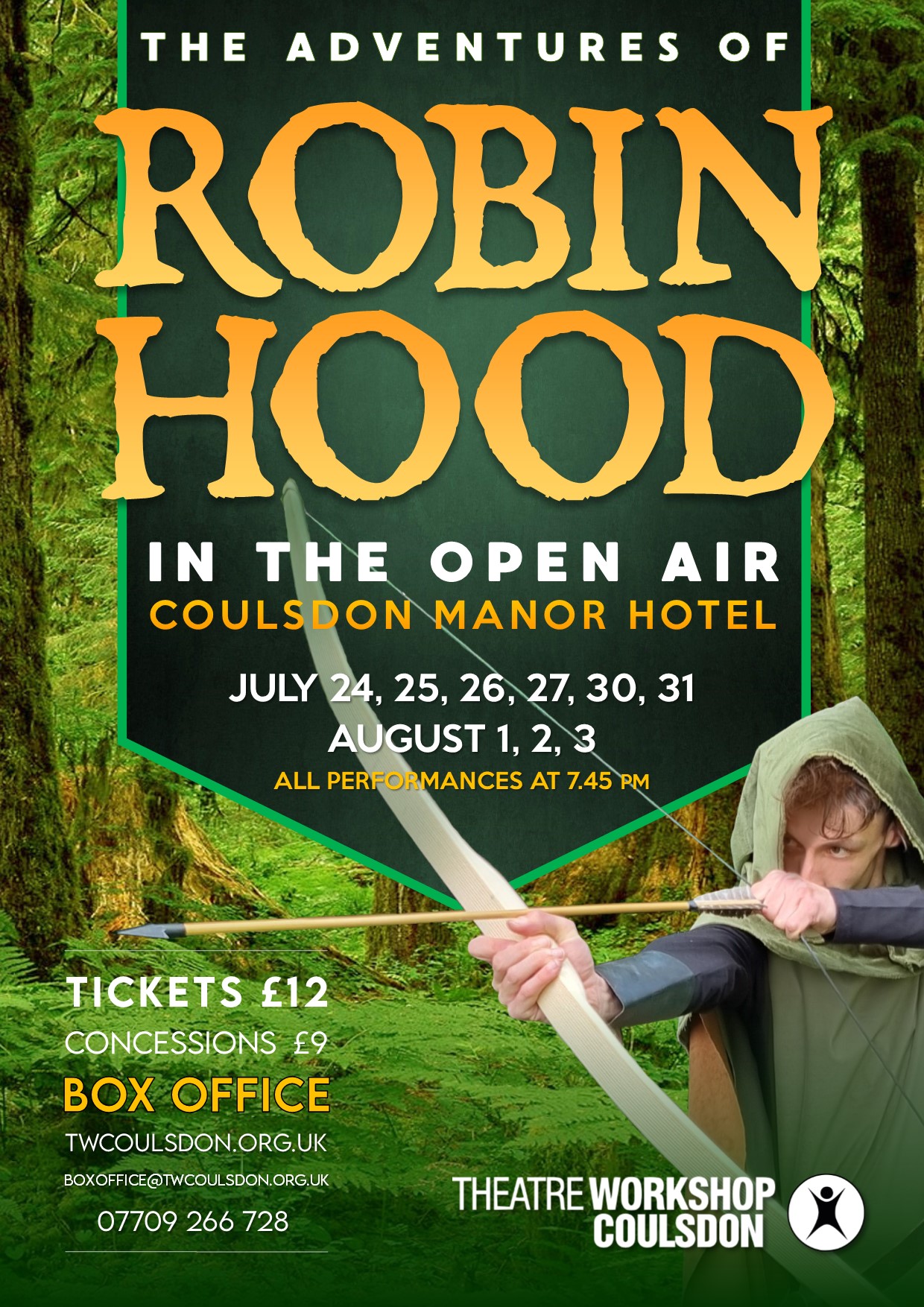
The Adventures of Robin Hood

Good King Richard is dead, and the throne is now held by his brother John, a man determined to make his mark no matter what the cost to the people he rules. In Nottingham, the evil Sheriff brutally extorts higher and higher taxes for his royal master, putting dissenters to the sword. The land has never been in greater need of a hero.

This Summer, we’re back in our idyllic woodland glade at the Coulsdon Manor Hotel with that most celebrated icon of English folklore, Robin Hood. Alongside his outlaw allies, Little John, Will Scarlet, Alan A’Dale and Friar Tuck, aided by the fearless Marian Fitzwalter, they’re going to challenge the tyranny and injustice that the Sheriff and his royal patron are imposing on the good people of England, and tear the whole rotten edifice down. Or die trying.

High adventure and fun on a Summer’s  evening – among the trees in the good company of the free men of Sherwood, witnessing thrilling and entertaining encounters as the fight for freedom begins, with sword, with bow, with quarterstaff and with laughter.

It’s A Wonderful Life

Bedford Falls is a small town in a big country, and for as long as he can remember, George Bailey had wanted to leave it behind and see the world, make a real difference. Somehow though, he never got the chance. Now, on a cold Christmas Eve, he stands on a snow-clad bridge parapet, looking down into the dark, icy river below. He faces ruin, but perhaps one last sacrifice can salvage some small hope for those he loves. But kind eyes are watching, and on the edge of tragedy, George is given a divine opportunity to see how his life has changed so many others.

This new adaptation of ‘It’s A Wonderful Life’ by Mary Elliot Nelson follows George and many of the other inhabitants of Bedford Falls from the end of the Great War, through the Depression of the 1930’s, to the end of the Second World War. From high school prom to happy marriage, the wins and the losses, the smiles and heartbreak, the characters both good and bad that make up life in Bedford Falls.

This play is based on the now classic 1946 movie directed by Frank Capra and starring James Stewart and Donna Reed. It’s an uplifting, moving story of love, redemption and community. It’s also a brilliant, evocative slice of period small town Americana.

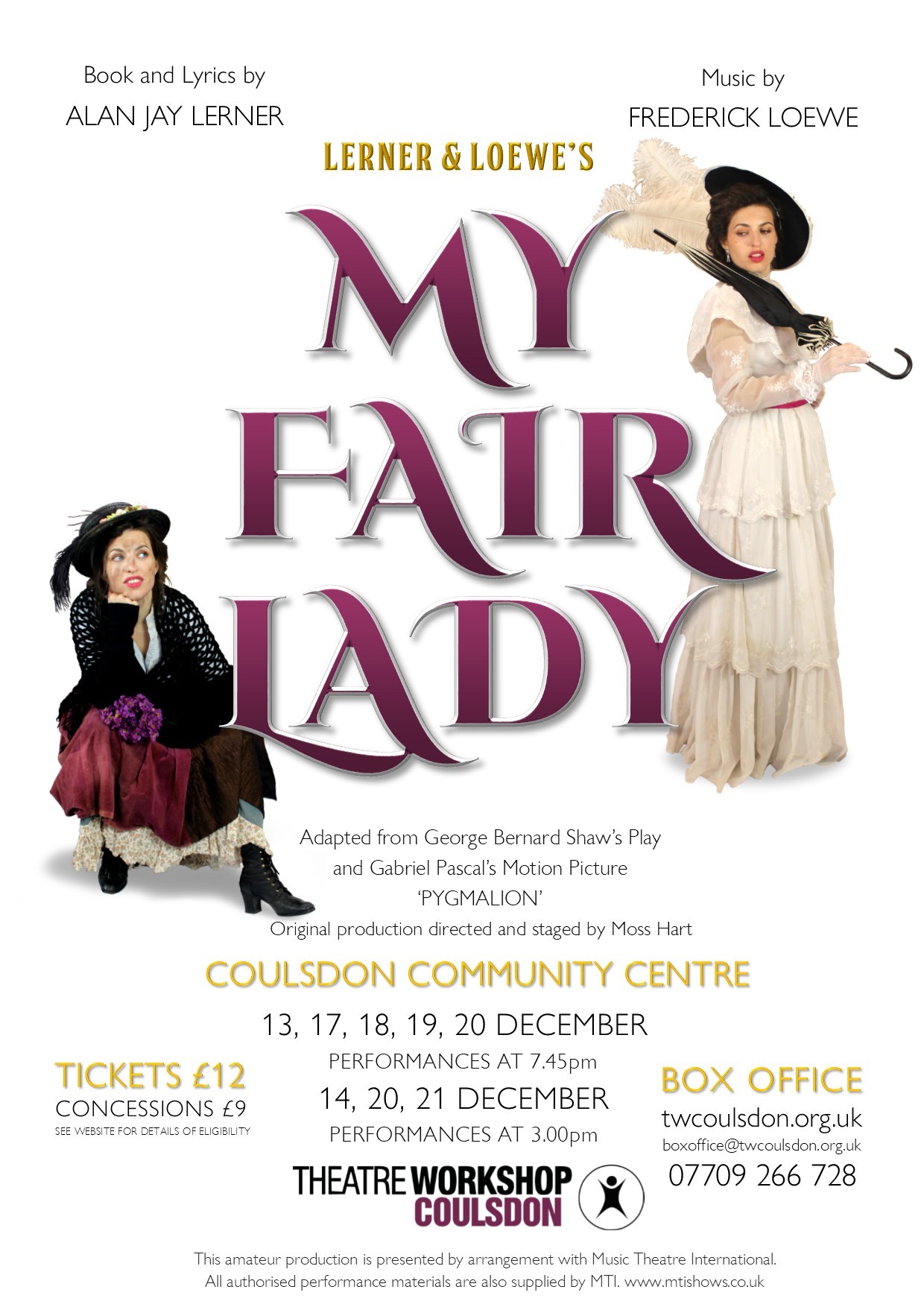
My Fair Lady

Lerner and Loewe’s celebrated stage musical adaptation of George Bernard Shaw’s ‘Pygmalion’ includes some of the best known and best loved show tunes ever written. From ‘Wouldn’t It Be Loverley’ to ‘I’m Getting Married in the Morning’, ‘I Could Have Danced All Night’ and ‘With A Little Bit Of Luck’.

It’s the story of a cockney flower girl’s transformation into the pride of London society – and its unforeseen consequences. In many places it’s very funny; in others, very poignant. When overbearing Professor Higgins stumbles on Eliza Doolittle outside Covent Garden Opera House, he recognises that her hideous vowels and lost consonants are all that separates her from the upper classes. Higgins casually makes a wager that within weeks he can pass Eliza off in polite society as a Duchess. But little does he know that beneath the dirty face and shabby clothes, young Eliza is stuffed full of human feeling. Too eloquent for a flower girl, yet lacking the breeding of the ruling classes, what on earth is to become of Eliza when the bet is over and the game has reached an end?

‘My Fair Lady’ was Lerner and Loewe’s musical adaptation of George Bernard Shaw’s ‘Pygmalion’, a much darker tale than the highly successful Broadway, West End and Hollywood show tells.

The character of ‘Pygmalion’ comes from Greek mythology, where he was sculptor who fell in love with a statue he had created, a statue that then comes to life. Bernard Shaw took that tale and twisted it, the sculptor becoming Henry Higgins, and the thing he creates, Eliza Doolittle. His play debuted in 1913 in Vienna, before going on to London and New York. Critics were generally favourable, though the ending created a certain level of controversy. A standard love story this wasn’t, and the ending was no more conventional. A film version was made in 1938, starring Leslie Howard as Higgins and Wendy Hiller as Eliza, and Shaw, initially distrustful, agreed to it being made only if he had a certain amount of creative control. This resulted in Shaw writing a whole new ballroom scene, the creation of a new character ‘Zoltan Karpathy’, and a new ending. He and his fellow screenwriters were awarded an Oscar for the screenplay, for which Shaw was characteristically dismissive, but it would be this screenplay that would be used as the basis for the musical.

The director of the movie, Gabriel Pascal, had spoken with Shaw about making it into a musical, but the author had refused. However, when Shaw died in 1950, that barrier was no longer an issue. Pascal approached lyricist Alan Jay Lerner to write the musical, with his partner, composer Frederick Loewe. At first, they couldn’t make it work but eventually they found a way, though not before Pascal had died. They called it ‘My Fair Lady’ after a provisional title to Shaw’s play ‘Pygmalion’, and it referred to the Cockney pronunciation of ‘Mayfair Lady’, helping to show Eliza’s transformation from working-class girl to upper-class woman. The part of ‘Higgins’ was initially offered to Noel Coward, who turned it down but suggested they approach Rex Harrison. ‘Eliza’ was offered to Broadway veteran Mary Martin who also turned it down, and they went instead for newcomer Julie Andrews. It opened on Broadway in March 1956 and was a massive success, going on to become, at the time, the biggest grossing Broadway show ever.

The 1964 movie was a similar success, winning eight Oscars including those for Best Picture and Best Actor (Rex Harrison). Interestingly, the Best Actress Oscar that year went to Julie Andrews for her portrayal of Mary Poppins, having been rejected for reprising the part of Eliza as not being famous enough by the studio. It went, famously, to Audrey Hepburn, whose singing voice was overdubbed by Marni Wood.

Theatre Workshop Coulsdon’s presentation of this fabulous show was directed by veteran actor/director Richard Lloyd with musical director and pianist Mark Taylor, and features Dan Carr as Professor Henry Higgins, Indianna Scorziello as flower-seller Eliza Doolittle, Paul Ford as her ne’er-do-well father Alfred, and Mike Brown as the bluff and amiable Col. Pickering.

Animal Farm (2025)

All is not well on Manor Farm. The animals are neglected and abused by their drunken owner, and anger and a sense of injustice are growing. They dare to dream of taking their destinies into their own hooves, paws and claws. When man is gone, fairness and equality for all animals shall be the rule! Won’t it?

TWC’s Summer 2025 open air production is a new, fast-paced, occasionally frightening and sometimes bleakly comic adaptation of one of the most celebrated novels of the Twentieth Century – George Orwell’s ‘Animal Farm’.

An army of downtrodden farm animals rises up to overthrow their human oppressors. But their dream of a society where all animals are equal soon collides with the seductive allure of privilege and the corrupting nature of political power. Orwell’s famous fable – a brilliant satire on the Russian revolution and the rise of Stalin – is a gripping tale of rebellion, heroism and ultimate betrayal. The writing is on the wall – literally:

ALL ANIMALS ARE EQUAL, BUT SOME ANIMALS ARE MORE EQUAL THAN OTHERS

Accidental Death of an Anarchist

Dario Fo’s dark comedy was based on the real life events in the aftermath of a terrorist bombing in Milan. While in custody, one of the suspects, ultimately found to be innocent, ‘fell’ from a window on the fourth floor of the police station.

In this new adaptation by Tom Basden, he shifts the spotlight from 1970s Milan to London and today’s Metropolitan Police, which in recent years has staggered from crisis to crisis, with incidents and allegations of inappropriate behaviour, abuse of power, racism and misogyny, all too frequently covered up or brushed under the carpet.

The coppers in the show no doubt believe that what they’re doing is right, or at least that their possibly dubious actions are defensible, under the circumstances. Honest, guv. The maniac, our main protagonist, is out to get to the truth or something close to the truth, and on the way show the complete absurdity of the situation. The play, is, first and foremost, a farce, fast-moving, funny and frantic. You’ll find yourself laughing out loud, and then later, thinking about why…

Please note this play does include some use of strong adult language. Parents may deem it unsuitable for younger children.

Grimm Tales (2022)

Dare you go down to the woods today?

Theatre Workshop Coulsdon has adapted ten of the most famous tales from the Brothers Grimm into a single play. By turns magical, terrifying comic and profound, our ‘Grimm Tales’ is a festive theatrical treat for all the family (well, almost), delving as deep as the dwarves into a rich dark seam of lost European folklore.

The tales we’ve included, from ‘Hansel and Gretel’ to ‘Little Red Cap’, ‘Snow White’ and ‘Rumpelstiltskin’, are stripped back to their origins, freed from layers of Victorian prudery and Disney schmaltz, revealing the simple, undiluted truths of these ancient stories. Often funny, sometimes brutal, occasionally touching – they’re familiar yet strange, like something you’ve always known, but are only now seeing them for the first time.

Some of them include some old-fashioned fairy tale revenge, mayhem and a modest amount of gore. In other words, just the kind of things that generations of kids have grown up loving! That said, it’s probably not really suitable for toddlers and the very young. Or those of a particularly nervous disposition.

So join us on a journey to the dark heart of the forest. It all starts with ‘Once upon a time…’

About the Brothers Grimm

The root of all theatre is storytelling. Our performance of ‘Grimm Tales’ is based on some of the best-known stories of Jacob and Wilhelm Grimm – those avid collectors of folk tales from across the German-speaking lands of central Europe.

The brothers grew up in the late Eighteenth Century – the flowering of the period of European Romanticism.  The German romantics sought Der Volkseele or ‘folk-psyche’, and returned to the folksongs, ballads, and folk tales of earlier centuries to find it. The simplicity and truth of these folk traditions, despised by the highbrow thinkers of the Enlightenment, suddenly acquired a new value. They pointed to a rich, oral, pan-Germanic cultural legacy.

This quest for a distinctive German identity was given huge impetus in the early Nineteenth Century, when the patchwork of German states, great and small, had been laid waste by Napoleon, and all things German had been crushed under the ascendancy of all things French. For the Grimms, collecting old stories from across the German-speaking lands, became a mission to reinvent a distinctive German culture. Der Volkseele would reinvigorate and bind together the disparate peoples and states of the German nation – culturally, if not politically. In this, the work of the Brothers Grimm foreshadowed German unification, which followed in 1870.

The brothers travelled all over Europe to collect their tales, from the Baltics to Bohemia, Switzerland to Schleswig-Holstein, hoovering up every scrap and morsel of part-remembered fable, coaxed from nobleman and peasant alike. They transcribed these contributions as faithfully as possible, binding in authentic bits of nonsense, dialect words, old sayings, arcane rhymes and doggerel, just as they had been told to them.

In their devoted search for origins, the brothers invented the modern science of folklorism. By the 1850s they’d published seven editions of their two volumes of collected tales. By the end of the Nineteenth century, their 200 or so tales had been translated so widely that they were renowned around the world. Today, they remain the most popular and famous collection of folk stories in the Western world.