The Wind in the Willows

For our eleventh summer production, staged in the open air at The Woodman, we’ve picked a classic of children’s literature ‘The Wind in the Willows’, based on the 1908 book by Kenneth Grahame.

There’s not a great deal one can say about ‘The Wind in the Willows’. Almost everybody is familiar with the adventures of Toad, Ratty. Mole, Badger and co., either because they’ve read the book, or at least they think they have. It’s certainly amongst the most widely loved of books – a rural riverbank idyll of friendship and innocence which seems to strike some peculiarly English sentimental chord.

Maybe it’s the little furry animals. Perhaps, viewed through the prism of history, the modest, meandering adventures of Rat and Mole, set as they are in an evocative pastoral England where good manners and tranquillity are only occasionally disturbed by the vainglorious antics of a certain ‘Nouveau Riche’ amphibian, genuinely do call to mind an time of lost innocence and comfortably parochial concerns. An England before the cataclysm of The Great War, and all the horrors of the industrialised, globalised conflicts that have occurred since.

However, ‘The Wind in the Willows’ doesn’t simply hark back to a bygone age. It presages the uncomfortable shape of things to come as Grahame saw them in 1908 – the ‘menace’ of the motor car for instance, and the upheaval of the deferential norms of polite society, where Wild Wooders and other assorted ‘lower orders’ simply don’t seem to know their place any more, and are starting, as Ratty says, ‘to break out’.

Much of the appeal lies in the story’s great comic set pieces, its sympathetic characters and larger than life caricatures such as the irrepressible Toad. Appalling amoral and utterly incorrigible, he’s become a firm favourite on stage for much of the twentieth century, mostly due to A.A. Milne’s ‘Toad of Toad Hall’, the first and most enduring of the many adaptations that the story has undergone.

That said, we’re actually using the more recent (1990) adaptation by Alan Bennett, with a few choice embellishments of our own. Some critics have said that Bennett’s version is somehow truer to the book than Milne’s classic, but if you watch our show closely, it’s clear that Bennett’s voice can be heard intermixed with that of Grahame’s. Regardless, as Mr Toad so succinctly put it, ‘Poop Poop!’.

Return To The Forbidden Planet

Since its debut in an inflatable tent on Blackheath back in May 1983, this strange, hybrid ‘juke-box’ musical, ‘Return to the Forbidden Planet’, has acquired something of a cult following, similar in some ways to its far raunchier predecessor ‘The Rocky Horror Show’. The Bubble Theatre Company used a cast of ten who acted, sang and played all the instruments. For a number of reasons, TWC have decided to spread the workload a bit further.

Writer and director Bob Carlton took as his inspiration the 1956 science fiction movie ‘Forbidden Planet’ (Starring Leslie Neilsen as John J Adams, commander of the United Planets starship ‘C-57D’), itself drawn on loosely on William Shakespeare’s ‘The Tempest’. He’s then plundered several of the Bard’s works for dialogue, and then added a score composed of numerous songs from the 1950s and 1960s, such as ‘Wipe Out’, ‘Great Balls of Fire’, ‘Shakin’ All Over’, ‘Good Vibrations’, ‘Oh, Pretty Woman’ and ‘Born to be Wild’. It probably shouldn’t work. The story only just about makes sense. But is it fun? Heck, yeah!

So join Captain Tempest, commander of the starship ‘Albatross’, and his crew, on a routine scientific survey flight across the stars that becomes anything but routine. A meteor shower drives the ship down toward the planet D’Illyria, where they encounter the enigmatic Doctor Prospero and his daughter Miranda, along with Ariel the robot. They have been marooned on the planet for years, having been sent into space by Prospero’s scheming wife Gloria, but now they are rescued, and everything will be fine. Won’t it?

Warning. As passengers on the ‘Albatross’, you will be required, when the order is given, to undertake the Reverse Polarity manoeuvre to ensure the ongoing safety of the ship.

Step 1 Put both your hands in the air

Step 2 Place your hands on the top of your head

Step 3 Press, using a downward motion, several times

Step 4 On the command ‘Polarity Reverse!’, equalise the external equilibrium by quickly raising both hands and arms and exhaling thus – ‘Phewwwww!!’

The Little Shop Of Horrors

Back in 1960, director Roger Corman, ‘king’ of the low-budget movie, made a horror comedy film called ‘The Passionate People Eater’ on practically no budget, in very little time, using sets left over from a previous movie. Released in that same October under the new title of ‘The Little Shop of Horrors’, it slowly gained a cult following, and over twenty years later, in 1982, a musical version (with some significant changes to the story) opened off-off-Broadway, written by Howard Ashman and Alan Menken. It was successful enough to merit a transfer to the off-Broadway Orpheum Theatre in Manhattan’s East Village, and there it ran for five years, winning numerous awards and becoming the highest-grossing production in off-Broadway history. A transfer to Broadway was proposed, but writer Ashman declined, saying it belonged where it was. In much the same way that Mel Brooks’ ‘The Producers’ was first a film, then a stage musical, followed by film of the stage musical, so to did a film version of ‘The Little Shop of Horrors’ emerge, in 1986. Starring Rick Moranis as Seymour, this was anything but low-budget, costing US$25 million, with cameos from Steve Martin, Jim Belushi, Bill Murray and John Candy, and the voice of Audrey II being provided by Levi Stubbs, lead singer with 1960s and 70s Motown group, The Four Tops.

Theatre Workshop Coulsdon don’t have US$25 million to throw around, but we do have people with creative skills, buckets of talent, and lots of enthusiasm. We’ll not disappoint.

So, what’s it all about?

Well, down on Skid Row, in the crummy part of town, grumpy store-owner Mushnik runs a seedy, run-down florist’s, with two assistants, Seymour and Audrey. Seymour, orphaned and poor, with only the little money he gets from Mushnik, is secretly in love with pretty, blonde Audrey. However, not only does he lack the confidence to share his feelings, but she’s already got a boyfriend, the arrogant and sadistic Orin Scrivello, a leather-clad, motorcycle-riding dentist. One day, after a sudden eclipse, Seymour discovers a mysterious plant, looking a bit like a Venus Fly-Trap, which he names Audrey II. He tends it carefully, but despite his best ministrations, the plant is clearly ailing. Then, while working with some roses, Seymour pricks his finger on a thorn, and Audrey II eagerly laps up the drops of blood. This is what the mysterious plant thrives on…

Complete with four piece band, TWC’s ‘The Little Shop of Horrors’ gives you eighteen singalong numbers as the story charts the misadventures of Seymour, Audrey, and Mushnik and the murderous growth of Audrey II. It’s blooming marvellous!

The Christmas Curse Of Fu Manchu

Created by English author Sax Rohmer back in 1910, Doctor Fu Manchu can rightly lay claim to being one of earliest ‘Super-villains’, a man whose insidious plotting and scheming would, if not stopped by his heroic rival Denis Nayland Smith and his like, have brought down Western civilisation, and ensured the final victory of ‘The Yellow Peril’. Rohmer, whose real name was the somewhat more ordinary Arthur Ward, lived for a while just down the road, in a house called Little Gatton, on Gatton Road, Reigate.

However, he could not have guessed that one day his evil creation would sink to the level that Mark Taylor has devised in his latest pantomime adventure, with the eradication of every Santa Claus on the planet!

Fu Manchu will surely not have it all his own way. Not when faced with the might of Scotland Yard’s finest, Inspector Burke, with assistance from the uniformed (or is that uninformed?) branch in the shape of WPC Shapely, along with PC Manly and Sergeant Duffem. And then there’s Lavinia. Lavinia Smythe-Bottonne to those who know, Dame to you. If you take-away just the one thing about her, it’s that she’ll not stand for any oriental skulduggery. She might sit of course, if the seat is comfortable enough, but obviously not the ones in the hall that you’re sitting on.

(The Director would like to point out that no real Santa Clauses were harmed in the course of making of this pantomime, and that all Santas appear by kind permission of the REAL Father Christmas, who is, as we all know, busily preparing for Christmas in Lapland at this very moment.)

The Recruiting Officer (1998)

Written in 1706 by Irish writer George Farquhar, ‘The Recruiting Officer’ is a comedy set in and around the town of Shrewsbury in Shropshire. As the War of the Spanish Succession rumbles on in Europe, two recruiting officers, the womanising Captain Plume and the effete and cowardly Captain Brazen, attempt to entice the men of the town into the army and the women into their beds. Plume has an advantage here, for on his side is the redoubtable Sergeant Kite, who will use any means, fair or foul, to get men to join up.

Life is complicated by the women in their lives, who are far more independently minded, and smarter, than they can honestly cope with. Plume is promised to Sylvia, the daughter of a local Justice, Balance, but he’s also the father to a bastard born of a local girl, who Sylvia knows about and is caring for. Melinda, Sylvia’s cousin, was the amour of Plume’s friend Worthy, but he refused to marry her and instead proposed that she become his mistress, because she was too poor. Now she’s inherited a fortune, he’s back, but Melinda’s going to have a little fun with Worthy, by playing up to Captain Brazen. And then there’s Lucy, Melinda’s maid, who by subterfuge intends to wed Brazen too.

Hidden motives, trickery, miscommunication and disguise, all go towards making this boisterous romantic comedy laugh out loud funny, and it’s been doing it for over 300 years. It was the first play ever performed in New York City, at the Theatre on Nassau Street, on 11 December, 1732 (by amateurs too!). However, Farquhar didn’t benefit from its success. Heavily in debt and made ill with worry, he died in April 1707, not two months after the debut of his last play, ‘The Beaux Stratagem’.

Mort

Welcome to Discworld, the light-hearted fantasy universe devised by the author Terry Pratchett and unleashed upon an unsuspecting world in 1983, with the publication of the first Discworld novel, ‘The Colour of Magic’. Contained within its pages was a fleeting appearance of Death, not as a concept but as a personification, complete with hooded robe (over a seven foot tall skeletal body), scythe, sonorous voice and riding a pale horse called… Binky.

Death would go on to become one of Pratchett’s defining creations, and appeared in all bar two of the 41 Discworld novels that Pratchett wrote before his death in 2015. In ‘Mort’, the fourth Discworld novel, published in 1987, the story focuses on Death as he takes an apprentice, the aptly named Mort (‘Mort’ meaning ‘death’ or ‘dead’ in French). Mort, who prefers to be called by his full name, Mortimer, is a gangly, inattentive but well-meaning teenager whose father is only too glad to pass on to another’s responsibility.

Mort does his best of course, but allows his feelings to get in the way. One night, while undertaking ‘The Duty’, he’s called to the bedroom of Princess Keli of Sto Lat, who is about to be assassinated by an agent of the scheming Duke of Sto Helit. Rather than simply escort her soul away in the aftermath of her death however, he prevents the assassination, which sounds great, but sadly, it doesn’t end there. She may not have been killed, but as her death was already pre-determined, people are beginning to act as if she’s not really there…

Stephen Briggs adapted ‘Mort’ for the stage in 1993, and as a frequent collaborator with the author has actually adapted over twenty of Terry Pratchett’s novels for the amateur stage. TWC have performed three of them, ‘Mort’, ‘Wyrd Sisters’ and ‘Lords and Ladies’, all directed by Mike Brown.

.

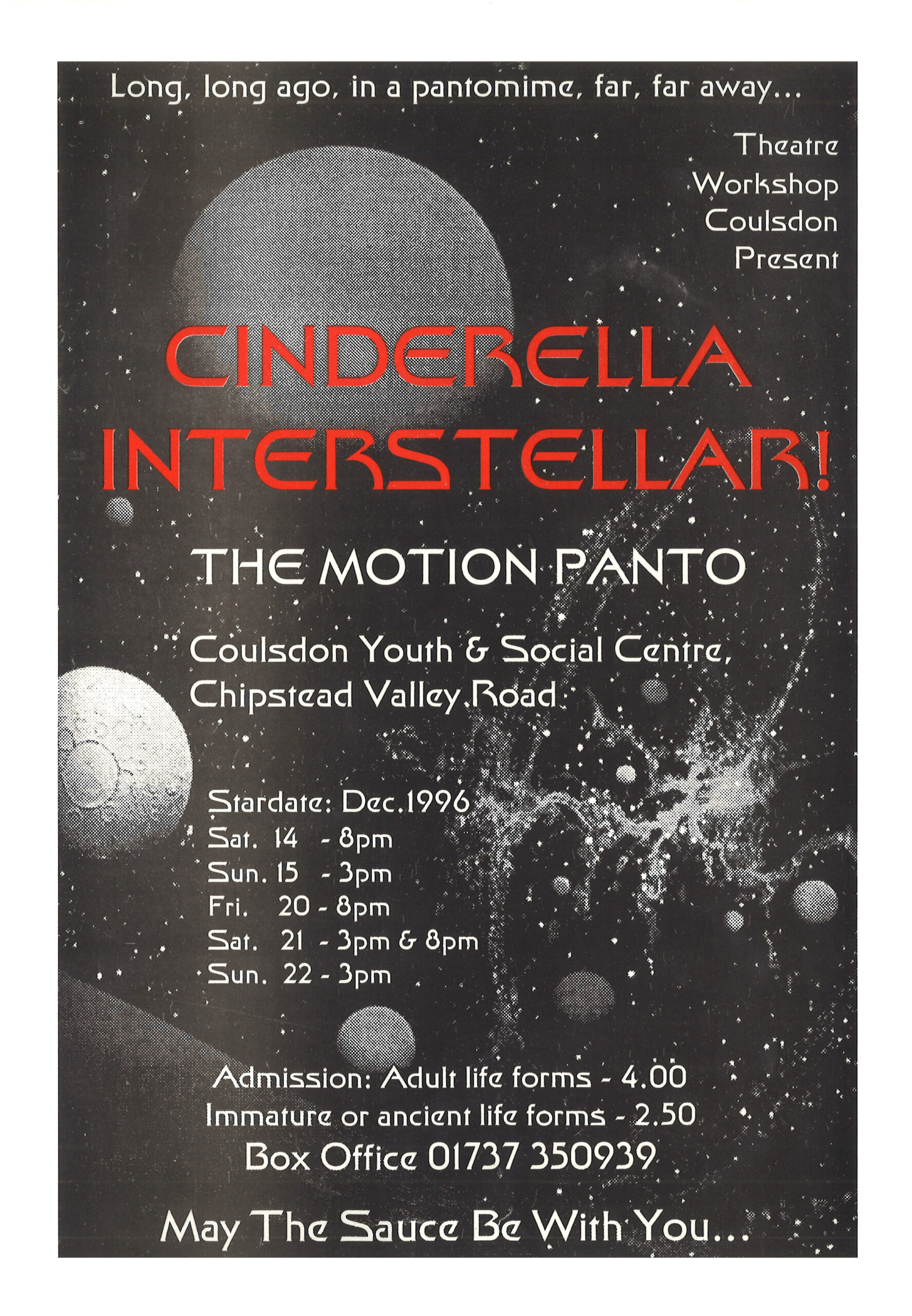
Cinderella Interstellar!

A long time ago, in a galaxy far, far away, there was a pantomime that looked quite a lot like ‘Star Wars’…

Take Cinderella and her ugly sisters and then thrust them into a world of science-fiction adventure, inhabited by characters that are nearly, but not quite, those from the epic blockbuster trilogy of the late 1970’s and early 1980’s.

A cocky, star-faring smuggler and his hairy co-pilot, a kid who’s a whiz behind the controls of space fighter, a monk-like individual wise in the ways of the Source, a black-clad villain in a full-face helmet with breathing difficulties and an army of soldiers who can’t hit a Death Star at close range. They’re all there, just not as you knew them.

Throw in the best Cantina band this side of Tatooine to help belt out some brilliant songs, and you’ve got a powered up panto ready to do the Kessel run in less than 12 parsecs.

This is the panto you were looking for.

A Midsummer Night’s Dream

This is the second time that Theatre Workshop have visited the strangely English forest that exists just outside Shakespeare’s Athens. Peter Quince and his band of tradesmen cum would-be actors have wandered out from the city to ensure they’re not overlooked as they go about their amateur thespian labours, but either they’ve wandered much further than they intended from the busy streets of London, or there’s a thriving English enclave of ex-pat artisans tucked away in the shadow of the Parthenon. 

There are changes. Not least in the location of our endeavours. Having seized the opportunity to take the group from its home and perform in the open-air just three years previously, we’ve gone further, and at the invitation of Southern Water, will take the production to the shores of the Bewl Water reservoir, near Lamberhurst in Kent. Though the setting is idyllic, this represents no small undertaking, especially for an amateur group whose members are mostly in full-time employment. So we can feel for Messrs Starveling, Bottom, Snug, Snout and co., as we do a full day’s work and then barrel down the A21.

But we’ve not given up on our first open-air home, and will perform first at The Woodman before packing up and heading for Bewl. We could hardly do otherwise, given that it’s our regular watering-hole.

Let’s talk about the music for a moment. Most of the music you’ll hear will be played live by Mark Taylor, though there are a couple of passages that are pre-recorded. He’s composed most of it himself too, because he’s a talented gentleman. Exceptions include the fairy and bergomask dances in Act IV and V which are set to traditional tunes. He’s also composed the music for ‘Philomel with Melody’, whose lyrics are by Shakespeare, and given that Shakespeare’s own lyrics to the fairy benediction at the end of the play are lost to us, we’ve used a 5th Century Celtic blessing as the basis for a song, which again will be accompanied by Mark Taylor’s music.

One last thing. The production is dedicated to the memory of Lesley Argles, a member of Theatre Workshop almost since the beginning. She died aged just 44, as the result of a tragic accident on the 13th July, only two weeks before curtain up. Her husband, Chris, who she met through the group, as well as her son, Luke, and daughter Kimberley, are all on stage here tonight. They were united in their decision that the production should go ahead with their full participation, despite grievous personal loss. They are certain it was what she would have wanted.

Treasure Island – The Panto, or ‘Panto Walks The Plank’

‘Treasure Island’, that perennial favourite of British children since its first publication, might seem like an obvious candidate for panto treatment. However, actually arriving at a well-rounded pantomime, incorporating all the essential elements of that genre but also sticking fairly strictly to the plot and characters of Stevenson’s great novel, poses a few problems!

So if ‘Panto Walks The Plank!’ gets under way as a close pastiche of ‘Treasure Island’, you might notice it change tack part way through, in order to accommodate a boarding party of pirate clichés inspired by a wider literature.

After all, as any fan of the Hollywood pirate epics of the 1930s and 1940s will tell you, ‘Treasure Island’ (one of the most famous adventure stories in English literature) is fatally flawed. There’s absolutely no love interest. In fact there are no women at all, with the exception of Mrs Hawkins, and she’s written out of the plot by page 27!

Now, no good pirate movie was truly complete without the love interest, usually represented by Maureen O’Hara. Or the presence of the dastardly Spanish, immaculately attired, elegantly presented and constantly scheming. In fact, the two elements were so quintessential that they were frequently combined through the well-worn dramatic device of ‘Swashbuckling hero falls for the haughty yet gorgeous daughter of the wicked Spanish governor’. So, expect to find both in our version too,

There are other important omissions from ‘Treasure Island’ that undermine its credentials as a bona-fide all-round classic pirate story. For instance, absolutely no-one walks the plank! Now, as it happens, that’s probably because no-one ever really did walk the plank. People who really know their pirates will tell you that this infamous punishment was simply the macabre whimsy of the Victorians and their overheated imaginations. However, if you’re set on telling a good old-fashioned blood and thunder tale of skulduggery on the high seas, you’ve got to include it. It’s part of the tradition.

Being a pantomime also dictates certain changes to the story. For instance, no-one is horribly murdered. Any violence is strictly of the gratuitous slapstick variety. And of course, Long John’s legendary parrot serves splendidly as a pantomime animal. This one even talks! And a ‘Crimson Parakeet’ does have a certain resonance with the 1952 Burt Lancaster comedy adventure movie, ‘The Crimson Pirate’, filmed in glorious Technicolour!

So, shiver your timbers and splice your mainbrace, while Theatre Workshop heaves to and delivers a hefty broadside of fun and adventure. And you may lay to that, arrrrrh!

The Canterbury Tales

Geoffrey Chaucer (c. 1340 – 1400) has been called the father of English Literature. Certainly there is nothing quite like his epic ‘The Canterbury Tales’ to put the present-day observer in touch with the ordinary life of our medieval forebears. Nothing to match the unflinching realism of Chaucer’s portraits of his fellow men. And nothing quite so effectively holds up a mirror, not only to the England of his times – but to the unchanging nature of human experience.

We considered four different published playscripts before creating our own adaptation of ‘The Canterbury Tales’. In the end we decided against paying royalty fees to use someone else’s script. After all, Chaucer is part of our shared heritage – his words should belong to all of us.

Across the different playscripts there had been a range of selections made regarding which tales were best to tell. Clearly, given that there are 28 tales in all, you can’t use all of them in one two hour show (and note that Chaucer had intended for there to be 120!), so a choice has to be made. However, most seemed to go for the stories with classical settings, such as The Knight’s Tale, The Franklin’s Tale and The Merchant’s tale.

Focused on the nobility, and concentrating on stories of courtly love and mortal combat as they are, we decided that these rarified tales were not the ones we wanted to tell. We wanted to hear from the ordinary people, engaged in the medieval day-to-day of simple pleasures, petty jealousies and mundane squabbles. Exuberant and resilient folk, yet dominated by an overbearing Church. So, these are the stories we chose:

The Nun’s Priest’s Tale

The Wife of Bath’s Tale

The Friar’s Tale

The Pardoner’s Tale

The Miller’s Tale

The Reeve’s Tale

Our adaptation is actually based on the 1985 Oxford University Press translation by David Wright, though we’ve edited out much of the narrative in favour of dialogue. This is a drama after all, not a story telling, and that has meant some minor amendments in order to make sense of the editing. Regardless, we’ve actually added or rewritten very little. So the words you’ll hear spoken are Chaucer’s own, translated with fidelity into modern English by one of the foremost scholars in this field. If you take any pleasure from the tales we unfold for you today, reflect for a moment on the fact that these are the same stories that entertained your ancestors, some 600 years ago.