Grimm Tales (2001)

A collection of traditional European folk tales are here given a new lease of life, stripping away much of the saccharine coating so many have accumulated through adaptation for children’s books, TV and film. Yes, we’re looking at you, Disney.

We’ve chosen nine tales all told, each with it’s own director and unique music composition, from one of three talented musicians, Pete Bird, Dominic Russell and Mark Taylor. See the programme for full details. The nine stories are;

Ashputtel

The Golden Goose

The Lady and the Lion

A Riddling Tale

The Hare and the Hedgehogs

Hansel and Gretel

Little Red Cap

Rumplestiltskin

The Magic Table

We like to finish our open air shows with a song, where we can. For this production, we’ve chosen ‘Who’s The Fool Now?’, an old song, first published in 1580 but most certainly far older than that. It doesn’t come from a Grimm tale, but it is a song about tall tales, and it’s also a drinking song, which given we’re sitting in a pub beer garden seems very appropriate. Join in the chorus if you fancy.

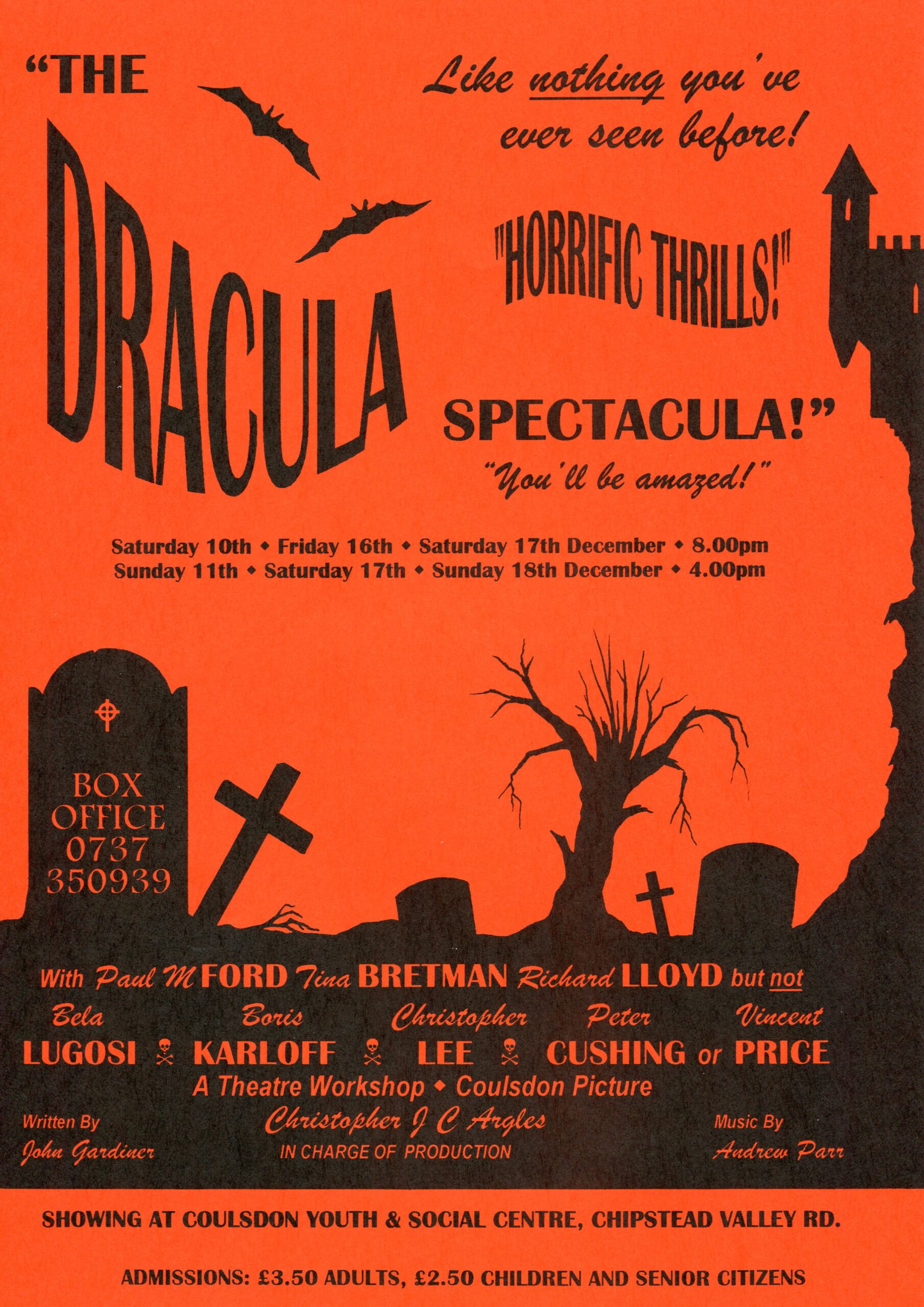
The Dracula Spectacula

It’s been seventeen years since Theatre Workshop Coulsdon first staged ‘The Dracula Spectacula’. At the time it was regarded by the group as probably the biggest and best production that had been performed by them up to that point (we’d only been in existence seven years by that time), involving over 50 people and having a full band.

1995 will be our 25th anniversary year, and we decided that we’d start the celebrations early, by revisiting what was a landmark production for the group.

Amazingly only two of those fifty members who were involved in the 1977 production are actively talking part this time – those being Chris Argles, the director who played Dracula in the original production, and Tim Young, who will recreate his role as Hans, the Innkeeper.

So, how well has ‘The Dracula Spectacula’ stood the test of time? Was it really the terrific show that we fondly remembered, or have the rose-tinted glasses of nostalgia left us with a false impression? Well, let’s be honest, we had to make some changes to the script. Seventeen years doesn’t seem like a long time, but its enough to make some of the dialogue, and the characterisations, sound dated. A number of the songs too, which may have knocked them un-dead back in the day, really don’t cut it now, and so we’ve replaced them with exuberant pastiches of songs that you might just have heard before.

What you see tonight then is very much a brand-new incarnation – albeit of an old favourite, resurrected and rising from its dusty resting place with a whole new lease of life.

Whether this is the first or second time you’ve seen Theatre Workshop Coulsdon perform ‘The Dracula Spectacula’ we hope you enjoy the experience, and live to tell the tale!

The Arabian Nights

For our inspiration, ‘The Arabian Nights’ draws on the 1001 tales supposedly told by Shaharazad (or Scheherazade). King Shahryar, having suffered at the hands of an unfaithful wife, has become bitter and vengeful, undertaking to marry every day, but execute each wife as the next day dawns to prevent their infidelity. Shaharazad, the clever daughter of the court vizier, volunteers to become his wife, to try and prevent the needless bloodshed. Every night she tells Shahryar a story that enthralls him, but deliberately leaves it unfinished come the sunrise, and so the King stays her execution. She does this again and again, for 1001 nights, by which point he renounces his violent ways and spares her life permanently.

In reality, the stories, which are many but nowhere near 1001, are taken from sources across the Islamic world. From Moorish Spain to the borders of China, across the Middle East, reaching as far south as sub-Saharan Africa and north to the Balkans and the Caucasus mountains. The fullest version of the 1001 tales was compiled, translated and edited by the eminent Victorian explorer, Sir Richard Burton, who had published a massive 16 volume edition in 1885. However, it remains only one of a dozen or so major retellings written across the 19th and 20th centuries.

Most of the stories are simple folk tales, a number sharing many similarities with folk tales from other cultures. Two of the tales (strangely enough, two of the most famous, ‘Aladdin’ and ‘Ali Baba and the Forty Thieves’) were almost certainly shoehorned into the collection at a late stage, bearing little resemblance to the story structure of the rest and differing in other aspects too.

For our production, we kept part of Shaharazad’s tale to frame the other tales we wanted to tell, a mere six against 800 or so we had to choose from. We’ve tried to cover a range, from the profound to the absurd, the sinister and the scary to the comic and just a little bit naughty. All human (and some non-human) life is here. Enjoy.

The tales are;

Ali Baba and the Forty Thieves

The Talking Head

The Simpleton and the Two Sharpers

The Little Hunchback

The Lady and Her Four Suitors

The Strange Tale of Sidi Nu’uman


The Taming of The Shrew

‘The Taming of the Shrew’ was one of Shakespeare’s earliest comedies, but has in recent years become considered by some to be controversial, mainly in its depiction of the cruel treatment handed out to the ostensible heroine, Katherina, by the her suitor and eventual husband, Petruchio. However, this was never intended to be a hard and fast primer on how men should behave with women, especially when you wish to marry them!

There are two main storylines at play here, both set around the wooing of a woman by a suitor, or in Bianca’s case, a number of suitors. Katherina is shown as being wilful, haughty, disobedient even, when in fact she is merely displaying an independence of thought and spirit. Her father, Baptista, being of an older generation, has no understanding of this, and though he truly loves her and wishes to protect her, he sees the biggest barrier to her ongoing happiness as herself and her attitude. Bianca, the younger daughter, plays a very different game. Her supplicatory attitude to her father’s ways earns his favour, and is indulged. Her gentler ways, and good looks, also earn her the attention of the pragmatic Hortensio and the aging and foolish Gremio, both vying for her hand, and undoubtedly her dowry. Baptista is a wealthy man. Into this come two new protagonists. Petruchio of Verona appears to see Katherina as a challenge, and becomes seemingly determined to ‘break her’ as you would a wild horse. Lucentio, from a wealthy family in Pisa, has come to Padua to study but falls for Bianca and so cooks up a scheme to woo her by disguising himself as a Latin tutor. The scene is therefore set for some absurd behaviour and comedic antics set around confused identities such as Shakespeare delighted in.

As the play comes to an end, each of the two women reach a decision over their futures and they are very different, but also very personal to them as individuals. In some ways, neither woman has been portraying themselves honestly, that is, true to their natures, before this point. And more obviously, neither Petruchio or Lucentio have been themselves either. Each couple will now face a future with the facades stripped away. Whether those relationships will thrive, we can only guess at.

This was Lucy-Ann Martin’s first production in the director’s chair. All the more impressive given that at the time she was just 16. And though she was supported by both her family and the group in the endeavour, as you’d expect, it remains a remarkable achievement.

More Grimm Tales

The root of all theatre is storytelling, and the unfolding of a simple tale in the space between the teller and the listener is arguably the purest form of theatre.

Theatre Workshop has visited the stories of Jacob and Wilhelm Grimm, best known as the Brothers Grimm, before. Just three years ago we put on ‘Grimm Tales’ here in the pub beer-garden of The Woodman. That time we used a script taken from Tim Supple and the Young Vic Theatre Company, based on translations of the original German text by no less than Carol-Ann Duffy, the Scottish poet (who went on to become Poet Laureate in 2009). This time though we’re taking the project into our own hands, and the adaptation of the tales has been done by Richard Lloyd, with Heidi Bush and Mike Brown. This has the advantage of a script that plays to our company’s strengths. At least, that’s the plan. And though the tales hark back to some of the darker aspects of folklore, indeed we’ve leant into that idea, it remains a family show in more ways than one. The Lloyd family entire will be on stage this evening, as will three quarters of the Martin family, while the remaining quarter will have undoubtedly given you ‘The best seat in the house’ as you entered the auditorium area. So it can’t be that scary, can it?

The stories we have selected for your entertainment are;

Little Snow White

Briar Rose

The Robber Bridegroom

Clever Hans

The Musicians of Bremen

The Spirit in the Bottle

The Devil and his Mother

The Frog Prince

Now listener, make yourself comfortable and we shall let the tales unfold.

The Wind in the Willows

For our eleventh summer production, staged in the open air at The Woodman, we’ve picked a classic of children’s literature ‘The Wind in the Willows’, based on the 1908 book by Kenneth Grahame.

There’s not a great deal one can say about ‘The Wind in the Willows’. Almost everybody is familiar with the adventures of Toad, Ratty. Mole, Badger and co., either because they’ve read the book, or at least they think they have. It’s certainly amongst the most widely loved of books – a rural riverbank idyll of friendship and innocence which seems to strike some peculiarly English sentimental chord.

Maybe it’s the little furry animals. Perhaps, viewed through the prism of history, the modest, meandering adventures of Rat and Mole, set as they are in an evocative pastoral England where good manners and tranquillity are only occasionally disturbed by the vainglorious antics of a certain ‘Nouveau Riche’ amphibian, genuinely do call to mind an time of lost innocence and comfortably parochial concerns. An England before the cataclysm of The Great War, and all the horrors of the industrialised, globalised conflicts that have occurred since.

However, ‘The Wind in the Willows’ doesn’t simply hark back to a bygone age. It presages the uncomfortable shape of things to come as Grahame saw them in 1908 – the ‘menace’ of the motor car for instance, and the upheaval of the deferential norms of polite society, where Wild Wooders and other assorted ‘lower orders’ simply don’t seem to know their place any more, and are starting, as Ratty says, ‘to break out’.

Much of the appeal lies in the story’s great comic set pieces, its sympathetic characters and larger than life caricatures such as the irrepressible Toad. Appalling amoral and utterly incorrigible, he’s become a firm favourite on stage for much of the twentieth century, mostly due to A.A. Milne’s ‘Toad of Toad Hall’, the first and most enduring of the many adaptations that the story has undergone.

That said, we’re actually using the more recent (1990) adaptation by Alan Bennett, with a few choice embellishments of our own. Some critics have said that Bennett’s version is somehow truer to the book than Milne’s classic, but if you watch our show closely, it’s clear that Bennett’s voice can be heard intermixed with that of Grahame’s. Regardless, as Mr Toad so succinctly put it, ‘Poop Poop!’.

Return To The Forbidden Planet

Since its debut in an inflatable tent on Blackheath back in May 1983, this strange, hybrid ‘juke-box’ musical, ‘Return to the Forbidden Planet’, has acquired something of a cult following, similar in some ways to its far raunchier predecessor ‘The Rocky Horror Show’. The Bubble Theatre Company used a cast of ten who acted, sang and played all the instruments. For a number of reasons, TWC have decided to spread the workload a bit further.

Writer and director Bob Carlton took as his inspiration the 1956 science fiction movie ‘Forbidden Planet’ (Starring Leslie Neilsen as John J Adams, commander of the United Planets starship ‘C-57D’), itself drawn on loosely on William Shakespeare’s ‘The Tempest’. He’s then plundered several of the Bard’s works for dialogue, and then added a score composed of numerous songs from the 1950s and 1960s, such as ‘Wipe Out’, ‘Great Balls of Fire’, ‘Shakin’ All Over’, ‘Good Vibrations’, ‘Oh, Pretty Woman’ and ‘Born to be Wild’. It probably shouldn’t work. The story only just about makes sense. But is it fun? Heck, yeah!

So join Captain Tempest, commander of the starship ‘Albatross’, and his crew, on a routine scientific survey flight across the stars that becomes anything but routine. A meteor shower drives the ship down toward the planet D’Illyria, where they encounter the enigmatic Doctor Prospero and his daughter Miranda, along with Ariel the robot. They have been marooned on the planet for years, having been sent into space by Prospero’s scheming wife Gloria, but now they are rescued, and everything will be fine. Won’t it?

Warning. As passengers on the ‘Albatross’, you will be required, when the order is given, to undertake the Reverse Polarity manoeuvre to ensure the ongoing safety of the ship.

Step 1 Put both your hands in the air

Step 2 Place your hands on the top of your head

Step 3 Press, using a downward motion, several times

Step 4 On the command ‘Polarity Reverse!’, equalise the external equilibrium by quickly raising both hands and arms and exhaling thus – ‘Phewwwww!!’

The Adventures Of Tom Jones

Back in 1746, when Henry Fielding’s ‘Tom Jones’ was first published, there was an uproar amongst polite society. Why? Because Fielding’s biting satire painted a very unlovely picture indeed. Polite society was, in fact, anything but! Fielding’s masterwork wasn’t just a hatchet-job though. It was brilliantly funny, a rollicking comedy tale told over two hundred chapters (!), intricately plotted and with probably as many characters. There was depth too, with Fielding using the smokescreen of humour to discourse long and loud on such subjects as politics, philosophy, morality and religion.

All of which may be wonderful for a quiet Sunday afternoon’s reading, but for a dramatic evening’s entertainment, it just won’t do. What we want, nay, what we need, is a full-blown eighteenth century romp, full of colourful costumes and no less colourful characters, so with apologies to Mr Fielding, he’s been rather hijacked.

Into the heady mix have been brought characters and situations from other playwrights, whose swagger matches the feel and atmosphere of the base material. George Farqhuar provides the landlord Boniface and the roguish highwayman Gibbett for instance, both characters and situation taken from ‘The Beaux Stratagem’ (with just a dash of MacHeath from John Gay’s ‘The Beggar’s Opera’ of 1728). The recruiting sergeant’s opening speech is taken from Farqhuar’s ‘The Recruiting Officer’, and if Farqhuar’s highwayman is infinitely better character than Fielding’s own take, then the two recruiting sergeants are strangely similar. The rascally recruiters may possibly have a been a familiar stereotype and both authors took delight in playing with it.

So, literary fidelity you don’t get. A number of Fielding’s characters have been merged, others ejected wholly. What you do get is an evocative venture into eighteenth century England, following Tom Jones as he looks to find his fortune, leaving his numerous indiscretions behind him and with bold new exploits tantalisingly awaiting just over the next sun-lit hill. Enjoy.

The Three Musketeers – Le Panteau

Our pantomime version of ‘Treasure Island’ was not only immense fun for us to do, but proved to be a big hit, not just here in Coulsdon but in the wider world of amateur theatre. In the two years since its publication, there have been over 60 productions of our tongue-in-cheek swashbuckling tale!

So, what better reason to give another classic story of adventure and derring-do the pantomime treatment. Like ‘Treasure Island’, ‘The Three Musketeers’ transcends age and generations, and has slipped across the border from literature into folklore. Written originally in 1844, there have been so many adaptations over the years, across so many media, that people who are perfectly familiar with the characters, the plot and the musketeers’ bold call to arms, have never read so much as a word of Alexandre Dumas’ original tale. Athos, Porthos, Aramis and D’Artagnan are no longer confined to the printed page, they are creatures of myth, with a life all their own.

So, our pantomime is not so much a spoof of the book, as a pastiche of the very idea of ‘The Three Musketeers’, only taking those parts of the plot and the characters that easily lend themselves to being funny. Yes, it does bear some resemblance to the original, but only very loosely (probably about as much as the usual Hollywood treatment). One very significant difference to most versions is that in ours, D’Artagnan and the other gallant comrades in arms are all played by women.

It’s our opinion that the female of the species can swashbuckle as well any male, but rarely are they given the chance. Well, here’s that chance, and alongside Dame D’Artagnan (the would-be musketeer’s aunt) and a pantomime snail (yes, really) they will fight for honour, justice and outright silliness, along with some excellent songs.

‘All for one, and one for all!’*

*For the record, Dumas may have used this as the Musketeers motto and made it famous, but guess who wrote it and used it first? Yep, William Shakespeare, in his narrative poem of 1594, ‘The Rape of Lucrece’. We’ll not be making a panto out of that.

The Merry Wives of Windsor

‘The Merry Wives of Windsor’ is one of Shakespeare’s more unusual comedies. No strange land for this one for a start. No far-flung Illyria, exotic Messina or Syracuse, but instead the action centres round The Garter Inn in Windsor. A real place no less, and one that stands to this day. Similarly, the Princes, Dukes and sundry other nobles that inhabit so many of his tales are notable by their complete absence, replaced by the title-less and newly prosperous middle classes. The only knight of the realm that features is the rascally, roguish Sir John Falstaff, a knave who sets out with poor intentions to fool the good wives of Windsor out of money, but fails spectacularly at every turn.

It is said that the character of Falstaff was one that Queen Elizabeth herself was most fond of. He appeared first in Henry IV Part One, and again in Henry IV Part Two, a portly, aging disreputable sot, too fond of his drink and of cheap women, forever lacking in funds. Quick to borrow, never to repay, and cowardly to boot, Falstaff does retain a certain charm and zest for life, and it’s this, for a time, that endears him to Prince Hal. However, when the prince becomes the King, all his former life is left behind, including Falstaff. In Henry V, Mistress Quickly delivers a eulogy outlining the circumstances of his death, and there, one might suppose, was the end of him. If a queen commands though, a humble playwright must write, and so, two years after his death, Sir John Falstaff lived again.

So ‘The Merry Wives…’ is what we would call today a ‘prequel’. Reunited with his low-life comrades, Pistol, Nym and Bardolph (the latter two also dying in Henry V, executed for looting), Falstaff unknowingly engages in a battle of wits with Mistress Page and Mistress Ford and finds himself distinctly unarmed, or at least badly under-gunned. Unlike the bittersweet nature of his antics in the histories though, these adventures are purely comedy, descending almost into farce. It dispenses with the oft-used conventions of romantic comedy, such as the mistaken identity, the flirtatious wordplay, the lovesick entanglements, and replaces them with Falstaff, the aging would-be suitor and lothario (supremely lacking in self-awareness) falling for the tricks being being played on him. In parallel, middle-aged, middle-class Francis Ford, consumed with ill-founded jealousy, repeatedly makes a fool of himself while attempting to prove, vainly, his wife an adulterer.

It’s funny, but this, undoubtedly the most original of Shakespeare’s works, drawing on no ancient text or foreign translation, is looked down upon by numerous scholars of the Bard. They seem to forget that the texts weren’t designed to be pored over, dissected and examined by fusty literary experts. It was created to have life on the stage, uproarious, physical life as popular entertainment.

And that is what you have before you. Enjoy.